You've done the hard work. You're getting traffic to your site, maybe even a lot of it. But when you look at your sales and lead numbers, there's a frustrating disconnect. If this sounds familiar, you don't have a traffic problem—you have a funnel problem. This disconnect is where revenue leaks out, silently eroding your marketing ROI.
Every business has a path its customers take, from a search query on Google to the moment they click "Buy" or "Request Demo." And in my experience as an SEO strategist, nearly every one of those paths has leaks. Untargeted traffic, confusing user experiences, and technical friction all create holes that cost you qualified leads and sales.
This guide provides a practical, revenue-focused framework for conversion funnel optimization. We will move past vanity metrics and focus on what actually moves the needle: turning the right visitors into profitable customers.
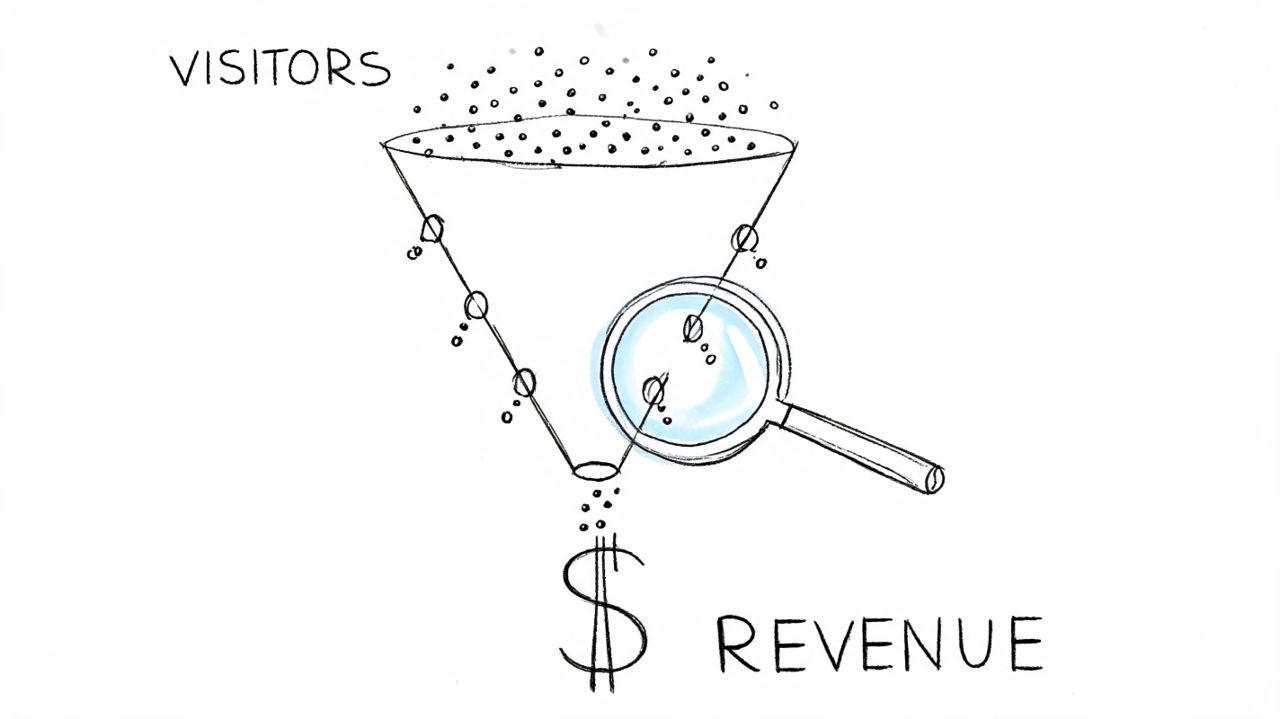
The Real Cost of a Leaky Funnel
Let's talk numbers, because this is where the business case becomes undeniable. The average sales funnel conversion rate hovers around a surprisingly low 2.35%. But top-performing companies? They’re seeing rates north of 5.31%.
For an ecommerce store with 100,000 monthly visitors, closing that gap means an extra 2,950 sales every single month—without spending another dollar on advertising. This is why organizations with teams dedicated to conversion optimization see a 38.4% higher marketing ROI. It’s the direct result of continuous, iterative improvement.
It’s a classic mistake to think more traffic is the answer to low revenue. In reality, untargeted visitors just lead to high bounce rates and zero engagement, doing nothing for your bottom line. An optimized funnel, on the other hand, extracts maximum value from the qualified traffic you already have.
Before you start changing buttons and rewriting copy, you need to diagnose why your funnel is leaking. If you’re looking for a starting point, this diagnostic guide for marketing teams is excellent. You have to diagnose the illness before you can prescribe the cure.
Mapping Your Funnel to Pinpoint Revenue Leaks
You can't fix a conversion problem you can't see. Your first move must be a ruthless audit of your current customer journey. We need to map the entire path, from the moment someone types a query into Google to the final conversion—be it a sale, a demo request, or a signup.
Your go-to tools for this are your analytics suite (like Google Analytics 4), your CRM, and user behavior software that provides heatmaps and session recordings. The goal is to visualize the customer’s path and, more importantly, calculate the drop-off rate between each stage. This is how you find where the money is leaking out.
Isolate Your Biggest Drop-Off Points
Start by asking the tough questions, backed by data. If you’re running an ecommerce site, what percentage of users who add a product to their cart actually complete the purchase? For a SaaS business, how many people who land on your key feature page ever start the signup process?
To get your bearings, it helps to understand the standard metrics for your industry. For online retailers, reviewing common e-commerce performance metrics is a great way to establish a baseline before you dive in.
The AIDA model (Awareness, Interest, Desire, Action) provides a classic framework for this analysis. By assigning key performance indicators (KPIs) to each stage, you can quickly diagnose where your funnel is failing.
Key Funnel Stages and Diagnostic Metrics
| Funnel Stage (AIDA) | Primary Goal | Key Metrics | Diagnostic Question |
|---|---|---|---|
| Awareness | Attract Quality Visitors | Impressions, CTR, New Users, Bounce Rate | Are we reaching the right audience with search intent, and is our message compelling enough to earn the click? |
| Interest | Engage & Educate | Pages per Session, Avg. Session Duration, "Add to Cart" Rate | Once they arrive, are visitors engaging with our content and showing signs of genuine interest in our solution? |
| Desire | Build Purchase Intent | Wishlist Adds, Demo Requests, Pricing Page Views | Are we effectively creating desire and trust, encouraging them to take the next step toward a purchase decision? |
| Action | Drive Conversions | Conversion Rate, Cart Abandonment Rate, Form Submissions | What friction or anxiety is stopping them from finalizing the purchase or submitting the form at the last moment? |
By looking at your funnel through this lens, you can move from vague problems ("low sales") to specific, data-backed hypotheses ("our product page isn't building enough desire") that are ready for testing.
A common mistake is getting fixated on the overall conversion rate. The real gold is in the micro-conversions between each step. A low "Add to Cart" rate points to a different problem (e.g., unconvincing product pages) than a high cart abandonment rate (e.g., issues with your checkout flow).
Systematically mapping your funnel and calculating these stage-by-stage rates is where you'll find the biggest opportunities. For instance, if you see 500 users landing on your contact page but only 50 submit the form, that 90% drop-off is screaming for an investigation. This is the foundation of revenue-driven SEO and CRO.
Optimizing the Top of Your Funnel for Quality Traffic
A leaky conversion funnel often traces back to one root cause: attracting the wrong audience. Real conversion funnel optimization doesn't start on the checkout page. It begins with your SEO strategy and how you attract visitors in the first place. The goal is to fill the top of your funnel (ToFu) with qualified prospects who have a real problem you can solve, not just chasing empty traffic for vanity's sake.
This means making a critical shift in your SEO strategy. Move beyond obsessing over broad, high-volume keywords and start targeting long-tail, problem-aware search queries. These are the phrases people type in when they’re not just browsing; they’re actively looking for a solution.
Aligning Search Intent with On-Page Experience
Think about the difference in intent. A search for "CRM" is informational and broad. But a search for "crm for small law firms" is transactional and specific. The user has a clear context, a specific need, and likely a budget. They are much further down the path to purchase.
The same goes for ecommerce. Instead of "running shoes," a query like "waterproof running shoes for wide feet" comes from a buyer who knows exactly what they want. They aren't just looking; they're trying to buy.
Your content's job is to deliver on the promise your page made in the search results. A disconnect between the search snippet and the on-page experience leads to a high bounce rate. That’s a conversion killed before it even had a chance.
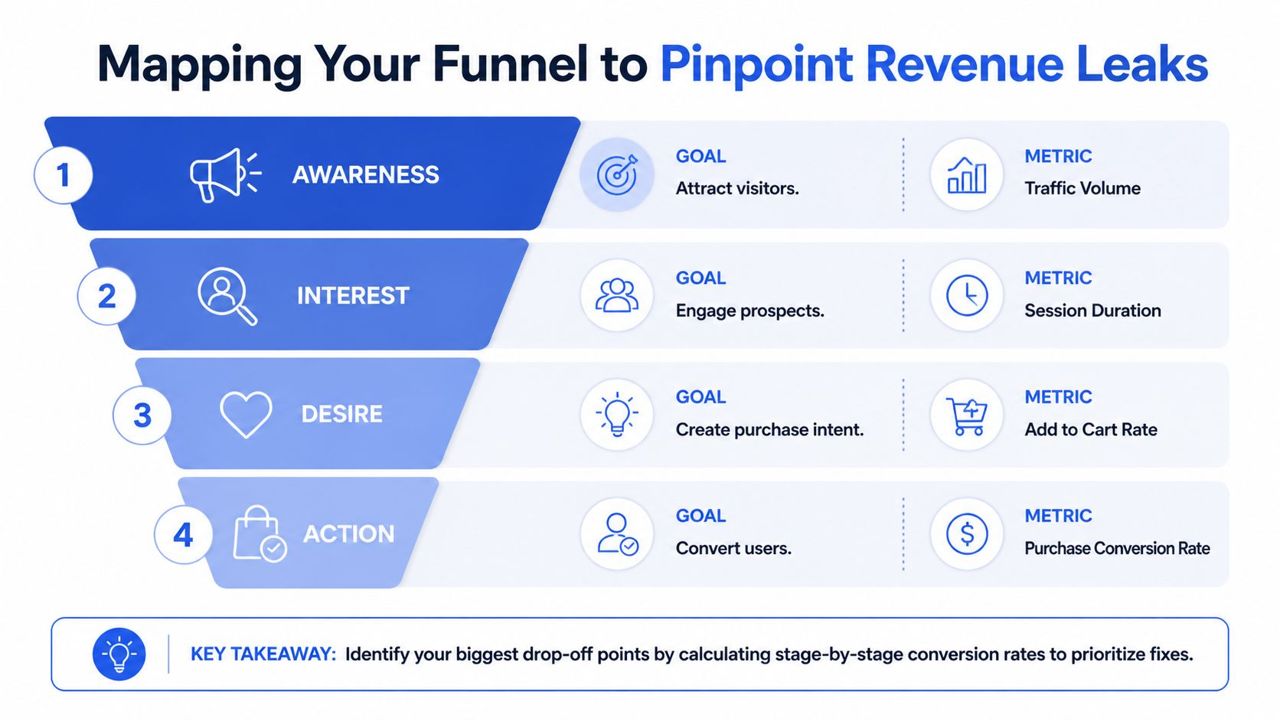
As you can see, you have to track progress at every single step, from that first flicker of awareness to the final sale, to figure out where to focus your energy.
Top-of-funnel optimization is about quality over quantity. I'd rather have 100 highly-qualified visitors from organic search than 1,000 random visitors with no clear intent. That's the bedrock of an SEO strategy that actually drives revenue.
And don't forget the technical side. Factors like slow page load times (Core Web Vitals) or a clunky mobile usability experience create immediate friction. A user who has a frustrating first few seconds on your site is gone for good. A proper technical SEO audit will shine a light on these roadblocks, ensuring your site is ready to convert the high-intent traffic you worked so hard to attract.
Plugging Leaks at the Finish Line: The Middle and Bottom of the Funnel
This is where the money is made—or lost. When a potential customer reaches the middle and bottom of your funnel, they've moved past simple awareness. They’re seriously considering a purchase, and your job is to make it incredibly easy for them to say "yes." This is where conversion funnel optimization delivers its most immediate, tangible impact on your revenue.
For any ecommerce site, this means putting your checkout process under a microscope. I’ve seen countless stores lose sales by forcing users to create an account. The fix? Offer a guest checkout. Is the page a chaotic mess of banners? Strip it down. Get rid of distractions and prominently display trust signals like security badges or recent customer reviews to ease any last-minute anxiety.
The same principle applies if you're a SaaS business, but your focus shifts to the demo request or signup flow. Every single form field you add is another reason for someone to abandon the process. Simplify. Cut the form down to the bare essentials, state the value proposition one last time, and place social proof—like well-known customer logos or a powerful testimonial—right next to the final call-to-action button.
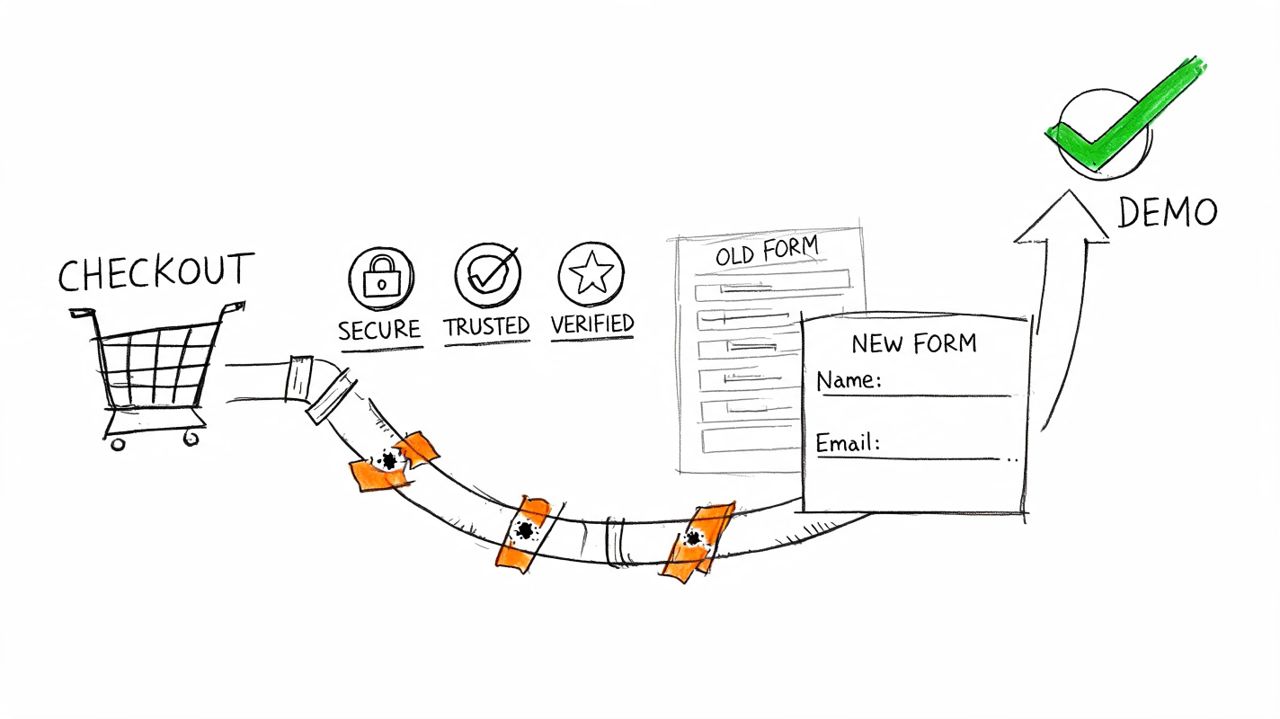
Making the Final "Yes" Easy for Any Business Model
While the tactics differ by business model, the core idea is always the same: remove friction for qualified prospects.
- Local Businesses: Your Google Business Profile is a critical bottom-of-funnel tool. Optimize it relentlessly for "Get directions" and "Call" clicks. Ensure your hours, address, and phone number are perfectly accurate and easy to find.
- Service-Based Companies: Your contact or quote request form is where you get paid. Stop using a generic "Submit" button. A/B test a value-driven CTA like "Get My Free Quote" and measure the impact.
- SaaS & Ecommerce: You absolutely must have abandoned cart or session recovery emails. A simple, well-timed reminder can claw back a surprising amount of revenue you would have otherwise lost for good.
You can't fix a leak you can't see. Using tools like heatmaps from Hotjar or session recordings is non-negotiable. Watching exactly where users get confused or drop off gives you the hard evidence needed to make targeted, effective changes.
The insights from these tools are gold. As you dig deeper into modern conversion funnels, it becomes clear: small, data-informed fixes are what drive major revenue growth. It’s time to stop guessing and start making decisions that directly impact your bottom line. To achieve this, consider working with an experienced SEO consultant who can connect technical analysis with business outcomes.
Building an Iterative Optimization Roadmap
Let's be clear: optimizing your conversion funnel is not a one-and-done project. It’s a continuous loop of improvement. The goal isn't just to check off a list of fixes but to build a durable system for testing and learning that becomes a core part of how you grow revenue.
Think of it as a constant feedback cycle:
- Analyze Data: Dig into analytics and user behavior to identify a drop-off point.
- Form Hypothesis: Develop a data-informed theory for why the drop-off is happening.
- Run Test: Implement a controlled A/B test to validate or disprove your hypothesis.
- Learn & Iterate: Analyze the results and use the learnings to inform your next move.
Prioritizing Your Experiments with the PIE Framework
With endless things you could test, how do you decide what to test first? Prioritization is key to avoiding wasted time on low-impact changes. I use the PIE framework to score ideas and focus on what matters.
- Potential: How much improvement can we realistically expect? High-traffic pages with low conversion rates have the highest potential.
- Importance: How valuable is the traffic to this page? A small improvement on a checkout page is almost always more valuable than a huge lift on a low-intent blog post.
- Ease: How difficult is this to implement? Swapping a headline is easy. A complete redesign of your core user flow is not.
By scoring each test idea against these three criteria, you can build a roadmap that smartly balances easy wins with bigger, more strategic initiatives.
The most powerful optimization happens when you stop seeing SEO and CRO as separate jobs. Insights from landing page tests are gold for on-page SEO. If a test proves a certain headline or value proposition converts like crazy, that language needs to be in your title tags and meta descriptions to attract more qualified clicks from search.
Ultimately, you have to break down the silos between traffic generation and conversion. A unified strategy focused on driving revenue is the only way to win long-term. For many businesses, the perfect starting point for that journey is a strategic SEO audit to uncover the biggest, most actionable opportunities.
Frequently Asked Questions about Conversion Funnel Optimization
Here are direct answers to common questions about how conversion funnels connect with a revenue-focused SEO strategy.
What is a good conversion rate for a B2B SaaS funnel?
There is no single magic number. A "good" conversion rate depends entirely on your industry, traffic source, and product complexity. Chasing a universal average is a waste of time.
Instead, focus on improving your own baseline. As a rough benchmark, a lead-to-MQL (Marketing Qualified Lead) rate of 15-25% is a solid target. From there, seeing 30-40% of those MQLs become SQLs (Sales Qualified Leads) is a great goal. However, a 5% lift on your own demo request form is a real, tangible win that directly impacts revenue. That’s what matters.
The most successful SaaS teams stop obsessing over industry averages and start obsessing over their own stage-by-stage drop-off rates. Find your biggest leak and focus all your energy there first.
How do SEO and conversion funnel optimization work together?
They are two sides of the same revenue-driving coin. SEO attracts people with the right intent. Conversion funnel optimization ensures that valuable traffic turns into leads or customers.
A smart organic growth strategy integrates them so they feed each other:
- SEO Informs CRO: Keyword research reveals user problems and intent. This data should directly guide which pages you optimize first and the messaging you use. High-intent keywords point to high-value pages.
- CRO Informs SEO: If an A/B test reveals a new headline doubles conversions, that's not just a CRO win. That winning headline should be integrated into the page's title tag and meta description. This can boost your click-through rate from search, creating a powerful growth loop.
What are the first steps to start optimizing my conversion funnel?
Before changing a single button, you must understand what's actually happening on your site. You can't optimize what you can't measure.
- Validate Your Analytics: First, ensure Google Analytics 4 (or your chosen tool) is properly tracking your primary conversion goals, like form submissions or trial signups. If not, this is job number one.
- Install Behavior Analytics: Second, get a user behavior tool like Hotjar or Microsoft Clarity. Many have excellent free plans. Install the tracking code on your most important pages (homepage, service pages, checkout flow).
- Observe and Learn: Spend a week observing heatmaps and session recordings. I guarantee your first "aha!" moment will come from watching a real user get stuck somewhere you never expected.
How long does it take to see results from conversion funnel optimization?
Results can be almost instant if you find a "quick fix," like a broken button on mobile that was killing conversions. I've seen teams ship a simple fix and watch their lead numbers jump overnight.
For more structured A/B tests, you need to be more patient. Reaching statistical significance—meaning you can trust the results—can take anywhere from a few days to a few weeks, depending on the page's traffic volume.
The real key is to see this as a continuous process. The biggest gains don't come from a single test. They come from the compounding effect of consistent, iterative optimization, month after month. That's how you build a search strategy around revenue, not vanity traffic.