You can grow organic traffic for a year and still miss pipeline targets.
That usually happens when the content strategy rewards volume instead of buyer readiness. The team publishes guides that rank, category pages that don't answer commercial questions, and comparison terms that send visitors to generic blog posts. Traffic goes up. Sales asks why lead quality hasn't improved. The CMO ends up defending an SEO program that looks busy but doesn't clearly contribute to revenue.
Search intent optimization fixes that problem when it's treated as a business model decision, not a copywriting tweak. It forces every target keyword, landing page, internal link, and schema choice to answer a harder question: what is this visitor trying to accomplish, and what page format will move them closer to a sale?
One result is practical, not theoretical. A case study from SMA Marketing's search intent optimization example showed top-10 keyword rankings increasing from 95 to 148, a 56% improvement, while overall engagement increased 250% after intent-focused optimization.
Stop Attracting Traffic and Start Attracting Customers
Most SEO underperformance isn't a ranking problem. It's a targeting problem.
Companies often build content around phrases with obvious search volume, then discover those queries attract students, junior researchers, and early-stage evaluators who were never close to buying. The content team hits production goals. The dashboard shows more sessions. Revenue stays flat because the pages don't match the commercial moment.
Search intent optimization changes the unit of planning. Instead of asking, "Can we rank for this keyword?" ask, "If we rank, what kind of visitor do we get, and what do we want them to do next?" That shift affects everything from content briefs to internal linking and page templates.
What this changes in practice
- Keyword selection becomes stricter: A term only matters if its dominant SERP pattern can support your offer, directly or indirectly.
- Content formats stop competing with each other: Guides serve education, comparison pages support evaluation, and product or service pages capture action.
- Reporting becomes more honest: You stop celebrating traffic from pages that generate no qualified leads.
Practical rule: If a query sends users to pages that educate, don't force a sales page. If a query sends users to pricing, demo, product, or location pages, don't send them to a thought-leadership article.
This is why intent work usually improves more than rankings. It improves fit. And fit is what turns organic visibility into pipeline.
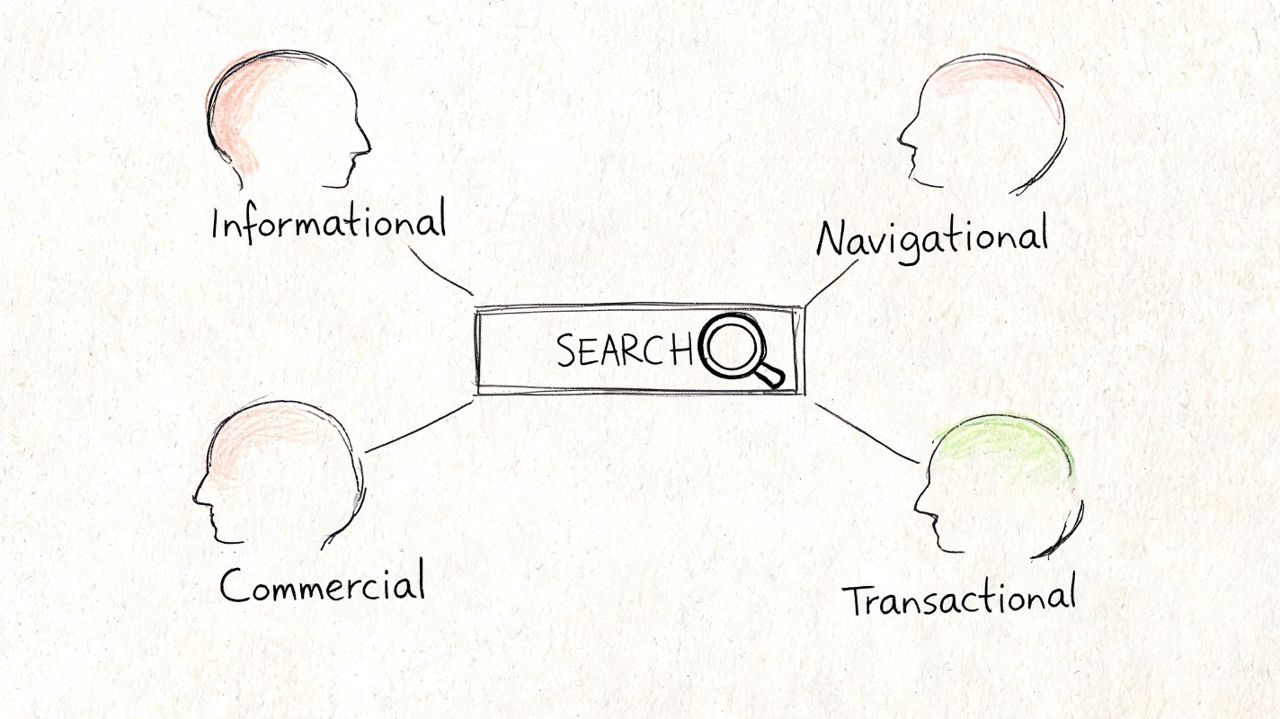
The Four Core Types of Search Intent
Search queries look similar on a spreadsheet. They don't behave the same in a sales funnel.
A user searching "what is endpoint detection" is in a different state than someone searching "endpoint detection pricing." If you treat both as SEO opportunities without separating intent, you build mixed messages into your site architecture.
Informational
Informational intent sits at the awareness stage. The user wants to understand a topic, solve a problem, or learn a process.
This traffic can matter a lot for B2B and SaaS, but only if you connect it to the next step. A strong informational page teaches clearly, answers obvious follow-up questions, and points readers toward deeper evaluation pages when relevant. A weak one collects visits and ends the journey there.
Typical formats include:
- Guides and explainers: Definitions, workflows, tutorials, and strategy articles
- How-to assets: Step-by-step walkthroughs, checklists, and frameworks
- Educational FAQs: Concise answers for recurring questions sales teams hear every week
Navigational
Navigational intent means the user already knows the destination. They're trying to reach a brand, product, login area, or specific page.
This intent usually isn't where new demand is created, but it still matters. If your branded SERP is messy, or if key pages are hard to find, buyers get friction right when they're trying to move forward.
A few common examples:
- Brand queries: Company name, product name, leadership name
- Utility queries: Login, support, documentation, locations
- Branded service searches: "[brand] pricing" or "[brand] integrations"
Commercial investigation
Commercial intent sits in the evaluation stage. The buyer knows the category and is comparing options, use cases, or trade-offs.
Many businesses leave money on the table when they rank a generic article for a high-value comparison query, but the page never helps the user make a decision. Comparison pages, alternatives pages, buyer guides, and category explainers perform better because they support vendor selection.
Commercial intent is often the bridge between SEO traffic and sales-qualified leads. Ignore it, and competitors will own the decision stage.
Transactional
Transactional intent is the closest to revenue. The user wants to buy, book, sign up, request a demo, or contact a provider.
For this intent, clarity beats cleverness. Visitors need the offer, proof, pricing context, friction-reducing details, and a direct CTA. If the page hides the action behind too much education, conversion suffers.
Think in page types, not just keywords:
- eCommerce: Product pages, category pages, filters, shipping and returns support
- SaaS: Demo, pricing, free trial, use-case landing pages
- Local services: Service area pages, appointment pages, call-focused local landers
How to Accurately Decode Search Intent from SERPs
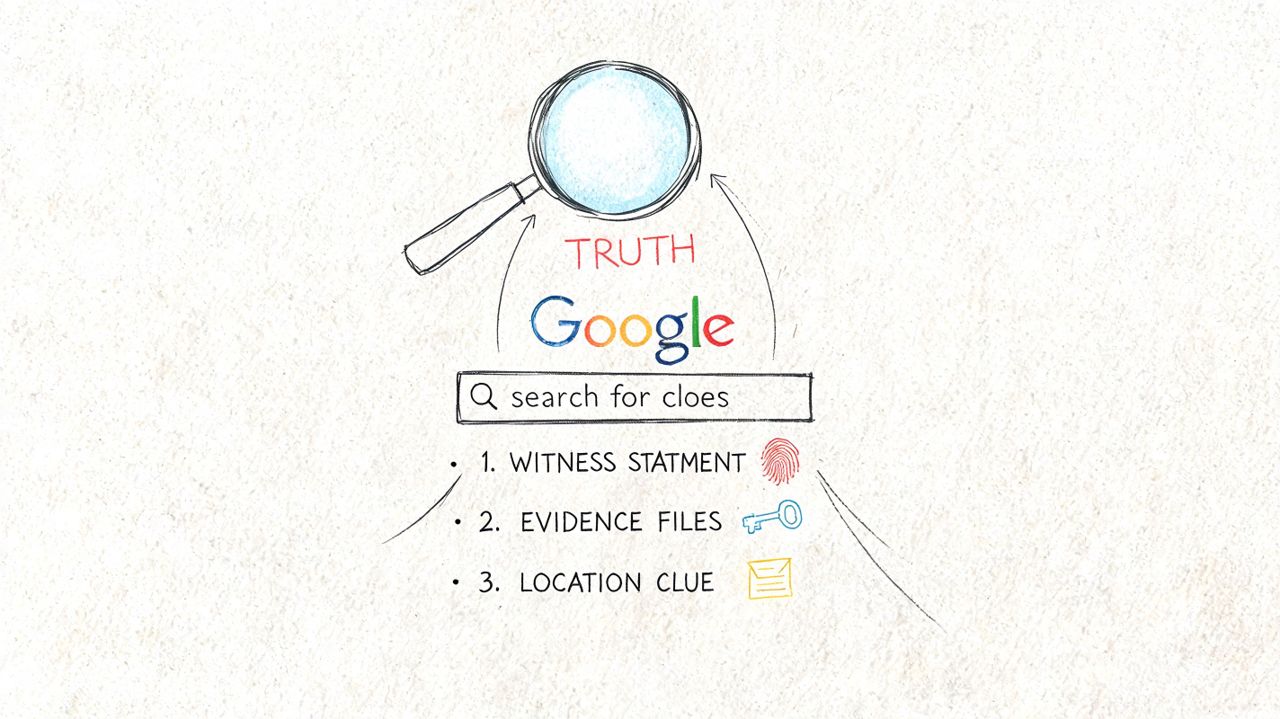
Intent isn't guessed from a keyword list. It's decoded from the search results that already rank.
That's the most reliable way to avoid building the wrong page for the right phrase. Google has already tested user behavior at scale. Your job is to read the pattern.
Read the page types first
Start with the top results and classify them by format. Are you seeing blog posts, product pages, category pages, homepages, comparison articles, local landing pages, or app pages?
This first pass often tells you more than the keyword itself. A query that sounds transactional may instead return listicles and reviews, which means the user is still evaluating. A phrase that looks informational may show vendor pages because the market has commercialized the query.
Use a simple review process:
- List the dominant page archetype: Note whether the SERP favors editorial, commercial, transactional, or mixed formats.
- Check title patterns: Words like "best," "vs," "pricing," "near me," and "how to" reveal what users expect.
- Look at the CTA model: Pages ranking for high-intent terms usually make the next action obvious.
- Review the top few pages manually: A ranking URL alone can hide whether the page is really educational, sales-led, or hybrid.
Use SERP features as intent clues
SERP features add another layer. A featured snippet often signals educational demand. Product carousels suggest commercial or transactional behavior. Local packs point to navigational or local action intent. "People Also Ask" often means the query needs broader context before a conversion happens.
Pay attention to ad density too. If a query attracts heavy ad coverage, that usually indicates clear commercial value. That doesn't mean you shouldn't target it organically. It means the query has buying energy, and your page needs to reflect that reality.
When the SERP is crowded with product results, local packs, comparison content, or ads, Google is telling you that users want decisions, not essays.
A quick manual SERP review is still one of the highest-value tasks in SEO. It prevents expensive content mistakes before design, copy, or development time gets wasted.
To see how practitioners walk through this process visually, this short video is useful:
Watch for intent drift
Intent doesn't stay fixed. Product categories mature. Google updates how it interprets queries. Buyers change how they search.
A SurferSEO search intent analysis found that about 12% of keywords changed their dominant intent over a single year, which is why one-time keyword mapping isn't enough.
That has two consequences for CMOs and SEO leads:
- Revisit priority queries regularly: Especially revenue-driving terms, competitor comparison terms, and category keywords.
- Don't overcommit to outdated page formats: A page built to win an old SERP can slowly become misaligned while still keeping some rankings.
Teams that monitor SERPs continuously usually catch these shifts early. Teams that don't often assume a content problem when the actual issue is intent drift.
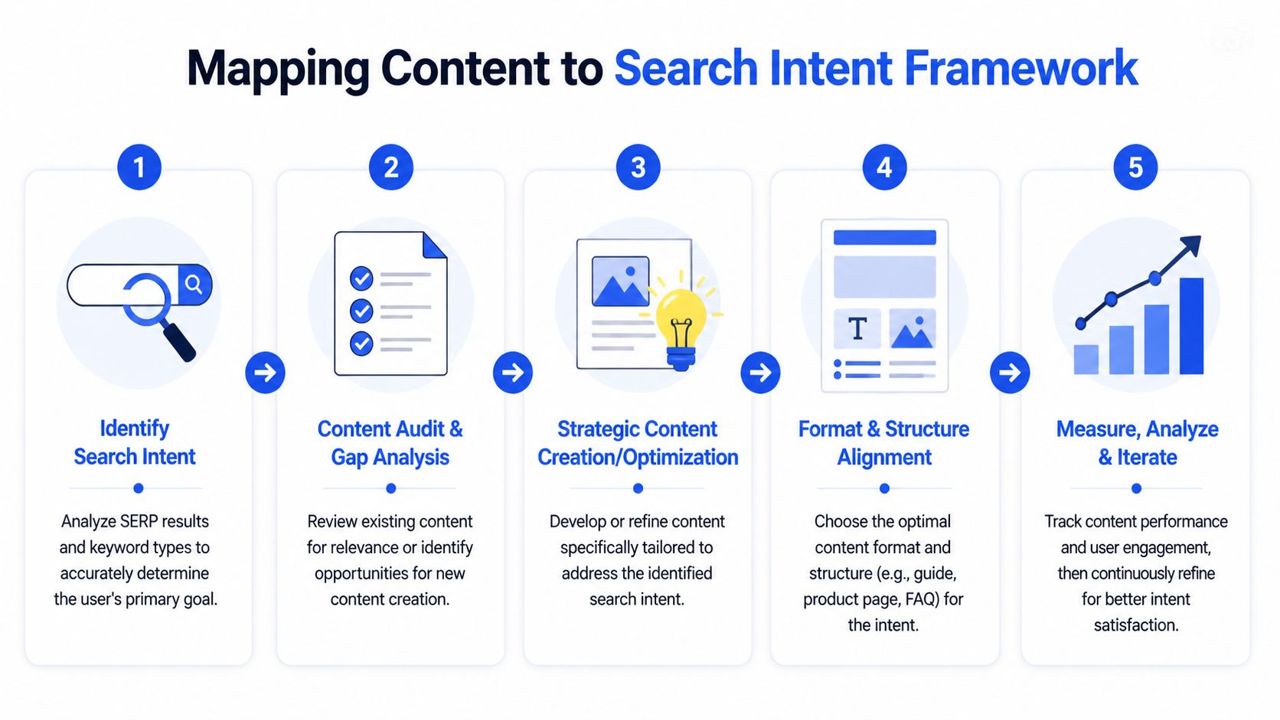
A Framework for Mapping Content to Search Intent
A content program starts producing qualified pipeline when each page has a defined commercial role. Pages built to rank for broad terms without a clear buying job often attract visits that never turn into opportunities. The fix is tighter mapping between query intent, page type, and the next business action.
Map the page to the buying job
Start with page archetypes tied to buyer readiness.
Informational queries usually belong to guides, tutorials, explainers, and glossary pages. Commercial investigation queries perform better on comparisons, alternatives pages, buyer guides, and category-level landing pages. Transactional terms need product, service, demo, pricing, or location pages built to reduce friction and convert demand.
Sequencing matters as much as format. An informational article should answer the question cleanly, then route the reader to an evaluation asset if the topic suggests purchase intent. A comparison page should help a buyer make a decision, not read like a detached encyclopedia. Intent work, therefore, usually improves more than rankings. It improves traffic quality, lead quality, and the efficiency of the path from first click to revenue.
Content and Schema Mapping by Search Intent
| Search Intent | Primary Goal | Ideal Content Format | Key Schema Markup |
|---|---|---|---|
| Informational | Learn or solve a problem | Guide, tutorial, explainer, FAQ | HowTo, FAQPage, Article |
| Navigational | Reach a known destination | Brand page, login page, location page, documentation page | Organization, WebPage, LocalBusiness |
| Commercial Investigation | Compare options and evaluate fit | Comparison page, alternatives page, buyer guide, category page | FAQPage, Product, Review |
| Transactional | Take action now | Product page, service page, pricing page, demo page, local landing page | Product, Offer, LocalBusiness |
Structured data supports the page's purpose in the SERP when it matches the actual content on the page. According to DashClicks on schema and search intent, intent-aligned structured data can improve click-through rates by 20-30% by helping pages earn rich results such as star ratings and FAQs.
Use on-page signals that reinforce intent
Format alone will not carry the page. The copy, layout, proof, and calls to action need to confirm that the visitor landed on the right asset.
Use these checks before publishing:
- Headline fit: The H1 should reflect the dominant query pattern. Comparison queries need comparison language. Transactional pages need clear offer language.
- Opening clarity: The first screen should confirm relevance fast. Visitors should not have to scroll to figure out whether the page matches their goal.
- CTA alignment: Informational pages can point readers to demos, product pages, or consultations, but the CTA has to match buyer readiness.
- Internal linking logic: Links should move users to the next-intent page in the journey, not to unrelated blog posts.
- Schema support: Markup should match the page type and the SERP features the page is eligible to earn.
For larger sites, this work becomes operational quickly. Teams often use Google Search Console exports, content audits, and clustering workflows to map page types at scale. Ahrefs, Semrush, and in-house analytics stacks can support the process, especially when teams are aligning page architecture, schema, and internal linking with commercial intent.
A page does not satisfy intent because it includes the keyword. It satisfies intent because the format, proof, structure, and next step match the user's actual job.
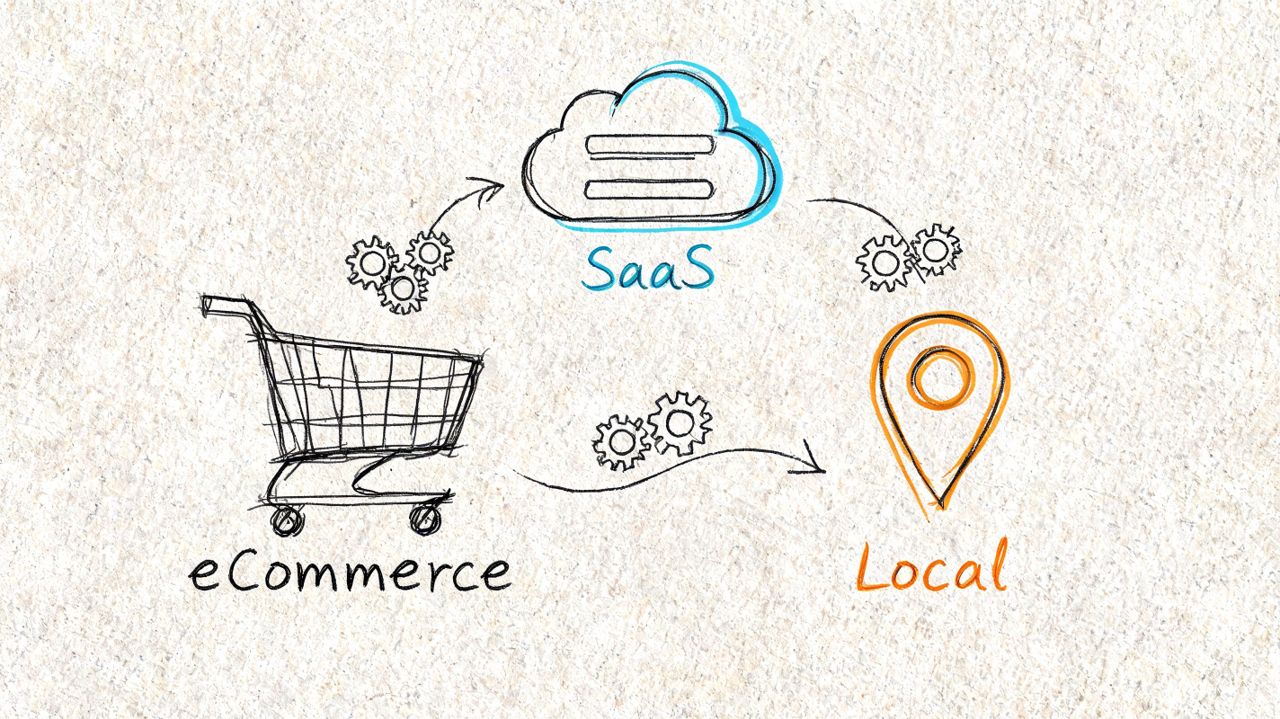
Advanced Intent Optimization for eCommerce, SaaS, and Local
Intent work gets more valuable when you adapt it to the business model. The same keyword logic won't fit an online retailer, a B2B SaaS company, and a multi-location service brand.
eCommerce
An eCommerce site usually loses intent battles in two places. First, category pages are too thin to win commercial queries. Second, blog content attracts research traffic that never gets connected to product discovery.
A stronger setup separates category and content jobs clearly. Category pages should answer evaluation questions, not just display products. That includes sizing context, use-case guidance, filter clarity, trust signals, and internal links to subcategories or buying guides. Product pages should handle transactional objections cleanly, especially around availability, returns, compatibility, and reviews.
A practical pattern looks like this:
- Commercial query: "best trail running shoes"
- Best-fit page: A category or buyer-guide hybrid that helps compare models
- Transactional follow-up: Individual product pages with strong product detail and offer clarity
SaaS
SaaS teams often publish educational content well, but fail to build the middle of the funnel. They rank for broad category topics and never bridge readers into evaluation pages that support demos or signups.
The strongest SaaS intent model usually has three layers. Educational pages answer category questions and pain points. Commercial pages compare options, explain use cases, or position the product against alternatives. Transactional pages focus on pricing, demo requests, free trials, or solution-specific landers.
For AI search visibility, this structure matters even more. According to Grow and Convert on intent and AI Overviews, as of 2026, content is 2.5x more likely to appear in AI Overviews for B2B SaaS queries if it's structured with topical authority clusters and appropriate schema, yet only 15% of intent-optimized pages use FAQ schema to capture the questions that feed those responses.
That should change how SaaS teams build content hubs. If a company targets "best CRM for remote teams," the winning approach usually isn't one isolated article. It's a connected cluster of category education, comparison assets, product detail, FAQs, and schema-supported pages that make the offer easy to quote and summarize.
Local
Local businesses deal with two intent layers at once. One user wants information about the service. Another wants a provider nearby and is ready to call.
That means local SEO can't rely on one generic service page. High-performing local setups usually combine service intent with geography. A city page, service-area page, or location landing page needs clear local relevance, service details, trust elements, and conversion paths such as calls, forms, or appointment booking.
For local brands, watch for these common mismatches:
- Generic service pages ranking for local terms: Users want local proof and location relevance, not a broad homepage.
- Location pages with no commercial detail: If the page only lists an address, it won't support action well.
- GBP and site messaging misalignment: If the Google Business Profile promises one thing and the landing page says another, conversion friction rises.
Local intent optimization works best when the page answers all three questions fast: what do you do, where do you do it, and how does the customer take the next step?
Measuring the Revenue Impact of Intent Optimization
If reporting stops at rankings and sessions, intent optimization will always look softer than paid media. That's a reporting failure, not an SEO limitation.
Executives don't need more proof that some pages attract clicks. They need proof that intent-aligned pages attract the right visitors and produce better commercial outcomes.
An Ahrefs study cited in Amquest Education's overview of search intent ROI found that intent-optimized pages drove 37% higher conversion rates, yet only 22% of marketers used attribution models to connect those changes to revenue.
What executives should review
The cleanest way to measure intent work is to segment performance by page role and query intent, then compare business outcomes.
Review performance through a lens like this:
- Informational pages: Assisted conversions, email signups, product page clicks, qualified session quality
- Commercial pages: Demo clicks, pricing page visits, sales-assisted conversions, lead quality
- Transactional pages: Direct conversions, call volume, form submissions, purchases, booked meetings
- Navigational pages: Brand defense, branded CTR, friction points, support-path efficiency
This approach makes content strategy easier to defend. It also exposes waste fast. If informational content generates sessions but never assists commercial movement, the issue may be internal linking, CTA strategy, or the wrong keyword targeting.
A practical reporting model
Use Google Search Console to group queries by intent. Then map those queries to landing pages and review the downstream behavior in analytics and CRM reporting.
A simple operating model works well:
- Tag core pages by intent category: Informational, commercial, transactional, navigational.
- Group target queries the same way: This helps catch pages ranking for the wrong search stage.
- Track next-step behavior: Product clicks, demo requests, purchases, calls, or assisted conversions.
- Review conversion quality with sales data: Not all leads from SEO deserve equal value.
- Prioritize updates where business impact is realistic: Pages close to revenue usually deserve attention first.
The point of intent reporting isn't to prove SEO created traffic. It's to prove SEO created movement toward revenue.
Once you do that consistently, content planning changes. Teams stop asking which topics will bring the most visits. They start asking which intent clusters can move qualified buyers.
Frequently Asked Questions About Search Intent
Can one page target multiple intents
Sometimes, but only when the intents are close enough that the same page format can satisfy both without confusing the user.
A category page can often serve commercial investigation and transactional intent at the same time. A strong service page can support both local navigational and transactional behavior. But combining informational and transactional intent on one page usually creates a diluted asset that serves neither well.
If the SERP shows multiple page archetypes, build the page that matches the dominant business opportunity. Then use internal links to route users into adjacent intents.
How AI search changes intent work
AI systems reward content that is clear, structured, and easy to cite. That means intent optimization now affects not just rankings, but also whether your brand gets summarized in AI-generated answers.
For B2B SaaS especially, topical clusters, FAQ coverage, schema, and strong entity clarity make content easier for AI systems to interpret. Pages that answer one clear question well and connect logically to surrounding commercial assets are easier to quote than vague pages trying to cover everything.
How often should you re-evaluate intent
Re-check your most important keywords on a recurring basis, especially for product categories, high-value service terms, and comparison queries.
You don't need to re-audit every keyword constantly. Focus on the terms tied to demos, purchases, booked calls, and category visibility. Also re-evaluate when rankings fall, CTR drops unexpectedly, or competitors begin ranking with different page formats than before.
The rule is simple. If the SERP changes, your content strategy may need to change with it.
If your SEO program is generating visibility without enough qualified leads, SEOBRO® can help you rebuild it around search intent, technical clarity, content prioritization, and reporting tied to conversions and revenue instead of vanity traffic.