You’ve probably heard two conflicting takes about FAQ schema markup.
One says it’s obsolete because Google cut back FAQ rich results. The other says you still need it everywhere. Both miss the underlying business issue. The old visual win in search results matters less now than the machine-readable clarity behind it.
That shift matters because search behavior has changed fast. AI-referred sessions increased by 527% in 2025, and FAQ schema shows one of the highest citation rates among structured data types, according to Epic Notion’s FAQ schema analysis. If your commercial pages answer buyer questions but don’t structure those answers clearly, you’re harder for Google, AI Overviews, and answer engines to trust, extract, and cite.
For most businesses, that means missed demos, missed product page clicks, and missed quote requests. Not because the page lacks information, but because the information isn’t packaged in a way search systems can use confidently.
FAQ schema markup still matters. It just matters for a different reason now. The win is no longer “can I get a dropdown in the SERP?” The win is “can I become the answer source on the pages that influence revenue?”
Introduction Why FAQ Schema Is More Important Than Ever
The misconception is simple. Google reduced FAQ rich snippets for most commercial websites, so people assumed FAQ schema markup stopped being useful.
That’s the wrong conclusion.
What changed was the display layer, not the value of structured Q&A as a search signal. FAQ schema still helps machines interpret your content as clear question-and-answer pairs. In today’s search environment, that matters as much for AI visibility as it does for classic SEO.
A lot of businesses still treat faq schema markup like a cosmetic add-on. They add it to an old FAQ page, never revisit it, and expect a visual SERP feature to appear. That’s not how this works anymore. The practical use case now is putting well-written, buyer-relevant FAQs on important pages like service pages, product pages, pricing pages, and category pages.
FAQ schema works best when it resolves commercial friction. Shipping doubts, implementation concerns, pricing confusion, eligibility questions, and trust objections are usually stronger targets than generic “what is” content.
The business upside comes from clarity. Search engines and AI systems don’t have to infer what your page is saying. You label the questions. You label the answers. You reduce ambiguity.
That matters more as answer engines become part of the buying journey. A prospect asks a comparison question, a delivery question, or a security question. If your answer is visible on-page and marked up cleanly, you have a better shot at becoming the source behind that answer.
The companies getting this right aren’t chasing outdated snippet tactics. They’re building structured answers into their commercial pages so search visibility supports pipeline, not just impressions.
What Is FAQ Schema Markup and How Does It Work
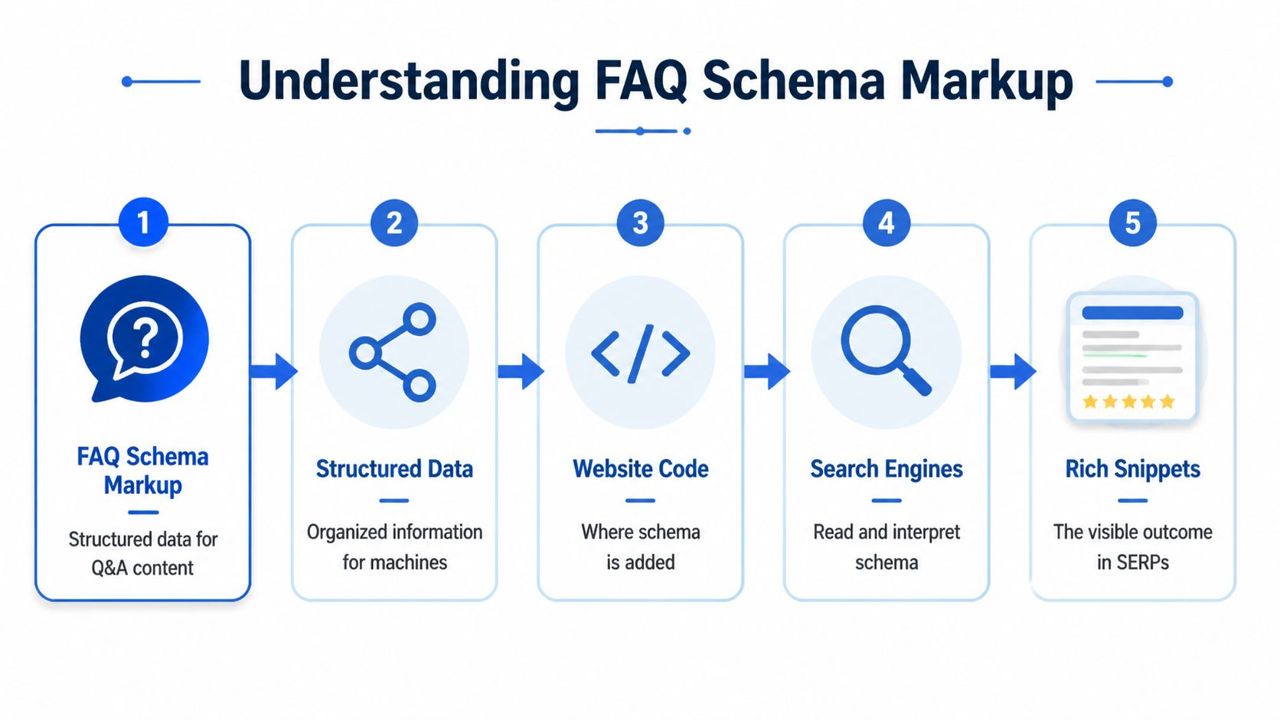
FAQ schema markup is a type of structured data based on Schema.org’s FAQPage specification. It tells search engines that a section of a page contains authored questions and answers, not just regular body copy.
That sounds technical, but the logic is straightforward. You publish a question on the page. You publish the answer on the page. Then you add machine-readable markup that defines the relationship between the two.
The core structure
The standard implementation uses a JSON-LD script block with a parent FAQPage object and nested Question and Answer entities. As noted in this FAQ schema markup example from AirOps, correct nesting is mandatory for validation.
A simplified example looks like this:
{
  "@context": "https://schema.org",
  "@type": "FAQPage",
  "mainEntity": [
    {
      "@type": "Question",
      "name": "Your Question?",
      "acceptedAnswer": {
        "@type": "Answer",
        "text": "Your Answer."
      }
    }
  ]
}
Three parts matter most:
FAQPagedefines the page section as FAQ content.Questionlabels the exact question text.acceptedAnswercontains the answer that corresponds to that question.
If those relationships are broken, malformed, or incomplete, the markup may validate poorly or get ignored.
Why JSON-LD is usually the right choice
JSON-LD is usually the best format because it sits in a script block and doesn’t require you to wrap visible HTML elements in schema attributes. That makes it cleaner for developers, easier to maintain, and less fragile when a CMS template changes.
For many organizations, the workflow is simpler with JSON-LD because:
| Approach | Practical upside | Common drawback |
|---|---|---|
| JSON-LD | Easier to deploy and edit without touching visible markup | Can drift from visible content if editors update the page but forget the script |
| Microdata | Tightly tied to the visible HTML | More tedious to implement and easier to break during redesigns |
Practical rule: Treat FAQ schema as a translation layer, not a content substitute. If the answer isn’t visible to users, it shouldn’t live only in the markup.
This is why faq schema markup isn’t just a technical checkbox. It’s a way to make your existing commercial content legible to search systems that increasingly reward explicit structure.
The Strategic Business Case for FAQ Markup in 2026
The strongest case for faq schema markup today isn’t richer-looking search results. It’s competitive positioning in a search market where AI systems need clean, extractable answers.
Why low adoption matters
This is still underused. Only 0.3% of websites use FAQ schema, yet pages with it are 3.2x more likely to appear in Google AI Overviews and can see click-through rate increases up to 87%, based on Studiohawk’s FAQ schema research.
That gap creates a real opening.
Most businesses either never implemented it, implemented it badly, or left it on a neglected FAQ hub that has little commercial value. That means you don’t need a gimmick to stand out. You need cleaner execution on the pages that matter most.
The opportunity is larger when you remember that structured Q&A can live beyond a dedicated FAQ page. Product pages, service pages, category pages, integration pages, pricing pages, and comparison pages often have stronger buyer intent than a generic support-style FAQ page ever will.
Where the real business value shows up
The practical win from FAQ markup usually shows up in four places:
- Pre-sales friction reduction because answers to objections sit directly on high-intent pages.
- Better AI visibility because the content is easier for answer engines to parse and cite.
- Stronger organic CTR when the result becomes more informative and relevant.
- Higher content efficiency because one page can rank, qualify, and convert instead of pushing users through multiple weak pages.
A short explanation from a search strategy angle helps here:
The businesses that benefit most aren’t always the biggest brands. They’re often the ones with a clear offer and a page that addresses buyer hesitation directly. When someone asks about return policies, contract terms, onboarding complexity, coverage area, or compatibility, the page that answers cleanly has an edge.
Think of FAQ schema as a conversion support layer for SEO. It helps the right page answer the last serious question before a lead form submission, a demo request, or a purchase.
A Practical Workflow for Implementation and Validation
The technical side of faq schema markup is manageable. The part that usually goes wrong is process. Teams rush to generate code before deciding which questions belong on which pages.
Start with the page, not the code
Pick a commercial page with clear intent. That might be a product detail page, a pricing page, a service page, or a local landing page. Then identify the questions that block action.
A practical workflow looks like this:
Audit the page’s intent
Ask what the visitor is trying to decide. Buy now, request a quote, compare plans, book a call, or confirm service availability all lead to different FAQ choices.
Write visible Q&A content
Keep the FAQs on the page itself. If the answer is worth marking up, it’s worth showing the user.
Generate JSON-LD
You can write it manually or use tools such as TechnicalSEO’s schema generator, Rank Math, Yoast, or a custom template in your CMS.
Add the script to the page
Most sites handle this in the
<head>or through a structured data module managed by development or a tag system.Test the live URL
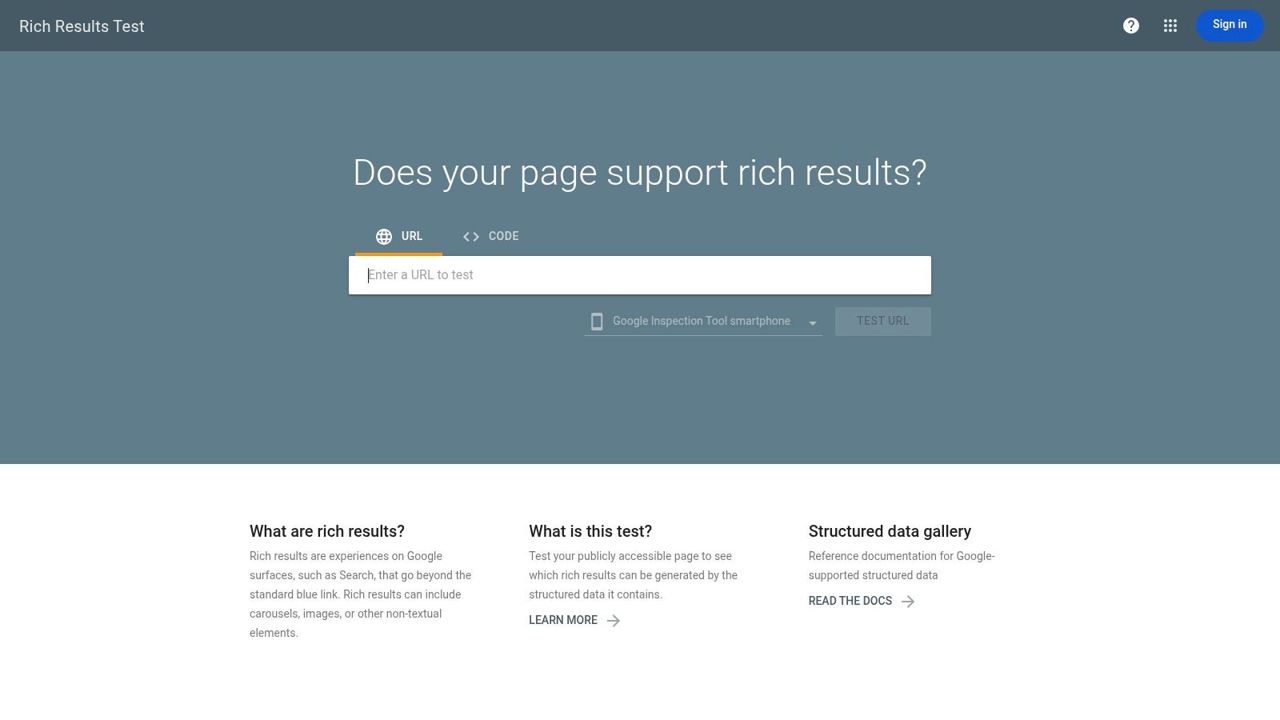
Run the page through Google’s validation tools before rolling the setup out across templates.
Validate before you scale
Validation is where disciplined teams separate themselves from everyone else. One correct implementation on one template is useful. One broken implementation across hundreds of URLs is a cleanup project.
Use a checklist like this before deployment:
- Match visible content exactly. The wording in the markup should reflect the wording users see.
- Check nesting and syntax. One small formatting issue can invalidate the block.
- Avoid duplicate FAQ blocks across many pages unless the question belongs everywhere.
- Review page intent again. A product page FAQ should support that product, not carry generic corporate policy filler.
- Monitor Search Console for errors after deployment and after template updates.
A good internal rule is simple: don’t scale schema from a plugin just because you can. Template-wide automation often creates repetitive, low-value FAQs that add code but not clarity.
The best implementations are usually selective. A small number of strong FAQs on important pages beats sitewide clutter every time.
If you’re managing a larger site, assign ownership. Content owns the questions. SEO owns the strategy. Development owns deployment. Someone still needs to own ongoing QA, because schema breaks without notice when CMS fields, templates, or page modules change.
Strategic Implementation for Your Business Model
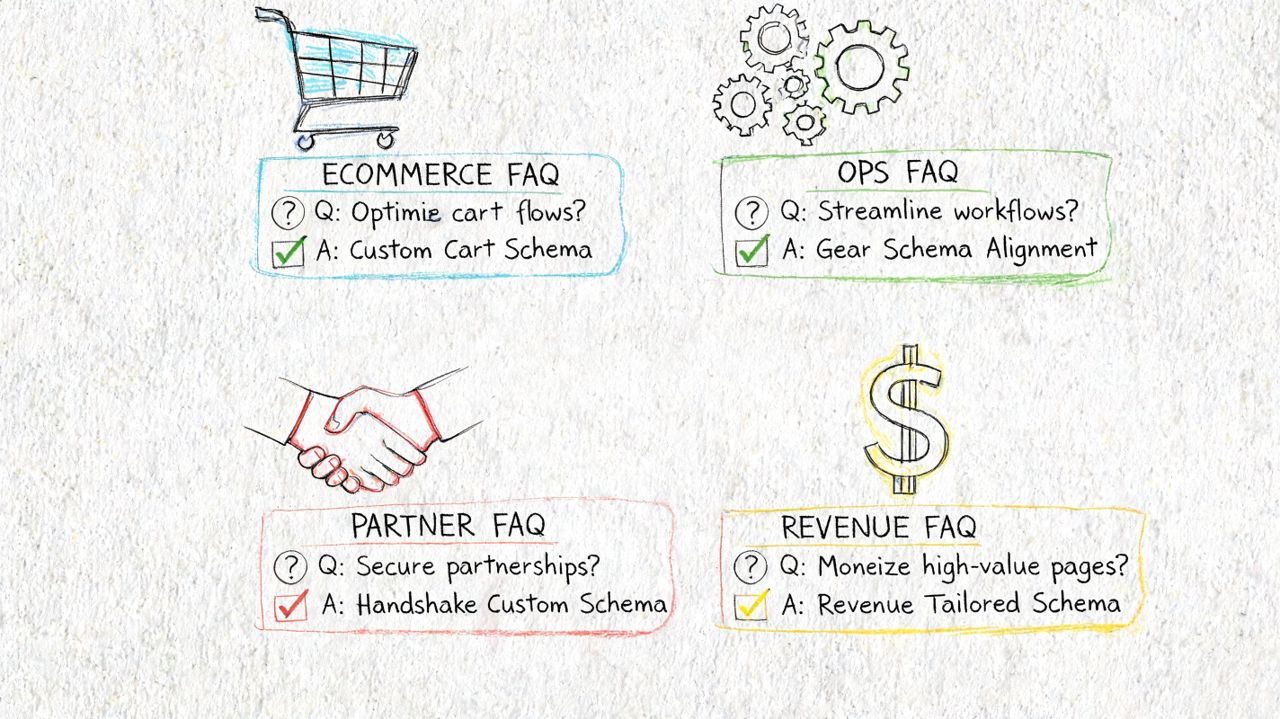
The same markup can serve very different business goals. What matters is where you place it and what objections the questions remove.
eCommerce product and category pages
On eCommerce sites, FAQ schema markup works best close to the buying decision. A generic FAQ page about the store is rarely the most effective option.
A product page usually benefits from questions like:
- Materials and fit for apparel, furniture, or premium goods
- Shipping and returns when buyers hesitate at checkout
- Compatibility for accessories, electronics, or replacement parts
- Care and maintenance for higher-consideration products
A category page can handle broader questions. Think sizing guidance, shipping thresholds, or how products in the range differ.
The mistake is turning these into sales slogans. “Why is this the best product on the market?” isn’t a strong FAQ. “Is this model compatible with X?” is.
SaaS pricing, feature, and comparison pages
SaaS teams often hide important answers in support docs when they belong on revenue pages.
Pricing pages should resolve friction around billing logic, plan limits, trial terms, onboarding expectations, and cancellation conditions. Feature pages should clarify integrations, security considerations, implementation requirements, and use-case fit. Comparison pages can answer neutral buyer questions that help qualified prospects self-select.
A useful pattern is to place short FAQs under the primary conversion section, not buried at the bottom beneath unrelated content.
Here’s a simple planning table:
| Page type | Good FAQ focus | Weak FAQ focus |
|---|---|---|
| Pricing page | Billing, usage caps, implementation, contract questions | Broad educational questions already answered elsewhere |
| Feature page | Integrations, setup, workflows, limits | Vague brand messaging |
| Comparison page | Fit, migration, overlap, use-case differences | Aggressive competitor claims |
Local service pages and multi-location SEO
For local businesses, faq schema markup should answer decision-stage questions tied to service delivery.
Examples include:
- Service areas and whether nearby towns are covered
- Appointment process and what happens after form submission
- Urgency and availability for repair, legal, medical, or home services
- Estimate expectations so leads understand the next step
- Licensing or insurance questions where trust is critical
This works especially well on location-specific or service-specific pages where the question supports a quote request. A plumbing page might answer whether emergency service is available in a certain area. A law firm page might address consultation structure. A clinic page might explain referral requirements.
The principle stays the same across models. Put the FAQ where hesitation happens, not where your navigation says “FAQ.”
Common Mistakes and Google Policy Violations to Avoid
Most faq schema markup problems aren’t advanced. They’re basic quality and compliance failures.
What breaks trust fast
The biggest issue is invisible content. If the page doesn’t show the question and answer to users, don’t mark it up. Search systems expect the schema to reflect what’s on the page.
Another common problem is using FAQ markup as disguised ad copy. Following Google’s 2023 update, many sites were left with outdated or invalid implementations. Audits reported that 70% to 80% of commercial sites that had chased snippets retained markup risking penalties under rules against purely promotional use, according to Search Engine Land’s analysis of the rise and fall of FAQ schema in SEO.
That’s why “marketing FAQs” often fail. If the question is really just a sales headline in disguise, it’s risky and weak.
What compliant implementation looks like
Good FAQ content is helpful, direct, and specific. It answers what a buyer wants to know.
Avoid these patterns:
- Hidden answers tucked into code only
- Promotional wording that reads like ad copy
- Duplicate FAQs copied across many unrelated pages
- Wrong schema type used on forums, review pages, or user-generated Q&A
- Template bloat where every page inherits the same low-value block
Search systems reward clarity, not manipulation. If a question doesn’t help a user make a decision, it probably doesn’t deserve FAQ markup.
There’s also a practical brand risk here. Bad FAQ implementation usually signals shallow SEO work. It clutters templates, creates compliance headaches, and gives internal teams one more thing to fix later.
The safer approach is narrower and better. Fewer FAQs. Better questions. Strong alignment with page intent. Regular validation.
Advanced Tactics Using sameAs and mentions
Once the core implementation is clean, you can strengthen faq schema markup with entity signals. Two properties worth understanding are sameAs and mentions.
When entity linking strengthens your answers
These properties can help search systems connect your answer to known entities in the broader knowledge graph.
According to Google’s FAQPage documentation as cited in the provided data, adding sameAs or mentions can contribute to an average 1.5 position lift for long-tail queries and a 10% to 25% increase in featured snippet eligibility when crawlers infer expertise more confidently.
Used properly:
sameAslinks an answer to an authoritative entity referencementionsindicates that your answer discusses a specific entity without claiming equivalence
That matters in cases where ambiguity hurts interpretation. If your answer references a product line, competitor, standard, manufacturer, or organization with a known entity footprint, these properties can reduce confusion.
For example, a SaaS FAQ about integration compatibility may mention a well-known platform. An eCommerce answer about product materials may refer to a manufacturer or certification body. A local business answer may mention an organization or area-specific entity relevant to the service.
How to use these properties without overcomplicating the page
The value here isn’t in adding more schema for its own sake. It’s in making nuanced answers easier to trust.
A simple decision framework helps:
| Property | Use it when | Don’t use it when |
|---|---|---|
sameAs |
Your answer clearly aligns with a known authoritative entity or canonical reference | You’re trying to force authority by linking loosely related pages |
mentions |
You refer to a brand, organization, product, or entity discussed in the answer | The mention is incidental and adds no semantic clarity |
A few practical guardrails matter:
- Keep the answer readable first. The content still has to help the buyer.
- Use authoritative destinations when linking entities.
- Avoid stuffing entity references into every answer.
- Reserve this for pages with strong intent or ambiguity rather than applying it indiscriminately.
The advanced play isn’t more markup. It’s better disambiguation on answers that influence trust, comparison, and conversion.
For teams investing in AI search visibility, FAQ schema begins to act less like a SERP feature and more like an authority signal. You’re not just labeling text. You’re helping machines understand exactly what your answer is about, and how it connects to recognized entities.
Frequently Asked Questions About FAQ Schema
Should FAQ schema markup only live on a dedicated FAQ page
No. It often performs better on product, service, pricing, and category pages where the questions remove buying friction. The key is that the Q&A must be visible and useful on that page.
Can I use the same FAQ block on many pages
Usually, that’s a bad idea. Repeating the same generic answers across multiple URLs weakens relevance and can look manipulative. Write FAQs that match the specific intent of each page.
Is rich snippet visibility the main goal anymore
For most businesses, no. The stronger use case now is helping search engines and AI systems parse, trust, and potentially cite your answers on commercially important pages.
If your site has valuable answers buried in product pages, service pages, or pricing content, a strategic FAQ schema rollout can turn that content into a stronger visibility and conversion asset. SEOBRO® helps businesses build revenue-focused SEO systems that connect technical execution, structured data, content strategy, and AI search visibility to real business outcomes.