A SaaS business model is a software delivery method where a company centrally hosts an application and licenses it to customers on a subscription basis, creating predictable recurring revenue instead of one-time sales. In 2025, approximately 75% of all applications are deployed as SaaS solutions, which tells you this isn’t a niche model anymore.
If you're a founder, CMO, or growth lead, the question usually isn’t just what is saas business model. It’s whether this model can produce durable revenue without forcing you into endless custom work, erratic cash flow, and a sales process that never compounds.
That's a key appeal. SaaS turns software from a one-off transaction into an operating system for recurring revenue. But the model only works when the product, pricing, retention, onboarding, and acquisition engine all reinforce each other. If one breaks, the economics break with it.
For search-driven growth teams, that has a direct implication. SEO for SaaS isn’t about traffic for its own sake. It has to support signups, demos, expansion revenue, and lower acquisition costs over time. A subscription business lives or dies by efficiency.
The Shift to Subscription Why SaaS Dominates Modern Business
A lot of founders face the same early choice. Sell software once and chase the next deal, or build a subscription business that compounds if customers stay. The first path can create quick revenue. The second can create a stronger company, but only if retention and acquisition are under control.
SaaS won because buyers prefer access over ownership in many categories. They want software that’s available in the browser, updated centrally, and easier to adopt across teams. Vendors want recurring revenue, tighter feedback loops, and a product they can improve for everyone at once.
That shift is no longer theoretical. Approximately 75% of all applications are now deployed as SaaS solutions in 2025, and by the end of 2024, 99% of companies were using at least one SaaS solution. The average company now manages 305 SaaS applications according to BetterCloud’s SaaS statistics.
Why that matters for founders
When a delivery model becomes the default, buyer expectations change with it. Customers start expecting:
- Fast access: They don’t want long installation cycles.
- Continuous updates: They expect fixes and features without a migration project.
- Lower friction in buying: They prefer a manageable subscription over a large upfront commitment.
- Clear proof of value: They still need to see that the monthly or annual spend is justified.
Practical rule: A SaaS product isn’t just software in the cloud. It’s a promise that customers can keep getting value without rebuilding the relationship every quarter.
This is also why SEO matters more in SaaS than many teams realize. A recurring-revenue business needs a repeatable way to generate demand from buyers already looking for solutions. High-intent organic pages for category terms, comparison terms, integration terms, and use-case queries can support both demos and self-serve signups. Without that acquisition layer, even a solid product can end up overdependent on paid spend or founder-led sales.
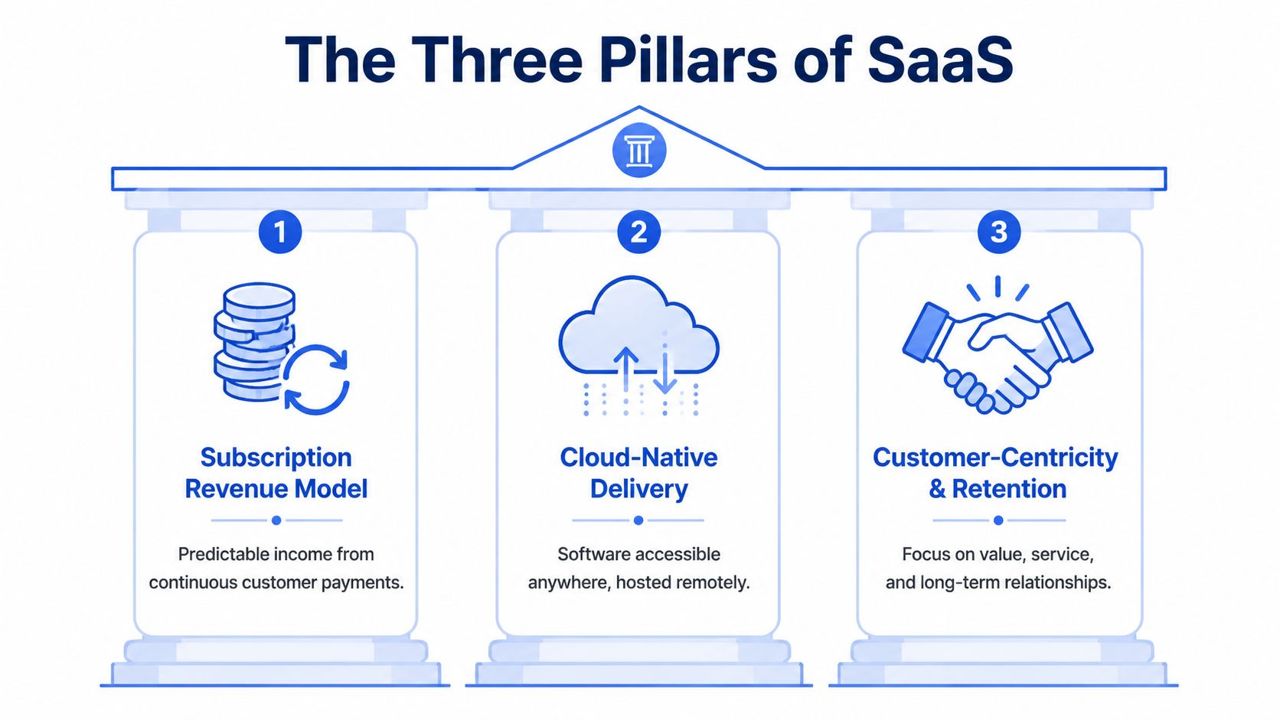
The Three Pillars of the SaaS Business Model
The easiest way to understand what is saas business model is to strip it down to three parts. If one is missing, you don’t really have a SaaS business. You have software with a subscription attached.
Centralized hosting changes the economics
Traditional software often behaved like a product shipment. You sold a version, the customer ran it, and updates were a separate event. SaaS behaves more like a service platform. The vendor hosts the application centrally and delivers it over the internet.
That matters because the company controls the environment. It can deploy updates, monitor performance, manage user access, and improve onboarding without asking each customer to reinstall anything. Tools like AWS, Azure, PostgreSQL, Kubernetes, and Stripe Billing often sit somewhere in that stack, depending on the product’s complexity.
Consider the difference between building a home gym and paying for a gym membership. Ownership gives control, but it also pushes maintenance, upgrades, and setup onto the user. SaaS sells access instead.
Subscriptions turn delivery into a revenue system
The second pillar is licensing through subscriptions. Customers pay monthly or annually for continued access rather than buying a permanent copy.
That changes how the business thinks. Revenue doesn’t stop at the sale. It has to be earned continuously through uptime, support, feature delivery, and real business value.
For founders, this creates several operational consequences:
- Pricing becomes strategy: Packaging affects who buys, how accounts expand, and whether larger teams adopt.
- Onboarding becomes revenue-critical: A confusing first-use experience can kill payback.
- Customer success becomes commercial: Retention isn’t support overhead. It protects future cash flow.
Retention is part of the product
Many teams misunderstand the model. In SaaS, the customer relationship doesn’t end after conversion. It starts there.
If users don’t adopt the product, invite teammates, hit the “aha” moment, and renew, the business stalls. That’s why the best SaaS companies build retention into product design, documentation, lifecycle email, in-app guidance, integrations, and support.
The SaaS model works best when product, growth, and support teams treat renewal and expansion as shared responsibility.
From a marketing perspective, this also shapes SEO. A strong SaaS search strategy isn’t only top-of-funnel blog content. It includes solution pages, feature pages, competitor-alternative pages, integration pages, help content, and schema-friendly FAQs that answer pre-sale and post-sale questions clearly. Those assets help acquire the customer and reduce friction after signup.
SaaS Revenue and Pricing Models Explained
Pricing is where the SaaS model becomes real. Founders can describe a vision all day, but the market responds to packaging, perceived value, and how easy it is for buyers to understand the spend.
There isn’t one “best” SaaS pricing model. There’s only the model that fits your product usage, sales motion, and customer behavior.
Four common pricing models
Flat-rate pricing is simple. One product, one price. It’s easy to explain and easy to buy, but it can undercharge large accounts and limit expansion.
Tiered pricing groups features, usage limits, or support levels into plans. This works well when customers have clearly different needs. It gives sales and product teams room to segment the market, but bad tiering can create confusion or hide its full value.
Usage-based pricing ties revenue to consumption. This often fits API products, infrastructure tools, and products where value scales with activity. It can align price with customer outcomes better than a fixed subscription. It also requires clean billing, transparent metering, and careful communication.
Per-user or per-seat pricing is common in collaboration software and workflow tools. Buyers understand it quickly, and revenue expands as teams grow. The downside is that customers may restrict seats to control cost, especially if adoption inside the account is uneven.
Comparison of SaaS Pricing Models
| Model | Revenue Predictability | Scalability | Best For |
|---|---|---|---|
| Flat-rate | High | Moderate | Simple products with one clear use case |
| Tiered | High | High | Products serving multiple segments or maturity levels |
| Usage-based | Moderate | High | API-heavy or consumption-driven software |
| Per-user | High | High | Team software with broad internal adoption |
What investors look at
SaaS investors don’t just ask how much revenue you booked. They ask how revenue behaves.
The core equation is MRR = (New MRR + Expansion MRR) - (Churn MRR + Contraction MRR), and investor-grade health is often framed through the Rule of 40, where growth % + profit margin % ≥ 40%, according to Stripe’s guide to the business of SaaS. The same source notes that usage-based pricing often outperforms flat subscriptions by 25% in expansion revenue for API-heavy SaaS.
That doesn’t mean every company should rush into metered pricing. It means the pricing model should reflect how value is created and how accounts naturally expand.
If you’re comparing packaging options, this resource on how to boost SaaS revenue in 2025 is useful because it forces the right question: are you optimizing for easier entry, stronger expansion, or cleaner forecasting?
A practical pricing lens for founders:
- If sales needs simplicity, avoid overcomplicated tiers.
- If product usage varies widely, consider usage-based elements.
- If collaboration drives stickiness, per-seat pricing can work.
- If enterprise buyers need procurement clarity, keep packaging legible.
Pricing isn’t just monetization. It tells the buyer how your product creates value and tells investors how durable that value might be.
SEO supports pricing more than many realize. Buyers search for pricing, alternatives, plan comparisons, and use-case fit long before they talk to sales. If those pages don’t exist, paid channels and sales calls have to do too much explanatory work.
Core Metrics for Measuring SaaS Performance
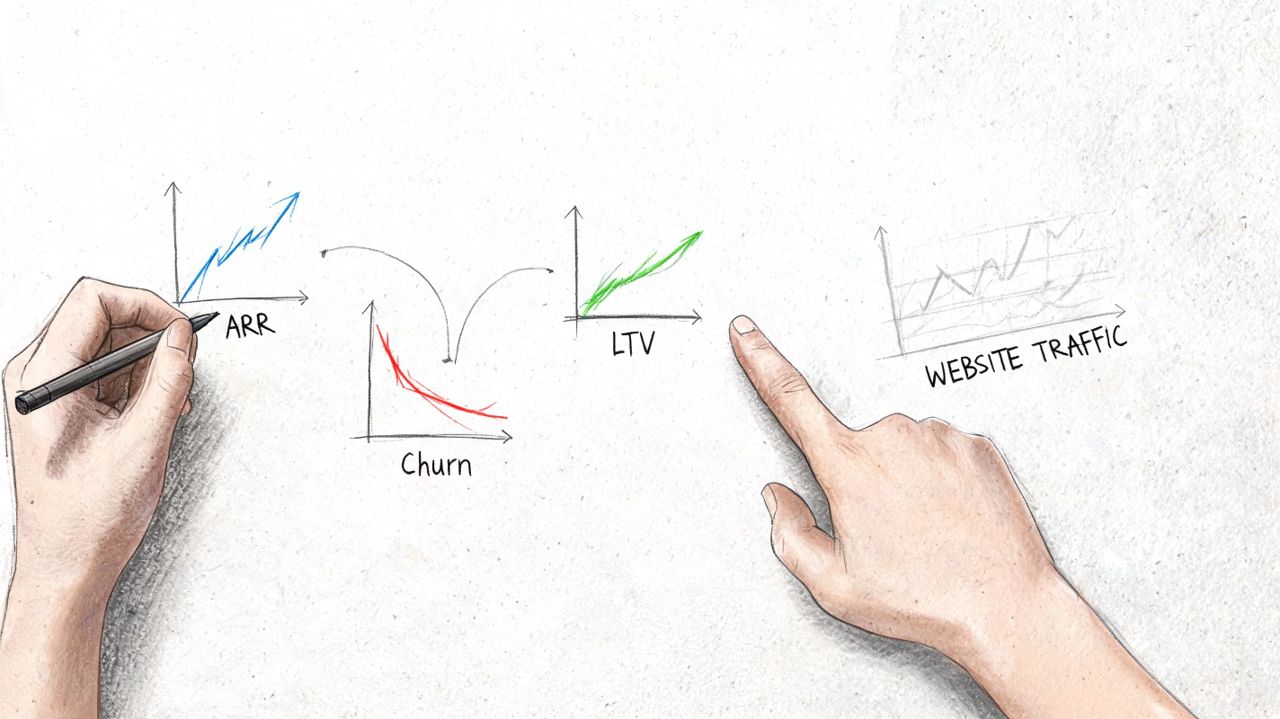
A SaaS company can have impressive traffic and still be unhealthy. What matters is whether acquired customers stay, expand, and repay what it cost to win them.
Start with the metrics that expose business quality
MRR and ARR show recurring revenue momentum. They help operators and investors see whether the business is adding durable income or replacing what it loses.
Churn shows how many customers or how much revenue disappears. Even a strong acquisition engine struggles if customers leave too quickly.
NRR shows whether existing customers expand enough to offset churn and contraction. This is one of the clearest signs that the product keeps becoming more valuable after the initial sale.
A strong benchmark for SaaS health is the LTV:CAC ratio, with healthy businesses typically falling between 3:1 and 5:1. The average customer churn rate is around 5%, and top-quartile companies achieve Net Revenue Retention between 108% and 116%, according to Eleken’s SaaS business model metrics overview.
Why LTV to CAC matters so much
LTV:CAC is where product, sales, and marketing finally meet the same scoreboard.
If acquisition is expensive and retention is weak, growth becomes fragile. If acquisition is efficient and customers stay, the model compounds. That’s why this ratio matters so much to founders and investors. It tells you whether the business can scale without constantly needing more capital to cover weak economics.
Here’s a useful walkthrough of SaaS metrics in action:
What a practical SaaS dashboard should include
A useful dashboard doesn’t need dozens of charts. It needs the few numbers that change decisions.
- MRR and ARR movement: Track new, expansion, contraction, and churn components separately.
- CAC by channel: Compare SEO, paid search, outbound, partnerships, and referrals.
- Activation indicators: Watch whether users reach meaningful product usage early.
- Retention cohorts: Separate logo retention from revenue retention.
- Pipeline to revenue: Tie demos, trials, and SQLs back to recurring revenue outcomes.
Watch the gap between lead volume and retained revenue. That’s where weak positioning, poor onboarding, or bad-fit acquisition usually shows up first.
For SEO teams, the key is tying channel performance to business quality, not just sessions. A keyword that brings fewer visitors but produces qualified demos can matter far more than a traffic-heavy informational query. SaaS content should be mapped to commercial intent, onboarding friction, and expansion potential, not just search volume.
Common Go-to-Market Strategies for SaaS
A SaaS model needs a route to market that matches the product’s complexity and price point. The common mistake is copying another company’s playbook without asking whether the economics fit.
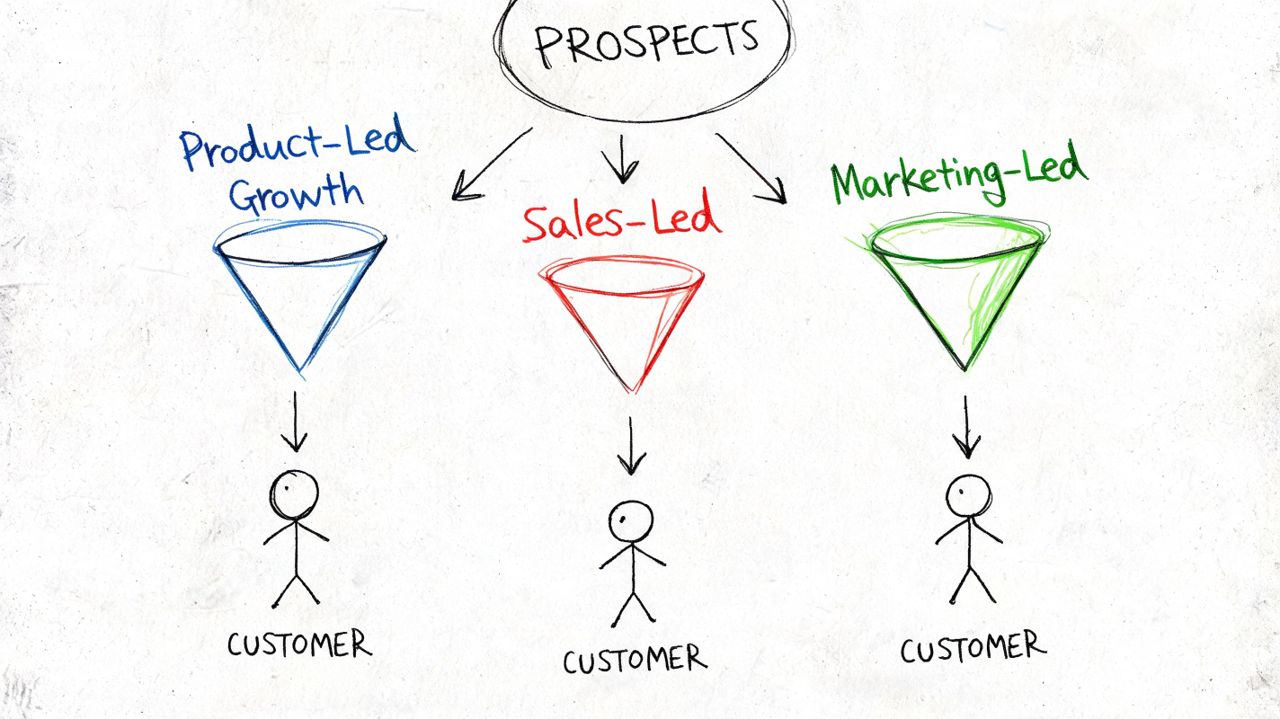
PLG, SLG, and content-led growth solve different problems
Product-Led Growth (PLG) uses the product itself as the acquisition engine. Free tools, freemium plans, or free trials let users experience value before buying. This can work well when setup is light and the product is intuitive. It usually struggles when implementation takes stakeholder coordination or technical help.
Sales-Led Growth (SLG) relies on demos, account executives, and a more guided buying process. It fits higher-value deals, more complex products, and enterprise procurement. The trade-off is a longer sales cycle and heavier acquisition cost.
Content-led and SEO-led growth builds inbound demand by showing up for the queries buyers search before they purchase. This works especially well for problem-aware, solution-aware, and comparison-stage searches. It also supports the other two motions by warming buyers before signup or demo.
A practical way to build a robust SaaS GTM plan is to start with customer complexity, buying committee size, and onboarding friction. Those three factors usually tell you whether self-serve, sales-assisted, or hybrid will work.
Where SEO fits in
SEO shouldn’t be treated as a blog factory bolted onto the GTM plan. In SaaS, it often performs best when it supports multiple funnel stages at once.
For example:
- PLG teams need feature-led and use-case pages that convert product-aware demand.
- SLG teams need comparison pages, pain-point pages, and category pages that generate qualified demo intent.
- Hybrid teams need both, plus help content and integration pages that reduce pre-sale hesitation.
The best SaaS SEO programs usually focus on search journeys such as:
- problem to solution
- alternative comparison
- integration discovery
- pricing and fit evaluation
- post-signup education
A good GTM motion acquires customers. A good SEO layer makes that motion cheaper, clearer, and easier to scale.
If your acquisition strategy depends only on paid traffic or outbound, your CAC usually stays under pressure. Organic search won’t solve a weak product, but it can make a strong product much more efficient to grow.
The Pros and Cons of Adopting a SaaS Model
SaaS has obvious strengths. It also has failure modes that are easy to ignore when recurring revenue starts sounding attractive.
Where the model is strong
The biggest advantage is revenue quality. Subscriptions create predictability that one-time licensing doesn’t. That can improve planning, hiring decisions, and investor confidence when retention is healthy.
SaaS also gives operators direct visibility into product usage. Teams can see where onboarding breaks, which features get adopted, where accounts stall, and what support issues repeat. That feedback loop is one of the model’s biggest structural advantages.
From a growth perspective, the model can scale well because improvements compound. Better onboarding, stronger positioning, cleaner pricing, and clearer search acquisition can all improve retention and acquisition at the same time.
Where founders get caught out
The hard part is that SaaS front-loads the work. You build the product, support infrastructure, onboarding, billing logic, and acquisition engine before the recurring revenue base is mature enough to carry the business.
There’s also a customer-side challenge that many vendors underplay. Longer implementation periods are primary objections in enterprise SaaS deals, especially when buyers can’t tell how quickly they’ll see value, as noted in Zuora’s overview of SaaS business models. If the ROI timeline feels vague, deals slow down.
Another issue is fit. SaaS works best when many customers can use a standardized product. It can fail for specialized, low-volume workflows where buyers need one-off customizations or unusual operating models. In those environments, a rigid product roadmap can cost deals.
A useful founder checklist here is simple:
- Can buyers reach value quickly enough to justify subscription spend
- Can the product serve a broad enough segment without custom work taking over
- Can onboarding, support, and SEO explain value clearly enough before sales gets involved
- Can the company keep shipping improvements fast enough to protect retention
When teams ignore those questions, they often mistake demand problems for marketing problems. Sometimes traffic isn’t the issue. The issue is that the offer doesn’t fit the buying reality.
Conclusion Building a Revenue-Driven SaaS Strategy
The SaaS model is powerful, but it isn’t automatic. Recurring revenue only becomes durable when product delivery, pricing, retention, and go-to-market all work together.
That’s the practical answer to what is saas business model. It’s not just software sold as a subscription. It’s a business system built around recurring value, customer retention, and scalable delivery.
Founders who win with SaaS usually do a few things well. They keep packaging clear, track the right metrics, reduce time to value, and build acquisition channels that keep lowering dependence on paid spend over time. Support matters too, especially as the customer base grows. Teams thinking about improving SaaS support with AI and self-service are usually moving in the right direction because better support can protect retention and free up the team to scale.
If you want SaaS growth, build a search strategy around revenue, not vanity traffic.
Frequently Asked Questions About SaaS
Is SaaS the same as cloud software
Not exactly. SaaS is software delivered as a service through the cloud, usually with subscription access and centralized hosting. “Cloud software” is broader and can include other delivery and infrastructure models.
How long does it take a SaaS company to become profitable
Often longer than founders expect. For many early-stage SaaS companies, profitability can take several years and may come after multiple funding rounds because R&D and customer acquisition costs are high. A healthy CAC payback period ideally sits under 12 months, as noted earlier in the Stripe benchmark referenced in the pricing section.
Can a non-technical founder build a SaaS business
Yes, but only if they’re realistic about execution. Non-technical founders still need technical leadership, disciplined product scoping, and a clear understanding of buyer pain. The biggest mistake is trying to launch with too many features and no clear wedge.
When is SaaS a bad fit
SaaS is often a poor fit when customers need heavy customization, have low-frequency workflows, or can’t adopt a standardized process. It’s also tough when the value is hard to prove quickly enough for the buyer’s budget cycle.
If you’re running a SaaS company and want organic search to drive qualified demos, signups, and long-term revenue, SEOBRO® is built for that kind of work. The focus isn’t on generic traffic growth. It’s on strategic SEO audits, technical fixes, commercial content, authority building, and AI-search visibility that support a healthier acquisition engine.