AI search traffic isn't a side channel anymore. It has surged 527% year over year from January to May 2024 versus the same period in 2025, according to Semrush's summary of the 2025 Previsible AI Traffic Report. That single shift changes the commercial reality for SEO teams, founders, and CMOs.
Your business can still rank in Google and still lose visibility where buying research increasingly happens. Buyers now ask ChatGPT, Perplexity, Copilot, and Google's AI interfaces for comparisons, vendor shortlists, definitions, pricing context, and recommendations. If your brand isn't cited in those answers, your competitor gets the trust transfer before the click ever exists.
That's why ai search optimization services matter. This work isn't about chasing hype or publishing “AI-ready” fluff. It's about making your site technically accessible, structurally clear, factually consistent, and easy for AI systems to quote accurately. The business goal is straightforward: protect discoverability, earn citations in high-intent prompts, and turn that visibility into pipeline, revenue, and branded demand.
The New Search Landscape Your Business Cannot Ignore
The old SEO model assumed that visibility led to a click, and the click led to the sale. That model is under pressure. AI systems increasingly answer the question on the results page or inside the assistant itself, which means buyers can form a preference before they ever visit your site.
The important change isn't just traffic source diversification. It's decision-making compression. A founder evaluating software, a shopper comparing products, or a homeowner looking for a local provider can now get a synthesized answer instantly. If that answer cites your brand, you stay in the consideration set. If it doesn't, you may never enter it.
Google's AI interfaces are expanding too. Semrush notes that AI Overviews now appear in over a quarter of searches in the same source linked above. That matters because these placements reshape who gets seen, who gets trusted, and who gets the next step.
Practical rule: In AI search, visibility often happens before the visit. Your brand has to be understandable and citable, not just rankable.
Three commercial consequences follow:
- Fewer guaranteed clicks: A strong impression can still produce no visit if the interface answers the query directly.
- Higher value on source attribution: When AI tools cite a brand, they pre-frame credibility.
- More pressure on content quality: Weak pages with vague claims, thin service descriptions, and inconsistent business details don't survive summarization well.
This is why ai search optimization services have moved from experiment to operating priority. Traditional SEO still matters. But by itself, it no longer covers the full surface area of modern search visibility.
What Are AI Search Optimization Services
AI search optimization services are the technical and editorial work required to make a business easier for AI systems to understand, trust, and cite. You'll also hear the terms GEO (Generative Engine Optimization) and AEO (Answer Engine Optimization). The labels vary. The job is the same.
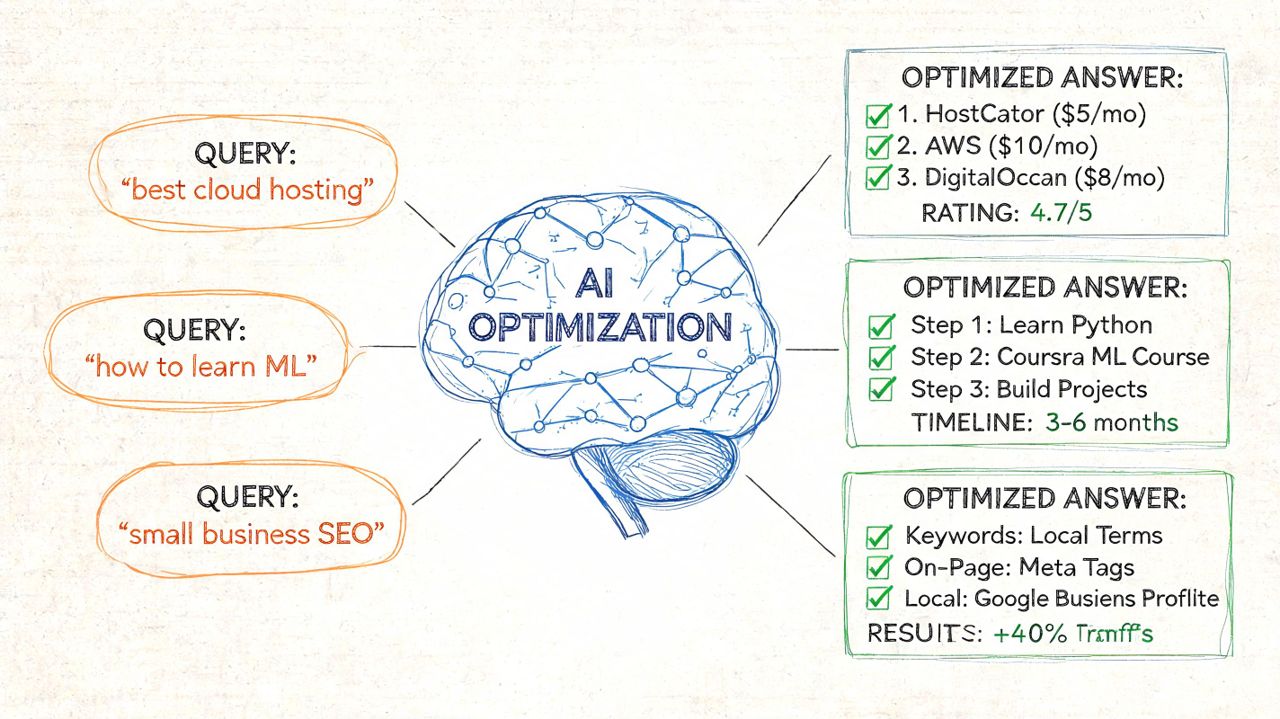
What the service is actually trying to do
A good provider isn't trying to manipulate a chatbot. They're trying to remove ambiguity from your digital footprint.
That means your site needs to answer basic business questions cleanly:
- Who are you
- What do you sell
- Who is it for
- Where do you operate
- Why should anyone trust you
When those answers are buried in marketing language, split across inconsistent pages, or unsupported by structure and proof, AI systems are more likely to ignore you or summarize you poorly.
What this work usually includes
The service usually blends technical SEO, content architecture, and entity clarity. In practice, that often means:
- Structured data: Adding JSON-LD schema for products, services, FAQs, organizations, reviews, and local entities.
- Citation-friendly content formatting: Clear headings, answer-first sections, concise definitions, and pages that can stand on their own when excerpted.
- Entity optimization: Making your brand, leadership, services, locations, and differentiators consistent across your site and major web profiles.
- Crawler guidance: Defining what AI crawlers should or shouldn't access.
For teams building internal playbooks, these actionable workflows for AI search discovery are useful because they force the right operational question: not “how do we game AI,” but “how do we make our best pages the easiest source to extract from?”
What doesn't work
A lot of businesses waste time on cosmetic AI tactics.
These usually underperform:
- Publishing generic “what is AI” content with no commercial relevance
- Stuffing pages with chatbot terms instead of clarifying intent
- Creating one-off AI landing pages while core service, category, or product pages remain weak
- Treating AI visibility as separate from SEO, rather than an added layer on top of technical quality, authority, and conversion paths
If a page can't explain itself clearly to a rushed buyer, it probably won't explain itself clearly to an AI model either.
How AI SEO Differs From Traditional SEO
Most businesses don't need to replace SEO. They need to expand it. AI SEO adds another layer of optimization focused on extractability, factual clarity, and citation potential.
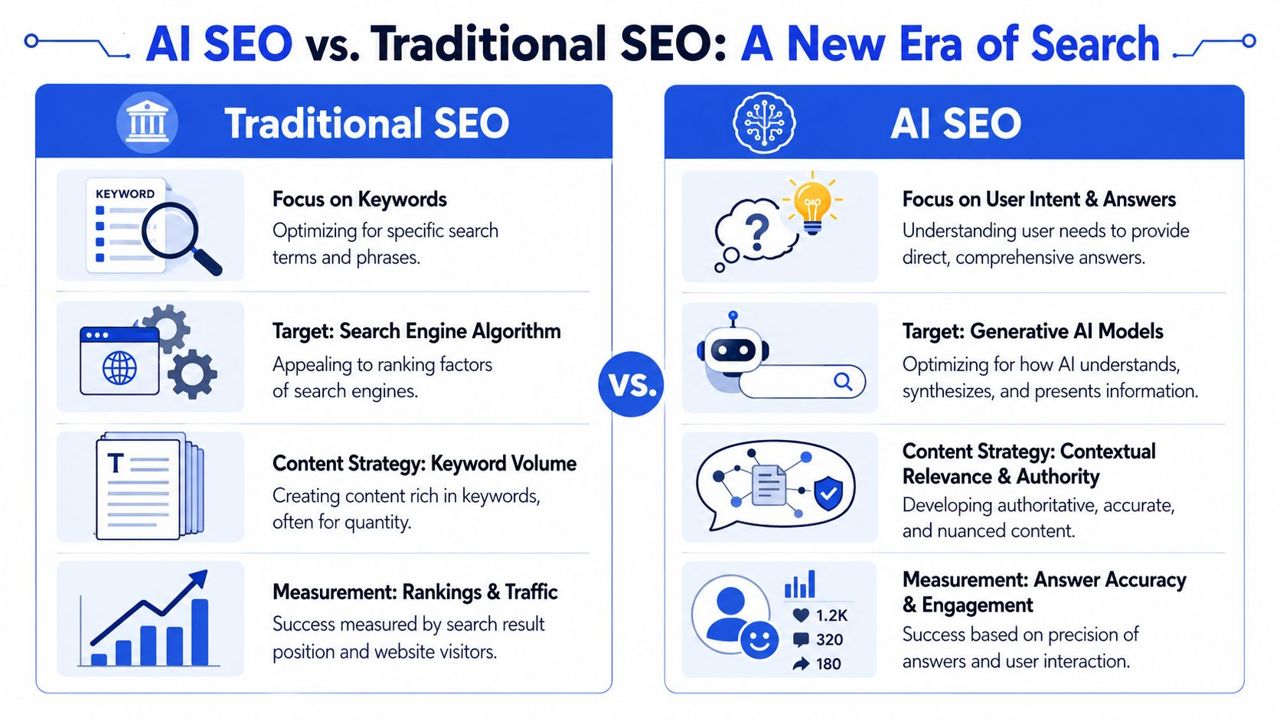
The core shift
Traditional SEO is built around rankings, snippets, and click acquisition. AI SEO is built around being selected as a trustworthy source in generated answers. There's overlap, but the emphasis changes.
Here's the simplest way to consider it:
| Area | Traditional SEO | AI SEO |
|---|---|---|
| Primary goal | Rank pages and earn clicks | Earn mentions, summaries, and citations |
| Optimization target | Search engine results pages | Generative answer systems |
| Content format | Keyword-led pages | Answer-led, structured, extractable pages |
| Authority model | Links, relevance, engagement | Entity clarity, consistency, credibility, structure |
| Success signals | Rankings, organic sessions, conversions | Citation presence, branded demand, referral quality |
What changes in execution
The tactical difference shows up fast when you audit a site.
A traditional SEO checklist may focus heavily on keyword mapping, title tags, backlinks, and internal linking. AI SEO still cares about those. But it asks harder questions:
- Can a model identify the exact service, product, or use case without guessing?
- Are the most important claims supported by clear page structure and consistent entities?
- Does the site present direct answers near the top, or bury them under brand copy?
- Can a machine confidently quote this page without misreading context?
For ecommerce brands, that extends into marketplace search too. Teams working on retail visibility should study optimizing for Amazon AI search because it highlights the same broader principle: systems that synthesize recommendations reward clean attributes, relevance, structured information, and product clarity.
What stays the same
Some teams overreact and assume AI search makes traditional SEO obsolete. It doesn't.
You still need:
- Crawlable, indexable pages
- Strong internal linking
- Useful content depth
- Relevant backlinks and mentions
- Fast, stable page experience
- Pages aligned to revenue intent
Strong SEO gives you the foundation. AI SEO determines whether that foundation can be quoted, summarized, and trusted inside generative results.
The businesses that will win aren't the ones abandoning search basics. They're the ones making their existing SEO assets more legible to AI systems.
Core Deliverables in an AI SEO Engagement
AI search optimization services should leave you with assets your team can review, ship, and measure. If a provider cannot point to page templates updated, schema deployed, crawler rules configured, and revenue pages rewritten for citation, the engagement is too abstract to justify budget.
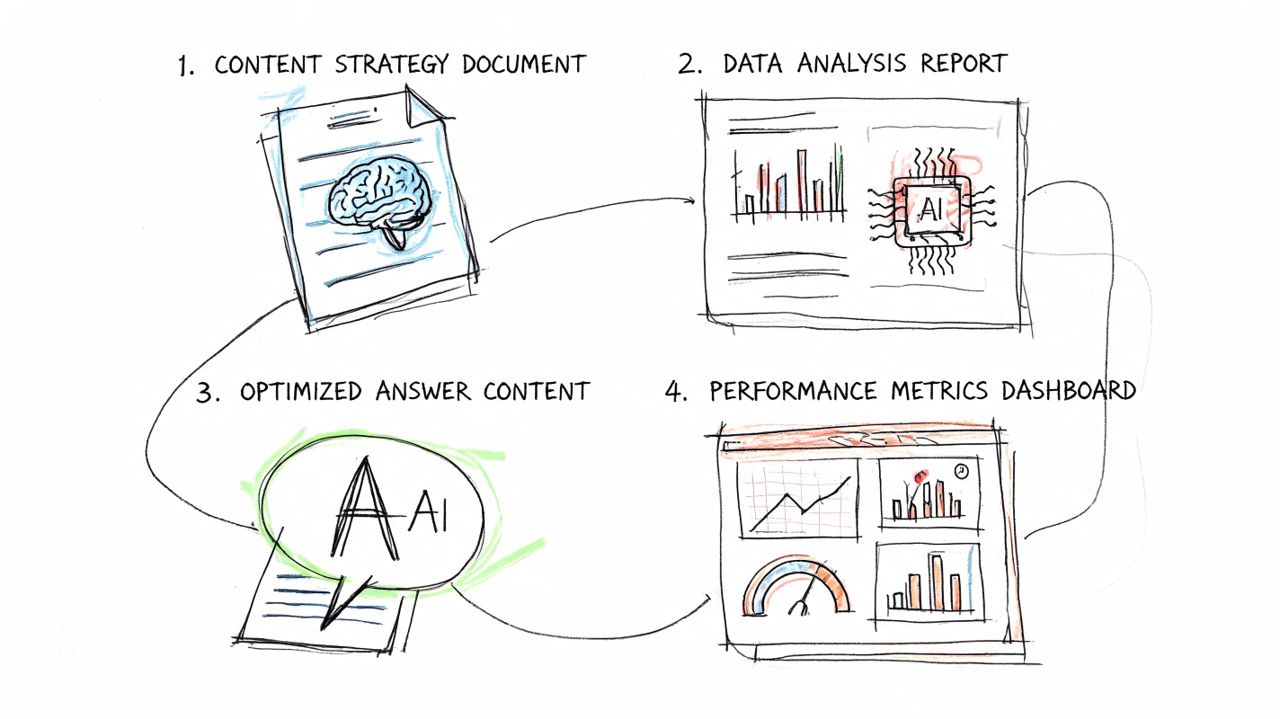
The best engagements also separate work by business model. An eCommerce brand usually needs cleaner product attributes, review markup, and comparison copy. A SaaS company needs use-case pages, integration pages, and proof-driven category content that models can quote without guessing. A local business needs location clarity, service specificity, and consistent business data across every local page.
Structured data that matches real page intent
Schema helps AI systems classify a page correctly. It does not fix weak positioning, vague copy, or unsupported claims.
The work that matters is template-level mapping. A serious provider identifies which schema belongs on each page type, validates the markup, and checks whether the visible content supports it. That last part gets skipped more often than it should.
Typical mappings look like this:
- Service pages: Service, Organization, FAQPage where the page answers recurring buyer questions
- Product pages: Product, Offer, AggregateRating, Review
- Local landing pages: LocalBusiness, Service, business hours, service area, and location details
- Editorial explainers: Article, HowTo, FAQPage if the page structure supports it
The trade-off is simple. More markup is not better markup. Inflated schema can create contradictions between what the page says and what the code claims, which makes extraction less reliable.
llms.txt and crawler control
Crawler access needs deliberate configuration. This is usually a fast way to tell whether you are dealing with an operator or a sales deck.
Professional providers use llms.txt and related crawler controls to shape what AI systems can access and summarize. Page One Power's analysis of AI search optimization notes that llms.txt paired with clearly structured schema can improve inclusion in generative responses, based on agency benchmarks.
What matters is not the file itself. What matters is whether it supports a real content strategy.
A proper setup helps teams:
- Allow access to pages worth citing
- Limit access to duplicate, thin, gated, or proprietary sections
- Guide crawler behavior where support exists
- Reduce extraction noise from low-value pages and utility sections
This explainer is worth watching if you want a visual overview of how AI search workflows fit together before implementation decisions start.
Entity optimization and source consistency
AI visibility often breaks because the brand entity is inconsistent. The homepage says one thing. Service pages use different terminology. Third-party profiles describe the company differently. That weakens confidence at the exact moment an AI system has to decide whether your page is a safe source to cite.
A real engagement usually includes:
- Business identity cleanup: company name, service descriptions, leadership references, and location details aligned across the site
- About and author credibility: clear expertise signals on pages where trust affects conversion
- sameAs and profile alignment: connecting the brand to major platforms and recognized profiles
- Internal entity reinforcement: linking service pages, location pages, FAQs, comparison pages, and supporting resources around consistent terms
For founders and CMOs, solo experts often outperform large agencies. A good specialist will spot naming conflicts, product taxonomy issues, and trust gaps quickly because they are close to the strategy. Bloated agency teams can turn simple entity cleanup into a long production cycle with little commercial impact.
Citation-friendly content structures
A page that ranks is not always a page that gets cited. Citation-friendly pages answer the query early, define the offer clearly, and present facts in a format that can be extracted without losing context.
Pages that perform well in AI summaries usually share these traits:
| Good structure | Weak structure |
|---|---|
| Direct answer near the top | Long brand-led intro |
| Specific subheadings | Clever but vague headings |
| Clear facts, use cases, and constraints | Dense, ambiguous copy |
| Service, audience, proof, next step | Broad claims with no support |
The business case for these services becomes evident. For eCommerce, better extractable product and category copy can improve visibility on high-intent queries before the click. For SaaS, tighter use-case and comparison pages can raise demo quality because buyers arrive with more context. For local businesses, cleaner service and location pages can increase qualified calls from users who discover the brand inside AI answers instead of ten blue links.
What I look for first: Can I pull a short, accurate answer from the page without needing the rest of the site for context? If not, the page usually needs rewriting before it needs more tooling.
Typical Workflow Pricing and ROI
Most worthwhile engagements follow a simple operating model. First comes the audit. Then prioritization. Then implementation. Then reporting against commercial outcomes.
A realistic workflow
The sequence usually looks like this:
Audit
- Review page templates, structured data, internal linking, entity consistency, and AI extractability.
- Identify which revenue pages are most likely to benefit first.
Roadmap
- Prioritize fixes by business impact, not by novelty.
- Separate technical blockers from content gaps and authority work.
Implementation
- Update schema, page structure, FAQs, entity references, and crawler controls.
- Rewrite or expand weak service, category, product, and comparison pages.
Reporting
- Track citation presence, referral patterns, branded search lift, lead quality, and assisted conversions where possible.
The ROI problem is real
This is the part many vendors avoid. ROI in AI search is still harder to benchmark cleanly than traditional organic search.
According to The Digital Intellect's review of AI search optimization services, few agencies provide benchmarked ROI metrics, and audits show only 20% to 30% of brands are “AI-ready.” That gap is important. It means there's real upside for early movers, but it also means buyers should be skeptical of overly precise revenue promises.
That doesn't make ROI unmeasurable. It means you need a practical framework.
What to measure instead of vanity visibility
Use a scorecard tied to business outcomes:
- Citation coverage: Are your core pages being referenced for high-intent prompts?
- Referral quality: Do visits from AI sources engage, convert, or assist pipeline?
- Lead source feedback: Are prospects mentioning AI tools, summaries, or “I saw your brand recommended”?
- Brand demand: Is branded search interest strengthening as citations improve?
- Sales enablement: Are your teams hearing fewer basic trust objections because buyers arrive more pre-qualified?
Pricing varies widely by scope, site complexity, implementation needs, and whether the provider is also handling technical SEO, content, and authority work. The useful question isn't “what's the average package.” It's “what work will get done, on which pages, by whom, and how will we judge whether it helped pipeline?”
How to Choose an AI Search Optimization Partner
The fastest way to waste budget is hiring a team that talks fluently about GEO, AEO, and LLMs but can't show operational depth. You don't need a futuristic pitch. You need an adult in the room who can audit a site, fix the right things, and report against business priorities.
Questions worth asking before you sign
Use these in a sales call:
Which pages would you prioritize first, and why?
If they can't identify your money pages quickly, they're probably selling a template.What schema would you implement on our core templates?
Look for clear references to Service, Product, FAQPage, LocalBusiness, Organization, and review-related markup where appropriate.How do you handle llms.txt and AI crawler governance?
If they dodge the question entirely, they may not do meaningful technical work.How do you assess entity clarity across the site and off-site profiles?
The answer should cover consistency, attribution, and business identity.How will you report progress if clicks don't tell the whole story?
A serious partner will discuss citations, referral quality, branded demand, and conversion assist patterns.
Agency versus senior solo specialist
This decision matters more than most buyers think.
According to Eyeful Media's discussion of AI search optimization, agencies often cost 3 to 5 times more, while solo senior specialists can offer more direct accountability and implementation access.
That doesn't mean agencies are bad. It means you should understand the trade-off.
| Model | Strength | Risk |
|---|---|---|
| Large agency | Broader resourcing and process coverage | Senior seller, junior delivery |
| Senior solo specialist | Direct expert access and tighter accountability | Capacity depends on scope and support network |
For many ecommerce, SaaS, and local businesses, the solo model works well because the job is less about headcount and more about judgment. You need someone who can decide what matters first, tie AI visibility to high-intent pages, and coordinate supporting work without burying the project in layers.
Don't buy “proprietary methodology” unless the provider can translate it into pages changed, markup added, entities clarified, and reporting you can actually use.
Red flags that should slow you down
- They promise fast domination across all AI platforms
- They focus on dashboards before implementation
- They can't explain the relationship between AI SEO and your existing SEO
- They sell broad audits but avoid page-level recommendations
- They talk about visibility without discussing leads, revenue, or commercial pages
The right partner should feel like a strategist with implementation discipline, not a trend consultant.
Quick Implementation Checklists for Your Business
Pages that shape buying decisions should get attention first. That is how AI search work turns into pipeline, booked demos, and revenue instead of another reporting layer.
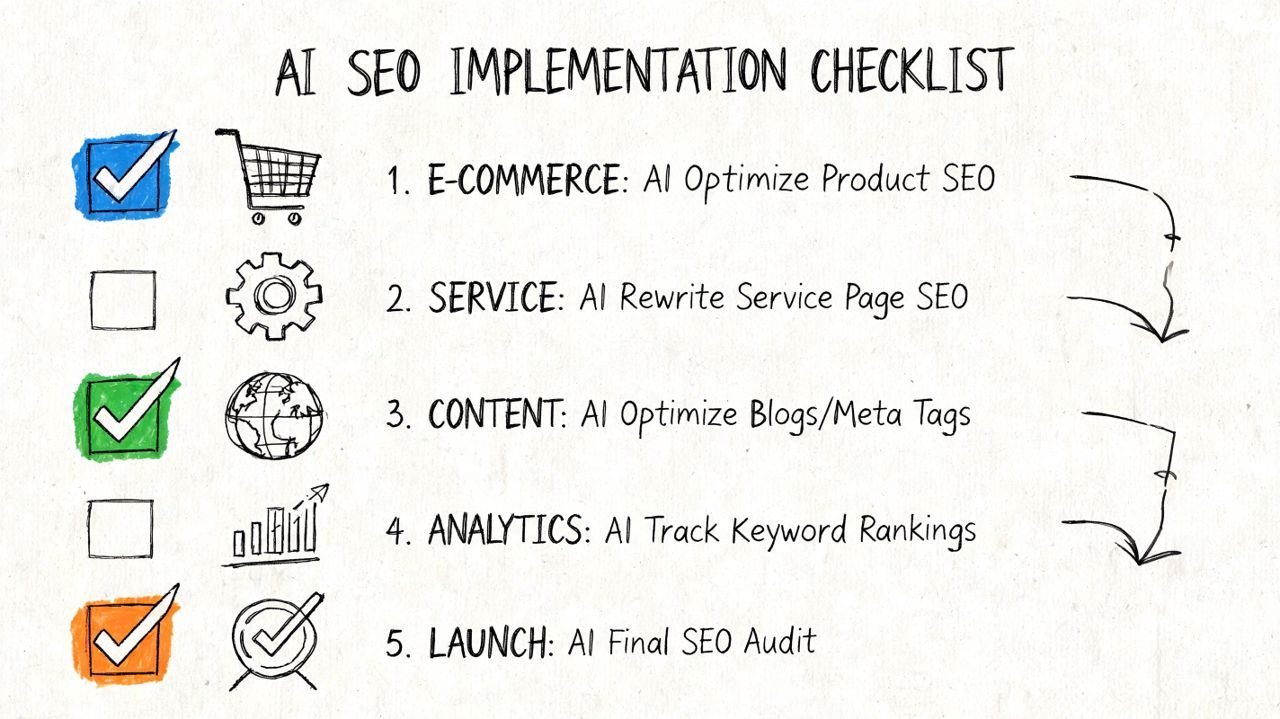
As noted earlier, stronger structured data and clearer page formatting can materially improve whether AI systems cite your pages accurately. The gain does not come from schema alone. It comes from making your commercial pages easy to interpret, easy to quote, and hard to misunderstand.
Use the checklist that matches your business model. Start with pages closest to revenue, then expand.
Ecommerce
AI visibility for ecommerce usually rises or falls on feed quality, product-page clarity, and comparison coverage. If product data is thin or inconsistent, AI tools have little reason to cite your store over marketplaces, review publishers, or manufacturers.
- Clean up core product schema: Use Product, Offer, AggregateRating, Review, BreadcrumbList, and ItemList where they fit the page type.
- Make product facts obvious: Put specs, sizing, materials, compatibility, shipping, returns, and availability in predictable page sections.
- Build comparison assets tied to purchase intent: Create pages for category comparisons, "best for" use cases, and product-versus-product decisions.
- Show proof on the page: Surface reviews, ratings, FAQs, and warranty details near the buying decision, not buried in tabs or lower-value pages.
- Prioritize high-margin and high-conversion SKUs first: AI SEO demonstrates its clearest ROI with these products.
SaaS
For SaaS, generic educational content rarely drives the best AI search returns. Feature pages, solution pages, integrations, migration content, pricing-adjacent pages, and competitor comparisons do.
- Audit your demo path pages: Check feature, solution, use-case, integration, and comparison pages before top-of-funnel blog content.
- Answer implementation questions directly: Use clear headings, short summaries, FAQ sections, and task-specific explanations buyers can quote.
- Clarify who the product serves: State the target team, problem, workflow, setup requirements, and expected outcome in plain language.
- Support claims with evidence: Add customer examples, screenshots, metrics you can substantiate, and integration details.
- Map pages to sales stages: Prioritize pages that influence demos, trials, and pipeline creation, not just traffic.
A practical test. If an AI assistant pulled two sentences from the page, would the buyer understand what your software does, who it is for, and why it is credible?
Local service businesses
Local businesses win AI visibility by removing ambiguity. The service, location, proof, and next step need to be explicit on every important page.
- Strengthen local business signals: Use LocalBusiness and Service schema. Keep your Google Business Profile, hours, phone number, and address details consistent everywhere you control.
- Upgrade service-area pages: Each page should explain the service offered, the geography served, the trust signals that matter locally, and the action you want the visitor to take.
- Put proof near commercial intent: Reviews, certifications, licenses, photos, response times, and insurance details should sit close to the contact or quote action.
- Differentiate locations properly: Do not publish near-duplicate city pages with swapped place names. Add real local detail, service differences, and proof.
- Start with your best-converting services: That keeps the work tied to calls, form fills, and booked jobs.
If you are deciding between a solo specialist and a larger agency for this work, use one filter. Ask who will directly change pages, fix structured data, coordinate content, and report against revenue pages. AI search visibility improves through execution, not presentation.
Frequently Asked Questions About AI SEO Services
Can an internal marketing team handle this without outside help
Yes, if the team already has strong technical SEO capability, content operations discipline, and development support. Most internal teams struggle when the work crosses departments. Schema, page architecture, entity cleanup, and reporting often sit with different owners.
How long does it take to see movement
Some improvements can show up quickly in how clearly your pages are interpreted and cited. Broader gains usually take longer because AI visibility depends on multiple factors working together, including page quality, authority, and consistency across the web.
Is AI SEO replacing traditional SEO
No. It extends traditional SEO. Rankings, crawl health, internal linking, useful content, and authority still matter. AI search adds a new requirement: your information has to be easy to summarize accurately.
What should a business do first
Start with the pages closest to revenue. That usually means service pages, category pages, product pages, solution pages, pricing-adjacent content, comparison content, and local landing pages. If those pages are vague, no amount of AI talk will save the strategy.
What's the simplest test for AI readiness
Review a key page and ask four questions:
- Is the main answer obvious near the top
- Is the page specific about what you offer
- Is there visible proof
- Can a machine quote two or three accurate statements without guessing
If the answer is no, the page needs work before the strategy gets more advanced.
If your team needs a practical roadmap for AI visibility, SEOBRO® can help assess where your revenue pages stand, what technical and content fixes matter first, and how to build a search strategy around qualified leads instead of vanity traffic.