Your content team did the work. The pages are optimized. The keywords are in the titles, headings, copy, and internal links. Yet competitor pages with looser keyword targeting keep appearing where your brand should be, especially in AI-driven search experiences.
That usually isn't a content effort problem. It's a retrieval problem.
Search systems no longer depend on exact phrase overlap alone. They increasingly evaluate whether a page is semantically close to the query, the task behind the query, and the entities connected to that task. That shift changes how SEO teams should plan content, build internal links, map pages to intent, and measure performance.
For B2B SaaS, eCommerce, local, and service businesses, this matters because high-intent visibility now depends less on repeating the right phrase and more on proving your page is the right answer. Vector embeddings for SEO are one of the clearest ways to understand that change. They also give you a practical way to audit where your content architecture supports revenue and where it subtly blocks it.
Introduction Your Best Content Is Already Invisible
A common scenario looks like this. A company publishes a strong commercial page, aligns it to a target term, adds supporting articles, and tightens on-page SEO. The page is relevant by every traditional checklist. Still, it loses visibility to pages that appear broader, more contextual, and more aligned to the underlying problem rather than the exact wording.
That isn't random. It's the result of semantic retrieval becoming more important in search.
If your SEO process still treats keywords as the main unit of strategy, you'll miss what search systems increasingly reward. A page can be well optimized and still be semantically weak. It can target the phrase but fail to connect to the related entities, use cases, subtopics, and intent signals that make it retrieval-worthy.
Practical rule: A keyword-perfect page can still underperform if search systems don't see it as the closest conceptual match to the query.
Vector embeddings begin to matter. Not as a buzzword. As a working model for how search engines and AI systems compare meaning across pages, queries, and entities.
For businesses, the opportunity is straightforward. If you understand semantic similarity well enough, you can improve content targeting, reduce cannibalization, strengthen internal linking, and build pages that are more likely to be surfaced, cited, or recommended. If you ignore it, you can keep publishing content that looks optimized in your CMS and remains weak in retrieval.
What Are Vector Embeddings A Practical Explanation
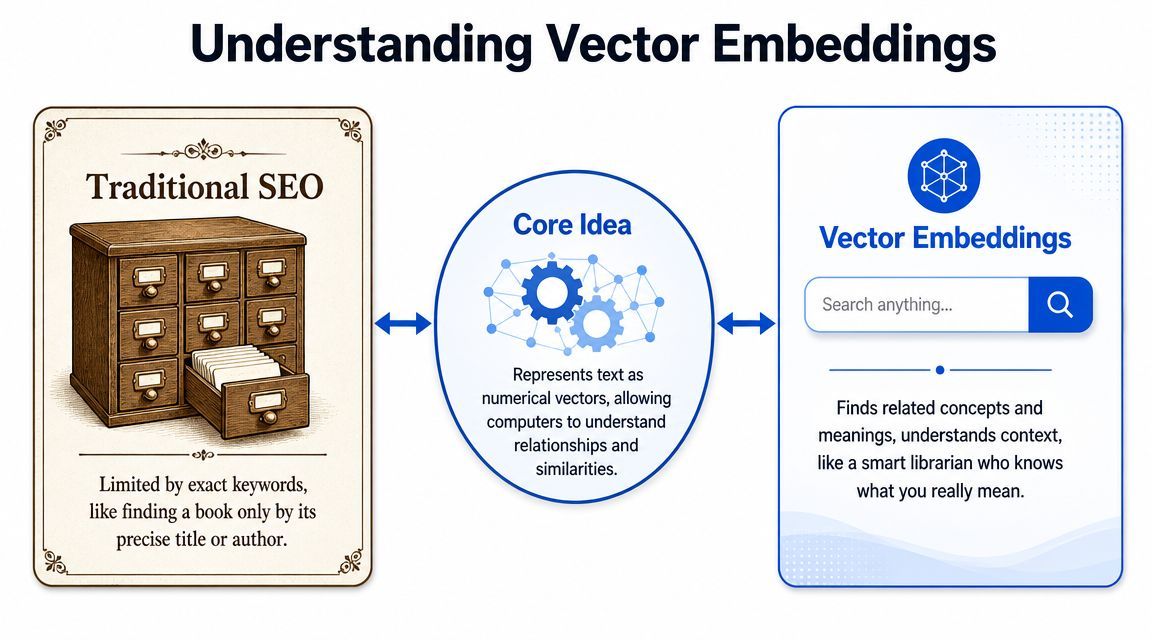
Traditional keyword SEO worked a lot like a card catalog. If the label matched, the system had a clear route to the page. If the wording shifted, the match became less reliable.
Vector embeddings work more like a strong librarian who understands what the searcher means, even when the wording changes. Instead of storing text as plain strings alone, a model turns text into a numerical representation in a high-dimensional space. That representation captures semantic relationships, which lets systems compare meaning instead of relying only on exact words. Lumar explains this clearly in its overview of semantic search and vector models in SEO.
Why keywords alone stop short
A person might search for "software for managing sales conversations" while your page uses "revenue intelligence platform." Those phrases don't match closely on the surface. Semantically, they may be related.
That difference is the point. Vector embeddings for SEO help explain why pages can rank, or fail to rank, even when classic keyword placement looks fine. Search systems can compare the embedding of the query against the embedding of a document and judge conceptual closeness.
This matters in everyday SEO work:
- Content gap analysis identifies missing concepts, not just missing phrases.
- Topic clustering groups pages by semantic relationship instead of folder structure.
- Internal linking improves when pages are connected by meaning, not just anchor repetition.
- Page targeting gets sharper because teams can evaluate whether a landing page matches the intended intent.
What proximity means in practice
When content pieces are close together in vector space, they are likely discussing related ideas. When they are far apart, they are conceptually weaker matches.
That gives SEO teams a more useful planning model than "does this page mention the term enough times?" It lets you ask better questions:
| SEO question | Traditional view | Embedding-driven view |
|---|---|---|
| Which page should target this query? | The page with the closest keyword match | The page with the closest semantic match |
| Which pages should link together? | Pages sharing similar words | Pages serving related intent |
| Where are our content gaps? | Missing keyword variants | Missing concepts and supporting entities |
Google's use of vector representations changes the optimization target. You're not only optimizing for phrase inclusion. You're optimizing for retrievability by meaning.
If you already work on search intent optimization, embeddings give you a stronger technical way to operationalize that work. Intent stops being a slide-deck concept and becomes something you can test against content relationships.
The New SEO Playbook Vector-Driven Strategies
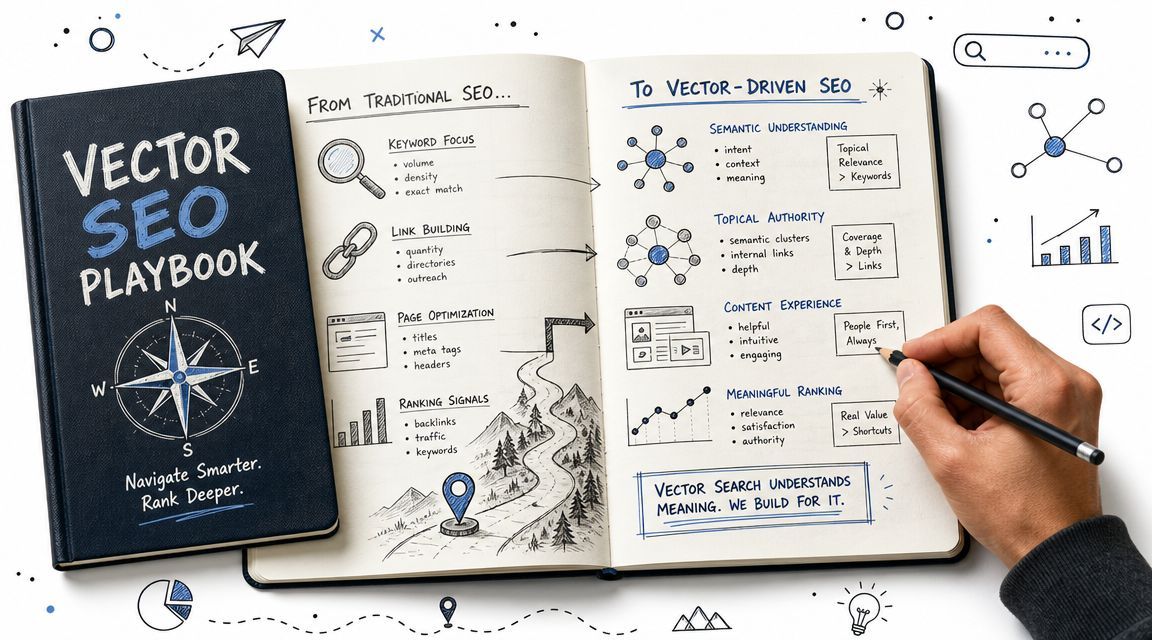
Embeddings don't replace SEO fundamentals. They upgrade how you execute them.
The biggest mistake I see is treating vector search as a side experiment for AI teams while the SEO team keeps using the same page-by-page keyword workflow. That split creates blind spots. Semantic retrieval affects core SEO decisions now, especially on larger sites with complex funnels, documentation, category structures, or location pages.
Build content around semantic coverage
Keyword maps still matter. But they don't go far enough when the core issue is incomplete conceptual coverage.
A strong workflow is to compare page embeddings against target query groups, adjacent commercial topics, and competing pages. That helps you see whether a page is thin in meaning even if it looks complete in copy length and on-page formatting.
Useful applications include:
- Cluster planning: Build topic hubs around semantically connected problems, jobs-to-be-done, and entities.
- Cannibalization review: Find pages that overlap conceptually, even when titles differ.
- Gap discovery: Spot missing support content that should reinforce money pages.
- Content pruning or consolidation: Merge pages that compete in the same semantic territory.
This is also where many AI visibility efforts break. Brands produce separate articles for tiny keyword variants, but they don't build a coherent knowledge structure. AI systems are far more likely to reward clarity and coverage than fragmented repetition.
For teams working on broader AI visibility, NanoPIM's guide to GEO is useful because it frames optimization around how generative systems retrieve and synthesize information, not just how search engines rank links.
Use meaning-based internal linking
Most internal linking programs are still too mechanical. They rely on exact anchors, manual judgment, or obvious navigational relationships.
Embeddings improve this because they surface pages that are contextually close, even when the wording differs. That makes internal links more useful for users and stronger for semantic site architecture.
A practical linking framework looks like this:
- Map commercial pages first. Start with product, service, category, and demo-driving pages.
- Find semantically adjacent support pages. Pull related articles, docs, FAQs, comparisons, and guides.
- Review link intent manually. Don't auto-insert links just because vectors are close.
- Strengthen journeys. Link informational pages to decision-stage pages where the user naturally progresses.
Internal linking works best when it reflects problem progression, not just keyword overlap.
Later in the process, this also supports answer-engine readiness. Structured, semantically coherent page relationships make it easier for systems to understand which pages are foundational and which pages provide supporting detail.
A good primer for that broader shift is this guide on AI search optimization services, especially if your team is trying to align classic SEO with AI discovery.
Plan for AI retrieval not just blue links
Embeddings are increasingly useful beyond standard rankings. Teams are using them for AI Overview citation analysis, competitor comparison, content recommendation systems, and retrieval layers connected to AI tools.
That doesn't mean every brand needs a full retrieval-augmented setup tomorrow. It does mean your content should be structured so AI systems can retrieve the right chunk, page, or answer.
This short video gives helpful context on how the broader shift is playing out:
The practical test is simple. If someone asks an AI system a high-intent question related to your business, does your site offer content that is semantically close, well structured, and easy to extract? If not, the issue usually isn't just authority. It's retrieval fitness.
Implementation Roadmap From Data to Search Results
Most companies don't need to become machine learning shops to use embeddings well. They need a disciplined implementation path.
The operational reality is straightforward. Search Engine Journal notes that embeddings are typically generated once, stored, and reused because generating them on demand is inefficient for sites with large content inventories. That pattern supports scalable SEO workflows such as semantic page matching and optimization analysis, as covered in this introduction to vector databases and AI for SEO.
Start with content quality and structure
Bad source content creates bad retrieval.
Before choosing any model or vector database, review the content itself. Product pages, service pages, help docs, blog posts, and location pages need clean structure and clear topical focus. If a page mixes several intents, weakens entity clarity, or buries key answers in fluff, embeddings won't rescue it.
Use this checklist early:
- Clean page purpose: Each important page should solve one primary search task.
- Reduce mixed intent: Split pages that try to rank for unrelated jobs.
- Preserve context: Keep headings, lists, and supporting details that clarify meaning.
- Standardize metadata: Titles, categories, template labels, and page types help later analysis.
- Version content inputs: If models change, you need a clear path to regenerate embeddings safely.
Unstructured guidance, referenced in the Search Engine Journal piece above, also emphasizes cleaning, enriching, and versioning metadata so teams can regenerate embeddings safely when models change. That operational discipline matters more than most SEO teams expect.
Store embeddings once then query them
Implementation then becomes useful rather than theoretical.
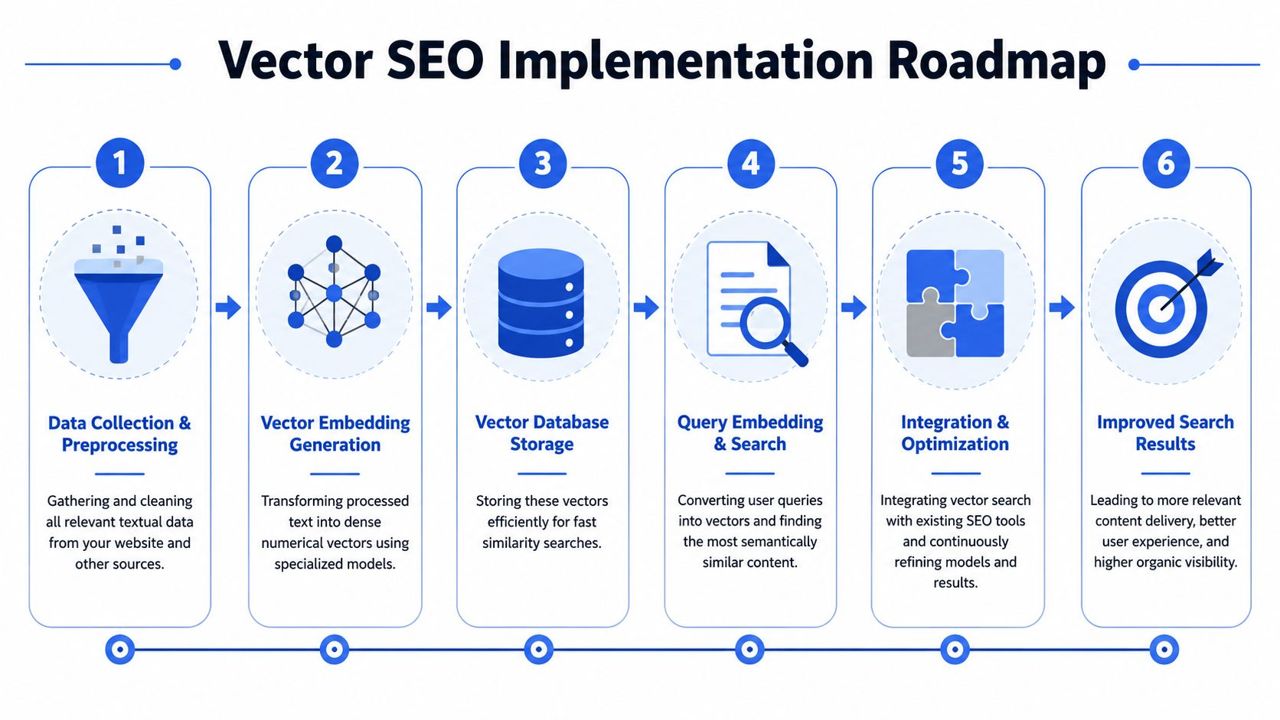
For a site with many pages, the usual pattern is:
- Export the content you want analyzed.
- Generate embeddings for each page or chunk.
- Store them in a vector database or similar retrieval layer.
- Compare target queries or prompts against those stored vectors.
- Review the closest matches for strategy decisions.
This supports practical work such as matching keywords to landing pages, checking whether the wrong URL is closest to a target intent, and identifying pages that should be linked, consolidated, or expanded.
A simple view of the workflow helps:
| Stage | What happens | Why it matters for SEO |
|---|---|---|
| Content extraction | Pull page content and metadata | Ensures the right inputs are analyzed |
| Embedding generation | Convert content to vectors | Creates semantic representations |
| Storage | Save vectors for reuse | Makes large-scale workflows feasible |
| Similarity search | Compare queries and pages | Finds closest semantic matches |
| Editorial review | Validate outputs | Prevents automation mistakes |
The technology is powerful. The judgment layer is still human.
Operational choices that affect outcomes
The tooling matters less than the decisions around it.
You can use commercial platforms, open-source components, or custom workflows. Pinecone and Weaviate are common names in this space. So are API-based embedding providers and self-hosted alternatives. The right choice depends on your content volume, privacy needs, engineering support, and whether the system is for internal SEO analysis, site search, or an AI-facing retrieval layer.
The trade-offs are usually these:
- Managed infrastructure: Faster to launch, easier for smaller teams, less control.
- Open-source stack: More flexible, more maintenance, better for technical teams.
- Chunking strategy: Larger chunks preserve context, smaller chunks can improve retrieval precision.
- Model changes: Better models may improve retrieval, but they can break comparability unless you reprocess consistently.
This is also where structured data still helps. Embeddings are not a replacement for schema, entity consistency, crawl control, or information architecture. They work better when your site already communicates clearly to machines.
If you're trying to connect semantic retrieval with broader AI visibility, this explainer on what AI optimization is is a practical next step. The overlap matters because the same clarity that helps vector retrieval often helps AI summarization and citation.
Vector SEO in Action Examples for Your Business
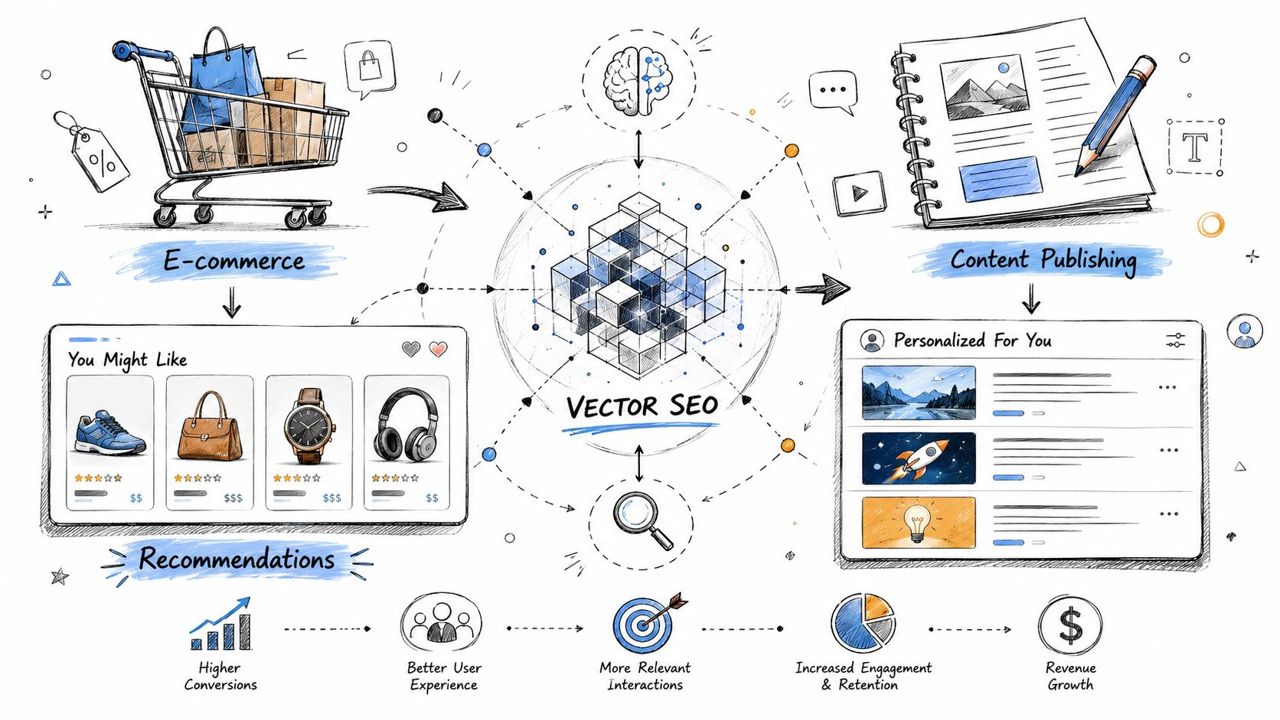
The business value of embeddings becomes clearer when you stop viewing them as abstract math and start viewing them as retrieval infrastructure.
eCommerce merchandising and discovery
An online store often has decent category SEO and weak product discovery. A shopper uses language around occasion, style, weather, or fit. The site architecture uses brand, material, or SKU naming.
Embeddings help bridge that mismatch. A retailer can connect queries and pages by meaning, not just category labels. That improves product recommendation logic, collection page support content, and internal linking between products, guides, and buying pages.
A practical example is linking "how to choose waterproof running shoes" to the category or product set that best matches the underlying intent, even if the exact product titles use different wording.
SaaS documentation and demo support
SaaS companies often separate marketing content from product knowledge so aggressively that users and search systems can't tell how they connect.
Embeddings can help surface the nearest support article, use case page, or feature explanation for a problem-focused query. That matters both for organic visibility and for self-serve evaluation. A prospect searching around reporting issues, integrations, onboarding friction, or workflow automation usually wants an answer tied to a product capability.
Good semantic matching can support:
- Docs discoverability: Better retrieval of help content from vague problem statements.
- Sales enablement: Stronger paths from educational content to demo pages.
- Feature clarity: Improved linking between pain-point articles and solution pages.
Local intent and service relevance
Local SEO isn't only about map signals and citations. It's also about matching nuanced service intent.
A local business might describe itself one way while customers describe the need differently in reviews, FAQs, and search behavior. Embeddings help connect those descriptions. That can strengthen service page planning, FAQ expansion, and review-informed content optimization.
A local page shouldn't only repeat a service term. It should reflect how people describe the problem, urgency, and outcome they want.
This is especially useful when building pages meant to earn both organic clicks and rich-result visibility. If you're refining pages for concise extraction, this guide on how to optimize for featured snippets complements the retrieval side well.
Measuring Success KPIs for Vector-Driven SEO
The hardest part of vector SEO isn't generating embeddings. It's proving what changed in business terms.
Wix's guidance on vector embedding and AI search makes an important point: the challenge isn't whether embeddings can identify semantic relationships, but which embedding-driven changes measurably improve demos, leads, or product-page visibility in an environment where AI Overviews can alter click behavior. Their analysis is worth reading in full in this piece on vector embedding and AI-search measurement.
What to stop overvaluing
Rank tracking still has value. It just can't carry the whole reporting model.
If you only monitor position changes for a fixed keyword list, you'll miss whether the right pages are being retrieved, cited, surfaced for broader intent variants, or contributing to assisted conversions. That's why teams can feel busy and still struggle to explain impact.
Old metrics become especially weak when:
- Clicks shift upward: AI interfaces answer more before the click.
- Page roles change: A support article may assist revenue without being a direct conversion page.
- Intent broadens: One page can gain value across many semantically related prompts.
What to measure instead
The better framework is mixed. Use search visibility data, semantic performance diagnostics, and business outcome metrics together.
A practical KPI set includes:
| KPI area | Better question |
|---|---|
| Citation visibility | Is our content being referenced or surfaced in AI-driven experiences? |
| Page-target alignment | Is the intended landing page the closest semantic match for core queries? |
| Cluster performance | Are topic groups contributing to leads, demos, or product visibility? |
| On-site search quality | Are users finding relevant answers faster with fewer dead ends? |
| Assisted conversions | Do semantically important pages influence pipeline, not just last-click traffic? |
If your reporting can't connect semantic improvements to revenue pathways, you don't have a strategy yet. You have an experiment log.
Conclusion Your Path to an AI-Ready SEO Strategy
Vector embeddings aren't a niche technical layer anymore. They reflect how modern retrieval works and why some pages outperform better-optimized competitors.
The strategic shift is clear. Teams need to build content around meaning, connect pages based on contextual relevance, and measure visibility with something more mature than a ranking snapshot. That takes technical coordination, editorial discipline, and better reporting. It also creates a stronger moat than chasing isolated keyword wins.
Businesses don't need to start by buying complex infrastructure. They need to identify where semantic mismatch is already costing them visibility, leads, or product discovery. From there, priorities become clearer.
If you're building internal capability, this practical guide on how to use AI for SEO is a useful companion read because it keeps the focus on workflows rather than hype.
For most companies, the sensible first move is a strategic SEO audit. Find the gaps in content architecture, page targeting, internal linking, and AI-search readiness, then build from there.
FAQs About Vector Embeddings in SEO
Do small websites need vector embeddings for SEO
Not always as a full technical stack.
A smaller site can still apply the thinking behind embeddings without building a custom vector database. The main value often comes from better content clustering, cleaner page intent, stronger internal linking, and reducing semantic overlap between pages. The concept matters before the infrastructure does.
Do you need a developer to use vector embeddings
For lightweight analysis, not necessarily. Some teams use third-party tools and exports for content comparison without deep engineering support.
For production use cases like semantic site search, large-scale retrieval workflows, or custom internal tools, developer support usually becomes important. The core question isn't "can marketing do this alone?" It's "which parts are strategic analysis and which parts are infrastructure?"
Are vector embeddings replacing keyword research
No. They make keyword research less literal and more useful.
Keywords still tell you how markets phrase demand. Embeddings help you understand how those phrases relate to intent, topics, entities, and existing pages. The strongest SEO programs use both.
How are vector embeddings different from entity SEO
They overlap, but they aren't the same.
Entity SEO focuses on clear recognition of people, places, products, brands, and concepts. Embeddings focus on semantic similarity and retrieval relationships. In practice, stronger entity clarity often improves the usefulness of semantic systems because the underlying content is less ambiguous.
Can vector embeddings help with AI Overviews and answer engines
They can support the kind of content architecture that makes citation and retrieval more likely. They don't guarantee visibility.
What helps most is clear structure, direct answers, strong topical coverage, consistent entities, and pages that accurately match the user problem. That's why semantic SEO and AI search optimization increasingly belong in the same strategy.
If you want a senior-level SEO partner to turn semantic search theory into a practical growth plan, SEOBRO® can help. The work starts with a focused audit, a realistic roadmap, and implementation priorities tied to leads, demos, and revenue rather than vanity traffic.