If you're looking at a giant keyword universe and a painfully small content team, you're in the same position as a lot of SaaS, eCommerce, and multi-location brands. You can see the demand. You can map the modifiers. You know there are pages you should have for locations, integrations, comparisons, use cases, inventory, and feature combinations. But producing them one by one is slow, expensive, and hard to maintain.
That's why programmatic SEO with AI has become attractive. Done well, it amplifies efforts in content production, internal linking, structured page creation, and search coverage. Done badly, it floods your site with thin pages, duplicate variants, broken variables, and index bloat that never turns into pipeline or revenue.
The business case is real. One industry white paper reports 30%–70% cost reductions, 3%–15% revenue increases, and article production costs falling from over $500 to as low as $50 with AI assistance, according to Gracker's white paper on AI and programmatic SEO. The trap is assuming speed is the strategy. It isn't. The strategy is building a scalable content asset that still deserves to rank.
The High-Stakes Game of Scaling Content with AI
Every serious content program hits a ceiling.
The SEO team has a backlog full of high-intent ideas. The commercial team wants pages for every product variant, every service area, every industry segment, every comparison query, and every search-intent cluster that buyers use before they convert. Manual production can't keep up, and the gap between opportunity and execution starts to show up as lost visibility.
Programmatic SEO with AI is the obvious answer, but it's also where weak systems fail fast. Teams see the publishing upside and ignore the governance problem. They automate copy before they validate search patterns. They generate pages before they structure the underlying data. They publish at scale before they decide what should never be indexed.
That's why the question isn't whether AI can help you create more pages. It can.
The harder question is whether those pages become a durable organic asset or a cleanup project.
Practical rule: If a page set can't survive manual review, it shouldn't survive automation.
Strong AI-assisted programmatic SEO works when each layer supports the next one:
- Search demand: the pattern has repeatable intent across many modifiers
- Data depth: each page has enough unique inputs to justify existing
- Template quality: the output reads like a real page, not a variable swap
- Editorial control: humans catch what the workflow misses
- Technical governance: only index pages that deserve crawl budget and authority
For a plain-English primer on the model itself, this overview of what programmatic SEO is is a useful starting point. The bigger issue for CMOs isn't the definition. It's whether the system supports revenue growth without creating long-term risk.
That's the standard worth using. Not page volume. Not prompt volume. Not how fast your team can hit publish.
The Foundation Discovery and Data Modeling
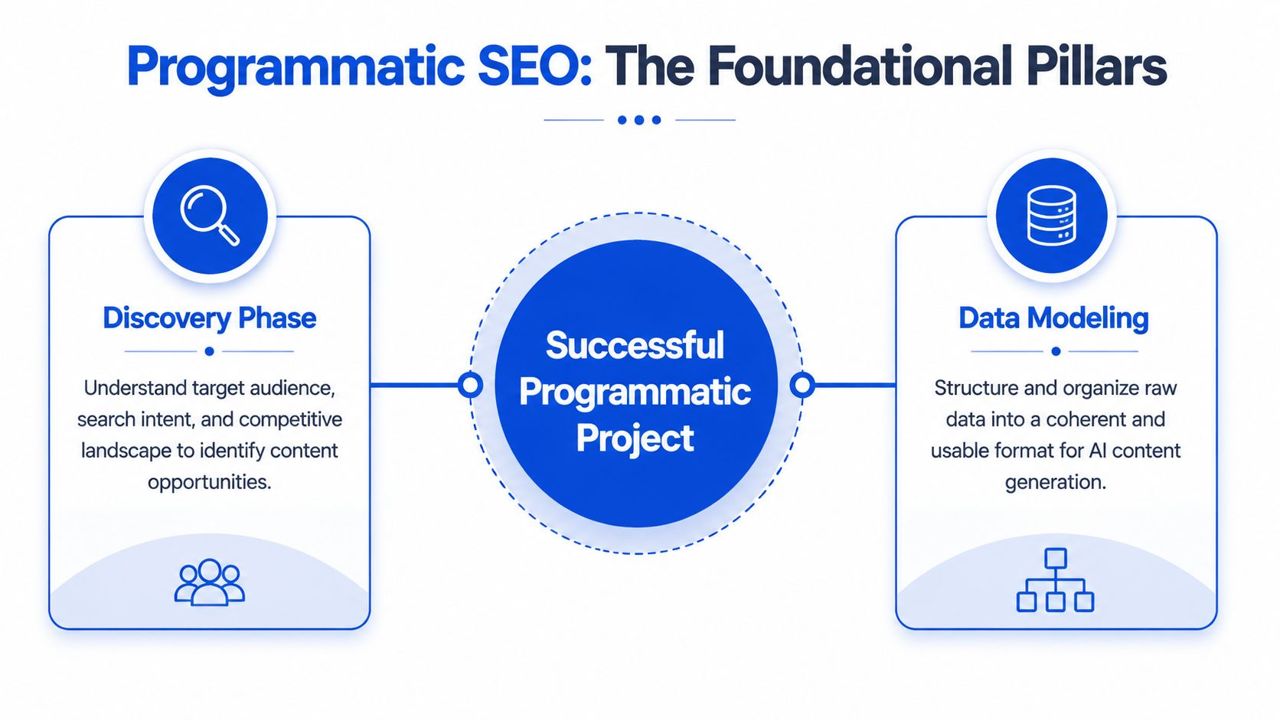
Most failed programmatic projects don't fail in production. They fail before content generation starts.
Teams usually blame AI quality, but the actual problem sits upstream. They chose the wrong query pattern, built on shallow data, or mixed search intents inside one template. Once that happens, no prompt can rescue the output.
Start with the query pattern, not the tool
A robust programmatic system has four core components: a structured dataset, a target keyword list, reusable page templates, and automation tooling. The workflow starts with validating a single query pattern before scaling, according to SEOPROFY's programmatic SEO framework.
That order matters. Keyword pattern first. Tooling later.
The best patterns are repeatable and commercially relevant. In practice, that often looks like:
- SaaS comparison patterns: [your product] vs [alternative], [feature] for [industry]
- eCommerce modifier patterns: best [product type] for [use case], [category] in [material/style/spec]
- Local patterns: [service] in [city], [service] in [neighborhood], cost of [service] in [location]
- Marketplace or directory patterns: [provider type] in [location], [category] for [audience]
The mistake is chasing a pattern just because it scales. A pattern only deserves scale if the underlying SERP expects the kind of page you can produce. If users want a deep comparison and you give them a generic landing page, you won't win just because you published more variants.
Good programmatic opportunities usually come from structured demand that already exists in your business model.
Build the dataset like a product system
The dataset is the core content engine.
If the row for each page contains only a keyword, a city name, and a short description, the output will be shallow. If the row contains product attributes, use cases, differentiators, local details, related entities, schema fields, and internal-link targets, the output becomes much harder to copy and much easier to expand.
A useful way to think about data modeling is to separate fields into layers:
| Layer | What it includes | Why it matters |
|---|---|---|
| Core entity data | product names, service names, locations, competitors, features | gives each page a unique subject |
| Commercial data | pricing notes, CTAs, availability, category relationships | aligns pages with conversion goals |
| Context data | buyer problems, use cases, industry fit, local specifics | makes pages feel relevant, not generic |
| SEO fields | title logic, H1 logic, meta descriptions, URLs, schema properties | supports scalable publishing |
| Relationship fields | parent hubs, related pages, comparison links | powers internal linking and discovery |
That structure also helps you decide what AI should and shouldn't write. AI can summarize, draft, and transform. It can't invent reliable differentiation for a weak dataset.
For teams planning product-led page sets, this guide to product page optimization helps frame which page elements should remain conversion-focused even when the workflow becomes automated.
A simple litmus test works well here. Remove the target modifier from three sample rows. If the remaining data still points to clearly different pages, the model is probably strong enough to build on. If everything looks interchangeable, the content will too.
The Blueprint Designing High-Value Templates and AI Prompts
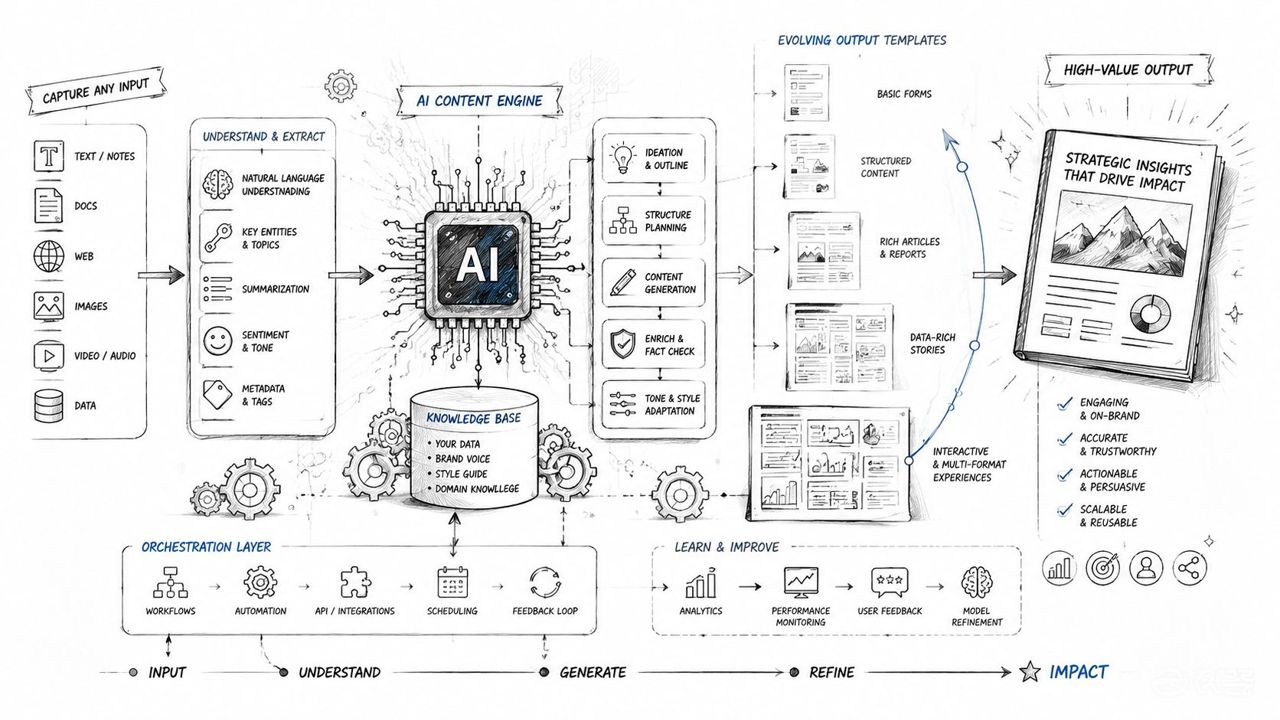
A template should behave like a publishing framework, not a mail merge file.
That distinction matters because most low-quality AI programmatic SEO fails at the template layer. The page technically exists, but every section feels interchangeable. Swap the city, competitor, feature, or product type and the copy barely changes. Search engines notice that. Users notice it faster.
What strong templates actually look like
The strongest templates mix three ingredients:
- Stable expert content that stays consistent across the page set
- Dynamic structured data pulled from the dataset
- AI-generated connective tissue that interprets the data in context
That creates a much better page than pure AI writing or pure variable insertion.
For example, an eCommerce template for best [product category] for [use case] might include:
- an expert-written introduction explaining the buying criteria for that use case
- dynamic blocks for specs, compatibility, material, or category filters
- AI-assisted copy that turns those inputs into readable recommendations
- internal links to category pages, product pages, and adjacent use-case pages
A SaaS comparison template for [your product] vs [competitor] works best when some sections stay fixed and opinionated. Buyers don't need another neutral rewrite of a homepage. They need a page that clarifies where one product fits better, where the alternative may still be stronger, and which feature differences matter by use case.
Local service templates usually break when they fake locality. Repeating the city name isn't local relevance. Local relevance comes from actual service-area details, nearby landmarks, neighborhood coverage, availability constraints, and service-specific intent.
The template should create room for judgment, not just room for variables.
Prompt design for pages that don't read like templates
Prompting for programmatic SEO with AI is less about clever phrasing and more about constraints.
A strong prompt usually tells the model:
- What role to play: editor, category specialist, comparison writer, local service strategist
- What inputs matter: only use provided data fields, don't invent unsupported claims
- What the section must do: explain fit, differences, trade-offs, or buyer guidance
- What tone to use: direct, commercial, expert, non-hyped
- What to avoid: repetition, filler, fake certainty, generic claims
For teams improving intent fit across template sets, search intent optimization is a useful companion process. If the page type doesn't match what the query needs, even the best AI output won't fix it.
Here's where many teams get this wrong. They ask AI to “write a landing page” or “create SEO content.” That's too broad. A stronger instruction is narrower and tied to the page's job.
Examples:
- eCommerce: explain why this product type suits a specific use case, using only the provided attributes and comparison notes
- SaaS: summarize practical differences between two products based on features, onboarding fit, integration depth, and buyer stage
- Local services: describe what customers in this area typically need, which services are most relevant, and what factors affect selection
A useful production habit is generating several variants of the same section from the same row, then choosing which prompt logic produces the cleanest, most specific copy. That process quickly reveals whether the problem is the model, the prompt, or the dataset.
The Production Line Content Generation and Quality Gates
At this juncture, programmatic SEO with AI either becomes a scalable asset or starts creating liabilities.
Publishing is easy. Quality control is the work.
A lot of teams still treat review as a final polish step. On a programmatic build, review is a core operating function. Without it, thin pages slip through, variables break in public URLs, schema fields mismatch the content, and the AI fills weak data gaps with vague language that adds no ranking value.
Why quality gates decide whether the program survives
One expert guide recommends a controlled rollout: publish an initial batch of 50 pages, wait for indexing and impressions, then scale to 100 pages per week and later 500 per week only after performance is confirmed. The same guidance warns against overnight launches and flags common failures such as thin content and broken variables left in the final copy, as detailed in Digispot's guide to programmatic SEO.
That recommendation is less about caution and more about diagnosis.
If you publish a limited batch first, you can inspect how the system behaves under real search conditions:
- Does Google index the pages?
- Do titles and canonicals render correctly?
- Do sections read naturally across edge-case rows?
- Are placeholders, null values, or “undefined” strings leaking into live pages?
- Do internal links point where they should?
The fastest way to kill trust in an AI-assisted content system is to assume the pipeline is clean because the sample output looked fine in a spreadsheet.
A short video can help show how this review mindset works in practice.
A review workflow that scales without losing control
The most reliable setup is a human-in-the-loop workflow with clear approval points.
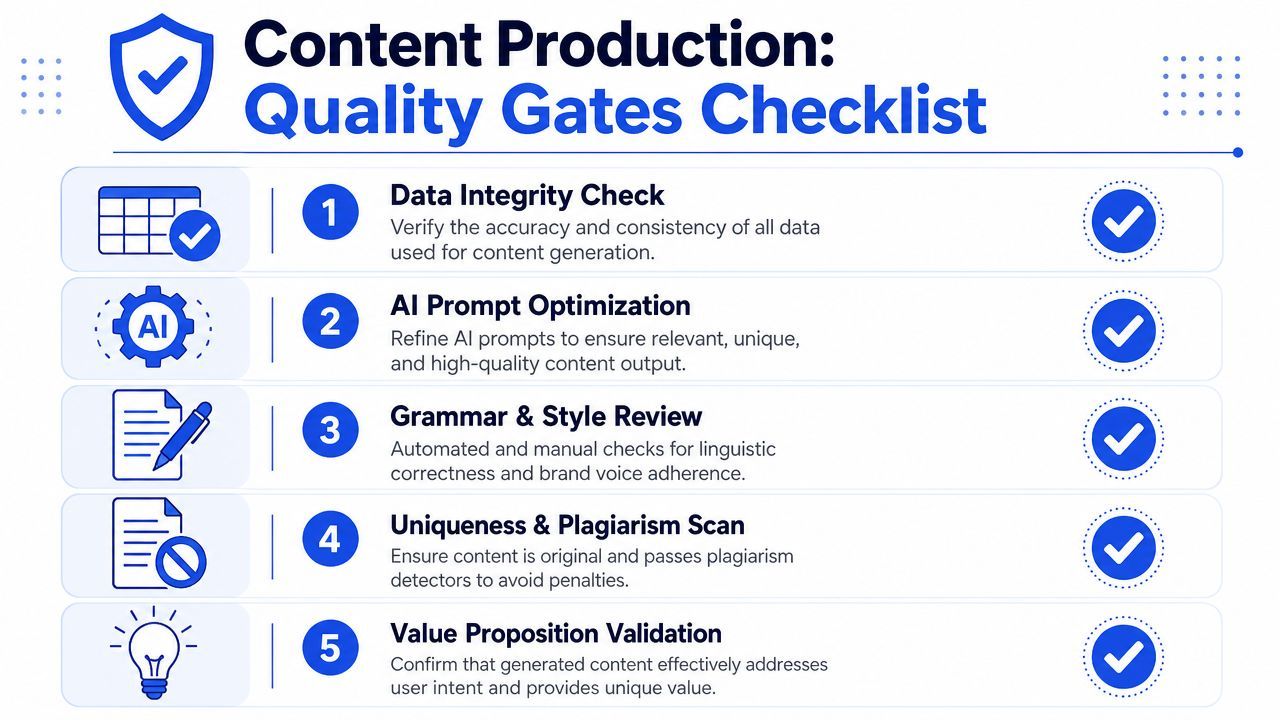
A practical review rubric usually checks five things:
- Data integrity: are the source fields complete, accurate, and mapped correctly?
- Intent fit: does the page satisfy the query type it targets?
- Content uniqueness: does it say something page-specific beyond the modifier?
- Brand and legal safety: are there unsupported claims, weak comparisons, or risky wording?
- Technical readiness: are schema, canonicals, headings, and internal links valid?
Don't review every word on every page. Review the failure patterns that repeat across page sets.
That means sampling across the batch, especially edge cases. Review rows with unusual names, missing fields, awkward competitor combinations, sparse local inputs, and long-tail variations that could expose template weaknesses. Those are the pages that reveal whether the system can survive scale.
Strong operators also keep a rejection log. If a page fails because the product data was incomplete, that's a dataset issue. If it fails because the AI repeated the same paragraph structure, that's a prompt issue. If it fails because the comparison format creates legal or brand risk, that's a template issue. Treating all errors as “content cleanup” hides the true bottleneck.
The Engine Automation and Publishing Pipelines
Once the foundation and review model are in place, the next job is connecting the moving parts without turning the workflow into a fragile mess.
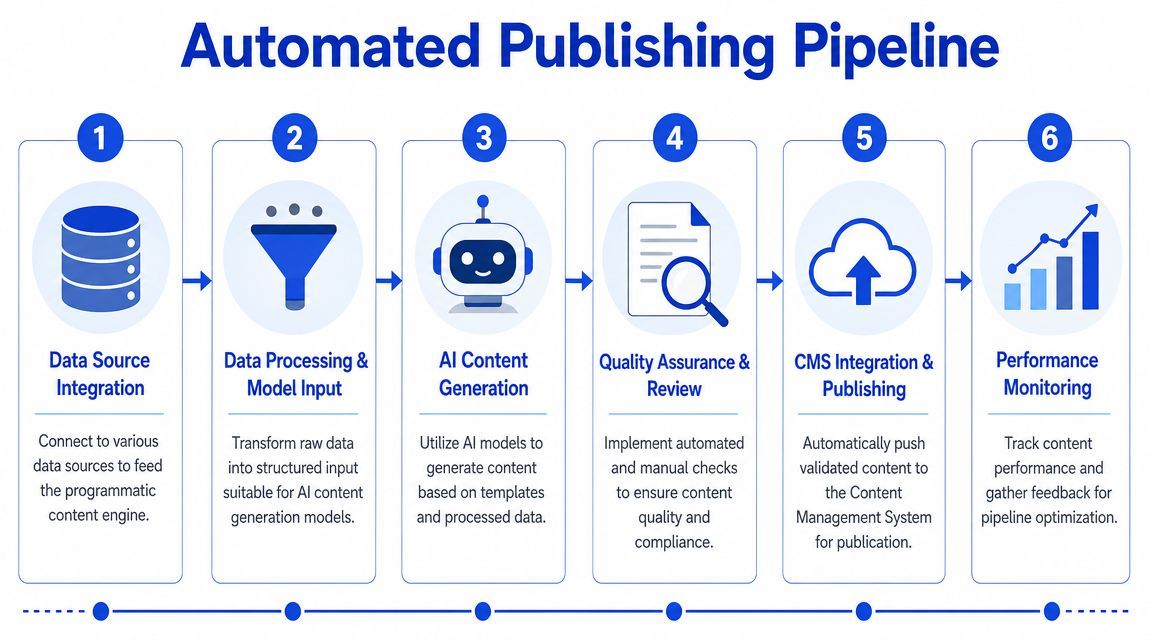
The stack doesn't need to be overbuilt. It does need clear ownership. Someone should know where the data lives, how prompts are triggered, where drafts are stored, who approves them, and what happens if a required field is missing.
A practical stack for smaller programs
For a smaller rollout, a simple architecture usually works:
| Component | Common options | Main job |
|---|---|---|
| Data source | Airtable, Google Sheets, Notion database | stores structured page inputs |
| Automation layer | Zapier, Make, lightweight scripts | moves data between systems |
| AI layer | API-based language model workflow | generates draft sections from templates |
| CMS | WordPress, Webflow CMS, headless CMS | receives drafts and publishes pages |
| QA layer | editorial checklist, manual approval queue | catches failures before publishing |
This model is often enough for early validation. It lets a team test one program, refine the data structure, and identify where manual review is still necessary.
For marketers thinking beyond content production, Sensoriium's B2B marketing blueprint is a useful reference for designing automation around approvals, handoffs, and repeatable workflow logic. That's especially relevant when SEO, content, product marketing, and development all touch the same pipeline.
What changes at larger scale
As the program grows, the weak points become obvious.
Draft storage gets messy. Field naming breaks consistency. Prompt versions drift. Editors start fixing the same issues manually because the system isn't learning from them. At that point, teams often move to a more durable setup with:
- A headless CMS for structured content management
- Webhook-based publishing to trigger generation and updates
- Serverless functions or custom scripts for validation and transformations
- Version control for prompts and templates
- Status flags such as draft, approved, rejected, noindex, and publish-ready
The important thing isn't choosing the fanciest stack. It's making sure the workflow supports revision loops.
A good automation pipeline doesn't just publish. It also supports reprocessing. If your product catalog changes, pricing notes shift, service areas expand, or a comparison page needs legal review, the system should update a page set cleanly. If every correction requires manual rewriting, you don't have an engine. You have a one-time generation script.
The Guardrails Technical SEO and Indexation Control
A large-scale page program without technical guardrails usually creates one of two problems. Either Google ignores most of it, or the site indexes too many weak URLs and dilutes its own authority.
Neither outcome helps revenue.
The core job here is deciding which pages deserve to be crawled, indexed, linked, and enhanced with structured data. That decision should be built into the system before you expand the page set.
Control crawling before you scale publishing
Programmatic sites often produce more URLs than they should expose.
That can include low-value combinations, duplicate filter states, near-identical variants, thin drafts, expired inventory pages, and support pages that were never meant to rank. If those URLs are crawlable and indexable by default, the site starts wasting crawl attention on pages with little business value.
A practical control layer usually includes:
- Canonical tags: use self-referencing canonicals on pages meant to rank, and prevent variant duplication where needed
- Meta robots rules: noindex page states that are too thin, too temporary, or not commercially useful
- Robots directives: reduce crawl access to low-value system paths and duplicate-generating URL patterns
- XML sitemap discipline: include only URLs you want search engines to prioritize
- Template conditions: don't publish or index a page when key fields are missing
For teams trying to improve readability and reduce the “generated” feel of scaled pages, how to humanize AI for content creators is a practical companion resource. It's useful when your pages are technically valid but still sound too synthetic to compete.
A page can be indexable and still not be worth indexing.
Build internal linking and schema into the system
Internal linking should never be an afterthought on a programmatic build.
If pages are isolated, Google has a harder time discovering and prioritizing them. If every template links only upward to a parent page, you miss the chance to create meaningful topical pathways. The strongest systems usually link in three directions:
- Upward to category, hub, or parent pages
- Sideways to related variants, alternatives, or adjacent use cases
- Downward to product, service, or conversion pages
That structure helps both discovery and user movement. It also makes template-level authority flow more intentional.
Schema works the same way. Don't add it manually after launch. Generate it from the same structured fields that power the page. Product pages should use product-relevant properties. Local pages should reflect local business or service context. FAQ blocks should only exist when the page answers those questions.
Google's guidance increasingly emphasizes helpful, reliable, people-first content and warns against scaled abuse patterns, as summarized in Swell AI's discussion of durable programmatic SEO. The takeaway is simple. Technical correctness matters, but it doesn't excuse weak page value.
For brands expanding into AI-facing discovery as well as traditional organic search, AI search optimization services offer a useful lens on why clear structure, entity clarity, and citation-friendly formatting matter beyond standard rankings.
The Dashboard Monitoring ROI and Governance
A programmatic SEO system should be measured like a portfolio, not like a blog.
That means looking at template performance, page-set performance, and business outcomes together. Traffic alone won't tell you whether the system is healthy. You need to know which page models attract qualified demand, which variants stall in indexation, and which sets influence leads, demos, or revenue.
Track templates, not just pages
The cleanest dashboard usually groups pages by template type or query pattern.
For example:
- comparison pages
- location pages
- use-case pages
- category modifier pages
- inventory or database-driven pages
Within each group, monitor:
- Indexation status
- Organic impressions and clicks
- Landing-page conversions
- Assisted conversions or influenced pipeline
- Pruning candidates
- Pages requiring enrichment
Governance moves from the theoretical to the practical realm. If one template family consistently attracts impressions but weak conversions, the issue may be intent mismatch. If another family indexes poorly, the page quality or crawl path may be weak. If a set converts well but remains small, that's the one to expand.
Governance is what keeps growth durable
A healthy program needs ongoing decisions, not just reporting.
Keep a simple operating cadence:
- Review live page sets regularly
- Prune weak or redundant URLs
- Enrich underperforming rows before expanding the template
- Update prompts when recurring quality failures appear
- Tighten indexation rules when edge-case pages slip through
The point of monitoring isn't to admire scale. It's to decide where scale still makes business sense.
When leaders ask whether programmatic SEO with AI is working, the best answer isn't “we published more pages.” It's “this page type is producing qualified organic entry points, this one needs refinement, and this one should stop expanding.”
Frequently Asked Questions About AI Programmatic SEO
Is programmatic SEO with AI considered spam
Not by default.
It becomes risky when pages exist only to cover keyword combinations without offering unique value. If the output is thin, repetitive, misleading, or built to manipulate rankings rather than help users, it moves into dangerous territory. If the system combines structured data, useful page-specific information, and human quality control, it can be a valid growth model.
What kinds of businesses benefit most from it
It fits best when a business already has structured entities that map to real searches. SaaS comparison pages, eCommerce category modifiers, marketplaces, directories, multi-location brands, and service businesses with repeatable location or use-case demand are common examples.
Can AI write the whole page
It can draft the whole page, but that doesn't mean it should own the whole page.
The strongest programs keep critical sections under tighter control. That includes product claims, positioning language, comparison logic, legal review areas, and conversion copy. AI is most useful when it transforms strong data into readable content, not when it invents value from a weak brief.
How many pages should you publish first
Start small enough to inspect closely.
A phased rollout is safer because it gives you time to validate indexing, content quality, template behavior, and internal linking before expanding the program. If the first batch exposes structural issues, you can fix them before those issues multiply.
What usually goes wrong first
Three issues show up early.
First, the dataset is too shallow, so every page reads the same. Second, the template overuses variables and creates awkward, repetitive copy. Third, technical controls are loose, so weak pages get indexed or broken fields reach production. Those failures are avoidable, but only if you treat governance as part of the build.
If you want to build programmatic SEO with AI as a revenue asset instead of a publishing experiment, SEOBRO® can help you evaluate the search opportunity, data model, technical guardrails, and rollout plan before scale creates cleanup work. A strategic SEO audit is often the right first step.