Most realtors already have a Google Business Profile. That's not the problem. The problem is that the profile is half-finished, controlled by the brokerage, missing the right category, or treated like a directory listing instead of a lead channel.
That's expensive.
When someone searches for an agent, a team, or a brokerage on Google, your profile often becomes the first impression before your website, before your listing portal presence, and before any referral call happens. If that profile is unclaimed, inconsistent, or weak, you lose trust before the lead even clicks.
A strong google business profile for realtors does three jobs at once. It increases discovery, clarifies who the business is, and converts local intent into actions like calls, website visits, and appointment requests. For real estate, that mix matters more than most service categories because so much of the buying journey starts with local trust.
Your Digital Storefront From Unclaimed to Unmissable
A Google Business Profile isn't just another citation. It's the most visible local entity record many realtors own.
That matters because local searchers act fast. Google data cited by CREA says 76% of people who search for a local business on their phone visit it within a day, and 28% make a purchase according to CREA's guidance on building a winning Google Business Profile. For realtors, the equivalent action isn't always a retail purchase. It's a call, a directions request, a site visit, or a booked consultation.
If you've ever wondered why one agent gets inbound brand searches and another gets ignored, GBP is often part of the answer. Google's local logic is commonly framed as relevance, distance, and prominence, and a neglected profile weakens all three.
What makes a weak profile costly
The profiles that underperform usually share the same problems:
- No ownership control. The listing was created by a brokerage admin, old assistant, or random user.
- Confused branding. The profile name, website, and phone number don't match the business people recognize.
- Thin trust signals. Few photos, stale updates, and no clear service coverage.
- Bad structure. Duplicates, wrong categories, or an address setup that doesn't match how the business operates.
Practical rule: If your profile would confuse a first-time buyer in ten seconds, it will also confuse Google.
What a strong profile does instead
A well-run profile helps you show up for category-driven discovery, reinforces your brand when someone Googles your name, and gives prospects enough confidence to act without visiting three other agent profiles first.
The shift is simple. Stop treating GBP as a setup task. Treat it like a local acquisition asset.
Initial GBP Setup and Verification Done Right
Setup is where realtor GBPs either become clean, scalable assets or future suspension cases.
The first job is ownership. Before editing categories, photos, or descriptions, confirm who controls the profile inside Google Business Profile Manager. I have seen agents spend months posting updates to a listing they did not own, only to hit a verification or access problem when they tried to change the phone number, website, or address settings.
A solid setup asset is worth reviewing before you touch anything:
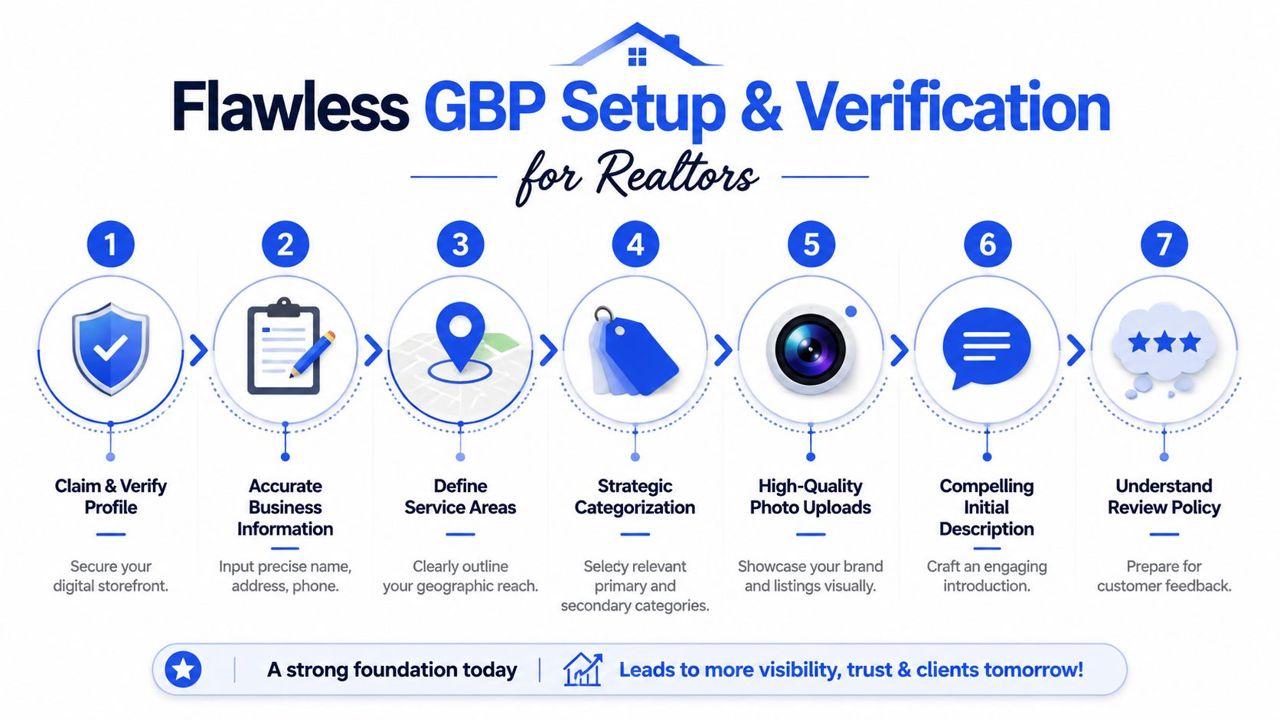
Claim before you create
For realtors, the right starting point is usually a search, not a fresh profile.
Look for existing listings under your personal name, team name, brokerage name, old phone numbers, and common brand variations. Google may already have a profile live from user edits, old brokerage setup work, or past marketing vendors. If you create a second listing before checking, you raise the odds of duplicate headaches, ranking dilution, and verification friction later. Jeff Lenney outlines that risk clearly in his guide to Google Business Profile setup for real estate.
Use this order:
- Search Google Maps and Search for every real-world name variation tied to the business.
- Claim the existing profile if a legitimate listing already exists.
- Confirm the business name matches offline branding exactly. No city modifiers or lead-gen phrases.
- Choose the closest primary category before filling out the rest of the profile.
- Complete the core fields so Google sees a real operating business, not a placeholder.
One bad decision here creates a long cleanup project. Duplicate practitioner listings are common in real estate, especially after brokerage changes, rebrands, or agent moves between offices.
Get verification details right the first time
Verification is not just a technical hurdle. It is Google checking whether the business can be trusted to represent itself accurately.
That means the name, category, website, phone number, and location setup need to line up before you request verification. If the profile says one thing, the website says another, and the signage or public branding says something else, you increase the chance of delays, re-verification requests, or suspension review.
For realtor profiles, the common trouble spots are predictable:
- Using a home address publicly when the business should be set as a service-area business
- Listing a desk or shared office that is not staffed the way Google expects
- Routing calls to a brokerage line when the profile is meant to represent an individual agent
- Using a landing page that does not clearly match the business name on the profile
- Requesting verification before removing old duplicates
Choose the structure that matches the business
Category and field choices need to reflect how the business operates.
A solo agent usually fits Real Estate Agent. A branded team often fits Real Estate Agency. A brokerage office may also use Real Estate Agency, but the supporting details should point to the office itself, not an individual producer. That sounds simple, but often many real estate profiles go off track. Agents set up team profiles with solo-agent signals. Brokerages create office listings that funnel to one agent. Google can still index that data, but it becomes harder for the system to understand which entity should rank for what.
Use this checklist during setup:
- Business name that matches public-facing branding
- Primary category based on the actual business entity
- Phone number answered by the person or team named on the profile
- Website URL that matches the profile entity, not a generic brokerage homepage unless that is the actual brand
- Service areas based on where business is done, not every city in the MLS
- Hours that reflect real availability or office operations
- Description written clearly for clients
- Services, attributes, and appointment link filled out with accurate operational details
This walkthrough is also useful for teams that need a visual process:
Many GBP problems blamed on ranking are setup problems. If Google is unsure who the profile represents, every later optimization works harder for a weaker result.
The Agent vs Brokerage Dilemma Structuring Your Local Presence
Here, most realtor GBP advice becomes too simplistic.
A solo agent, a branded team, and a brokerage office should not all use the same local profile strategy. The right structure depends on how the business is known offline, where direct client contact happens, and whether the location setup matches Google's eligibility rules.
Google's official guidance says businesses must represent themselves as they are known in the world, and only eligible businesses with direct in-person contact can have a profile. Service-area businesses can hide their address, but they still need to follow Google's representation and verification rules, as stated in Google's business profile eligibility guidelines.
Why this decision affects rankings and compliance
The wrong structure creates two problems at once.
First, it increases suspension risk. Second, it dilutes local authority because Google can't clearly tell whether the ranking entity is the brokerage, the team, or the practitioner.
A few common scenarios:
- An agent works from a brokerage office but wants a separate presence.
- A team operates under a brokerage brand but markets itself independently.
- A solo agent works from home and wants visibility without exposing a residential address.
- A brokerage has one office, but several agents try to create overlapping profiles.
The best approach is to align profile structure with business reality, not with whatever seems easiest in the dashboard.
GBP Structure Decision Framework for Realtors
| Structure Model | Best For | Address Handling | Key Challenge |
|---|---|---|---|
| Individual practitioner profile | Solo agents with a distinct client-facing presence | Use the real eligible location setup and hide the address if operating as a service-area business | Avoiding overlap with brokerage branding |
| Team profile | Established teams known separately from individual agents | Use the actual team location rules that match in-person operations | Preventing duplication with both agent and brokerage listings |
| Brokerage profile | Offices that serve as the central public-facing brand | Show the staffed office location when appropriate | Keeping agent-level visibility from cannibalizing office authority |
A practical way to decide:
Use an individual profile when
- Clients know and search for the agent by name.
- The agent has a distinct public identity.
- Contact flow should go directly to that practitioner.
- The listing can be represented accurately under Google's rules.
Use a team profile when
- The team has real brand recognition beyond one person.
- Lead routing belongs to the team, not a single agent.
- Marketing, reviews, and website assets are team-centered.
Keep the brokerage as the main profile when
- The office brand is the primary market-facing entity.
- Individual agents don't have clearly separate operations.
- The office wants one strong, centralized local presence.
If you need to explain the listing structure in a long email to Google support, the setup is probably too messy.
The trade-off is real. Separate profiles can increase visibility, but they also increase governance problems. More listings mean more chances for duplicates, inconsistent NAP details, split reviews, and internal competition. For many offices, one strong brokerage profile plus disciplined agent pages on the website is cleaner than a pile of weak practitioner listings.
Core Optimization for Discovery and Lead Flow
Most realtor profiles aren't losing because of one catastrophic mistake. They're losing because the profile is incomplete, underfed, and inactive.
GBP works best when you keep sending Google clear relevance signals. That means service areas, services, messaging, media, and ongoing updates all need to reinforce the same story about who you serve and where you work.
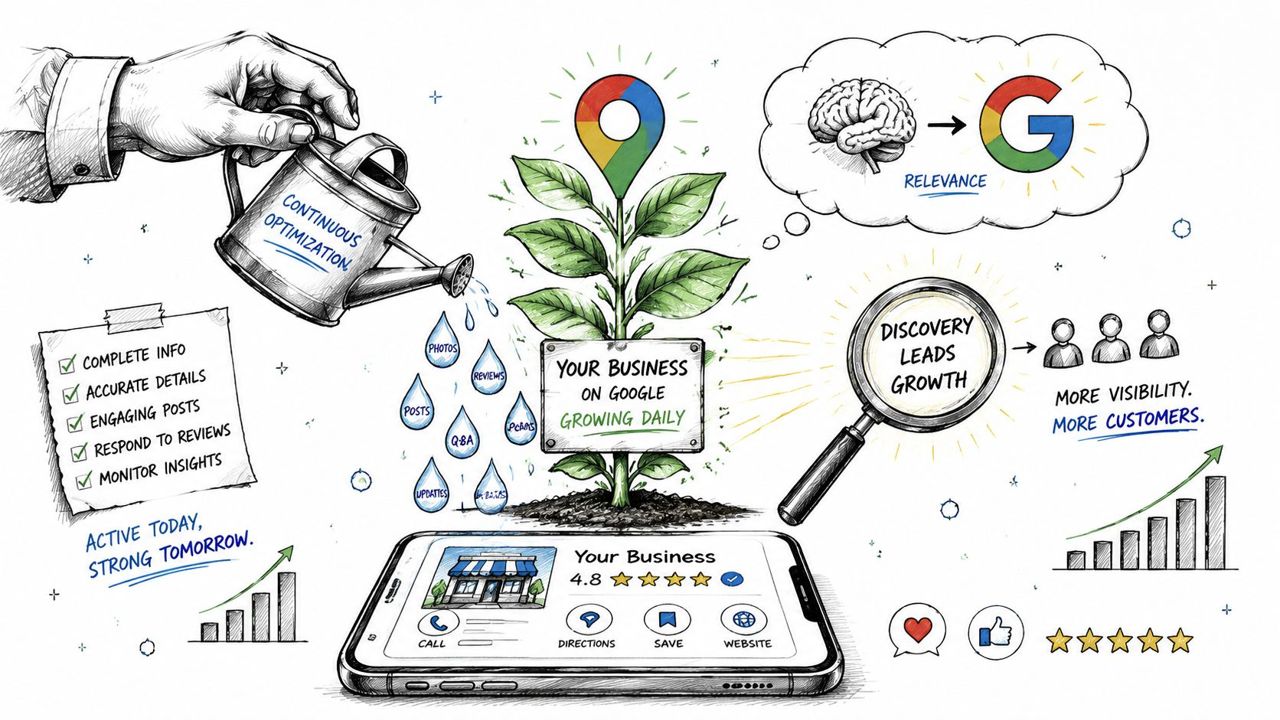
Feed Google complete local signals
Strong practitioner guidance for realtors recommends adding service areas tied to real client search patterns, turning on messaging, uploading substantial media, using Products and Services, and maintaining ongoing activity. The same guidance suggests a launch plan of roughly 25 to 40 photos, 2 to 3 short videos, and 10 to 20 Products within the first 30 days, based on the workflow shared in this GBP optimization tutorial for realtors.
That's the right mindset. Not “fill out a profile.” More like “build a living local asset.”
What to prioritize first:
- Service areas that reflect actual markets, neighborhoods, and client demand
- Services that describe what you do in plain language
- Messaging if you can respond quickly and consistently
- Photos and videos that make the business look active and credible
- Appointment links that reduce friction for high-intent prospects
What strong profiles keep updating
The best local profiles keep publishing evidence.
That evidence can include new listing photos, neighborhood visuals, sold property highlights, market updates, team photos, and service descriptions that match the language clients use. A profile with regular activity reads like a real business. A profile with no changes reads abandoned.
Here's where many agents miss an opportunity. Your website and your GBP should reinforce each other semantically. If you're expanding the profile's services and local language, your site should support that with structured data and local landing pages. If you need a clean implementation reference, this schema markup guide for agents is a useful companion resource for aligning on-site entity signals with local profile data.
A few things that usually don't work:
- Broad service areas that say everything and signal nothing
- Thin photo galleries with generic office images only
- Messaging turned on without response discipline
- Descriptions that sound like ad copy instead of business information
Treat every field as a signal, not decoration. Google reads the profile as structured business data long before a prospect reads it as marketing.
Building a Content and Reputation Engine
A realtor can have a well-structured profile and still lose leads every week.
The usual pattern is easy to spot. The profile has decent basics, a handful of old reviews, maybe a few listing photos from months ago, and no real signal that the business is active right now. In local search, especially for real estate, inactivity reads as low confidence. That matters even more as Google and AI-driven search systems pull local recommendations from freshness, sentiment, and business detail, not just category fit.
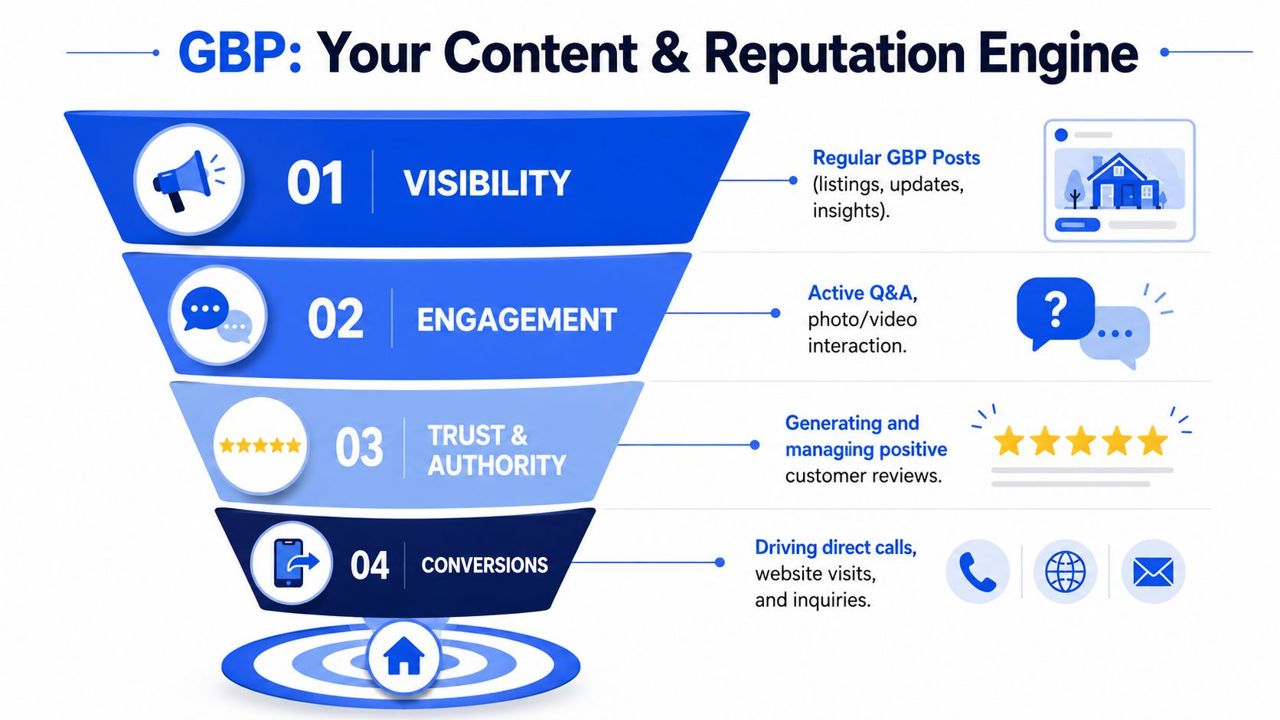
Posts, reviews, and conversion paths work together
For agents and brokerages, content and reputation should run as one operating system.
Reviews build trust. Posts and fresh media show that the business is active. GBP features such as appointments, services, Q&A, and messaging reduce the number of clicks a prospect needs to take before starting a conversation. Used together, those elements help the profile do more than rank. They help it convert.
I tell realtor teams to look at GBP the way they look at open houses. Traffic alone means very little. What matters is whether the right people show up, see enough proof, and take the next step.
A prospect often makes a decision in a fast sequence:
- category and service match
- review quality and recency
- photos that reflect current market activity
- an easy path to call, message, or book
Weakness in any one of those steps can send the lead to another agent.
A practical publishing rhythm
Random posting does not build momentum. A repeatable publishing system does.
For most real estate businesses, one to three meaningful updates per week is enough if the content reflects actual work in the market. That usually includes:
- Listing and sold updates with short context about the property or buyer need
- Neighborhood spotlights tied to areas you want to be known for
- Market observations based on what clients are asking right now
- Buyer and seller FAQs that remove friction before contact
- Team or brokerage activity that shows the business is present and responsive
The trade-off is simple. Promotional posts are easy to publish but tend to blend in. Specific posts tied to neighborhoods, property types, and real client questions take more effort, but they create better local relevance and better conversion signals.
Individual agents and brokerages should also avoid publishing the exact same content across every profile. If a brokerage has multiple offices or practitioner listings, duplicate posts weaken differentiation. Each profile needs its own local evidence, its own review base, and its own conversion path.
Reviews need process, not occasional effort
Realtors who collect reviews only when they remember usually end up with long gaps, uneven quality, and a profile that looks neglected.
Set review requests around milestones. After a closing, after a successful lease, after a smooth relocation, or after a buyer consult that clearly delivered value. Ask while the experience is still fresh. Give clients a simple path. Then respond to every review with enough detail to reinforce what future prospects should notice, communication, market knowledge, negotiation support, responsiveness, or neighborhood expertise.
Specificity matters here. A response that says "Thanks so much" does very little. A response that mentions helping a family relocate into a specific area, or handling a difficult listing timeline, adds context that both users and search systems can interpret.
For brokerages, review governance matters even more. If the brand profile gets all the requests while top-producing agents receive none, the brokerage may build brand authority but lose practitioner-level trust. If every agent pushes reviews to individual profiles only, the brokerage listing can remain weak. The best setup matches the profile structure you chose earlier and asks for reviews accordingly.
Build the conversion path inside the profile
A strong GBP should answer the prospect's next question before they leave Google.
Connect the features that fit your workflow:
- Appointment links for buyer consultations, listing presentations, or valuation calls
- Messaging only if someone can answer quickly and consistently
- Services that clearly describe seller representation, buyer representation, relocation, investment help, or local area specialization
- Q&A seeded with real pre-sale questions your team hears every week
This is also where brokerages can separate themselves from solo agents. A brokerage profile can support recruiting, office-level visibility, and branded trust, but it still needs lead paths tied to real consumer intent. If that broader marketing system needs work, this actionable marketing blueprint for brokerages is a useful reference.
A profile that keeps earning reviews, publishing proof, and making contact easy stops acting like a directory listing. It starts acting like a lead source.
Integrating GBP into Your Broader SEO Strategy
A realtor profile can rank well and still underperform as a business asset if it's disconnected from the website, citations, and local content strategy.
The goal isn't only to make GBP stronger. The goal is to make Google more confident that your profile, your website, your citations, and your local content all describe the same business entity.
Entity consistency beats isolated optimization
That starts with NAP consistency and representation discipline.
Business name, address approach, phone numbers, and linked website pages should align across your GBP, your site, major directories, brokerage pages, and social profiles. When those signals drift, local trust gets weaker. When they reinforce one another, rankings and conversion quality usually improve together.
The same applies to category alignment and service language. If your profile says one thing and your website says another, Google has to resolve that ambiguity.
Use your website to support what GBP can't fully explain:
- Location pages for neighborhoods or service areas
- Bio or team pages for practitioner clarity
- FAQ pages that answer repeated pre-sale questions
- Schema markup that strengthens entity understanding
Turn GBP demand into website assets
Your profile also gives you demand clues. The services you add, the neighborhoods prospects mention, the questions they ask, and the kinds of photos that reflect real market activity can all inform new site pages.
For brokerages building a wider local growth system, this actionable marketing blueprint for brokerages is a useful reference for connecting local visibility with broader digital execution.
Two important trade-offs to keep in mind:
| SEO Move | Upside | Trade-off |
|---|---|---|
| Create neighborhood landing pages | Supports long-tail local intent and reinforces service areas | Needs original, credible local content |
| Standardize citations | Strengthens entity consistency | Requires cleanup work across old profiles and directories |
| Add schema on key pages | Improves machine-readable clarity | Must match visible business details exactly |
If you want GBP to become a major lead source, don't optimize it in isolation. Tie it to on-site content, local trust signals, and structured business data.
Frequently Asked Questions for Realtors
Can a realtor have a personal GBP and also appear under a brokerage
Yes, but only when the setup reflects real-world operations and stays within Google's eligibility and representation rules. The key question isn't “Can I create another listing?” It's “Does this listing accurately represent a distinct practitioner or business presence?”
If the brokerage is the main public-facing entity and the agent doesn't have a separate, client-facing operating presence, a separate profile can create duplication and confusion.
Should realtors show their home address on GBP
Not always.
If the business operates as a service-area business and the address shouldn't be public, hiding the address may be the better route. What matters is that the setup remains accurate, verifiable, and compliant with Google's rules. Don't show an address just because competitors do. Don't hide one just because it feels easier either.
What category should a realtor choose
For a solo practitioner, Real Estate Agent is typically the best primary category. For teams, Real Estate Agency is often the better fit. Category selection should reflect the actual business model, not an SEO fantasy.
Don't overcomplicate secondary categories. If they don't clearly describe a real service line, leave them out.
How often should a realtor update GBP
Often enough that the profile looks maintained, current, and responsive.
In practice, that usually means updating media, publishing posts, reviewing service areas, checking contact routes, and responding to reviews on an ongoing basis. A static profile tends to become inaccurate long before the owner notices.
The best GBP maintenance rhythm is the one your team can actually sustain. Consistency beats occasional bursts of activity.
How does GBP help with AI-driven search
This is one of the biggest reasons GBP matters more now than it did a few years ago.
Recent industry guidance around real estate profiles points to a broader shift. AI Overviews and conversational search rely on structured, clear, and consistent entity information, and the opportunity for realtors is to align GBP data such as services, neighborhoods, and FAQs so it supports both classic local rankings and newer AI-mediated discovery, as discussed in this guide to Google Business Profile for realtors and AI visibility.
In plain terms, AI systems need clarity. They need to understand:
- who the business is,
- what services it offers,
- where it operates,
- and how those signals are confirmed across the web.
That means the future of google business profile for realtors isn't just more reviews or more photos. It's better entity definition.
Can one profile rank everywhere in a metro area
No profile can fully overcome proximity. Google's local systems still care about how physically close the business is to the searcher, which is why broad “I serve the whole region” setups rarely win on their own.
A better strategy is to strengthen neighborhood relevance and prominence around the places you serve, then support that with location-specific pages and citation consistency.
What should realtors avoid doing on GBP
Avoid tactics that create short-term noise and long-term risk:
- Keyword-stuffed names that don't match real branding
- Duplicate listings for the same person or team
- Weak address logic that doesn't match how the business operates
- Set-and-forget management where nothing gets updated
- Inconsistent links and phone numbers across web properties
If you want a broader view of how GBP fits into local organic growth, this guide to dominating local search is a helpful supplementary read.
If your Google Business Profile is live but not producing consistent local leads, it's usually a strategy problem, not a platform problem. SEOBRO® helps local businesses build revenue-focused SEO systems that connect GBP optimization, technical cleanup, local content, citations, and AI-ready entity signals so search visibility turns into qualified inquiries, not vanity metrics.