A familiar frustration sits inside a lot of SEO reports. The page ranks well, the query is relevant, the buying intent is there, and yet a competitor owns the answer box above the standard results. Your team did the hard part by getting onto page one. Someone else is collecting the extra visibility, more authority, and often the better click.
That gap matters most when the query sits close to revenue. If the search is about pricing, implementation, comparisons, qualification, or a task tied to product use, losing the featured snippet means losing an advantage at the exact moment the prospect is deciding what to do next.
The mistake is treating featured snippets like a universal content tactic. They aren't. The better play is to prioritize pages that already rank well, then build snippet-ready answers around high-intent questions that can lead to demos, signups, calls, or product-page visits rather than broad awareness queries, as discussed in this industry discussion on conversion-focused snippet targeting.
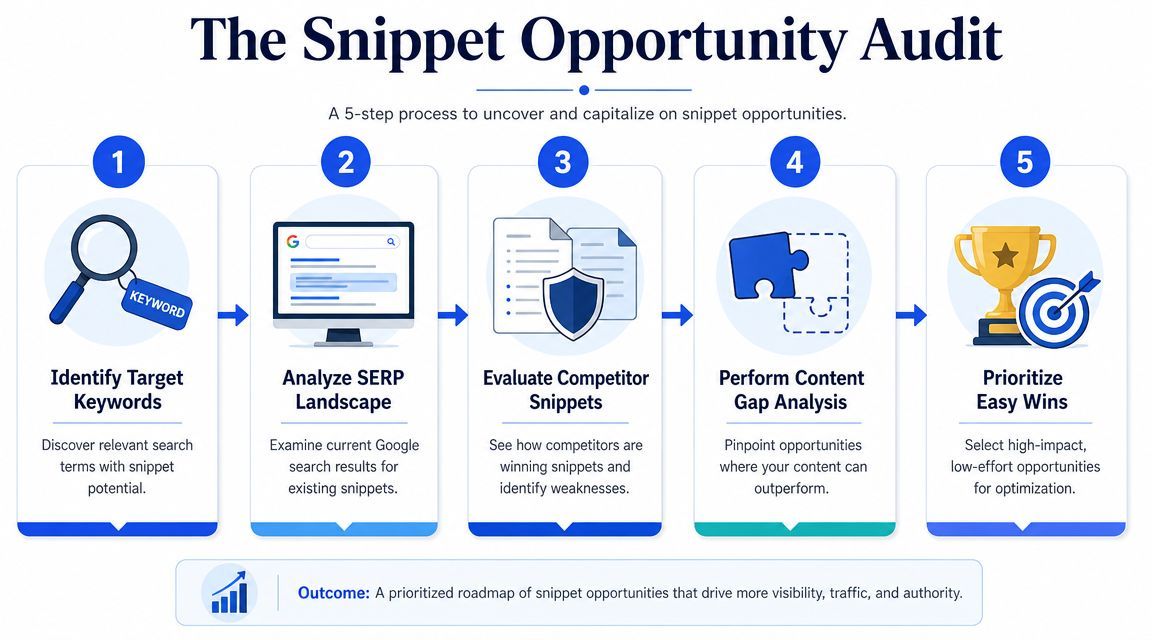
The Snippet Opportunity Audit Find Your Easiest Wins First
Starting with content production often leads to wasted time. The faster path is an audit. Find the queries where you're already visible, where Google already shows a snippet, and where the search has some commercial value if you win more attention.
Industry guidance is consistent on one core point. Featured snippets are a page-one opportunity, and the strongest candidates are usually pages already ranking well, especially positions 2 through 5 according to GetStat's featured snippet guidance.
Start with pages that are already close
Pull a list of keywords from Ahrefs, Semrush, or Google Search Console where your page is already on page one. Then narrow further:
- Prioritize snippet-triggering SERPs: Search the query manually and confirm that Google currently shows a featured snippet.
- Look for format clues: Is the current result a paragraph, a list, or a table? That tells you how Google wants the answer packaged.
- Check current ownership: If a weaker page owns the snippet, that's often a practical opening.
- Ignore non-competitive vanity terms: If your page isn't credibly in the running, snippet edits won't rescue it.
If your team needs a better workflow for monitoring result layouts over time, ScreenshotEngine's SERP guide is a useful reference for tracking how answer boxes and other SERP features change.
Practical rule: Don't start with the keyword your CMO wishes you ranked for. Start with the query where you're already close and the page is already trusted.
Score opportunities by business value, not curiosity
Revenue discipline matters. A snippet on a generic top-of-funnel query can look great in a dashboard and do very little for pipeline.
A simple prioritization lens works well:
| Query type | Example | Snippet value | Revenue potential |
|---|---|---|---|
| Broad informational | what is project management software | High visibility | Often weak on immediate intent |
| Commercial comparison | crm vs erp for small business | Strong | Closer to evaluation |
| Pricing or qualification | how much does managed it support cost | Strong | Often near buying action |
| Task-based product use | how to integrate slack with asana | Strong | Useful for product-led growth and adoption |
For different business models, the high-value patterns usually look like this:
- eCommerce: Comparison, fit, use-case, and care queries. Think product selection and buying reassurance.
- SaaS: Setup, integration, switching, pricing explanation, and qualification questions.
- Local services: Cost, timelines, service eligibility, emergency scenarios, and location-modified questions.
A snippet strategy should feel surgical. You're not creating a site-wide FAQ blanket. You're identifying a shortlist of queries where better formatting can turn existing rankings into stronger commercial visibility.
How to Craft Snippet-Ready Content for Any Business
Once you've chosen the right query, the work becomes editorial and structural. Google doesn't reward vague thought leadership here. It rewards answers it can extract cleanly.
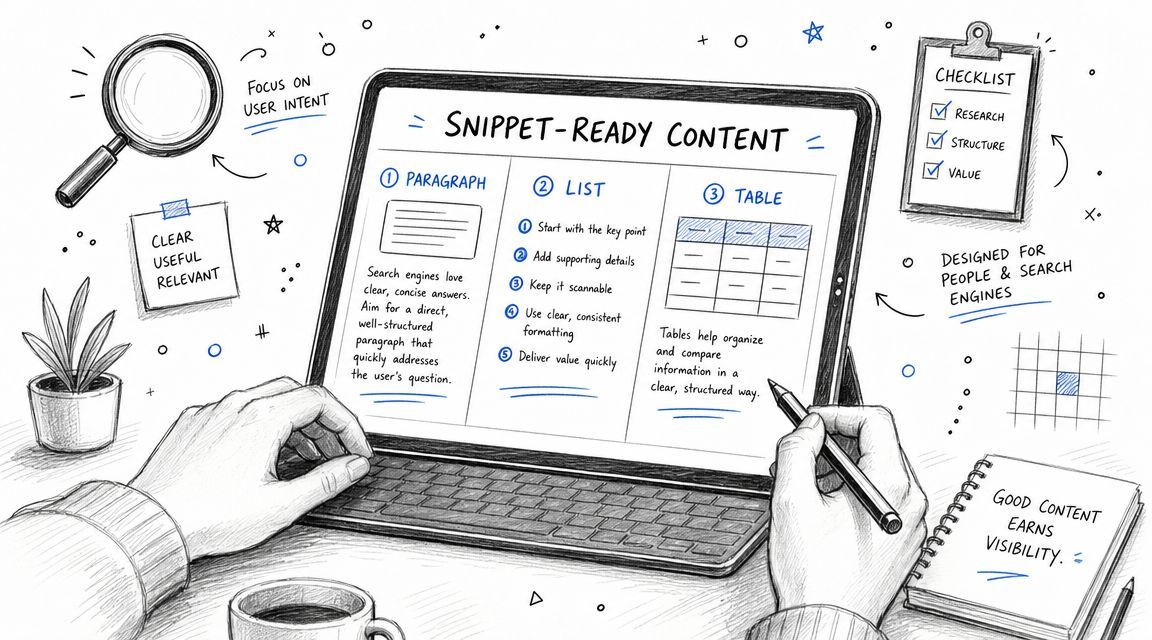
Different snippet formats need different content structures. Guidance from Moz on optimizing for featured snippets emphasizes placing paragraph answers near the top under an H2, formatting list snippets with proper HTML close to major headings, and using true HTML tables rather than images.
Paragraph snippets for definitions and direct answers
For a paragraph snippet, put the target question in a heading and answer it immediately below with an objective, standalone response. Keep the first answer tight. Then expand beneath it.
A SaaS example:
H2: What is churn rate?
Churn rate is the rate at which customers stop using a product or cancel a subscription over a given period. Businesses use it to evaluate retention performance, forecast recurring revenue risk, and identify where onboarding or product adoption needs work.
That format works because the answer can stand on its own. It doesn't rely on the previous paragraph for context.
What doesn't work:
- Lead-heavy intros: Long scene-setting before the answer
- Promotional wording: Claims that sound like sales copy
- Buried definitions: The answer appears halfway down the section
List snippets for processes, steps, and short collections
List snippets work best when the query implies sequence, ranking, or grouped items. Use real HTML lists, not styled paragraphs pretending to be steps.
For eCommerce, a query like how to clean white sneakers should be structured as a numbered list:
- Remove loose dirt with a dry brush.
- Mix a small amount of cleaner with water.
- Scrub the upper gently with a soft brush.
- Wipe away residue with a clean cloth.
- Let the sneakers air dry fully.
The step names should be short and scannable. Google often prefers that kind of clean structure because it can lift the list directly.
Keep the list close to the heading that frames the query. Don't hide it after a long product story or brand narrative.
Here's a useful walkthrough on the broader mechanics of answer formatting:
Table snippets for comparisons buyers actually use
Table snippets are underused by commercial sites. That's a mistake, because comparison searches often sit close to conversion.
A local service business could use a simple HTML table for a query like standard vs premium lawn care package:
| Package | Best for | Includes |
|---|---|---|
| Standard | Routine maintenance | Mowing, edging, cleanup |
| Premium | Higher-touch upkeep | Standard package plus seasonal treatments and detailed yard care |
The point isn't visual design. The point is extractability. If the content exists as a proper HTML table with a clear heading above it, Google has an easier job understanding what each row means.
A few content rules consistently help:
- Use question-led headings: Match the searcher's wording closely.
- Answer first: Don't make Google hunt for the extractable block.
- Support after the answer: Follow the short answer with detail, examples, caveats, or product context.
- Stay neutral in the answer block: Save the persuasion for later on the page.
Amplify Your Content with On-Page and Technical Signals
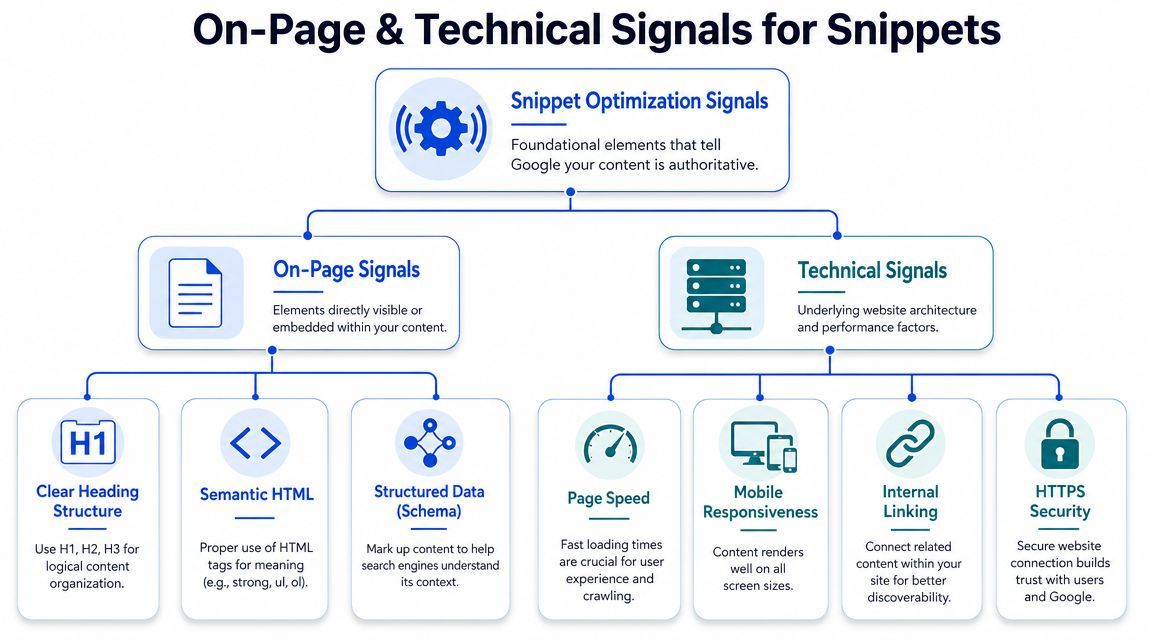
Strong snippet copy can still lose if the page structure is messy. The page needs to tell search engines what the question is, where the answer begins, and how the supporting detail is organized.
The technical common denominators are consistent. Wellows' guidance on featured snippet optimization highlights question-led heading architecture, semantic organization, and supporting elements such as FAQ schema and logically nested headings.
Build extraction paths, not just good copy
A clean snippet page usually includes:
- A direct query heading: Put the target question in an H2 or H3.
- A short answer block immediately below: Make it self-contained.
- Nested support sections: Use related subheadings that elaborate without disrupting the main answer.
- Relevant internal links: Point from stronger pages into the snippet-target page using natural anchor text.
- Structured reinforcement: FAQ schema can help clarify page meaning, even if it doesn't guarantee snippet ownership.
Schema isn't magic. It won't turn a weak page into a featured result. But it can reinforce content that is already clear and well aligned with intent.
Use an iterative publishing workflow
The difference between amateur snippet work and professional snippet work is process. Good teams don't publish and hope.
Use a repeatable checklist:
- Inspect the live SERP first: Confirm what format Google already rewards.
- Match the format exactly where it makes sense: Paragraph, list, or table.
- Request reindexing after the edit: Speed up discovery of the changes.
- Watch the query-level response: Look for improved visibility and better extraction signals.
- Revise if needed: Shorten the answer, simplify the heading, or improve the surrounding structure.
A lot of snippet losses come from over-optimization. Repeating the keyword, stuffing the heading, or forcing branded language into the answer block usually makes the content less extractable, not more.
The Iterative Loop Testing, Tracking, and Refining Results
Snippet optimization isn't a one-time content task. It's a feedback loop. You form a hypothesis about why Google prefers another answer, you adjust your format, and you measure the response.
What to watch after publishing
Start in Google Search Console. Use URL Inspection to request reindexing after the page update. Then monitor the target query in the Performance report.
The useful signals aren't complicated:
- Impressions: Is Google showing the page more often for the target query?
- Clicks: Are users choosing the result more often?
- CTR movement: Did the revised answer make the listing more compelling?
Manual SERP checks still matter, especially for high-value queries, because they show whether Google changed the snippet owner, altered the format, or replaced the answer box with another feature.
How to decide what to change next
When a page doesn't win, the fix is usually one of a few things:
| Problem | Likely issue | Practical revision |
|---|---|---|
| Answer is ignored | Too vague or too long | Rewrite the first answer block more directly |
| Wrong snippet type | Page structure mismatches query | Convert prose into a list or table |
| Competitor remains stronger | Better alignment with intent | Tighten the heading and supporting context |
| Page still lags overall | Base ranking isn't competitive enough | Improve the broader SEO foundation before forcing snippet work |
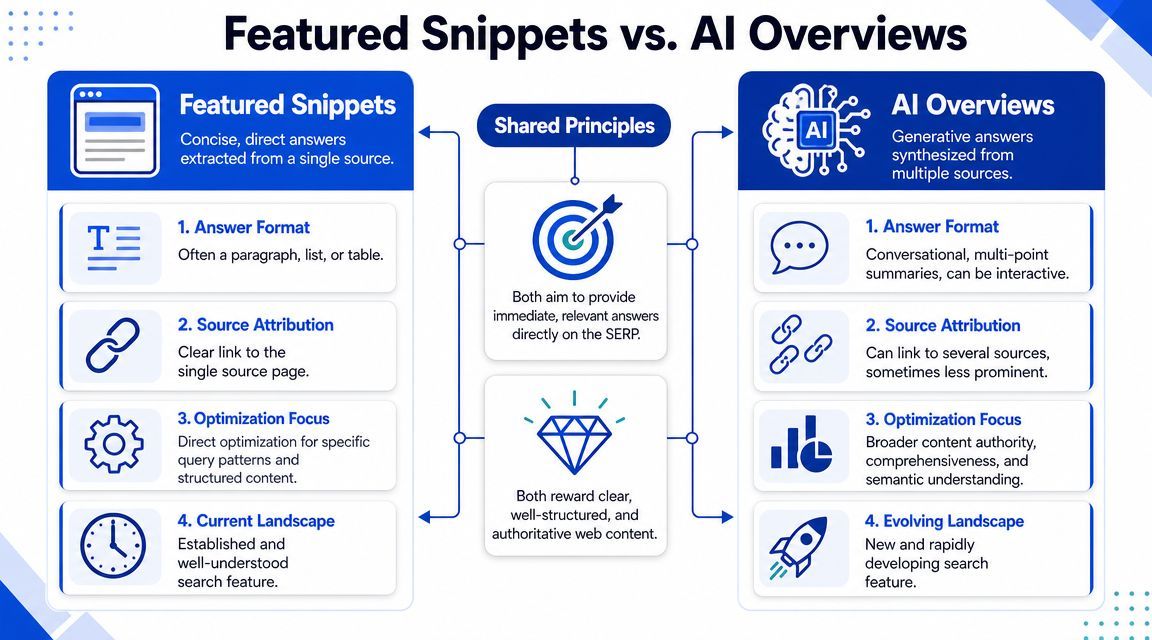
Snippet work starts helping beyond classic search. The more clearly you structure definitions, comparisons, and procedural answers, the more usable that page becomes for other answer surfaces too. You're not just chasing position zero. You're building content that machines can lift, summarize, and cite.
Future-Proofing Your Strategy for AI Overviews
A lot of snippet advice is stuck in an older SEO model. It treats the answer box as a standalone tactic. That view is getting outdated.
Google's Search Central documentation on featured snippets and snippet controls makes the broader point clear. Snippet optimization now sits inside a larger answer ecosystem, including controls that affect snippet display and the growing need for content that can be quoted across multiple search experiences.
Why snippet work now supports AI visibility later
The better question isn't just how to optimize for featured snippets. It's how to create pages that AI systems can summarize without distorting the meaning.
That changes the job in two ways:
- Concise answers still matter: AI systems still need a clear extractable core.
- Corroboration matters too: The answer should be supported by deeper explanation elsewhere on the page.
A thin answer block with no context may be enough for a classic snippet test, but it isn't always enough for stronger citation visibility across evolving search features.
What to add if you want citation-friendly content
Build pages that are easy to trust and easy to parse:
- Add clear source context: Explain who the page is for, what the answer means, and any limitations.
- Use updated timestamps where appropriate: Freshness cues can help users and machines interpret relevance.
- Keep formatting machine-readable: Headings, lists, tables, and FAQs still do heavy lifting.
- Write for extractability, then depth: Start with the concise answer. Follow with proof, examples, or caveats.
If you're expanding this work into broader answer-engine visibility, this guide on how to optimize for AI Overviews is a practical next read.
The pages most likely to survive search changes are usually the ones that answer clearly, support the answer properly, and make that structure obvious in the HTML.
Frequently Asked Questions About Featured Snippets
Should every page on my site be optimized for featured snippets
No. Focus on pages where the query has clear intent, the page already has visibility, and winning the snippet could support a commercial goal. Blanket optimization usually creates bloated content and weak prioritization.
Are featured snippets still worth targeting if AI Overviews appear
Yes, when the query is commercially meaningful and your page is already competitive. Snippet-ready content also improves your odds of being understood and cited in newer answer experiences, so the work has value beyond one SERP feature.
Does FAQ schema guarantee a featured snippet
No. It can support clarity, but it doesn't guarantee selection. Clear answer blocks, relevant headings, and the right content format usually matter more.
What kinds of queries are usually the best fit
Question-based, long-tail queries with clear informational intent tend to be the strongest fit. From a business perspective, prioritize qualification, pricing, comparison, and process questions that sit close to a sale, signup, or lead action.
What if my competitor has a stronger domain
You can still win if your page answers the query more cleanly and matches the snippet format better. But if your page isn't competitive in the underlying rankings, snippet edits alone probably won't be enough.
How long does it take to see movement
It depends on crawl timing, query volatility, and how close your page already is. Some changes are picked up quickly after reindexing. Others need multiple rounds of refinement before Google changes the extracted answer.
Can winning a featured snippet reduce clicks
Sometimes, yes. If the query is fully satisfied on the results page, some searchers won't click. That's why the best targets are the questions where a concise answer creates interest in the next step rather than ending the journey.
If your site already has page-one rankings but isn't turning that visibility into enough demos, leads, or sales, consider working with SEOBRO®. The right SEO partner won't just chase snippets. They'll audit where the easiest revenue wins already exist, tighten the technical and content structure, and build a search strategy around qualified growth instead of vanity traffic.