Most businesses treat Google Business Profile like a directory listing. They claim it, add a phone number, upload a logo, and move on. Then they wonder why competitors get the calls, the direction requests, and the high-intent leads.
That approach wastes demand you already earned. When someone searches for a local service, compares providers on Maps, or asks an AI system for the best option nearby, your profile often becomes the first filter. If it looks thin, outdated, or inconsistent, you lose before your website even gets a chance.
A strong profile does more than “show up on Google.” It pre-sells trust, matches service intent, reduces friction, and pushes qualified prospects toward calls, bookings, visits, and form fills. It also feeds structured business data into systems that increasingly summarize, recommend, and compare businesses on a user's behalf.
If you want to know how to optimize google business profile properly, start thinking like an operator, not a box-checker. The job isn't to complete fields once. The job is to build a local search asset that stays accurate, relevant, and active enough to support revenue.
Introduction Turning Your Profile from a Digital Postcard into a Lead Engine
Your profile is probably underperforming right now.
Not because Google Business Profile doesn't matter, but because most businesses stop at the shallow setup. They enter the basics, maybe upload a few photos, then ignore the profile for months. That leaves a stale listing trying to compete against businesses that actively shape relevance, trust, and buyer confidence.
The fix starts with the essentials. Verification, complete data, correct categories, service depth, fresh media, review management, and ongoing maintenance are required tasks. They're the baseline. If those pieces are weak, every advanced local SEO tactic gets less effective.
This matters beyond classic local SEO. A well-maintained profile can influence who gets surfaced in map results, who earns the click from branded and non-branded local searches, and which business looks safest to contact first. It also creates cleaner entity data for AI-driven discovery systems that rely on consistency and completeness.
Practical rule: If your profile doesn't answer the searcher's next question immediately, you're making the lead work too hard.
Treat GBP like a live sales asset. That means every field, image, post, review response, and service entry should help a prospect choose you faster.
The Foundational Setup for Trust and Visibility
Google rewards legitimacy before it rewards ambition. If your profile isn't verified and your core business information is sloppy, everything built on top of it is weaker.
According to Google Business Profile guidance, businesses with complete and accurate profile information are more likely to appear in local search results, and verification tells Google you're authorized to represent the business.

Claim and verify first
If you haven't claimed and verified the profile, stop everything else and do that first.
Verification is not busywork. It's the gatekeeper that signals control and legitimacy. Without it, you're trying to optimize an asset Google doesn't fully trust you to manage. That limits your ability to update details confidently and weakens the profile's authority.
For a local service business, verification supports the basics that drive leads: service area clarity, valid phone number, hours, and a true operational presence. For a SaaS company with offices but a broader non-local acquisition model, the profile should still reflect the actual location, business type, and contact details accurately. Don't force local intent where it doesn't belong. Use GBP where it supports branded trust, recruiting, partner credibility, and location-specific discovery.
Build clean business data
GBP optimization is really information architecture. Your name, address, phone number, business type, hours, and practical attributes need to line up with reality and with the rest of your web presence.
Use this audit list:
- Business name: Match your real-world brand. Don't stuff service terms into the name field.
- Address and service logic: If customers visit you, use a full address. If you're service-area based, make sure the setup reflects how you operate.
- Phone and contact path: Use a monitored number that routes to the team responsible for conversions.
- Hours and operational details: Keep regular hours, holiday changes, and customer-facing details current.
- Attributes: Add practical information that reduces friction, such as parking, Wi-Fi, or other relevant amenities where applicable.
Google also recommends adding photos and videos, and it supports practical profile details that help customers act with confidence. For eligible retail businesses, in-store products can also appear in local results. That's a clear sign GBP has moved well beyond a basic listing.
A profile with weak foundational data doesn't just rank worse. It converts worse because buyers hesitate when basic facts feel unreliable.
Completing Your Profile to Dominate Your Category
The fastest way to make a profile irrelevant is to describe your business in broad, lazy terms.
A complete profile isn't one with every field filled. It's one that maps your business to the exact ways buyers search when they're close to taking action. Category choice and service coverage do most of that heavy lifting.

Choose categories with commercial intent
Your primary category is one of the strongest relevance signals. Get that wrong and you handicap the whole profile. A profile can have one primary category and up to nine secondary categories, which gives you room to cover related intent without diluting the main focus, as noted in Semrush's GBP optimization guide.
Here's the decision framework:
| Business type | Weak category setup | Strong category setup |
|---|---|---|
| Emergency plumber | Primary only set to broad home service language | Primary set to core plumbing intent, secondary categories reflect urgent and related plumbing jobs |
| Cosmetic dentist | Broad healthcare category | Primary tied to dentistry, secondary categories reflect high-value services patients actually compare |
| Bakery | Only “Bakery” | “Bakery” plus specific intent categories such as “Wedding bakery” where relevant |
| B2B software with office | Generic business category with no local relevance | Category aligned to actual business model and local presence, not forced consumer intent |
The mistake I see most often is category minimalism. Businesses choose one broad label and leave discoverability on the table.
Turn services into search entry points
Services are not filler. They're one of the clearest ways to tell Google and the buyer what problems you solve.
List every major service separately. Don't dump everything into one vague paragraph. A profile with sparse services creates weak query matching and forces the buyer to guess. A well-built services section acts like a compact commercial catalog inside the search results.
Use service entries that:
- Name the service clearly: Write it the way a buyer would recognize it.
- Explain the use case: Say what the service is for and who needs it.
- Address the problem: Include the customer pain the service solves.
- Reflect buying intent: Prioritize high-margin and high-closing services first.
For local businesses, this is obvious. Separate drain cleaning from water heater repair. Separate roof repair from roof replacement.
For SaaS or ecommerce businesses with a local footprint, the same principle applies in a different way. Focus on location-relevant offerings such as demos, onboarding support, showroom visits, consultations, pickups, or local fulfillment where appropriate.
Static profiles fade into the background. Active, specific profiles win because they help Google match intent and help buyers decide faster.
Using Media and Posts to Engage Local Customers
Most profiles look abandoned. That hurts trust before anyone reads a word.
Fresh media and regular posts tell a prospect the business is active, responsive, and real. They also give Google new context about your brand, services, and operational freshness. High-performance GBP management includes posting weekly or monthly, adding high-quality branded photos, and reviewing performance to identify content gaps, according to Haley Marketing's guide to Google Business Profile optimization.

Publish proof, not decoration
Don't treat photos like branding wallpaper. Use them as evidence.
The strongest media sets usually include:
- Team at work: Technicians on-site, consultants in meetings, staff serving customers.
- Real environment shots: Exterior signage, reception area, workspaces, service vehicles, treatment rooms, retail shelves.
- Outcome-focused images: Before-and-after work for service businesses, finished installations, packaged deliveries, product-in-use scenes.
- Branded consistency: Similar lighting, visual style, and quality across uploads.
Video can be even better when it answers practical buyer questions fast. Show how your process works. Show what a visit looks like. Show what customers can expect when they call.
Use posts to keep your profile current
Posts are one of the easiest ways to stop your profile from going stale. They also give you a place to support offers, updates, seasonal demand, new services, and trust-building proof.
A simple post cadence works well:
- Promotional posts for limited-time offers or seasonal demand spikes.
- Service spotlight posts that explain one offer in plain language.
- Credibility posts featuring project examples, certifications, staff highlights, or customer FAQs.
- Operational updates for hours, events, temporary changes, or special availability.
Google also gives you another underused asset inside the profile: questions and answers. Don't wait for random users to shape that section. Seed the profile with common pre-sale questions and direct answers.
Buyers use your profile to screen risk. Photos, posts, and Q&A lower uncertainty and increase the chance they contact you now instead of “researching” for another week.
Managing Reviews to Build Authority and Drive Conversions
Reviews influence two things that matter: visibility and close rate.
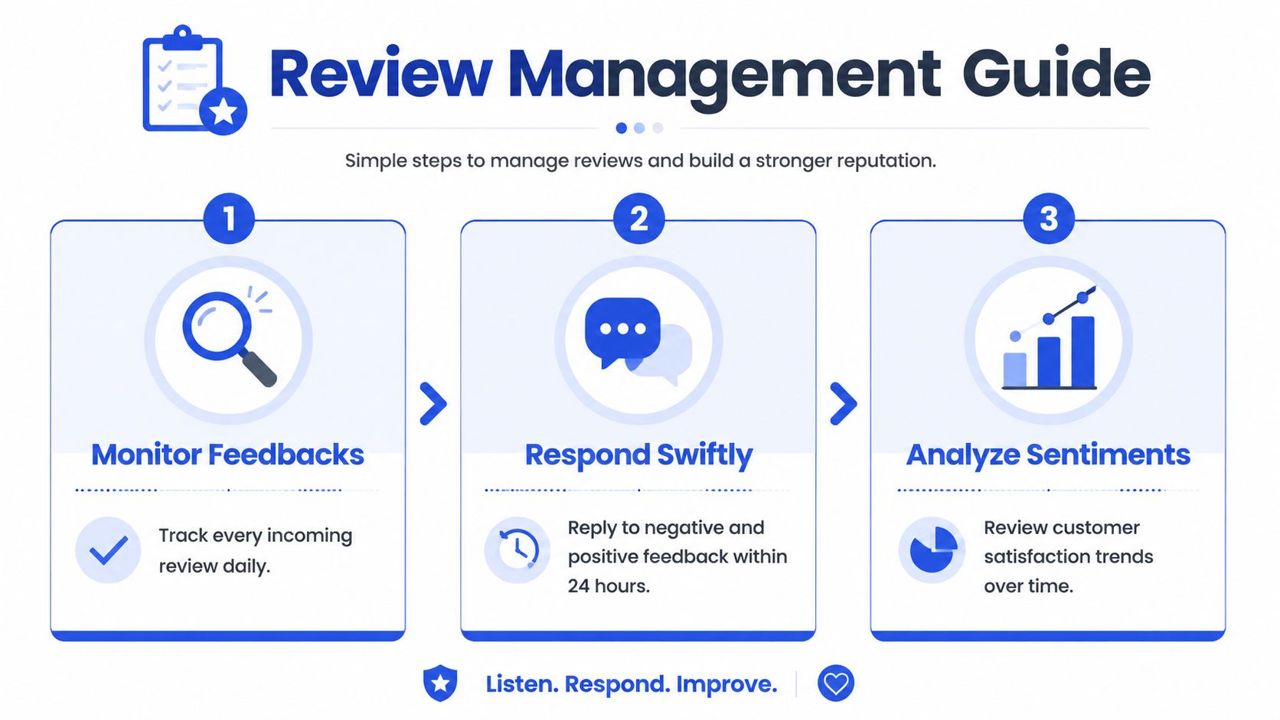
The conversion side is obvious. Buyers compare businesses quickly, and reviews often decide whether they call you or the competitor. The operational side matters just as much. Review generation and review response should be treated like a standing process, not occasional cleanup.
The numbers make the priority clear. 74% of consumers read at least two reviews before making a purchase, and 89% expect a business to respond to reviews, especially negative ones, according to the U.S. Chamber's guide on optimizing Google Business.
Build a review system, not a one-off ask
If your team only asks for reviews when someone remembers, volume and consistency will stay weak.
Build a simple workflow around customer satisfaction moments. Ask after successful delivery, completed installation, resolved support case, or positive in-store experience. Keep the request short. Make it easy to act. Route the ask through the people closest to the customer, not just marketing.
Useful channels include:
- Email follow-up: Good for professional services, SaaS onboarding, and higher-consideration purchases.
- SMS request: Strong for local service businesses right after job completion.
- In-person prompt: Best when staff already know the customer is happy.
- CRM automation: Helps multi-location teams standardize the process.
For businesses dealing with trust issues after poor feedback, it helps to pair GBP response work with broader strategies to fix your online reputation so the recovery isn't limited to one platform.
A quick visual walkthrough can help teams standardize the process internally:
Respond like revenue depends on it
Because it does.
Responding to reviews signals attentiveness to future customers reading the thread. It also gives you a controlled place to reinforce professionalism, service quality, and problem resolution. For positive reviews, thank the customer and mention the service naturally. For negative reviews, acknowledge the issue, avoid defensiveness, and move resolution forward.
Use this response logic:
| Review type | What to do | What to avoid |
|---|---|---|
| Positive | Thank them, reference the service, reinforce trust | Generic copy-paste replies |
| Mixed | Acknowledge both praise and concern, offer follow-up | Ignoring the concern |
| Negative | Stay calm, address the issue, invite offline resolution | Arguing, blame, legal threats in public |
A thoughtful response to a negative review can sell better than a perfect rating with no engagement. Buyers want proof that problems get handled.
Advanced Optimization for Scale and AI Visibility
Once the profile is operationally sound, the next job is reinforcement.
Google and AI discovery systems don't rely on one page alone. They evaluate clusters of signals. Uberall notes that search and AI engines evaluate signals such as primary category, proximity, completeness, and keywords, and that freshness and consistency across systems matter for visibility in AI-driven discovery. That's the important shift highlighted in Uberall's guide to optimizing Google Business Profiles.
Reinforce GBP with your website and citations
Your website should confirm what your profile claims.
That means your local landing pages, contact details, service pages, hours, and brand presentation should align with GBP. Add local business schema where appropriate so search systems can read the business entity more clearly. Schema won't save a weak profile, but it helps reinforce the same facts across your owned properties.
Citations still matter because consistency still matters. If major directories, social profiles, and local listings show conflicting data, you create unnecessary trust friction for both users and machines.
For multi-location brands, this becomes a systems problem. Standardize:
- Naming rules across every location
- Location page templates on the website
- Hours update workflow for holidays and temporary changes
- Category governance so teams don't improvise
- Media standards to avoid low-quality or off-brand uploads
If you're managing brand presence beyond local listings, it's also smart to protect your brand across social channels so customers and AI systems see the same business identity wherever they look.
Track actions, not vanity
Most businesses obsess over visibility screenshots. That's not enough.
Use GBP activity to support measurable actions. Add UTM parameters to website links so Google Analytics can attribute visits, leads, and revenue from the profile. If you run a call tracking setup, make sure the data still preserves a clean business identity and doesn't create consistency issues elsewhere.
For scaled teams, the operational checklist should look like this:
- Weekly: Review posts, new photos, new reviews, open questions, and unexpected edits.
- Monthly: Audit categories, services, landing page alignment, and UTM-tagged traffic quality.
- Quarterly: Review citation consistency, location-level content gaps, and brand-level governance.
By integrating these elements, your Google Business Profile transcends being a mere listing and becomes a core component of your broader search visibility system. That includes local SEO, entity clarity, structured data, conversion tracking, and AI citation readiness.
Measuring Performance and Tying GBP to Revenue
If you can't connect GBP work to pipeline activity, you're guessing.
The trap is focusing on profile views and impressions alone. Those can be useful directional signals, but they don't tell you whether the profile is generating commercial outcomes. What matters is whether prospects took action and whether those actions produced qualified leads, sales conversations, bookings, or store visits.
What to measure inside GBP
Start with the actions closest to revenue:
- Phone calls: Strong signal for service businesses with fast sales cycles.
- Website clicks: Useful when the site handles forms, demos, ecommerce, or deeper qualification.
- Direction requests: Valuable for storefronts, clinics, restaurants, and showrooms.
- Review trends and response coverage: Important because they influence both trust and conversion behavior.
Use these alongside your CRM and analytics platform. If lead quality from GBP is poor, the issue usually isn't “traffic.” It's message mismatch, wrong categories, weak service descriptions, or trust gaps inside the profile.
Use UTMs to connect clicks to leads
UTM tracking turns GBP from a blurry visibility channel into a measurable acquisition source.
Append UTM parameters to the website URL in your profile so analytics platforms can isolate traffic from GBP. Then build reports around form submissions, calls, purchases, demo requests, or booked appointments from that traffic source. If you have multiple locations, use distinct UTM tags for each profile.
A practical measurement model looks like this:
| Signal | Why it matters | Revenue connection |
|---|---|---|
| Website clicks | Indicates deeper interest | Can lead to tracked forms, demos, or sales |
| Calls | High-intent action | Often strongest lead signal for local services |
| Direction requests | Shows visit intent | Supports in-person revenue |
| Review response discipline | Supports trust | Improves conversion likelihood over time |
Don't ask whether the profile got attention. Ask whether it produced business outcomes.
Your Google Business Profile Questions Answered
How often should you update a Google Business Profile
More often than most businesses do. Update it whenever hours, services, staffing reality, offers, or operational details change. For active management, keep posts, photos, and review responses moving consistently so the profile doesn't look neglected.
What is the most important part of GBP optimization
Category accuracy is one of the most important relevance levers, but it only works properly when the profile is complete, accurate, and actively maintained. The biggest mistake is looking for one magic field instead of building a reliable whole.
Should service businesses list every service separately
Yes. Separate services give Google more relevance signals and give buyers more confidence. If you bundle everything into one generic description, you reduce your chances of matching intent and weaken conversion.
Can SaaS and ecommerce companies benefit from GBP
Yes, if they have a legitimate local presence. The role is different from a pure local service business, but GBP can still support branded trust, local discovery, office credibility, consultations, pickups, or showroom-related intent.
Do posts and photos really matter
Yes. They help keep the profile current, demonstrate operational reality, and reduce buyer hesitation. In practical terms, they make your business look active and easier to trust.
Is GBP a one-time setup
No. That mindset is why so many profiles underperform. The better model is continuous maintenance tied to search visibility, conversion support, and entity consistency across the web.
If your Google Business Profile is acting like a static listing instead of a lead source, it's usually a strategy problem, not a Google problem. SEOBRO® helps businesses turn local search visibility into qualified leads and measurable revenue through senior-level SEO strategy, technical execution, and ongoing optimization built around business outcomes.