If you're leading a B2B company right now, you've probably felt the same pattern. Paid acquisition gets more expensive. Outbound gets noisier. Sales complains about lead quality. Marketing reports activity, but pipeline still feels fragile.
That isn't a traffic problem. It's a demand capture problem.
Buyers already know they have a problem. They open Google, compare vendors, scan review pages, read service content, and increasingly ask AI tools to summarize the market for them. If you don't show up in that process, your team works harder just to stay in place.
SEO for B2B companies should be treated like a revenue system, not a content calendar. The economics are too strong to ignore. Organic leads close at 14.6%, compared with 1.7% for outbound leads, a difference of 8.6x, according to the benchmark cited in this B2B SEO statistics roundup. That gap exists for a reason. Search captures buyers when they're actively evaluating solutions, not when you're interrupting them.
So we don't approach B2B SEO as "publish more blogs and hope." We build it like an operating system. Technical foundations. High-intent pages. Internal linking. Authority building. Conversion paths. AI-ready content structures.
If you want predictable pipeline from organic search, that's the work.
Introduction Why Your B2B Growth Engine is Stalling
Most stalled B2B growth engines look healthy on the surface. The CRM has activity. Ad dashboards show clicks. SDRs are busy. Content gets published. But the underlying system is weak because it depends on constant spending and constant chasing.
That model breaks when CAC rises and response rates fall.
SEO changes the equation because it captures buyers with intent. Someone searching for a solution category, a service comparison, a migration path, or a vendor alternative is already much closer to revenue than someone cold-contacted in a crowded inbox. That's why the close-rate gap between organic and outbound matters so much in B2B.
The real issue isn't traffic
You don't need more unqualified visits. You need more of the right visits from the right searches.
In B2B, a single high-intent page can outperform a dozen broad awareness posts if it attracts the right buyer. A strong comparison page, service page, product integration page, or solution page often influences demos and sales conversations far more directly than generic educational content.
Practical rule: If a page can't support buyer evaluation, sales enablement, or commercial discovery, it probably shouldn't be a priority.
What leadership teams should change
We recommend shifting the conversation from marketing output to search visibility across the buying journey.
That means asking better questions:
- Demand capture: Are we visible for commercial and evaluation-stage queries?
- Sales alignment: Do our pages answer the objections buyers raise in demos?
- Technical readiness: Can Google and AI systems crawl, render, and understand our most valuable pages?
- Conversion path: Does each high-intent page lead naturally to a demo, quote request, or qualified next step?
SEO for B2B companies works when it's run like infrastructure. You build it once, strengthen it over time, and let it compound.
Why B2B SEO is a Different Discipline Not Just B2C on a Bigger Budget
A lot of teams fail at B2B SEO because they copy B2C habits. They chase broad keywords, publish lightweight blog content, and judge success by traffic spikes instead of pipeline contribution.
That approach wastes time.
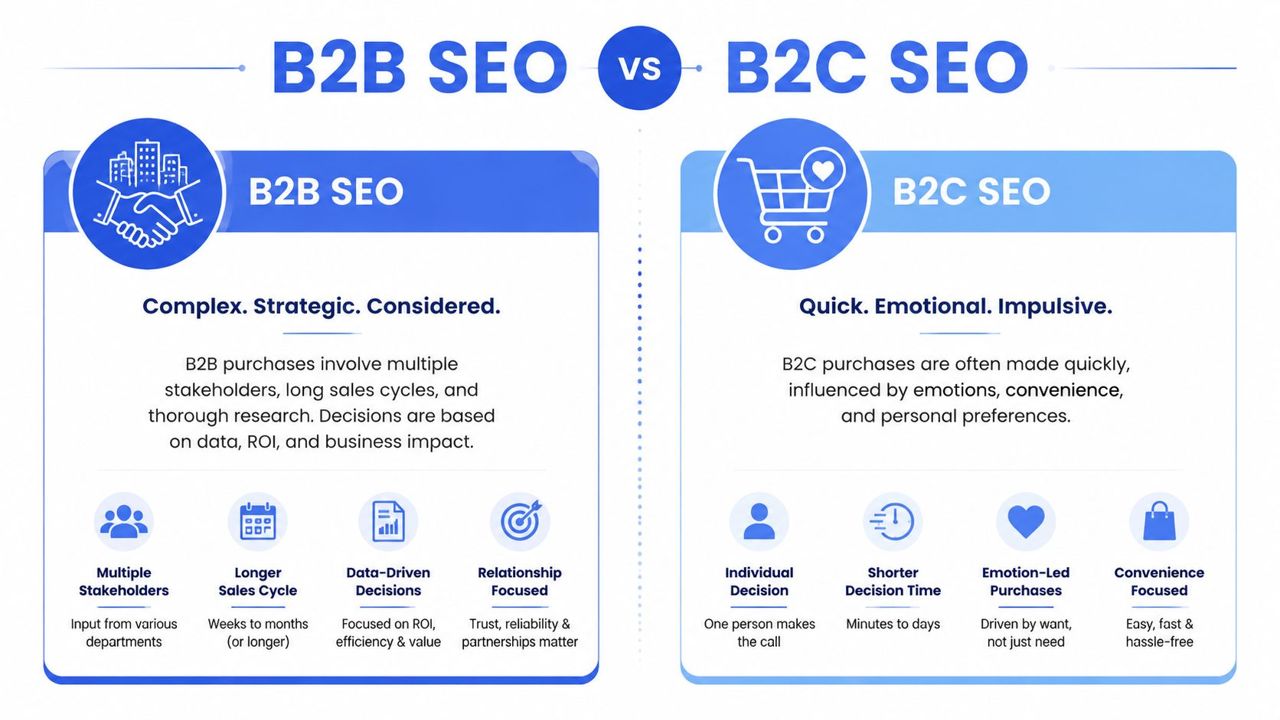
B2B buyers don't behave like retail shoppers. They conduct thorough comparisons, involve multiple stakeholders, and often search in narrow, technical language. The keyword may have low volume, but the contract value behind it can be significant. That changes everything about how we prioritize pages, structure content, and define results.
Why low-volume keywords matter more in B2B
The wrong SEO team sees a low-volume term and ignores it. The right team sees a query with clear commercial intent and builds the best page on the web for it.
Examples of B2B high-intent searches include:
- Category evaluation: "enterprise CRM for healthcare"
- Comparison intent: "platform A vs platform B"
- Implementation intent: "ERP integration partner"
- Procurement support: "managed IT services for multi-location retail"
These aren't vanity keywords. They're buyer journey signals.
One qualified visit from a decision-maker is worth more than a hundred visits from people who will never buy.
B2B vs B2C SEO comparison
| Dimension | B2B SEO | B2C SEO |
|---|---|---|
| Buyer behavior | Research-heavy, committee-driven, slower | Faster, individual, often impulse-driven |
| Keyword value | Lower volume, higher intent, niche language | Higher volume, broader commercial demand |
| Content role | Educates, compares, validates, reduces risk | Attracts, persuades, converts quickly |
| Primary conversions | Demo, quote, consultation, sales inquiry | Purchase, add-to-cart, sign-up |
| Trust signals | Case studies, expertise, compliance, implementation detail | Reviews, price, shipping, convenience |
| Internal linking strategy | Supports complex journeys across solution, industry, use case, and proof pages | Supports product discovery and category flow |
A B2B SEO program needs tighter targeting and more commercial discipline. We care less about total keyword count and more about whether the site covers problem-aware, solution-aware, comparison, and decision-stage searches with the right page type.
The Revenue-Driven B2B SEO Framework
Most B2B SEO programs fail because teams split the work into disconnected tasks. Dev fixes technical issues. Marketing publishes content. Someone buys links. Nobody owns the system.
That setup doesn't compound. It fragments.
We use a simple model. Technical foundation, high-intent content, and authority signals have to reinforce each other. If one is weak, the whole program underperforms.
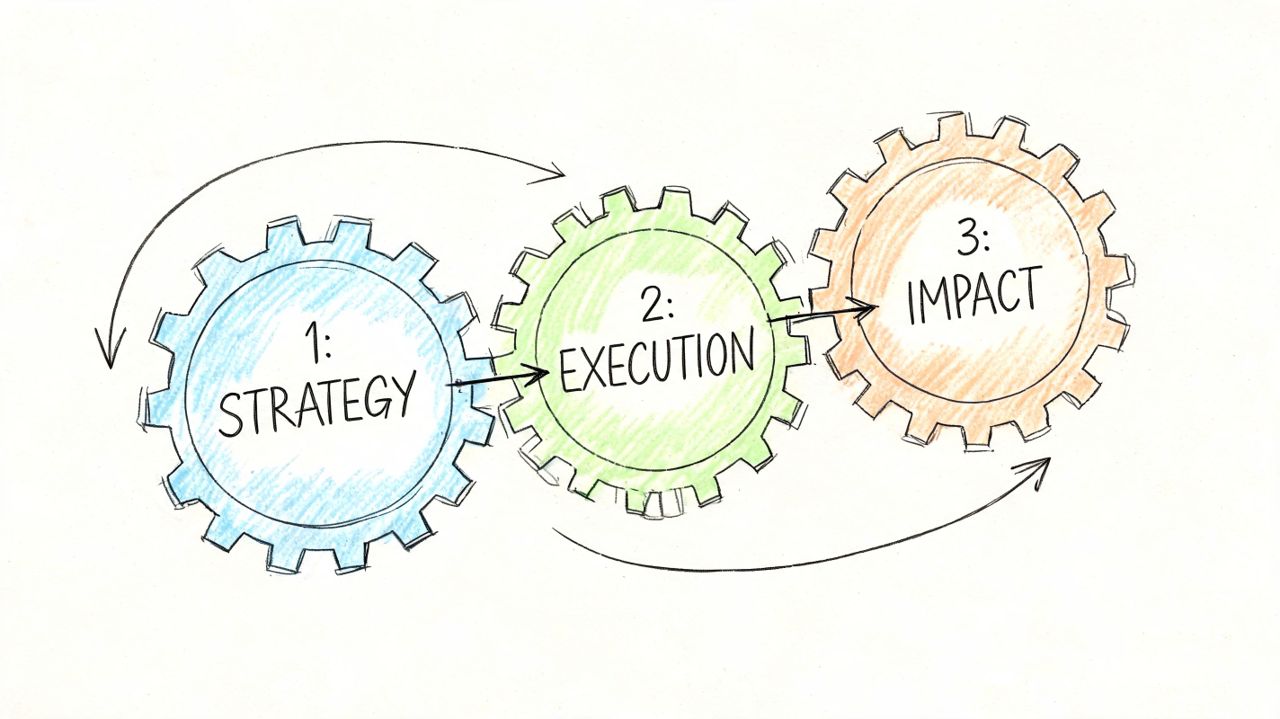
Three pillars that have to work together
Technical foundation
This is crawlability, indexation, rendering, schema, internal linking architecture, and page experience. If search engines can't process the site properly, your best pages won't perform.Content for high-intent funnels This includes solution pages, comparison pages, use case pages, product or service detail pages, case-study-adjacent proof content, and tightly aligned informational assets. Demand gets captured here.
Authority through trust signals
This comes from relevant backlinks, industry mentions, expert contributions, research assets, and clear brand credibility. Authority helps your important pages compete in harder SERPs and supports AI citation potential.
A useful outside perspective on this systems view appears in Breaker's approach to B2B SEO, which also treats SEO as a business growth function rather than a checklist.
What leadership should expect from the program
Leadership shouldn't approve SEO based on volume of deliverables. Approve it based on whether the program improves visibility for revenue-driving searches.
Use this lens:
- Are we fixing pages that matter to pipeline first
- Are we building content around buyer decisions, not editorial calendars
- Are we earning trust from the sites and sources our market respects
- Are implementation and reporting tied to qualified conversions
If the answer is no, you're probably funding motion, not growth.
Pillar 1 Executing the Technical Foundation for B2B
Technical SEO isn't housekeeping. It's access control for revenue. If your key pages aren't discoverable, renderable, indexable, and understandable, they won't contribute to pipeline no matter how strong the copy is.
That's especially true in B2B sites with service variations, product catalogs, knowledge bases, partner pages, documentation, or JavaScript-heavy front ends.

Fix crawl and index control first
Start with the pages that should rank and influence revenue. Then verify whether Google can access them.
We usually audit these areas first:
- Log files and crawl behavior: See whether search engines are spending time on important URLs or wasting effort on junk pages, duplicate filters, or thin archives.
- Search Console validation: Confirm target pages are discovered and indexed, not just published.
- JavaScript rendering: Check whether core content, links, and metadata appear in rendered HTML for SPA or JS-heavy stacks.
- Internal linking paths: Make sure important pages aren't buried behind weak navigation or orphaned from the rest of the site.
- Template consistency: Keep headers, copy blocks, schema, and conversion elements stable across solution and service templates.
If your site hides critical content behind rendering problems or weak architecture, content production becomes expensive theater.
Use schema where it changes visibility
Schema isn't magic, but it's one of the few technical layers that can directly affect how your result appears in search.
A B2B technical SEO guide reports that pages with structured data see rich results 4x more often and achieve 20-30% higher CTR, while FAQ schema is cited as boosting CTR by 20-50% for B2B content in Onely's B2B SEO guidance. That's a direct operational reason to implement schema on service, product, FAQ, and comparison-driven pages.
Good schema use in B2B usually includes:
- Service schema: For service and capability pages
- Product schema: For software, platforms, or catalog items where applicable
- FAQ schema: For pages that answer pre-sales objections
- Organization and entity signals: To reinforce brand clarity and relevance
This walkthrough is worth watching if your team needs a practical view of implementation priorities:
Technical SEO should answer one simple question. Can our best commercial pages be found, understood, and trusted by search systems without friction?
Pillar 2 Building Content for High-Intent Funnels and AI Answers
The old B2B content model was simple. Publish blog posts, target keywords, and hope traffic turns into leads.
That model is weak now. Buyers want answers faster, and AI systems increasingly summarize the market before a user clicks a site. So the goal can't just be traffic. It has to be commercial influence.
Stop publishing content nobody buys from
Most B2B sites overinvest in broad awareness content and underinvest in decision-stage assets.
Your content mix should center on pages that help buyers choose:
- Solution pages for core services or products
- Use case pages for industry, role, or workflow-specific needs
- Comparison pages for alternatives and vendor evaluation
- Implementation pages for migration, integration, onboarding, or deployment concerns
- Proof pages such as case-study formats, methodology pages, and expert commentary
The strategic objective should shift from raw traffic to citation-worthy exposure in AI answers. That's the core recommendation in Directive's take on why SEO matters for B2B. In practice, that means building fact-dense pages, original point-of-view content, and entity-clear page structures that answer real buying questions cleanly.
Structure pages for buyers and answer engines
AI systems don't reward vague marketing language. They favor pages that are easy to parse, specific, and grounded in clear claims.
We recommend this page structure for high-intent B2B content:
Direct answer near the top
State what the page is about in plain language.Scannable comparison or decision criteria
Use tables, bullets, and short sections.Role-specific pain points
Address concerns from operations, marketing, finance, IT, or procurement where relevant.Entity clarity
Be explicit about product names, service categories, integrations, industries, and workflows.Conversion path
Give the reader a logical next step, not a generic "contact us" dead end.
If you're building topic clusters with AI visibility in mind, this resource on optimizing topic authority for LLM answers is useful because it emphasizes hub structure and content relationships, not just standalone posts.
The page most likely to win in B2B isn't the loudest one. It's the one that makes evaluation easier for both the buyer and the machine reading it.
Pillar 3 Earning Authority with Digital PR and Strategic Outreach
Authority in B2B SEO isn't about collecting random backlinks. It's about earning trust from the publications, communities, and organizations your buyers already respect.
That means most "link building packages" are a waste of money.
If a vendor is offering directory spam, irrelevant guest posts, or bulk placements with no industry relevance, walk away. Those tactics don't build brand trust, and they rarely support the commercial pages that matter.
What good B2B link building actually looks like
Strong B2B authority building looks a lot more like digital PR than old-school SEO.
Focus on earning mentions and links from:
- Industry publications your prospects read
- Trade associations tied to your market
- Partner ecosystems where integration or referral credibility matters
- Niche newsletters and expert communities with actual decision-maker attention
- Podcasts, webinars, and contributed commentary that can be cited and linked
A single relevant mention from a respected vertical publication can be more useful than a large pile of generic links. Relevance beats volume in B2B because trust is contextual.
Authority assets worth building
You earn better links when you give publishers something worth citing.
The most practical authority assets are:
- Original research or benchmark pages: Give journalists and writers a reason to reference your brand.
- Expert commentary: Have a credible operator explain market shifts, implementation mistakes, or buyer considerations.
- Comparison assets: These attract links because they help readers evaluate vendors.
- Partner content: Co-created pages with complementary platforms, consultants, or associations can drive both links and sales alignment.
If your content team and PR effort are separated, merge the planning. The content that helps rankings should also help outreach. That includes statistics you can stand behind, useful frameworks, and concise pages that are easy for publishers to reference.
B2B SEO Playbooks SaaS eCommerce and Service Businesses
The tactics change by business model. The underlying system doesn't. You still need technical clarity, high-intent content, and authority. But where you place the effort depends on how the business sells.
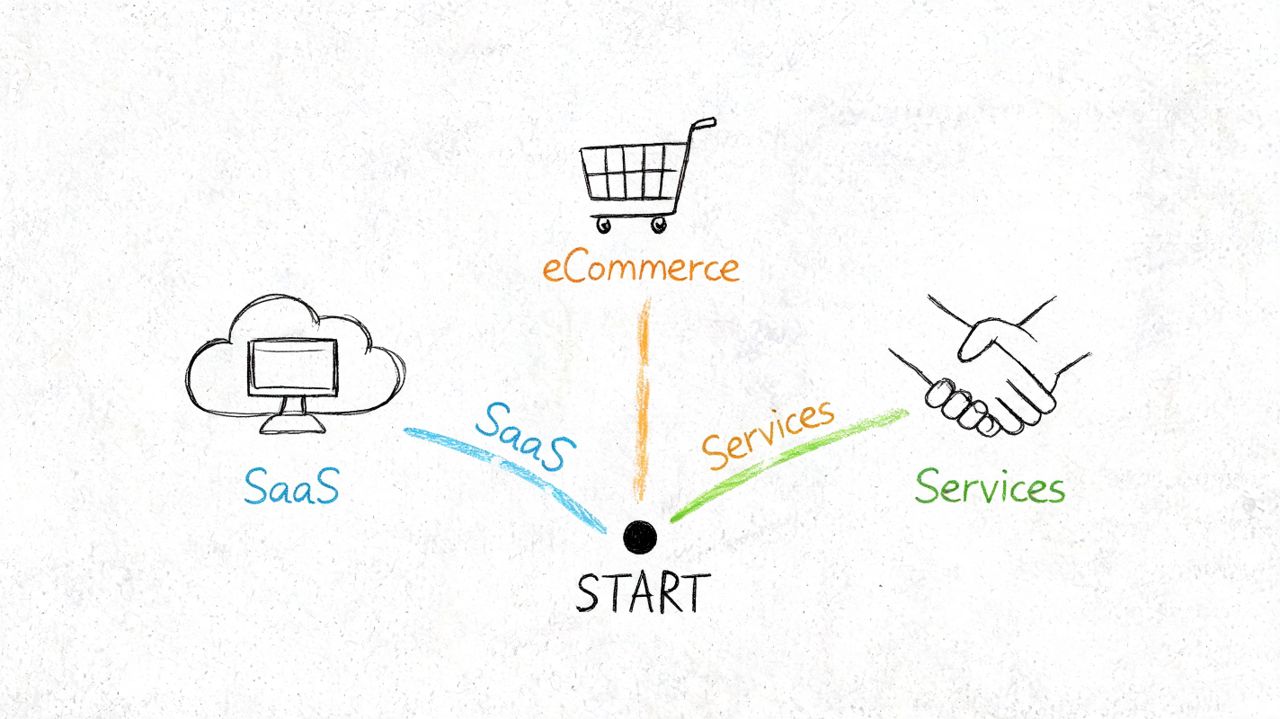
SaaS playbook
A SaaS company usually loses organic revenue in three places. Weak feature pages. No comparison content. Thin integration or use-case coverage.
The first three moves should be:
- Build solution architecture: Create pages for core product categories, use cases, industries, and integrations.
- Own comparison intent: Publish credible alternative and versus pages without turning them into sales fluff.
- Tighten demo funnels: Align page copy, internal links, and CTAs around demo requests, not just education.
For SaaS, programmatic expansion often works when it's controlled. Integration pages, feature pages, industry pages, and job-to-be-done pages can scale well if each page has unique value and conversion relevance.
B2B eCommerce playbook
B2B eCommerce often has a different failure mode. The catalog exists, but search engines struggle with filters, duplicate URLs, thin product copy, and unclear category intent.
Priority actions:
- Clean faceted navigation: Prevent useless filtered combinations from bloating the crawl space.
- Strengthen category pages: Write for commercial intent, applications, and procurement questions, not just SKU listings.
- Support bulk-buying journeys: Add spec sheets, FAQs, shipping and volume information, and quote-oriented CTAs where relevant.
This is also where a structured audit matters. Teams often use tools like Screaming Frog, Ahrefs, Google Search Console, and practical implementation support from specialists such as SEOBRO® when they need one partner to align technical fixes, content planning, schema, and revenue-focused prioritization across the whole campaign.
Service business playbook
Service businesses usually need fewer pages than SaaS or eCommerce brands. But each page has to work harder.
If you're a B2B service company, start here:
Create strong service pages
Each core service needs its own page with clear scope, outcomes, proof, and buying triggers.Build geo or industry pages carefully
Multi-location and territory-driven businesses need location pages only where there is real commercial intent and sales capacity.Publish trust-building commercial content
Add pages for process, audits, pricing approach, vendor comparisons, and common objections.
A good service SEO program feels close to sales enablement. The site should help a buyer answer, "Do these people understand our problem, and can they solve it?"
Frequently Asked Questions About B2B SEO Strategy
Leadership teams usually ask the right questions once they stop thinking about SEO as publishing and start treating it as revenue infrastructure.
How should we measure SEO ROI with a long sales cycle
Don't judge SEO only by last-click form fills. In B2B, that's too narrow.
Measure contribution across stages:
- Qualified organic conversions: Demo requests, quote requests, consultation bookings
- Sales-assisted influence: Pages viewed before pipeline creation or deal progression
- Commercial keyword coverage: Visibility for high-intent queries tied to services, categories, comparisons, and alternatives
- Assisted journey metrics: Organic entry pages that repeatedly appear in converting paths
If you only report sessions, you're hiding whether the program helps revenue.
Should we prioritize Google rankings or AI visibility
You need both. Treating them as separate channels is a mistake.
The average CTR for the #1 organic result is 27.6%, but 13.14% of Google queries trigger AI Overviews, and those can reduce clicks by 34.5%, according to Powered by Search's B2B SaaS SEO stats summary. That's why modern SEO for B2B companies has to cover classic rankings and answer-engine visibility at the same time.
Use this decision rule:
| If the query is mainly about | Prioritize |
|---|---|
| Category discovery | Organic rankings and strong category or solution pages |
| Vendor evaluation | Comparison pages, alternatives, proof content, and schema |
| Direct factual answers | Clear definitions, FAQs, tables, and citation-friendly formatting |
| Complex buying questions | Deep pages with expert commentary and structured subsections |
Should we hire a consultant or an agency
Hire based on what you actually need, not brand size.
A consultant is often the better choice when you need senior diagnosis, prioritization, technical judgment, and direct accountability. An agency can make sense when you need broader production capacity across content, dev, design, and outreach.
The mistake is hiring either one without asking these questions:
- Who sets priorities and why
- Who owns implementation
- How are recommendations tied to revenue pages
- How is progress reported beyond rankings and traffic
- Can they work across technical SEO, content strategy, and authority building together
If they can't answer those clearly, don't sign.
If you're serious about building seo for b2b companies around qualified demand, stronger commercial pages, and AI-era search visibility, consider working with SEOBRO®. Roman Sydorenko runs senior-level SEO campaigns focused on audits, prioritization, implementation, and reporting tied to leads and revenue, not vanity traffic.