Your analytics already show demand outside your home market. Visitors from Germany browse product pages. Buyers in Japan read feature pages. Prospects in Brazil hit pricing and leave. The problem usually isn't lack of international interest. It's that the site wasn't built to rank, route, and convert by market.
That gap gets expensive fast. Teams spend on content, paid acquisition, and expansion planning, then send global users into a site structure that confuses search engines and frustrates buyers. The result is familiar: wrong pages ranking in the wrong countries, translated copy that feels off, weak reporting, and a revenue story that stays stubbornly domestic.
International SEO services sit at the center of that problem. Done properly, they align technical SEO, localization, content strategy, internal linking, authority building, and conversion measurement around actual market expansion. Done poorly, they create complexity without commercial return.
The market is moving in that direction quickly. The global SEO services market is valued at $108.28 billion in 2026 and is projected to reach $203.83 billion by 2030, a 17.1% CAGR, according to Research and Markets' SEO services market analysis. That matters because more businesses are making the same decision you are: whether to treat international search visibility as a side project or as a growth channel.
Introduction Are You Losing Revenue in International Markets
Many CMOs see the same pattern before they call for help. International traffic is present, brand interest exists, and paid campaigns prove there is demand. Yet organic revenue from those markets stays weak because the website still behaves like a domestic site with a few translated pages attached.
That disconnect shows up in several ways. Search engines index the wrong regional URLs. Product and solution pages don't reflect local search intent. Pricing, messaging, and conversion paths feel imported rather than market-ready. Leadership reads a traffic report and assumes expansion is working, while sales and ecommerce numbers say otherwise.
International SEO services matter because they solve a routing problem and a business model problem at the same time. Search engines need clear technical signals. Buyers need culturally relevant content, commercial clarity, and trust. Analytics needs to tie those efforts to pipeline, orders, and qualified demand by market.
International SEO isn't a language layer. It's a market entry system built inside your website.
If your business is expanding across countries, languages, or search engines, the decision isn't whether to invest. It's which components you need, in what order, and how you'll judge whether the investment is producing revenue rather than vanity visibility.
The Strategic Foundation Choosing Your Global Site Architecture
The architecture decision affects everything after it. Rankings, development complexity, reporting, localization workflows, and link equity all follow from how you separate markets.
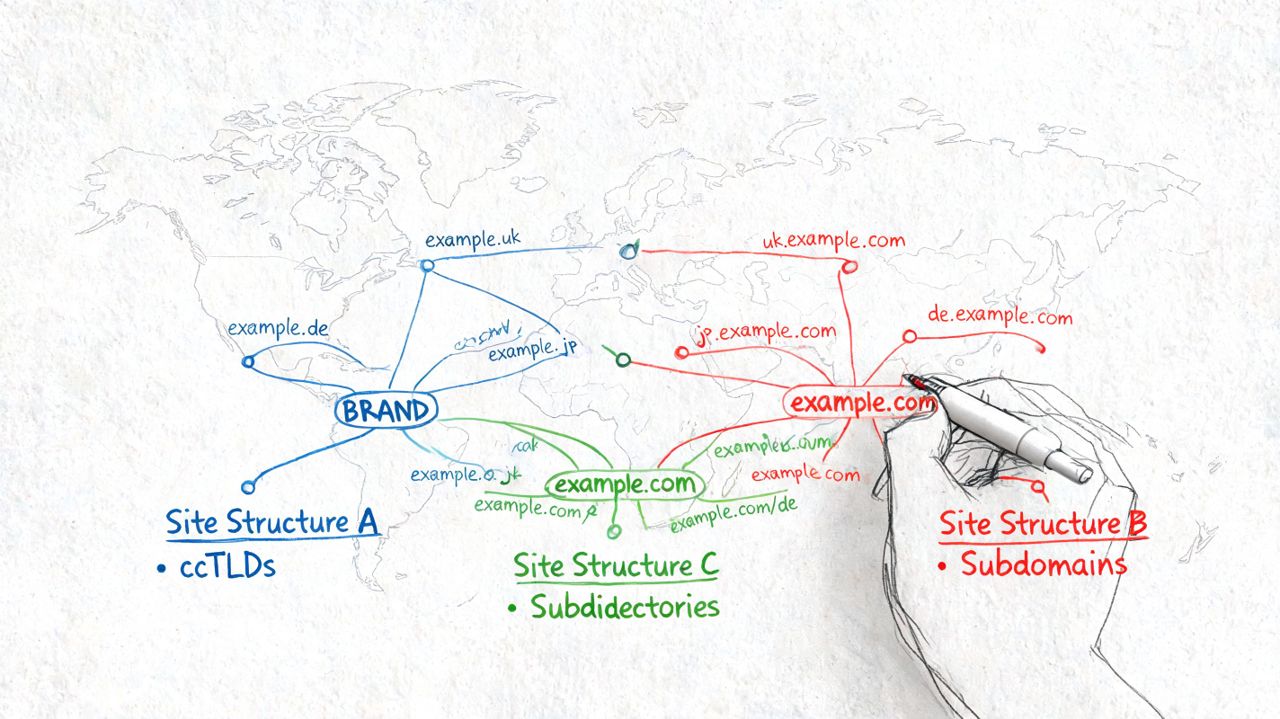
The three structures and what they really cost
ccTLDs such as yourbrand.de or yourbrand.fr send the strongest country signal. They also create the highest operational burden. You are effectively running multiple web properties, each needing its own technical governance, content production, authority development, and sometimes local legal and hosting considerations.
Subdirectories such as yourbrand.com/de/ usually give the best balance for companies that want scale without fragmenting authority. They consolidate most SEO effort under one root domain, simplify analytics, and reduce development duplication. They are often the practical choice for brands that need international SEO services without building several semi-independent sites.
Subdomains such as de.yourbrand.com sit in the middle. They can make sense when different regional teams need partial independence, separate stacks, or different deployment cadences. They also create more room for technical drift. In practice, subdomains often become an organizational compromise rather than a pure SEO choice.
A simple way to decide:
| Structure | Best fit | Main upside | Main trade-off |
|---|---|---|---|
| ccTLD | Country-first expansion with strong local presence | Strong geotargeting and local trust | Highest maintenance and fragmented authority |
| Subdirectory | Centralized global brand with shared infrastructure | Consolidated authority and easier management | Less separation for local teams |
| Subdomain | Mixed ownership across regions or platforms | Operational flexibility | Higher risk of inconsistent SEO execution |
When the search engine itself changes the decision
Architecture isn't only about Google. In some markets, your primary search engine isn't Google at all. That changes both platform requirements and how much local infrastructure you may need.
An underserved area in international SEO services is support for non-Google search ecosystems. Suso Digital's international SEO agency analysis notes that Baidu holds 62% search share in China and Yandex holds 65% in Russia. If those markets matter to your business, a default Google-first architecture and tooling stack may not be enough.
Practical rule: Choose the structure your team can govern consistently for years, not the one that looks most sophisticated in a pitch deck.
For most companies, that means resisting unnecessary complexity. If you can't support local content operations, technical QA, and authority building market by market, a sprawling international architecture becomes a liability.
Core Technical Execution Hreflang Canonicalization and Crawl Control
The fastest way to waste international SEO spend is to publish multiple regional versions of a site without giving search engines a coherent set of instructions. In such cases, technical execution stops being a checklist and starts becoming revenue protection.
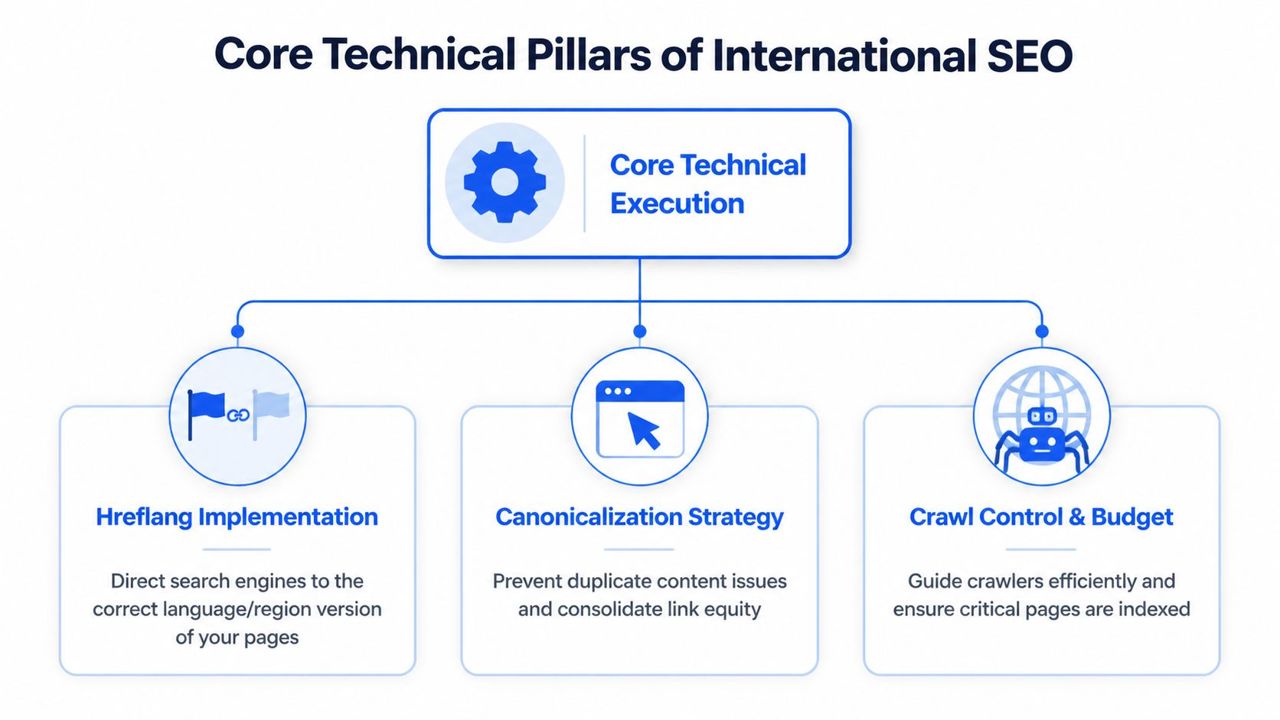
How the signals work together
Think of international SEO like routing deliveries to similar addresses in different cities. The addresses look related, but the destination has to be precise.
Hreflang tells search engines which language and regional version belongs to which user.
Canonical tags tell search engines which page should be treated as the primary URL for indexing when pages are similar.
XML sitemaps help crawlers discover and process those URLs efficiently at scale.
The problem is that these signals can't contradict each other. If one page says "this is the preferred version" through a canonical tag, while hreflang says "these alternates should also be served," you create mixed instructions. Search engines then choose their own interpretation, and that choice often doesn't match your commercial priorities.
What breaks in real deployments
Most failures aren't dramatic. They're quiet. A team rolls out new country folders. Templates inherit the wrong canonical. Hreflang references are incomplete. Search Console stays mostly clean at a glance, but rankings and conversions flatten in specific regions.
According to Search Engine Land's international SEO guidance, misconfiguration between hreflang and canonical tags can impact organic traffic by 15% to 40%, depending on market overlap. The same source notes that for platforms with 10+ regional targets, automating hreflang generation reduces configuration errors by about 85%.
That matters because manual implementation doesn't scale well. Once a site has category templates, product variants, blog content, support documentation, and legal pages across multiple locales, one-off tagging becomes a maintenance trap.
A sound execution pattern usually includes:
- Template-level logic: Build hreflang and canonical rules into the CMS or rendering layer so teams don't rely on manual entry.
- Sitemap validation: Use locale-specific XML sitemaps or validated hreflang sitemap entries so engineering and SEO can audit changes before launch.
- Crawl controls: Keep noindex rules, pagination handling, faceted navigation controls, and internal linking consistent across markets.
- Search Console review: Check international targeting signals, index coverage, and wrong-page surfacing after each release cycle.
If one country page keeps ranking in another country, don't assume the content is weak. Check the technical signals before rewriting copy.
For enterprise ecommerce and SaaS sites, technical QA should happen before content localization at scale. There is no upside in translating hundreds of pages if search engines can't reliably interpret which version belongs where.
Beyond Translation Content Localization and Regional Keyword Strategy
A translated page can be technically indexable and commercially useless. That's one of the most expensive mistakes in international SEO.
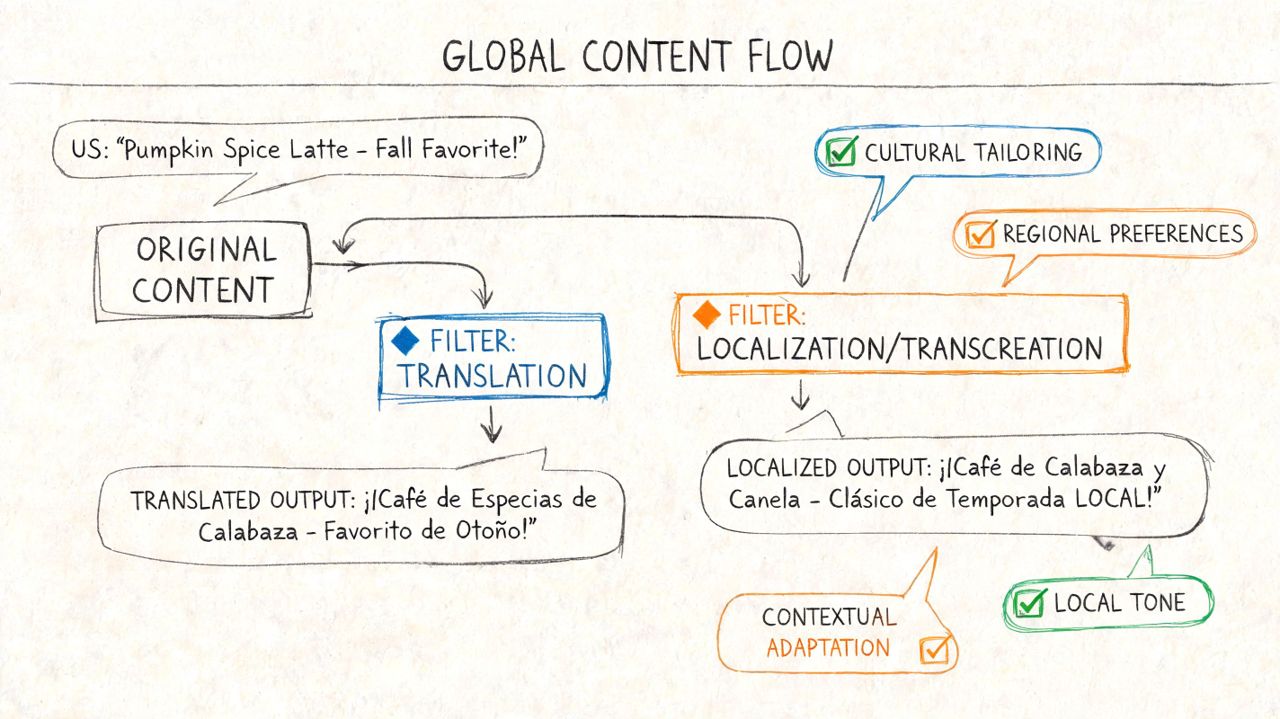
Translation fills pages but localization wins markets
Literal translation preserves words. It rarely preserves intent, urgency, trust, or buying logic. That gap is where rankings stall and conversions fall apart.
The Gray Company's international SEO technical analysis states that automated or literal translation reduces ranking velocity and conversion efficiency by 20% to 35% in high-intent markets. The same source reports that properly localized content with region-aligned keyword targeting generates 35% to 50% higher conversion rates than translated equivalents.
Those numbers line up with what practitioners see in the field. Buyers don't search in neatly translated equivalents of your US keyword map. They search using local product language, regional shorthand, local regulations, preferred buying formats, and phrases shaped by how that market evaluates risk.
A B2B SaaS company may discover that a US page optimized around "book a demo" underperforms in a market where searchers respond better to evaluation language tied to compliance or implementation. An ecommerce brand may learn that local users expect product dimensions, shipping expectations, payment methods, and promotional language to appear differently than they do on the source-market page.
A translated page says what you meant. A localized page says what the market expects.
When teams need operational support for that process, resources like Translators USA's global localization solutions can help frame the difference between simple translation workflows and full website localization.
What localized keyword strategy looks like
Localized keyword work starts from zero for each language-region pair. It doesn't begin with exporting a domestic keyword list and handing it to a translator.
Strong execution usually includes:
- Independent keyword research: Use regional databases in tools like Ahrefs or SEMrush to find terms used in-market.
- Intent mapping: Separate informational, commercial, and transactional demand by locale. The same language doesn't guarantee the same funnel behavior.
- On-page rebuilds: Rewrite titles, headings, internal anchors, schema fields, and supporting copy around regional search behavior.
- Commercial adaptation: Align currency, delivery expectations, proof points, trust signals, and CTA language with the market.
The practical test is simple. If a local buyer lands on the page, does it feel built for them or merely converted for them? Search engines increasingly reward the first version because users do too.
Applying the Framework International SEO for eCommerce SaaS and Local
The same international SEO service package won't fit every business. The revenue model changes the priorities.
eCommerce brands
An ecommerce retailer expanding into multiple countries usually hits the same friction points first: product duplication, category overlap, inconsistent filters, and weak local trust signals.
Consider a brand selling apparel across the US, the UK, and Germany. The core catalog may stay similar, but size standards, shipping expectations, returns messaging, currency display, and even seasonal merchandising often need market-specific treatment. If the UK category pages inherit US copy and product attributes, rankings may struggle even before conversion problems appear.
For ecommerce, the work typically centers on:
- Category and product localization: Not just copy, but naming conventions, product specs, and supporting content.
- Structured data alignment: Product schema, availability messaging, and commercial markup need to reflect what a user in that market is able to buy.
- Review and trust adaptation: Regional proof matters. Testimonials, shipping policies, and returns language should feel local.
The common mistake is launching too many market pages too early. A smaller set of well-localized categories almost always outperforms a broad roll-out of thin, duplicated inventory pages.
B2B SaaS companies
SaaS has a different problem. The product may be identical worldwide, but the reasons to buy it are not.
A CRM, analytics platform, or workflow tool may solve a universal problem, yet the search journey changes by region. Some markets respond to efficiency and automation language. Others respond to security, implementation support, or compatibility with local workflows. That changes the keyword universe, page hierarchy, and CTA strategy.
For SaaS, effective international SEO services usually focus on:
- Localized solution pages: Reframe use cases, not just interface descriptions.
- Regional funnel design: Support both self-serve intent and sales-led demo intent depending on country.
- Integration and ecosystem relevance: Content around local partners, standards, or workflows often matters more than generic feature pages.
- Documentation and help content: This often ranks early in expansion efforts and strongly influences trust.
A mature SaaS SEO partner may also connect technical implementation, localized content planning, and conversion tracking into one roadmap. That can be done by internal teams, agencies, or focused consultants such as SEOBRO®, depending on how much strategic and hands-on support the company needs.
Local and multi-location service businesses
Service businesses expanding internationally often misunderstand the challenge. They assume one translated service page per country is enough. It usually isn't.
A firm entering new regions needs local landing pages that reflect service availability, geography, operational scope, and trust. If the business has physical locations or local teams, business listing consistency and geo-targeted content become important. If it's a remote-first service model, authority signals and service-area clarity still matter.
Examples include:
- A legal or consulting firm: Needs country-specific service language, local credential framing, and pages aligned with regional demand.
- A home services franchise: Needs local business profiles, location pages, and region-specific reviews.
- A healthcare or education provider: Needs careful content localization around terminology, compliance, and trust language.
The right international SEO model depends less on industry labels and more on how your business gets bought.
That is why service scope should follow business model first, then geography. Ecommerce needs merchandising and product architecture discipline. SaaS needs funnel and use-case localization. Local businesses need market trust and regional landing-page depth.
Measuring ROI KPIs Pricing Models and Vendor Selection
If an international SEO provider can't explain how revenue will be measured by market, the engagement is already at risk. The technical work may still get done, but finance and leadership won't trust the outcome.
What to measure by market
Vanity reporting hides weak execution. A rise in total sessions means very little if the wrong countries are growing, the wrong pages are ranking, or localized visitors don't convert.
Embarque's analysis of international SEO agency gaps states that 70% of international campaigns fail ROI benchmarks due to improper multi-regional GA4 setups that ignore hreflang-driven traffic segmentation. The same source says localized funnels boost conversion by 35%, yet only 15% of services include conversion-rate-optimized schema for demos and signups.
That should change how you evaluate SEO reporting. For international programs, the useful KPI set is usually:
- Organic sessions by country and language
- Localized keyword visibility by market
- Landing page performance by locale
- Qualified leads, demos, signups, or revenue by country
- Conversion rate from organic traffic by market
- Indexation and technical error trends by regional section
If your analytics doesn't separate those dimensions cleanly, reporting becomes political instead of operational. Teams argue about attribution because the implementation never supported clean attribution in the first place.
How pricing models shape execution quality
International SEO services are often sold under three models: monthly retainers, fixed-scope projects, and hybrids. None of these approaches is flawed by nature. The risk comes from mismatch.
A project-based model works when the business needs a clear architecture decision, a technical audit, hreflang remediation, or a market-entry roadmap.
A retainer model works when the company needs ongoing localization, content deployment, authority building, testing, and reporting.
A hybrid model often fits best for serious expansion. Audit and roadmap first, then implementation and iteration over time.
When reviewing costs, it helps to understand adjacent localization expenses too. For teams planning multilingual rollout budgets, Django localization pricing models offer a useful reference point for how translation and localization pricing can differ operationally.
International SEO Vendor Evaluation Checklist
A capable vendor should be able to connect architecture, technical QA, content localization, and revenue measurement without hand-waving. Use this checklist in procurement or during shortlist calls.
| Evaluation Area | Key Questions to Ask | Look for (Green Flag) | Avoid (Red Flag) |
|---|---|---|---|
| Market prioritization | Which countries should we enter first, and why? | Prioritization based on commercial intent, operational readiness, and search opportunity | "We should launch everywhere at once" |
| Site architecture | Why are you recommending ccTLDs, subdirectories, or subdomains for us? | Clear reasoning tied to business model, resources, and governance | One-size-fits-all recommendation |
| Technical validation | How do you audit hreflang, canonicals, indexing, and crawl behavior? | Uses tools such as Google Search Console, crawlers, template reviews, and QA processes | Talks about hreflang but can't explain validation |
| Localization process | Who handles keyword research and content adaptation by locale? | Separate keyword research and human-led localization workflow | Direct translation presented as SEO strategy |
| Conversion strategy | How will localized pages improve leads or sales, not just traffic? | Ties landing pages, CTAs, schema, and funnel behavior to outcomes | Reports rankings without conversion discussion |
| Analytics setup | How will you track performance by country, language, and page type? | Clean GA4 segmentation and market-level reporting design | Blended reporting that hides weak markets |
| Implementation ownership | Who actually executes changes across dev, content, and SEO? | Named owners, clear handoffs, and deployment process | Strategy-only engagement with no path to implementation |
| Search engine coverage | Do you support markets where Google isn't the default engine? | Acknowledges Baidu, Yandex, and local search realities when relevant | Assumes Google is the only engine that matters |
The strongest partners don't oversimplify. They also don't make international SEO sound mystical. They show how the work gets prioritized, deployed, validated, and tied back to revenue.
Conclusion Building Your Global Growth Engine
International expansion through search isn't a plugin, a translation pass, or a set of hreflang tags dropped into the head of the site. It's a commercial system. Architecture determines how well the system can scale. Technical execution determines whether search engines can trust it. Localization determines whether buyers will act on it. Measurement determines whether leadership will keep funding it.
That is why international SEO services should be treated as a strategic investment, not a tactical add-on. The upside is substantial when your site is aligned to how each market searches and buys. The downside is equally real when global traffic lands on pages that were never built to rank or convert locally.
If your company is entering new markets, this is the right time to pressure-test your current setup. Look at architecture, technical signals, localization depth, and market-level attribution together. If those pieces don't connect, consider a strategic SEO audit and work with an experienced SEO consultant who can build a search strategy around revenue rather than vanity traffic.
Frequently Asked Questions about International SEO Services
How long does international SEO take to show results
Some improvements happen quickly after technical fixes, especially when a site has major routing or indexing errors. If hreflang, canonicalization, or crawl controls are broken, correcting those issues can help search engines process the site more accurately in the near term.
Meaningful business impact takes longer. New localized pages need to be indexed, evaluated, and compared against competitors already established in those markets. Content quality, internal linking, authority signals, and localized funnel performance all take time to mature. In practice, international SEO should be treated as a medium-term growth investment rather than a short campaign.
What is more important ccTLDs or subdirectories
Neither is always better. The right answer depends on operating model, resources, and how independently each market needs to run.
ccTLDs are stronger when local trust, distinct country presence, and market separation are central to the strategy. They are heavier to manage.
Subdirectories are stronger when the company wants centralized authority, simpler governance, and lower operational sprawl.
Subdomains can work when technical or organizational constraints require separation, but they need tighter oversight.
The best structure is the one your team can support consistently with strong technical QA and local content operations.
Can I just use an automated translation plugin for my website
For serious international growth, no. Automated translation can help with rough internal drafts or temporary support content, but it doesn't replace localization. It usually misses regional keyword intent, weakens trust, and creates copy that feels generic or awkward to native users.
That problem affects SEO and conversion at the same time. Search engines need clearer local relevance signals. Buyers need language that reflects how they search, evaluate, and purchase in their market. If the page sounds imported, performance usually follows.
How do I know which markets to prioritize first
Start with real signals, not ambition. Review existing organic traffic by country, paid campaign performance, sales inquiries, shipping demand, partner activity, and operational readiness. Then compare that with search opportunity and competitive difficulty in each market.
The right first markets are usually the ones where demand, execution capacity, and business readiness overlap. It is better to win a smaller set of markets with strong localization and reporting than to spread effort across too many countries and underperform everywhere.
Do international SEO services include non-Google search engines
They should when the target market requires it. If your business is entering countries where Google isn't the only meaningful search engine, your SEO provider should account for that in research, technical setup, and content strategy.
This doesn't always mean a full parallel program for every engine. It does mean the provider should understand when a Google-only approach creates blind spots.
If you're planning international growth and need a senior partner to connect technical SEO, localization, conversion paths, and reporting into one accountable strategy, SEOBRO® can help assess the gaps and build an international SEO roadmap around qualified leads, revenue, and scalable organic visibility.