Teams looking at AI for SEO often find themselves in the same spot. The backlog keeps growing, but the work doesn't get easier. Someone still has to check Search Console patterns, review content decay, compare competitor pages, spot internal linking gaps, and turn all of that into changes that ship.
That's why agentic SEO gets attention. In theory, agents can audit, prioritize, draft, and execute across the SEO workflow without waiting for a person to push every button. In practice, that promise breaks fast if the system has weak instructions, poor data access, or no approval controls. A bad workflow doesn't just waste time. It can publish inaccurate content, over-apply changes, or create technical messes at scale.
The right way to think about agentic SEO workflows is the same way you'd think about building a house. You need a foundation, clear blueprints, and inspections before anything goes live. In SEO terms, that means role design, trusted data sources, trigger logic, approval gates, and rollback rules.
Used well, agents don't replace SEO judgment. They reduce repetitive labor and make optimization more continuous. A 2026 industry guide on agentic SEO reports 80% reduction in keyword research effort, 70% faster content creation, and 90% reduction in technical audit time, while describing the shift from scheduled SEO work to always-on optimization. That's the upside.
The catch is governance. High-stakes SEO work still needs humans in the loop, especially when an output can affect rankings, brand trust, leads, or revenue.
Introduction
Agentic SEO workflows aren't just automations with a smarter label. They are operating systems for SEO work. The difference matters.
A standard automation follows a preset instruction. Pull rankings, export a sheet, send a Slack alert. An agentic workflow can evaluate a goal, gather signals, choose from approved actions, and hand off a recommendation or task package for review. That's useful when the SEO team is overloaded and every high-value action depends on stitching together data from multiple places.
The mistake is assuming more autonomy automatically means better SEO. It usually doesn't. The strongest systems are controlled systems. Humans still decide what quality looks like, what risk is acceptable, and which changes can touch the live site.
What makes a workflow useful
Good agentic workflows do three things well:
- They reduce repetitive work like recurring audits, content refresh analysis, issue clustering, and internal linking suggestions.
- They improve prioritization by tying recommendations to search intent, commercial value, technical impact, or content gaps.
- They create cleaner execution paths so approved work moves faster from idea to implementation.
What breaks these systems
The weak versions usually fail for predictable reasons:
| Failure point | What happens |
|---|---|
| Bad inputs | The agent works from stale or incomplete data |
| Weak role definition | It tries to do too much and produces vague output |
| No approval gate | Drafts or changes go live before anyone checks them |
| No logging | Nobody can trace why a recommendation was made |
| No rollback path | A bad change stays live longer than it should |
Practical rule: If an SEO workflow can change indexation, publish content, alter links, or modify templates, it needs a review checkpoint before deployment.
That's the frame for agentic SEO. It's not automation versus control. It's controlled automation built to support better SEO decisions.
The Core Components of an Agentic SEO Framework
Before you assign an agent a single task, you need to define the environment it operates in. Most failed setups skip this and jump straight into tools.
What makes a workflow agentic
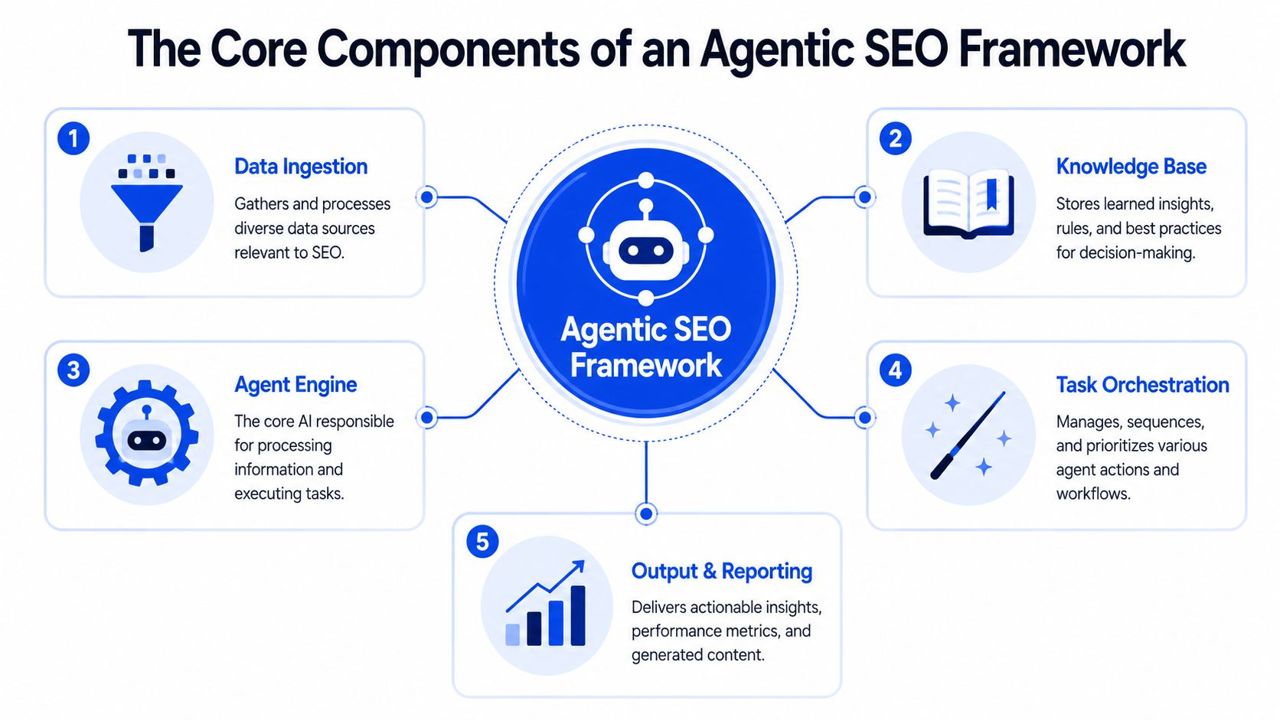
A practical workflow usually combines five moving parts:
- Data ingestion
- Knowledge base
- Agent engine
- Task orchestration
- Output and reporting
Many teams often confuse “AI in SEO” with a real operating model. A writing assistant is a tool. An agentic system connects context, rules, triggers, and actions.
If you want a useful outside primer on where AI fits into search operations more broadly, Spotlight Group has a solid piece on AI-powered search optimization that helps frame the broader shift.
The five components that matter
Data ingestion
Agents are only as good as the sources they can access. For SEO, that often means Google Search Console, analytics data, crawl exports, page templates, product feeds, CMS fields, internal link maps, and competitor observations.
The main rule is simple. If the input isn't trusted, the recommendation won't be trusted either.
Knowledge base
This is a frequently missed component. The agent needs rules. Brand constraints, no-go topics, schema standards, content templates, entity definitions, quality thresholds, approval logic, and escalation instructions all belong here.
Without a knowledge base, the agent improvises. That's where hallucinated recommendations start.
Agent engine
This is the reasoning layer that interprets the task and decides what to produce. In production, it should not have open-ended freedom. It should work within bounded instructions.
It's like hiring an analyst. You want judgment inside a role, not a freelancer inventing the job.
Task orchestration
This controls sequence. Which signal starts the process, what happens first, what gets checked next, and who receives the output.
Examples of useful triggers include:
- Ranking decline on a priority page that pushes the page into a refresh queue
- New product or feature launch that starts metadata, internal linking, and content brief generation
- Template issue detection that creates a technical QA ticket instead of changing the site directly
Output and reporting
Agents need a fixed output format. Not “thoughts.” Not raw chat. A proper workflow should return a brief, ticket, change log, recommendation set, or approval-ready draft.
The shift that matters isn't just speed. It's moving from occasional SEO activity to a continuous optimization loop with clear decision paths.
That's where the architecture earns its keep. Without it, you don't have agentic SEO workflows. You have scattered prompts and a false sense of progress.
Defining Agent Roles and Crafting Effective Prompts
A lot of agentic SEO projects fail before the first output gets reviewed. The problem is not model quality alone. It is vague role design, weak prompt structure, and no clear boundary between analysis, recommendation, and action.
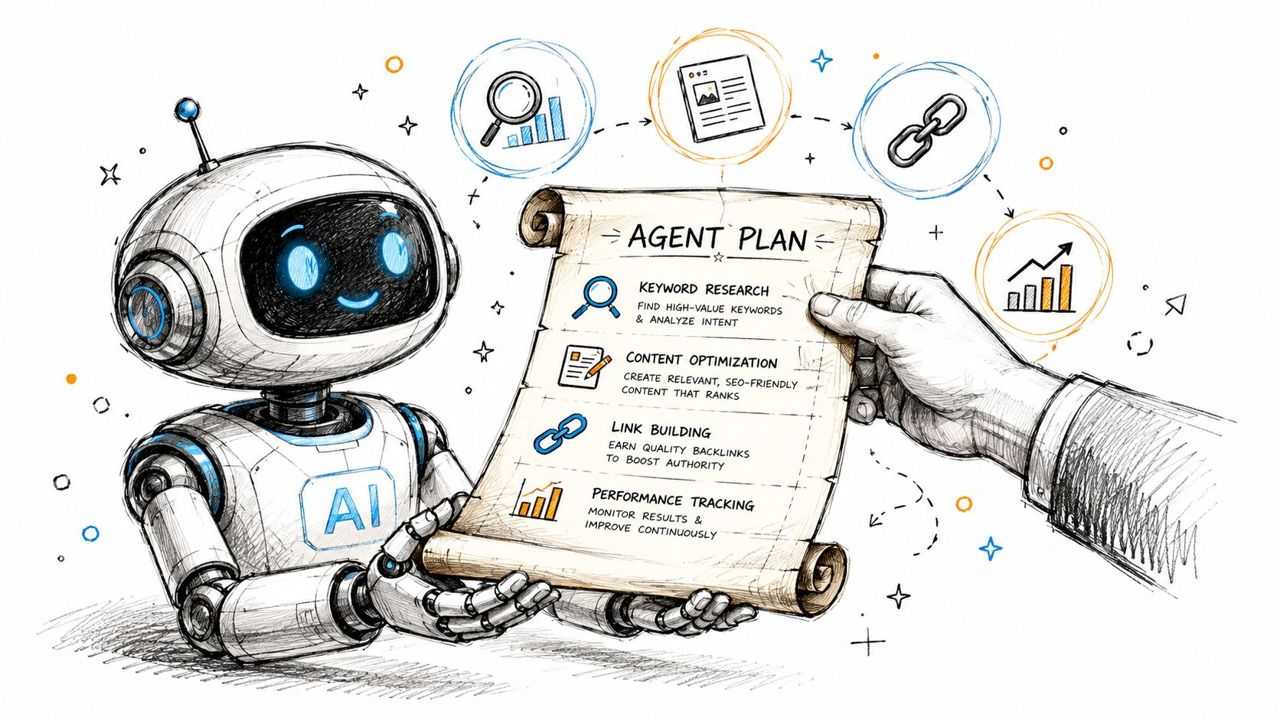
The fix is simple in concept and strict in execution. Give each agent one job, one approved evidence set, one output format, and one clear stop condition. If an agent can research, decide, rewrite, and publish in the same loop, you have created a control problem, not an SEO system.
Good roles reduce bad output
Start with narrow roles that map to real SEO functions and real review paths. I do not recommend a single "SEO super agent" for production work. It hides failure, makes QA harder, and increases the chance of hallucinated recommendations reaching a live page or a dev queue.
Three early roles usually carry the most value with the least operational risk:
| Agent role | Best use | Risk level |
|---|---|---|
| Opportunity scout | Finds content decay, keyword gaps, comparison topics, weak CTR pages | Low |
| Technical auditor | Flags crawl waste, broken links, orphan pages, redirect chains | Medium |
| Content strategist | Builds SERP-informed briefs and update recommendations | Medium |
That separation matters for governance. An opportunity scout can rank pages by refresh potential. It should not rewrite copy. A technical auditor can identify canonical conflicts or internal link gaps. It should not change directives on its own. A content strategist can draft a brief and list missing proof points. It should not invent claims to make the brief look complete.
Role-based setups also make handoffs cleaner across SEO, content, and engineering teams. Platforms built around AI workers, such as Donely, reflect the right operational model here. Assign bounded responsibilities, then review outputs at the points where brand risk, revenue risk, or implementation risk increases.
Teams that test these workflows often learn the same lesson. Agents perform better when they work from real page data, product facts, and defined templates. They fail when asked to generate generic SEO work at scale with little context and no approval logic.
Prompt structures that hold up in production
Useful prompts read like operating instructions. They specify the task, approved inputs, output schema, and failure conditions. That gives the model less room to improvise and gives reviewers a predictable artifact to approve, reject, or send back.
Opportunity scout template
- Context: You are analyzing existing site pages using Search Console, analytics, and page inventory.
- Objective: Identify pages with traffic decay, low CTR, or missing commercial follow-ups.
- Inputs: Page URL, target query set, recent performance window, page type, conversion goal.
- Output: Priority score, issue summary, recommended action, evidence used.
- Constraints: No publishing suggestions without citing available page data. Flag uncertainty explicitly.
Technical auditor template
- Context: You are reviewing crawl and internal architecture signals.
- Objective: Surface issues affecting discovery, indexation, and authority flow.
- Inputs: Crawl export, sitemap data, internal link graph, canonical data.
- Output: Issue type, affected URLs, likely cause, implementation note, escalation owner.
- Constraints: Do not alter robots directives or canonicals. Escalate instead.
Content strategist template
- Context: You are preparing a content update or new page brief.
- Objective: Match search intent and identify missing evidence.
- Inputs: Target topic, SERP observations, internal pages, product or service facts.
- Output: Working title, outline, internal links, proof requirements, CTA intent.
- Constraints: Do not fabricate examples, testimonials, statistics, or product claims.
Good prompts also define what the agent must do when the evidence is weak. That is one of the biggest differences between a demo and a production workflow. If Search Console data is incomplete, product facts are missing, or crawl exports conflict, the correct behavior is to return an exception state and request human review. Silent guessing is expensive.
Prompt quality also depends on what you leave out. Avoid broad instructions such as "optimize this page for SEO" or "create a best-practice brief." Those prompts produce polished filler, generic headings, and fake confidence. Ask for page-specific observations, tie every recommendation to a source input, and require the agent to label assumptions.
A practical prompt usually includes five parts: role, task, inputs, output schema, and refusal rules. If one is missing, quality drops fast. If two are missing, you should treat the result as draft material only, never implementation-ready.
The goal is not more AI activity. The goal is controlled output that a human reviewer can check quickly, trust selectively, and push into revenue-driving work without creating cleanup later.
Building Safety Guardrails and Human Handoff Points
The biggest mistake in agentic SEO is treating autonomy as the goal. For any workflow that touches live pages, autonomy is a risk category.
The model that keeps risk contained
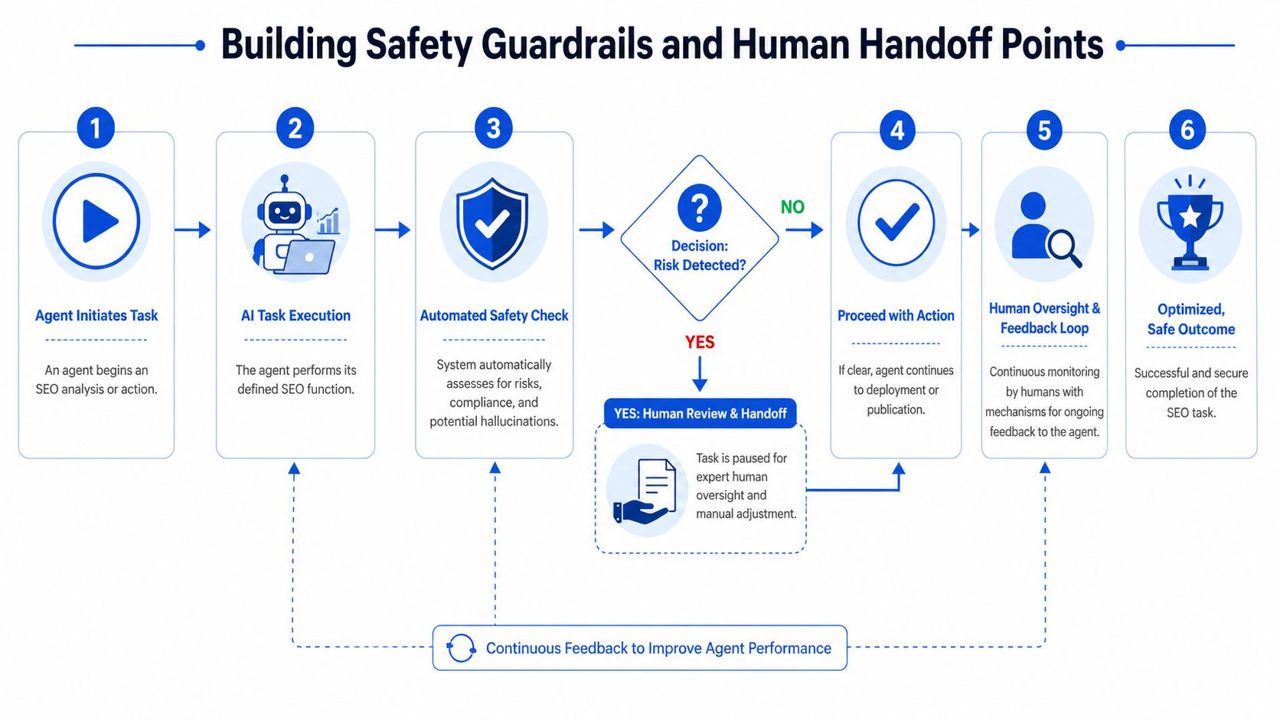
The baseline model should be propose → review → publish. That guidance is stated directly in Tetrate's expert workflow guidance, which recommends human approval, defined inputs and outputs, escalation paths, minimum quality thresholds, and logging for at least 90 days.
For search teams working on AI-era visibility, this same principle matters beyond classic rankings. If you're planning workflows around answer engines and citation-ready content, AI search optimization services should still be built with review gates, not blind automation.
A safe handoff model usually includes:
- Pre-checks for source validity, page eligibility, and content type
- Human review for factual accuracy, intent fit, and brand risk
- Staged release so changes hit a small batch before broader rollout
- Logging so every recommendation, approval, and publish action can be audited
- Rollback rules for poor output, indexing issues, or conversion decline
To see the handoff concept in action, this explainer is worth a quick watch:
Three practical workflow examples
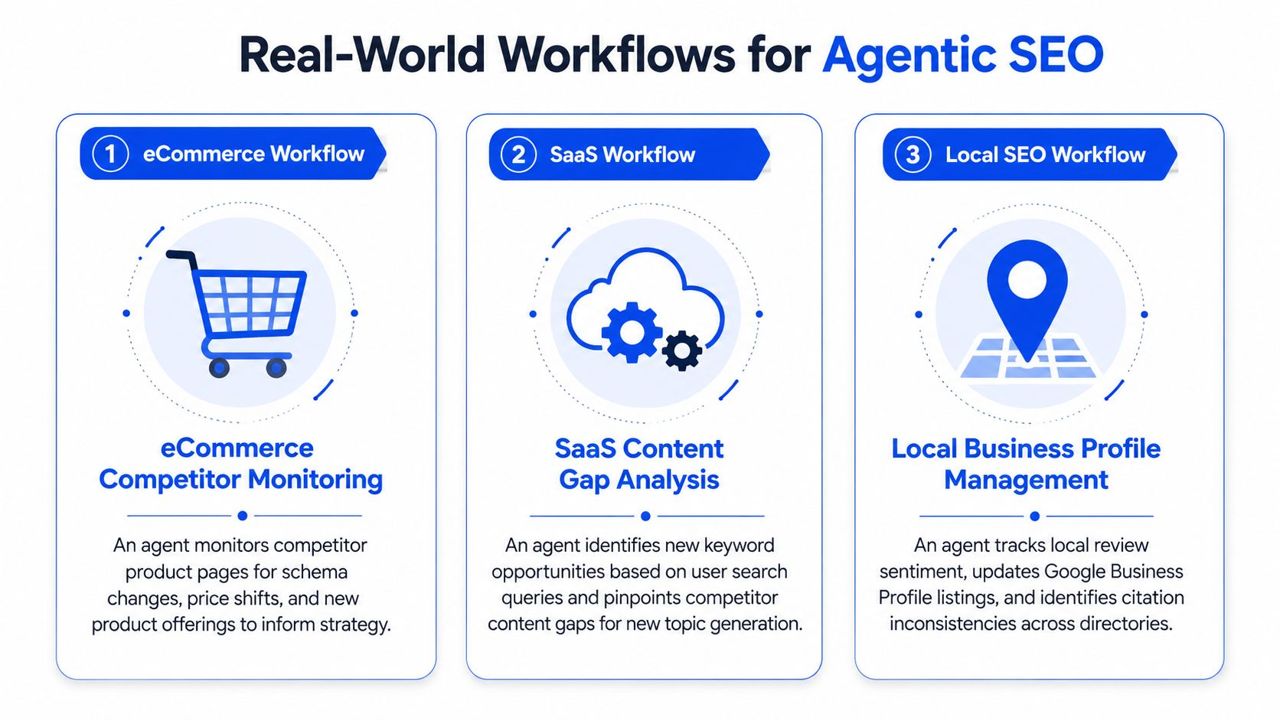
eCommerce
An online retailer uses an agent to monitor product and category pages for missing specifications, weak FAQs, and thin comparison copy. The agent doesn't publish. It creates a refresh queue, highlights missing proof points, and sends a merchandiser or SEO lead a structured recommendation set.
The handoff matters because product details change fast. A wrong attribute or outdated claim can create both SEO and conversion problems.
SaaS
A SaaS team runs an agent to detect emerging “vs” and “alternative to” topics. The system gathers SERP patterns, checks whether the company has a page that satisfies the query, drafts a comparison brief, and routes it to content and product marketing.
Here, the review gate protects the brand. Comparison content can't rely on guessed feature claims or soft assumptions about competitors.
Local business
A multi-location service brand uses an agent to draft answers for recurring Google Business Profile questions based on approved service information and location-specific details. A local marketing manager reviews each answer before it goes live.
The value of agentic SEO usually comes from selective automation of repetitive work, while humans keep strategy and QA.
That's the model that scales. Not full autonomy. Controlled throughput.
Real-World Workflows for eCommerce, SaaS, and Local SEO
An agent that looks productive can still do expensive damage. I have seen retail teams generate index bloat from auto-created category variants, SaaS teams publish comparison copy with guessed competitor claims, and local brands push location updates that changed hours or service details without anyone catching the error. The workflow only becomes useful when it is tied to a business model, a review path, and a clear owner.
eCommerce monitoring that leads to action
In eCommerce, the safest high-value workflows usually start with detection, not publishing. An agent can monitor product and category pages for missing specs, thin comparison copy, weak FAQs, out-of-stock dead ends, and internal search patterns that point to missing filters or subcategories. That is useful because it turns a huge catalog into a ranked queue of fixes.
The control point matters more than the draft. Product data changes fast, merchandising priorities shift, and faceted navigation can create a mess if an agent is allowed to expand URLs or rewrite template logic on its own. The better setup is simple. Let the agent flag issues, group them by revenue impact, and route them to SEO, merchandising, or dev based on the type of fix needed.
Strong eCommerce workflows also account for site mechanics, not just content output. If category expansion creates more crawl waste, weaker internal linking, or duplicate paths to the same products, the workflow should trigger a technical review before any new page is approved.
SaaS workflows that support revenue pages
SaaS teams usually get the best returns from workflows tied to commercial intent pages. That includes “vs” terms, alternative pages, integration pages, use-case pages, and refreshes on articles that already assist pipeline.
The mistake is letting the agent treat all of those page types as a writing task. They are evidence tasks. A useful workflow gathers SERP patterns, existing page coverage, product documentation, sales call themes, and approved competitive positioning. Then it prepares a brief or draft for review. Product marketing, SEO, and sometimes legal still need to check the claims.
As noted earlier, real gains tend to come from workflows that add original information to existing assets rather than rewording pages that already say what every other result says. In practice, that means customer examples, internal product knowledge, screenshots, integration specifics, and proof from sales or support data. If the agent cannot access trusted inputs, it should not be drafting comparison claims.
Runaway publishing is a real risk here. One poorly governed agent can create dozens of near-duplicate commercial pages, confuse canonical signals, and put inaccurate competitor statements on the site. I do not recommend auto-publishing for these workflows.
Local SEO workflows where accuracy matters most
Local SEO needs the tightest approval loop of the three. Hours, addresses, practitioner names, service areas, review responses, and pricing qualifiers can affect trust and operations as much as rankings.
A practical local workflow can:
- Monitor listing inconsistencies across major directories and queue fixes for approval
- Draft GBP Q&A responses using approved service and location information
- Surface review themes that should be reflected in local landing pages and FAQs
- Recommend geo-page updates based on real service delivery, proof, and location-specific details
The agent should work from a controlled source of truth, not from scraped listings or old page copy. If a business has multiple locations, each update also needs an owner. Someone has to confirm that the Dallas office still offers the service, that the clinician is still at that location, or that holiday hours were officially approved.
For all three business models, the KPI is business impact from approved changes. Track which pages or profiles were touched, what a human approved, what was rejected, and what happened after launch.
If an agent cannot connect its output to a business page, a search intent, and a measurable outcome, it is producing activity, not value.
Search intent optimization should inform workflow design. Agents are good at clustering signals and surfacing patterns. Humans still need to choose which intents are worth serving, which pages deserve investment, and which outputs are too risky to publish without a full review.
How to Measure the ROI of Your Agentic SEO Workflows
Often, the wrong thing is measured first. This involves counting drafts produced, tasks completed, or hours saved. While those can be useful operational metrics, they don't prove SEO value.
Measure page impact, not agent activity
A better approach is to evaluate pages and workflows like you would any other SEO investment:
- Track the pages touched by the workflow
- Label the type of intervention such as refresh, new brief, internal link update, or technical fix
- Compare performance after publication or implementation
- Tie outcomes to leads, demos, sales, or assisted conversions where possible
If an agent helps produce faster work but the page doesn't rank better, earn more qualified visits, or contribute to pipeline, the workflow hasn't proven ROI.
A practical ROI scorecard
A simple scorecard should include four layers:
| Layer | What to watch |
|---|---|
| Efficiency | Time saved in research, audits, briefing, or QA |
| SEO impact | Changes in clicks, impressions, rankings, and indexation health |
| Business impact | Demo requests, form fills, transactions, assisted revenue |
| Risk control | Error rate, human overrides, rollback events |
For teams trying to make this visible to leadership, the cleanest reporting model is page-based. Show which URLs were changed by an agent-assisted workflow, what was approved, and what happened next.
That also keeps everyone honest. If a workflow creates a lot of output but little movement, you can cut it. If it consistently improves high-intent pages, you can expand it.
For a more complete reporting setup, build workflow attribution into your broader measurement model and connect it to how to measure content marketing ROI. That keeps SEO automation tied to revenue, not vanity activity.
Conclusion
Agentic SEO workflows are useful when they behave like disciplined assistants, not rogue operators. The upside is real. Teams can reduce repetitive work, surface better opportunities, and keep optimization moving without waiting for quarterly clean-up cycles.
But the operating principle is simple. Automation handles repetition. Humans handle judgment.
If you want these systems to produce business value, keep the scope narrow at first. Assign clear roles. Use trusted data. Force structured outputs. Add approval gates. Log everything. Expand only after the workflow proves it can improve the work without increasing risk.
That's how agentic SEO becomes a competitive advantage instead of an expensive experiment.
Frequently Asked Questions About Agentic SEO
What's the difference between AI SEO tools and agentic workflows
An AI SEO tool usually performs one task at a time. It might generate a draft, cluster keywords, summarize a SERP, or score content.
An agentic workflow links multiple steps together under one goal. It can gather inputs, run an analysis, prepare a recommendation, and route that output to the right person for approval. The difference is orchestration.
Can agentic workflows build backlinks
They can support link building, but they shouldn't run outreach autonomously in most cases.
Agents are useful for prospect discovery, relevance checks, outreach research, and draft creation. Human review is still needed for relationship quality, pitch strategy, and brand protection. Fully automated outreach usually creates spam patterns faster than it creates authority.
How much technical skill do you need
That depends on the workflow.
Simple systems can run through no-code automation tools connected to APIs and spreadsheets. More mature setups often need engineering support for CMS integration, private data access, logging, permissions, and QA layers.
The smartest starting point is usually one contained workflow with low publishing risk.
Is there a risk of Google penalizing agentic SEO
There isn't a penalty for using AI or agents by themselves. The risk comes from poor output.
If a workflow publishes thin, repetitive, misleading, or low-value content at scale, performance can suffer for the same reason bad human-made content suffers. Search systems evaluate the result, not whether a person or model typed it.
What tasks should never be fully autonomous
High-risk tasks should always have human review. That includes:
- Publishing new money pages tied to sales, lead generation, or legal sensitivity
- Changing canonicals or indexation logic on important templates
- Writing competitor comparisons without fact checks
- Answering local business questions where accuracy affects trust
- Injecting internal links sitewide without editorial controls
What's the best first workflow to build
Start with a workflow that produces recommendations, not live changes.
Good first options include content decay detection, page refresh prioritization, issue clustering from crawls, internal link opportunity suggestions, or comparison brief generation. These workflows amplify efforts without giving the system too much authority too early.
Do agentic workflows help with AI search visibility
They can, especially when they help teams produce clearer structure, stronger entity coverage, better FAQs, and more evidence-backed updates. But the same rule applies. The workflow should improve information quality, not just content volume.
If you want to build agentic SEO workflows that improve rankings, leads, and revenue without creating avoidable risk, SEOBRO® can help you design the strategy, controls, and implementation path around real business outcomes.