You ask an AI assistant a simple SEO question: “What pages lost rankings this week?” or “Which competitors picked up new backlinks on our commercial terms?” The model sounds capable for a second, then hits the same wall. It can explain SEO. It can't see your current data.
That's been the primary limit of AI in search work. Not writing ability. Not summarization. Access.
Most SEO teams still live in a fragmented workflow. Search Console in one tab. Semrush or Ahrefs in another. Screaming Frog exports in a folder. CRM or revenue data somewhere else. Then someone manually stitches the story together and hopes the recommendation is still relevant by the time it reaches the client, founder, or CMO.
That gap matters because SEO isn't a static discipline. Rankings move, pages fall out of indexation, SERPs change, products go out of stock, and local competitors update offers without warning. If the AI system can't query live sources, it can't operate like a real analyst. It can only guess.
That's why MCP for SEO matters. Model Context Protocol gives AI systems a standardized way to connect to external tools and live business data, which turns the model from a disconnected assistant into something much more useful: an operational SEO layer.
The shift is bigger than “AI can now use tools.” It changes how SEO teams execute. Instead of asking a chatbot for generic advice, you can give an AI agent a business task tied to traffic, leads, or revenue. Pull live rankings. Compare them to site changes. Check technical issues. Surface what needs attention.
The practical value of AI in SEO starts when it can inspect live data before it makes a recommendation.
For business leaders, AI ceases to be a novelty and develops into a powerful resource. For practitioners, it's the point where the workflow changes from copy-paste analysis to connected, repeatable operations.
What Is MCP and Why Does It Matter for SEO
A practical SEO scenario makes the value of MCP clear. A revenue dip starts in organic search, the team opens Search Console, a rank tracker, analytics, and a site audit tool, then spends half the day stitching together an answer. Model Context Protocol (MCP) reduces that integration mess by giving AI systems and external tools a shared way to exchange context and actions. Anthropic introduced the protocol publicly in late 2024, and Livewire's explanation of MCP server SEO analysis gives a useful breakdown of how that connection model applies to SEO workflows.
MCP is the connection layer AI was missing
MCP works like a common interface between AI assistants and the systems SEO teams already use. Instead of building and maintaining separate integrations for Search Console, rank tracking, backlink data, technical crawls, and internal reporting, teams can connect through one standard that is easier to manage and extend.
That matters because fragmented connections create cost. They slow analysis, increase QA problems, and keep AI output generic because the model cannot access current business data.
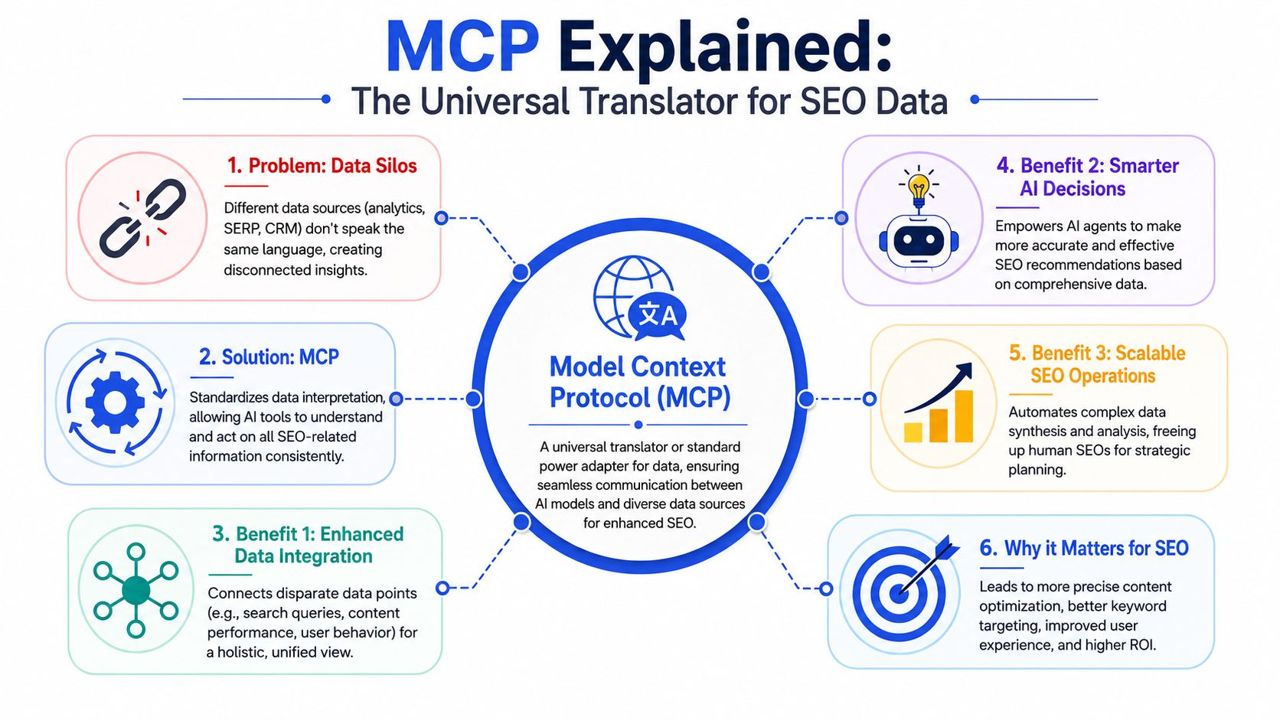
In SEO terms, MCP can let an assistant work with live inputs such as search demand, ranking changes, CPC signals, backlink data, crawl findings, and page-level performance inside the same working session. The trade-off is straightforward. MCP simplifies the architecture, but it does not remove the need for access controls, clean data sources, and clear workflow design.
Why SEO teams should care now
The business case is speed tied to revenue.
An AI model without live access can produce plausible recommendations that miss current ranking losses, product priorities, or local market shifts. An AI system connected through MCP can evaluate what changed, match that change to commercial pages or pipeline stages, and help teams act before the loss spreads.
That is useful for different reasons depending on the business model:
- eCommerce teams can connect ranking and product performance data to spot category or SKU pages that need fixes before organic revenue drops further.
- SaaS teams can connect search demand, funnel-stage content, and conversion data to prioritize topics with pipeline impact instead of traffic alone.
- Local businesses can compare location-level visibility, reviews, and GBP-related signals faster, which matters when leads depend on local intent and rapid response.
It also helps teams judge vendors more clearly. Some MCP products only retrieve data. Others support broader execution across research, reporting, and content operations. If you are comparing options for production workflows, use resources that evaluate AI content workflow MCPs through that operational lens.
For leaders, the takeaway is simple. MCP is not important because it is new. It matters because it connects SEO analysis to business systems in a way that can reduce lag, improve decision quality, and help teams protect or grow search-driven revenue.
Practical rule: If your AI cannot access live SEO and business data, treat its output as a draft, not a decision.
From Manual Analysis to Agentic SEO Workflows
Many teams don't have an SEO strategy problem. They have an execution bottleneck. The insight exists, but it's trapped inside exports, spreadsheets, and disconnected tools.
MCP changes that by enabling agentic workflows. That means the AI isn't just answering a question. It can carry out a multi-step task using connected systems.
What changes when AI can execute workflows
A normal chatbot responds once. An SEO agent can chain actions.
For example, instead of asking, “How are our rankings doing?” you can assign a workflow such as reviewing current keyword movement, checking whether affected URLs have crawl or indexation issues, comparing visibility changes to competitor movement, and generating a summary for the team.
That kind of setup isn't theoretical anymore. A key milestone for MCP for SEO was the rapid commercialization of the ecosystem in 2025–2026, with industry coverage listing SEO-focused MCP servers connected to Google Search Console, DataForSEO, Nightwatch, and other systems, while another source noted that Semrush launched an official remote MCP server. The scale is already meaningful. Nightwatch's MCP-based AI agent was described as tracking thousands of keywords across 200+ countries with daily updates, covered in this overview of SEO MCP tooling.
That matters most for businesses where search visibility changes fast. Ecommerce catalogs, SaaS funnels, and multi-market sites usually don't lose ground because they lack ideas. They lose ground because nobody saw the issue early enough or joined the data quickly enough.
If you're building a broader software stack for SERP analysis, it also helps to discover tools for dominating SERPs and then judge which ones fit into an MCP-enabled workflow instead of creating another silo.
Traditional SEO vs agentic SEO workflows
| SEO Task | Traditional Method (Manual & Siloed) | Agentic Method (Automated & Integrated) |
|---|---|---|
| Rank monitoring | Export position data, compare reports manually, flag changes later | Pull live ranking shifts, summarize material changes, route alerts automatically |
| Competitor tracking | Check tools one by one, save notes in docs or sheets | Query connected datasets and generate a recurring competitor summary |
| Technical issue triage | Review crawler output separately from Search Console and analytics | Cross-reference technical findings with impacted pages and performance trends |
| Content decay detection | Spot declines after traffic drops become obvious | Monitor page-level movement and surface likely causes earlier |
| Executive reporting | Build decks from multiple exports and screenshots | Generate current, source-connected summaries from the same workflow |
Manual SEO work often fails at handoff points. Agentic SEO reduces handoffs, which reduces delay and interpretation loss.
There's still a trade-off. Agentic workflows are only as good as the systems they can access and the instructions they receive. If the underlying data is messy, or if the workflow chases vanity metrics, automation only helps you move faster in the wrong direction.
Practical MCP Use Cases for Driving SEO Revenue
The business case for MCP gets clearer when you stop thinking about prompts and start thinking about lost revenue, missed demos, and weak local lead flow.
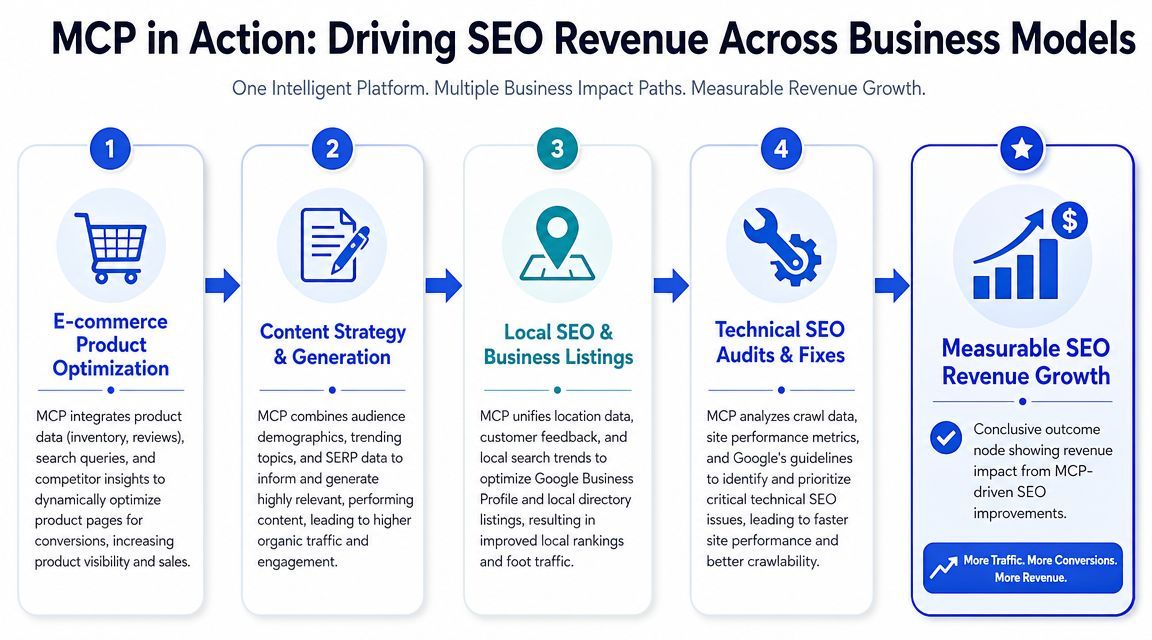
One reason this is becoming useful in practice is scale. For operational SEO workflows, an MCP server can expose tasks such as automated rank tracking across 200+ countries, site auditing, and AI visibility monitoring, which helps teams scale analysis to thousands of keywords and pages while keeping recommendations current, according to Nightwatch's SEO MCP documentation.
Ecommerce teams protecting organic revenue
For ecommerce, the highest-value use cases usually start with revenue protection, not content generation.
A practical workflow looks like this:
- Find commercial decline early: Ask the agent to identify product or category pages with dropping organic visibility.
- Cross-check operational causes: Compare that list against inventory, indexation status, internal linking shifts, and page template changes.
- Prioritize by money, not by traffic: Surface pages where search decline affects products that matter to sales.
A useful prompt might ask the system to review category pages with reduced non-brand visibility, flag pages with indexing anomalies, and note whether out-of-stock or template changes likely contributed. That's much closer to a real commercial review than a generic “optimize this page” prompt.
This is also where technical work matters. If your catalog is large or heavily faceted, live agentic analysis pairs naturally with stronger crawl budget optimization so the pages that drive revenue stay discoverable and indexable.
SaaS teams finding scalable content opportunities
In SaaS, MCP is especially useful when the problem is topic prioritization under changing SERPs.
A connected workflow can monitor high-intent keywords, compare current page formats on page one, identify gaps in your funnel coverage, and suggest whether the best move is a landing page, comparison page, integration page, or a programmatic asset.
That's valuable when a team is deciding whether to scale content production or tighten focus. If your model can inspect live search layouts and existing site coverage, it can help find opportunities that fit actual demand instead of forcing output into a stale content calendar.
For many SaaS companies, this leads naturally into programmatic SEO workflows, where repeatable page types become much easier to monitor, refine, and expand when data, templates, and SERP signals are connected.
Here's a practical pattern that works well:
Review commercial and comparison keywords where competitors rank with repeatable page types, compare our existing coverage, and return page models worth scaling.
That prompt is more useful than asking AI to “give me content ideas,” because it ties output to a monetizable search surface.
The video below gives additional context on how MCP-style workflows are being discussed in practice.
Local businesses reacting faster to market changes
Local SEO often looks simple from the outside, but local lead generation is highly sensitive to review velocity, competitor offer changes, service-area shifts, and Google Business Profile signals.
An MCP-enabled workflow can help a local business:
- Monitor review themes: Pull recent review patterns and highlight service issues that may affect conversions.
- Track competitor changes: Note when nearby competitors add service lines, update categories, or change promotional messaging.
- Spot page gaps: Compare local landing pages against real search behavior and business priorities.
This kind of monitoring works best when someone still makes judgment calls. Local SEO has too much nuance for blind automation. But connected analysis gives faster signal, and faster signal usually means fewer missed leads.
How to Implement MCP in Your SEO Program
Most companies should treat MCP adoption as an operations decision, not a trend decision. The question isn't whether the protocol is interesting. The question is where it fits your current SEO model.
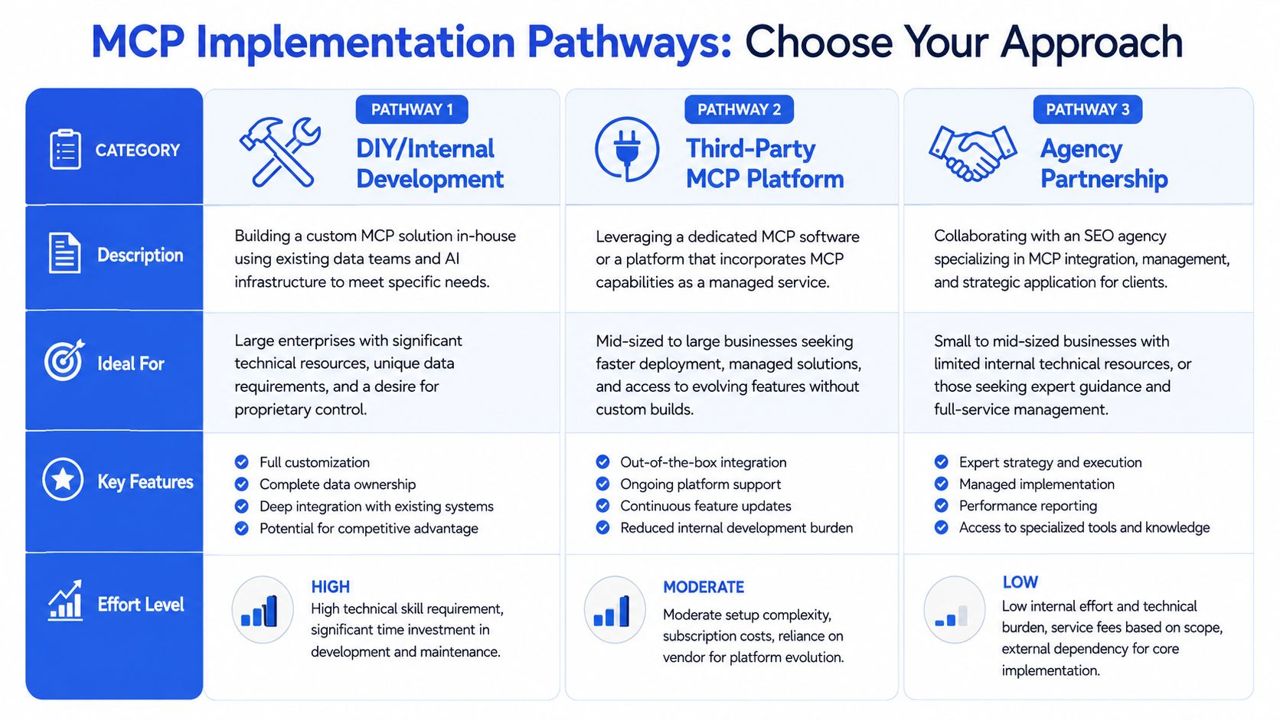
Path one using existing MCP-enabled platforms
This is the fastest route for many teams.
If you already use platforms that support MCP or expose MCP-compatible workflows, you can begin with one narrow use case such as automated reporting, visibility checks, or recurring technical summaries. That keeps complexity low while proving whether the workflow produces better decisions.
This path makes sense when you want faster adoption without building infrastructure internally.
Path two building a custom MCP layer
This route is stronger when your advantage sits inside proprietary data.
Examples include internal product margin data, CRM stages, support themes, location-level performance, or engineering logs that standard SEO tools don't understand in the right business context. A custom MCP layer can expose those sources to an AI system so analysis reflects how the business operates.
For technical SEO teams, this is especially useful when log files, crawl behavior, and indexation patterns need to be tied directly to prioritization. That's where standard audits often fall short. They find issues, but they don't always rank them by commercial impact.
Path three working with a strategic partner
A lot of businesses don't need to build or manage this in-house. They need someone to define the workflows that matter, connect them to business outcomes, and avoid expensive noise.
That's often the smartest option when:
- Leadership wants clarity fast: There's pressure to use AI productively, but no appetite for protocol-level experimentation.
- The SEO stack is already messy: Another tool layer won't help unless someone rationalizes the workflow first.
- Authority and content need coordination: Technical fixes alone won't solve visibility if the site also needs stronger digital PR and trust signals. That's where adjacent thinking like PBJ Stories' approach to PR SEO becomes relevant.
Good implementation starts with one recurring decision the business already struggles to make, then builds the MCP workflow around that decision.
What doesn't work is trying to automate everything at once. Start with one workflow that currently wastes time or delays action. Reporting. technical triage. competitor monitoring. content decay review. Then expand only after the signal quality is proven.
Measuring the ROI of Your Agentic SEO Strategy
If MCP doesn't improve execution, it's just a more modern way to create noise. The ROI question should be strict.
The three ROI lenses that matter
The first lens is efficiency. Measure what the team no longer has to do manually. Reporting, repetitive exports, spreadsheet cleanup, and recurring monitoring all count. If the workflow still needs heavy handholding every cycle, the gain is weaker than it looks.
The second lens is speed to insight. This is often more valuable than time saved. If a technical issue, ranking loss, or indexation problem gets surfaced earlier, the business gets more time to respond before pipeline or revenue suffers.
The third lens is direct commercial impact. This is the metric that matters most. Did the workflow help identify a recoverable revenue issue, a new commercial content opportunity, or a local visibility gap that produced more qualified leads?
A simple way to assess that is to track each agent-identified action through to outcome:
- Issue identified: What problem or opportunity did the workflow surface?
- Action taken: What did the team change?
- Business result: Did qualified traffic, leads, or sales improve afterward?
That approach is much better than treating automation as a win by default. If a workflow produces more dashboards but fewer decisions, it isn't helping.
For teams that want a tighter framework, use revenue mapping, assisted conversions, and page-level business value instead of vanity traffic. This is the same logic behind how to measure content marketing ROI. Build the search strategy around revenue, not reporting volume.
Frequently Asked Questions About MCP in SEO
Do I need a developer to start with MCP for SEO
Not always. If you use a platform that already supports MCP workflows or managed connections, you can start without custom development. You'll need technical help sooner if you want to connect internal systems, custom databases, or proprietary business data.
Does MCP replace SEO tools like Semrush or Ahrefs
No. MCP doesn't replace the tools. It connects AI systems to them.
That distinction matters. The tool still provides the dataset or capability. MCP gives the AI a standardized way to use it inside a broader workflow.
How is MCP different from an API
An API is usually a tool-specific connection. MCP is a standard way for AI systems to work across multiple tools through a shared protocol.
From an SEO operations perspective, that means less one-off integration work and a better chance of building repeatable workflows across your stack.
What is the fastest quick win
Typically, it's multi-source recurring reporting.
Start with a workflow that combines ranking movement, technical alerts, and top-page performance into one weekly or daily summary. That delivers immediate operational value because it reduces manual analysis without touching core site architecture.
Is MCP only useful for enterprise SEO teams
No. Large teams may have more systems to connect, but smaller companies often benefit faster because they have less process overhead. A focused workflow for ecommerce revenue protection, SaaS content prioritization, or local lead monitoring can be useful without a large internal team.
What should I avoid when adopting MCP for SEO
Avoid three things:
- Automating bad priorities: If the workflow chases low-value traffic, the output won't matter.
- Connecting too many systems too early: Start narrow and prove usefulness first.
- Trusting outputs without validation: Early workflows need review. Connected doesn't automatically mean correct.
What kind of SEO work benefits most from MCP
The strongest fits are recurring, data-heavy tasks where decisions depend on multiple sources. Technical triage, rank monitoring, competitor analysis, content decay detection, and AI visibility reviews are usually better starting points than pure content generation.
If you want to turn AI from a content toy into a real SEO operating layer, SEOBRO® can help you build the right strategy first. That means choosing workflows that affect revenue, lead generation, and search visibility, then connecting audits, implementation, and ongoing prioritization into one practical SEO program.