You've cleaned up technical issues. Your pages are indexed. Category copy is stronger. Product or service pages target the right terms. The site looks solid in audits, yet organic growth still feels capped.
That stall is common. It usually means the site has done most of what it can do on its own.
Search engines don't rank pages based only on what a company says about itself. They also evaluate what the rest of the web says about that company. That's where off-page seo services become commercially important. They create the external signals that help a business earn trust, authority, relevance, and visibility beyond its own domain.
For a CMO, that matters because growth bottlenecks rarely come from one weak title tag or one missing internal link. More often, the problem is that competitors have stronger authority signals, better media visibility, deeper local trust, or broader brand recognition across the places search engines use as validation.
Good off-page work isn't about collecting random backlinks. It's about building a defensible authority layer around revenue-driving pages, categories, service lines, and locations. That authority can support rankings, referral traffic, branded search demand, demos, leads, and local pack visibility.
Bad off-page work still exists. It comes dressed up as “high DR links,” bulk outreach, private blog network placements, and reports full of vanity metrics. That's why buyers need a sharper way to evaluate off-page SEO services: not as a bag of tactics, but as a system for turning external visibility into commercial outcomes.
Your On-Page SEO is Perfect So Why Has Growth Stalled?
A well-optimized site can still lose. That surprises a lot of leadership teams because on-page SEO feels measurable and controllable. You can fix templates, improve copy, add schema, tighten internal linking, and expand landing pages. Those things matter, but they don't fully solve a trust deficit.
Search engines need outside confirmation. If your competitors have stronger mentions in industry publications, better backlinks from relevant sites, more visible reviews, or broader local citations, they often look safer to rank for valuable queries. Your site may be technically better and still remain second-tier in search visibility.
Companies often make the wrong move here. They keep squeezing the same pages harder. More content. More keywords. More metadata revisions. More “SEO updates” that don't change the authority gap.
The real bottleneck is external validation
Off-page SEO is the process of building signals beyond your own website that support credibility and discoverability. In practice, that means links, citations, reviews, media coverage, brand mentions, partnerships, and presence across trusted third-party platforms.
Those signals do two jobs at once:
- They support ranking ability by showing that other websites and platforms reference your business.
- They support conversion quality by putting your brand in front of buyers before they ever land on your site.
Many SEO vendors treat authority as if it is abstract. It is not. Authority appears when buyers see your company in familiar places, when journalists or niche publishers mention you, when directories consistently validate business details, and when category pages attract links because they are useful resources.
Practical rule: If rankings have plateaued after solid technical and on-page work, stop assuming the next gain will come from another on-site tweak. Check whether the market trusts your competitors more than it trusts you.
Why CMOs should care
The growth ceiling created by weak off-page signals affects more than rankings. It affects category expansion, geographic visibility, branded search lift, and how efficiently content investments pay back.
Off-page SEO services become worth funding when leadership wants to answer questions like these:
- Which service lines need authority support first: Not every page deserves link acquisition.
- Which external placements can influence pipeline: Referral quality matters more than raw traffic.
- Which reputation signals improve buyer confidence: Reviews, mentions, and citations often help before a click happens.
- Which markets are hardest to win: Local and competitive B2B categories need different authority strategies.
At this level, off-page work stops being a tactical add-on. It becomes part of growth strategy.
What Off-Page SEO Services Actually Are
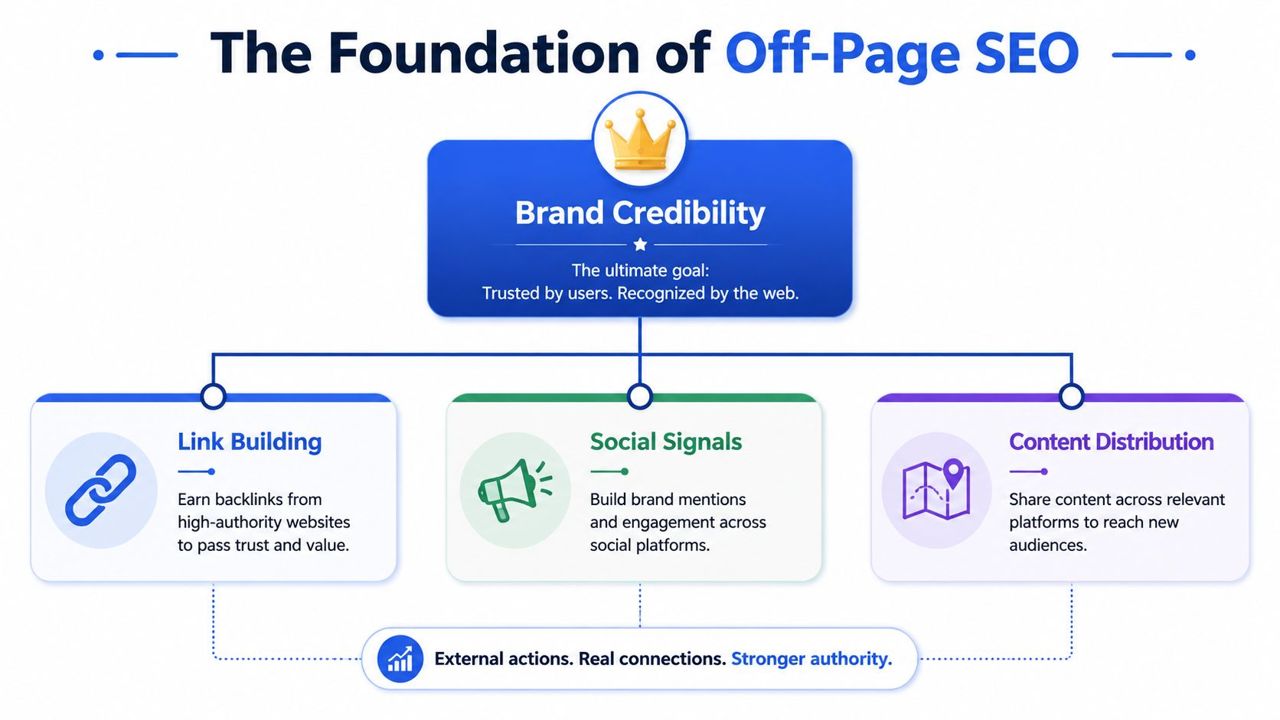
Off-page SEO services are the activities a business runs outside its own website to improve trust, relevance, and authority in search. That includes link acquisition, digital PR, local citations, review management, brand mention monitoring, and distribution across third-party platforms that influence how search engines interpret your business.
For local search, these signals carry serious weight. According to a 2020 Whitespark survey summarized by KlientBoost, off-page SEO elements accounted for over 50% of total ranking factors in local search results. In the same survey, backlinks contributed 15% to Local Pack rankings and 31% to local organic results, while GMB, citations, and reviews comprised 56% of Local Pack ranking weight.
Authority is built outside your website
The easiest way to understand off-page SEO is to treat it as market validation.
Your website says, “We're credible.” Off-page signals show whether independent sources appear to agree.
That's why a strong strategy usually follows a hierarchy:
- Foundational trust signals like citations, profile consistency, and review presence
- Authority-building assets like backlinks from relevant publications and resource pages
- Brand reinforcement through mentions, partnerships, and third-party references
- Distribution and amplification that helps content and expertise travel beyond your site
A useful primer on how link acquisition fits into that bigger picture is Domain Drake's guide on link building. It's helpful because it frames links as strategic assets, not as isolated transactions.
The business outcome behind each service
Not all off-page services solve the same problem.
Link building
The right links improve authority around priority pages. For eCommerce, that may mean category pages. For SaaS, commercial pages and comparison content. For service businesses, city pages or core service pages.
The business outcome is usually stronger ranking potential for terms that already have conversion intent.
Digital PR
Digital PR earns attention from publications, journalists, and niche media. The SEO benefit is often link acquisition, but the bigger commercial gain can be trust and qualified referral traffic from relevant audiences.
This matters when your brand needs credibility, not just indexable content.
Citations and reviews
For local businesses, consistency across business profiles and directories supports trust. Reviews also influence click behavior and local visibility.
This work is less glamorous than PR, but often more urgent for service-area businesses and multi-location brands.
Brand mentions and entity signals
Brands don't earn every citation as a link. That doesn't make the mention useless. Search engines still use broader web context to understand which companies are associated with a topic, niche, or region.
Off-page SEO services work best when they support a business objective first, and a ranking objective second. The ranking gain usually follows the market signal.
The Core Components of a Modern Off-Page Strategy
A modern off-page strategy involves more than a single channel. It is a combination of authority-building activities connected to the business model, sales motion, and search environment. A SaaS company selling demos requires a different approach than a local legal practice or an online retailer expanding category visibility.
High-authority link building
This is still the backbone for many campaigns. The deliverable isn't “more links.” It's relevant links that strengthen the pages that drive revenue.
For example, a SaaS company may need links to solution pages and high-intent comparison assets. An eCommerce brand may need links into collections, gift guides, category resources, or editorial content that supports product discovery.
The right KPI here is rarely just volume. It's usually a combination of:
- New referring domains to strategic pages
- Link relevance to the category or industry
- Movement in rankings for commercial queries
- Referral traffic quality from placements
Digital PR and media outreach
Digital PR is useful when a company needs to accelerate trust. It can produce links, yes, but its stronger role is often credibility transfer from known publications or niche outlets.
A vendor should be able to explain the campaign angle, the target publications, the audience fit, and how the placement supports either category authority or brand trust. If the pitch is only “we'll get you coverage,” that's too soft. The coverage has to connect to the funnel.
For smaller brands, this often overlaps with press-led tactics. If you want a practical perspective on how publicity can support rankings and authority for small businesses, that resource is worth reviewing with a critical eye. The key is relevance and credibility, not mass distribution.
Local citations and review management
For local businesses, this work solves visibility and trust problems that content alone won't fix. It includes business profile alignment, NAP consistency, directory cleanup, review generation workflows, and response management.
This is especially important for multi-location brands because inconsistency spreads fast. One wrong phone number or category mismatch can undermine performance in the markets that matter most.
Influencer and partner marketing
This channel is often overlooked in SEO discussions because it sits between PR, content distribution, partnerships, and brand. But it can work well when the business already has products, expertise, or a local footprint worth featuring.
The win isn't just reach. It's third-party validation from people or brands your audience already trusts. In some sectors, that can create direct referral traffic and stronger brand search behavior.
Unlinked brand mention monitoring
A lot of businesses get mentioned online without earning a link. That creates a missed opportunity.
An effective off-page program tracks mentions through tools like Ahrefs or Semrush, prioritizes high-authority sources, and runs outreach to convert the best mentions into links where appropriate. Even when a mention stays unlinked, it can still support broader credibility and brand recognition.
AI visibility and answer engine support
This area matters more now because search visibility isn't limited to classic blue links. According to The7Eagles, searches for 'off-page SEO services AI visibility' spiked 340% YoY as of May 2025, Google's AI Overviews now pull 28% from unlinked brand mentions, and SaaS firms have seen 62% demo increases via E-E-A-T signals amplified on review sites and forums.
That shifts off-page strategy in two ways:
- Review platforms, forums, and expert mentions matter more because AI systems often synthesize from third-party references.
- Entity clarity matters more because scattered mentions with weak consistency are harder for AI systems to interpret confidently.
If your off-page vendor ignores review sites, community mentions, and structured brand presence outside your domain, they're working from an older search model.
Deliverables KPIs and Measuring Real ROI
The hardest part of buying off-page SEO services isn't knowing what they are. It's knowing whether the work is producing commercial value.
A weak agency sends a monthly spreadsheet full of URLs and calls it progress. A strong one ties authority-building activity to ranking movement, qualified traffic, and conversion paths.
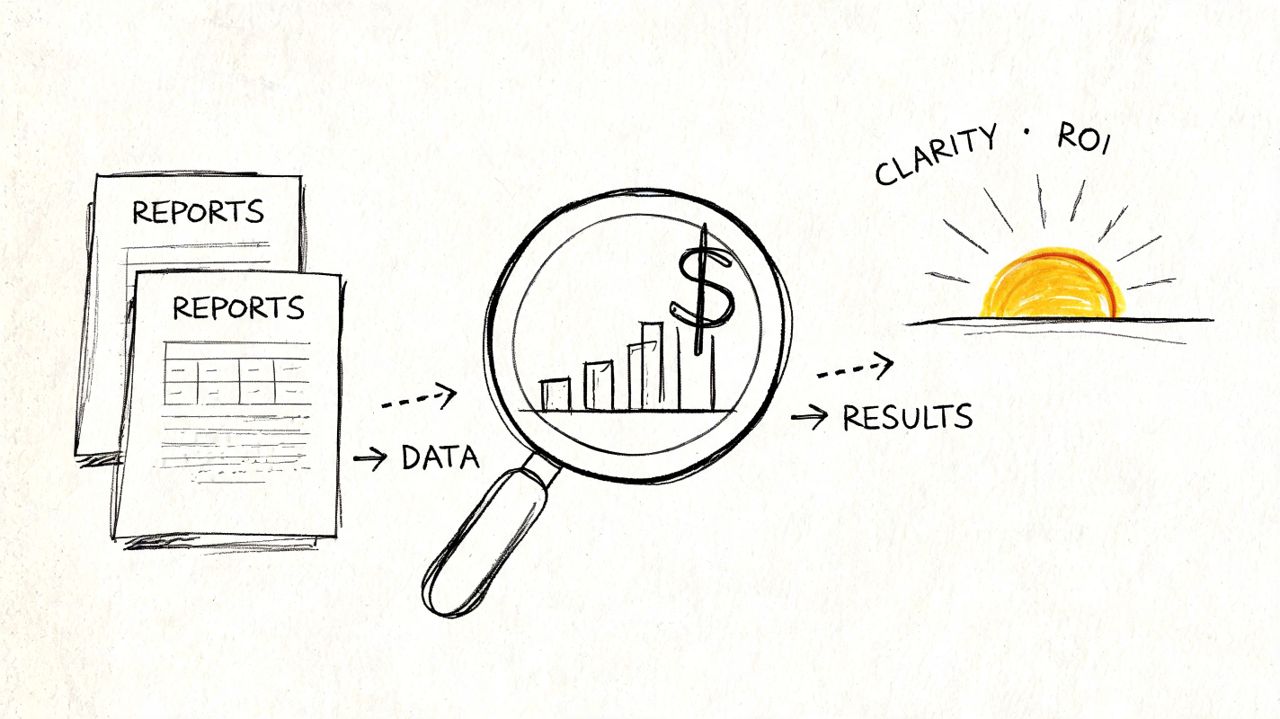
Targeted off-page work can produce measurable gains. In a Higher Visibility case study, off-page tactics led to a 110% increase in organic traffic and an 80% rise in organic traffic value. The same source points to metrics like backlink volume, referring domains, brand mentions, and referral traffic as useful ways to evaluate performance.
What you should actually receive
Off-page SEO shouldn't feel mysterious. At minimum, a monthly or campaign-level deliverable set should include:
- Placement reporting: Every earned link or citation, where it lives, which page it points to, and whether it's indexed.
- Outreach accountability: Which publishers, partners, or directories were targeted and why.
- Anchor and destination tracking: Not to manipulate aggressively, but to avoid random link patterns.
- Brand mention logs: Linked and unlinked references that may warrant follow-up.
- Traffic and conversion views: Referral visits, assisted conversions, and impact on priority organic landing pages.
If a provider can't show page-level destination strategy, they're probably buying placements or running generic outreach with little commercial logic.
Which KPIs matter and which ones mislead
Good KPI selection separates strategy from theatre.
| KPI | Why it matters | Common misuse |
|---|---|---|
| Referring domains | Shows breadth of external validation | Counted without relevance review |
| Referral traffic | Reveals whether placements send actual visitors | Celebrated even when traffic is unqualified |
| Brand mentions | Helps track off-site visibility and authority presence | Reported without showing source quality |
| Organic performance on money pages | Ties authority gains to business pages | Ignored in favor of blog traffic |
| Conversions from referral and organic landing pages | Connects SEO to demos, leads, or sales | Left out because tracking wasn't configured |
The right dashboard usually combines leading indicators and business outcomes. You need both. Links may arrive before rankings. Rankings may move before pipeline catches up. But the system should still connect.
Here's a practical walkthrough that helps frame the reporting conversation:
How pricing should be judged
There isn't one correct pricing model for off-page SEO services. Some providers charge by deliverable. Others bill monthly retainers. Some blend strategy, content, PR, and outreach into one program.
The right question isn't “what does a link cost?” It's “what work is required to build authority in our market without damaging the brand or wasting budget?”
Commercial lens: Cheap off-page SEO usually means one of three things. Low-quality placements, no strategic targeting, or reporting that hides weak outcomes behind activity metrics.
A fair proposal should show scope. Which assets are being created. Which pages are being supported. Which publications or directories fit. How success will be tracked in GA4, Search Console, Ahrefs, or Semrush. If that logic is missing, the quote is incomplete no matter how polished the deck looks.
Evaluating Vendors A Checklist for Hiring the Right Partner
Most off-page SEO proposals sound competent on first read. The pitch usually includes outreach, authority, media, relationships, and white-hat methods. That tells you almost nothing.
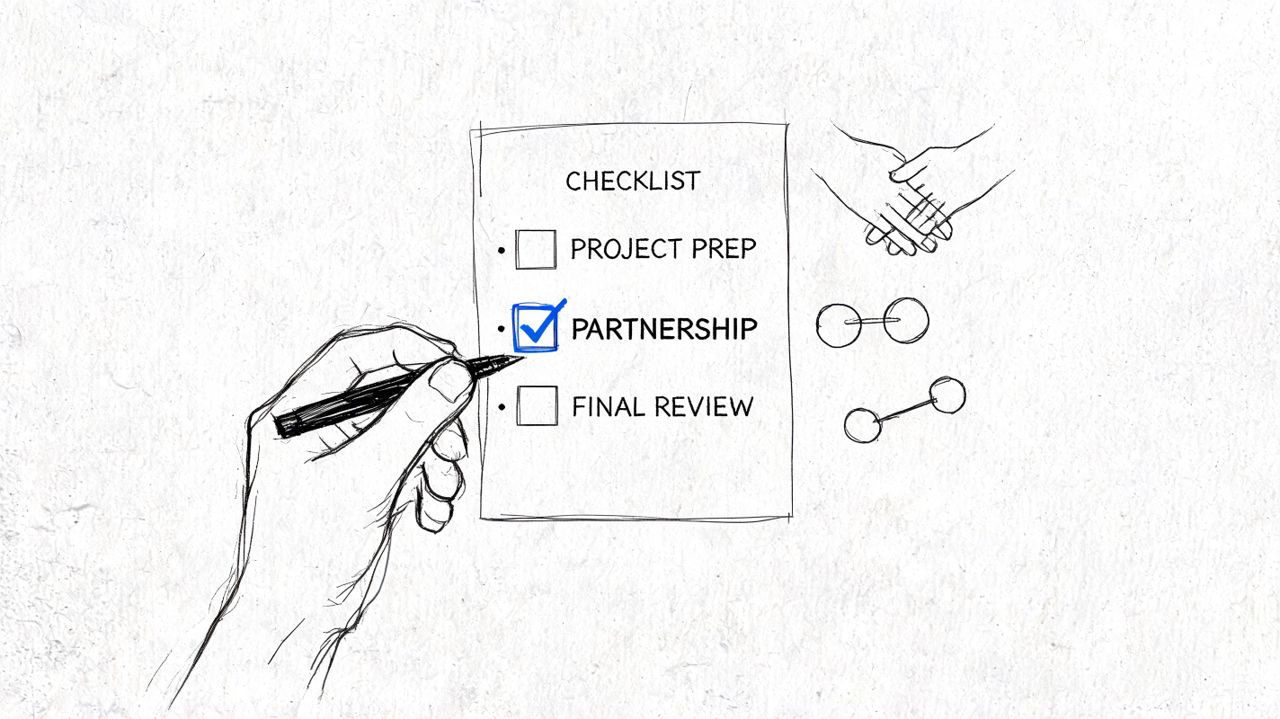
The genuine test is whether the vendor can explain trade-offs, risk controls, and reporting with enough precision that a CMO can hold them accountable.
According to Sevell, a 2025 SEMrush study found 68% of clients were dissatisfied with reporting, and only 22% of services tie link acquisition to conversion funnels. That aligns with what many buyers already suspect. Activity gets reported. Business impact gets blurred.
Questions that expose weak providers fast
Use these in sales calls and proposal reviews.
How do you choose target pages for link acquisition?
A serious provider talks about commercial intent, ranking gaps, internal linking support, and conversion paths. A weak one says they build links to “the homepage and blogs.”What kinds of placements do you avoid?
Good answers mention irrelevant sites, resold placements, obvious link farms, and networks with poor editorial standards.How do you report success beyond acquired links?
Look for referral traffic, assisted conversions, ranking movement on priority terms, and impact on money pages.What tools do you use to monitor progress?
Ahrefs, Semrush, Google Search Console, and GA4 are reasonable answers. The tool matters less than whether the workflow is clear.How would your strategy differ for SaaS, eCommerce, and local SEO?
Off-page strategy should change by business model. If their answer sounds identical for every company, it probably is.
What a strong answer sounds like
A strong partner usually does three things well.
First, they explain why a tactic fits the market. Not every brand needs digital PR. Not every local business needs aggressive outreach. Not every SaaS site should push links into the blog.
Second, they define what success looks like before execution starts. That may include stronger category rankings, more qualified demos from non-brand search, or improved local map visibility supported by citations and reviews.
Third, they talk openly about risk. Off-page SEO always involves judgment calls. Anchor text can be overdone. Publisher quality can drift. Guest post opportunities can look clean on the surface and still be weak. A credible vendor won't pretend those trade-offs don't exist.
Ask the vendor to show one reporting sample with sensitive details removed. If they won't, assume the reporting is vague.
The right hire isn't the provider with the biggest media list. It's the one with the clearest operating model.
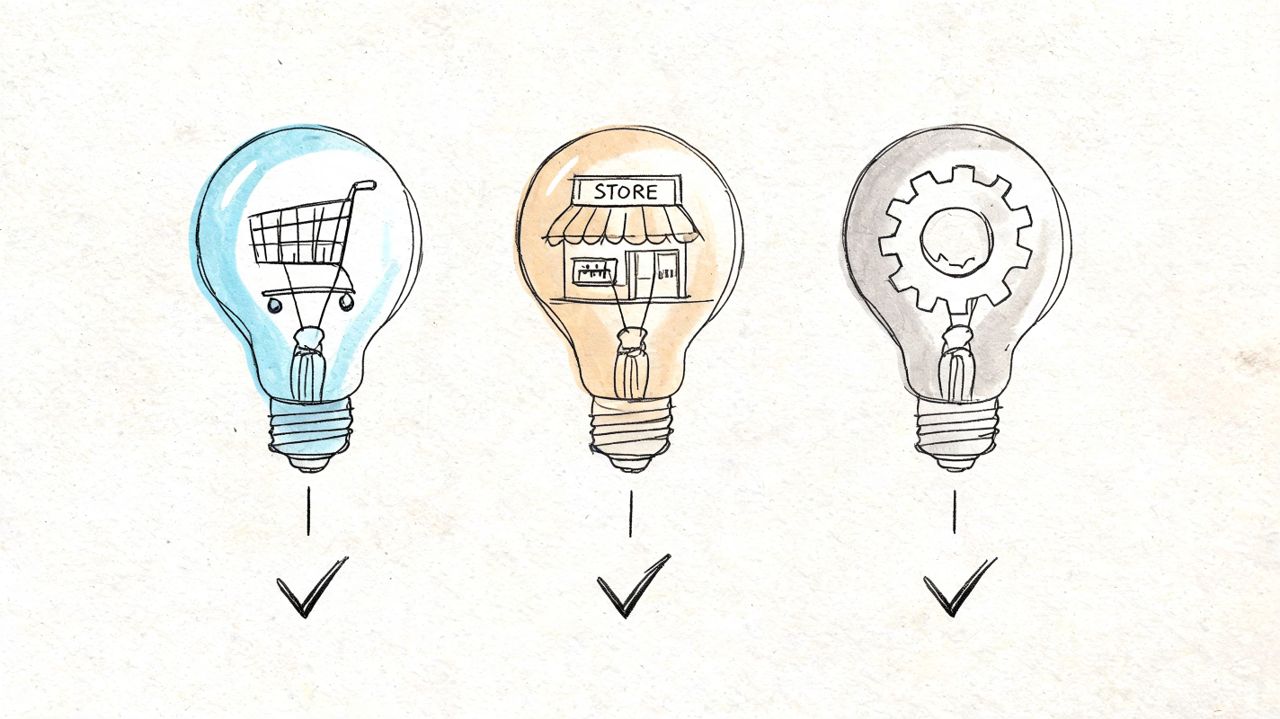
Off-Page SEO in Action Examples for Your Business
Abstract strategy only goes so far. Off-page SEO makes more sense when you map it to a real business situation.
eCommerce brand example
An online retailer has well-optimized product and category pages, but rankings stall because competing stores have broader editorial visibility. The category pages don't have enough external support.
The off-page solution is usually not “build links to every product.” It's more selective. Secure placements in gift guides, niche product roundups, publisher resource pages, and relevant editorial content that naturally references category pages or supporting guides.
The business outcome is stronger category authority, better discovery during non-brand research, and referral traffic from buyers who are already in shopping mode.
SaaS company example
A B2B SaaS site may publish solid product content and comparison pages but still struggle to win trust in a crowded niche. Buyers want external validation before booking a demo.
In that case, off-page work often combines guest contributions, partner co-marketing, analyst-style mentions, review platform visibility, and citation-worthy content assets such as data commentary or practical frameworks. The target isn't just rankings. It's building a web footprint that supports E-E-A-T and demo confidence.
A strong SaaS program also tracks which placements send visitors that engage with high-intent pages, not just blog readers.
Local service business example
A local service brand often has a different problem. The website may be fine, but map visibility is weak, reviews are inconsistent, and the business has scattered citations across directories.
The off-page fix focuses on profile accuracy, category alignment, citation cleanup, review generation workflows, and local mentions from chambers, trade associations, local publications, and community sites. For some businesses, influencer-style local promotion can also support visibility. This article on driving restaurant bookings with influencers is useful because it shows how third-party local visibility can support discovery beyond the website itself.
A simple decision lens
| Business type | Off-page priority | Main commercial goal |
|---|---|---|
| eCommerce | Editorial links and product discovery mentions | Support category rankings and sales |
| SaaS | Authority mentions, review platforms, niche publications | Increase trust and demo intent |
| Local services | Citations, reviews, local mentions | Improve local visibility and lead flow |
The tactics differ. The principle stays the same. Build external proof around the parts of the business that generate revenue.
Conclusion Building a Revenue-Driven Authority Engine
Off-page SEO services are often sold as a list of tactics. That framing is too small.
The essential task is to build an authority engine around the pages, service lines, products, and locations that matter commercially. Links matter. Reviews matter. Citations matter. Mentions matter. But none of them should be pursued in isolation or reported as if volume alone proves success.
That's the strategic shift CMOs need to make. Stop buying off-page activity. Start buying authority development tied to market visibility, conversion paths, and revenue goals.
On-page SEO gives search engines a clear site to crawl, understand, and rank. Off-page SEO gives them reasons to trust what they find. Without that second layer, many businesses hit a ceiling and stay there.
The best programs are selective. They know which pages deserve support, which publications are worth pursuing, which citations need cleanup, and which mentions can improve both search visibility and buyer confidence. They also know what to ignore, especially low-value placements dressed up as progress.
If your team has already invested in technical fixes and content but growth still feels capped, it may be time to look at the authority side of the equation. A strategic SEO audit or an experienced search partner can help you decide where off-page work will move pipeline, not just reporting metrics.
Frequently Asked Questions About Off-Page SEO
FAQ Quick Answers
| Question | Answer Summary |
|---|---|
| What are off-page SEO services? | They're activities outside your site that build trust, authority, and visibility. |
| How long does off-page SEO take? | It depends on competition, site readiness, and execution quality. It's not instant. |
| Are backlinks still important? | Yes, but quality and relevance matter far more than raw volume. |
| Do brand mentions matter without links? | Yes. They don't pass link equity, but they can support credibility and topical authority. |
| Is digital PR the same as link building? | No. They overlap, but digital PR is broader and often trust-led. |
| Can an internal team do off-page SEO? | Yes, if they have outreach, PR, editorial, and reporting capability. Many teams don't. |
| What should reporting include? | Placements, destination pages, referral impact, rankings, and conversion-oriented outcomes. |
| What should I avoid? | Cheap bulk links, irrelevant placements, vague reporting, and promises that sound too clean. |
How long does off-page SEO take?
It usually takes longer than on-page fixes because you're earning signals from external sites, not editing your own templates. Timelines depend on competition, the quality of your content and landing pages, your brand's existing credibility, and whether your offer is worthy of mention.
A site with weak technical foundations or poor conversion pages won't get full value from off-page work. Authority amplifies what already exists. It doesn't rescue a broken site by itself.
Are backlinks still the main thing?
They're still important, but not in the simplistic way many vendors pitch them. A relevant, earned link from a trusted site can matter far more than a pile of low-quality placements.
That's why experienced teams care about source quality, page relevance, destination strategy, and commercial alignment. They're not just filling a quota.
Do unlinked mentions help?
Yes, in a different way. According to The Digital Ring, Google's E-E-A-T framework values unlinked brand mentions as signals of credibility, and Google has confirmed that while these mentions don't pass “link juice,” they do help establish topical authority.
That means a mention in an industry publication, review platform, expert roundup, or forum can still matter even without a hyperlink. It may support trust, entity recognition, and broader authority signals.
Is digital PR different from link building?
Yes. Link building is usually narrower and SEO-led. Digital PR is broader and often starts with a story angle, brand narrative, or market insight that can earn coverage.
The overlap is obvious because strong PR placements can also earn links. But the planning process, campaign assets, and success criteria often differ.
Can a company do off-page SEO in-house?
Sometimes. In-house teams can handle parts of it well, especially review workflows, partner outreach, and brand mention monitoring.
The tougher parts are consistency and specialization. Outreach, publisher vetting, local citation cleanup, PR angles, tracking, and conversion reporting all require different skills. Many internal teams can do some of the work, but not all of it at a high level.
What should buyers ask for in reporting?
Ask for reporting that maps activity to outcomes.
That includes placements earned, which pages were supported, referral traffic quality, changes in visibility for priority pages, and conversion impact where tracking allows. If the report is mostly screenshots and link counts, it's probably hiding weak strategic value.
What off-page tactics should you avoid?
Avoid anything that looks mass-produced or oddly easy. That includes link packages, irrelevant guest posts, recycled outreach lists, and placements that exist mainly to sell outbound links.
If a vendor promises control over outcomes that are supposed to be earned, treat that as a warning sign.
If you want a senior-level view of whether your off-page SEO services are supporting revenue, SEOBRO® can help you assess the gap between your current authority profile and the visibility needed to grow demos, leads, and sales. The goal isn't more SEO activity. It's a search strategy built around qualified demand and durable organic growth.