If you're investing in SEO and still treating backlinks as a vague off-page task, you're leaving rankings and revenue to chance.
Most founders hit this point the same way. Traffic plateaus. Important pages sit on page two. Competitors with weaker products keep outranking you. Your team publishes content, fixes technical issues, and improves conversion paths, but authority still lags. That gap is often your backlink profile.
A backlink profile isn't just a count of links. It's the reputation layer around your site. Search engines read it as evidence of who trusts you, what topics you're trusted on, and whether that trust looks earned or manufactured. For a business, that changes much more than rankings. It affects which category pages can rank, whether demo pages get discovered, and how often your brand gets cited across Google and AI-driven search experiences.
For time-poor teams, the useful question isn't “what is a backlink profile” in the abstract. It's this: does your current profile help your most valuable pages compete, or is it holding them back?
What a Backlink Profile Is (And What It Is Not)
A founder sees 1,200 backlinks in a report and assumes authority is handled. Then rankings stall, non-brand pages stay buried, and paid search keeps carrying revenue targets. The problem is usually not a lack of links. It is a weak backlink profile.
A backlink profile is the full pattern of external links pointing to your website. It covers who links to you, which pages earn those links, the anchor text used, whether links can pass authority, and how consistent those links are across relevant sources. Search engines assess that pattern to judge trust, credibility, and whether your site deserves to rank for terms that drive business.
A useful comparison is a financial portfolio. Two companies can hold the same nominal value on paper and have very different levels of risk and upside. Backlink profiles work the same way. One site may have hundreds of links from junk directories and syndicated posts. Another may have fewer links, but from relevant publications, industry sites, partners, and cited resources. The second profile usually does more for rankings and revenue.

This distinction matters because bad link decisions look efficient in the short term. Teams buy placements on irrelevant sites, submit to low-quality directories, reuse exact-match anchors, and stack links to pages that have no commercial value. The spreadsheet grows. The ranking impact often does not. In some cases, the site becomes harder to trust.
Practical rule: Judge a backlink profile the way an operator judges assets. Look at quality, concentration, relevance, and durability, not just total volume.
It also helps to separate a backlink from a backlink profile. A backlink is one reference from one page. A profile is the full history and pattern of those references across your site. Search engines can evaluate whether the pattern looks earned, relevant, and commercially credible. That broader view is what affects your ability to rank product pages, service pages, and high-intent content.
For a revenue-focused audit, four misconceptions cause the most expensive mistakes:
- Raw link count as the main KPI. A larger total does not help much if the links come from the same weak sources or point to low-value pages.
- Third-party authority scores as the profile itself. DR and DA can help with prioritization, but they are proxies, not the operating reality.
- Off-page SEO treated in isolation. Links influence how well content, site structure, and internal linking can perform, especially on pages close to conversion.
- Cleanup as a one-time project. Profiles change as you launch campaigns, earn mentions, lose links, and compete in tougher search results.
The business takeaway is straightforward. Your backlink profile is part of your site's ranking capacity. A weak profile limits how far good content can go. A strong one gives your commercial pages a better chance to rank, hold positions, and turn organic traffic into pipeline, sales, and booked revenue.
The 8 Core Components That Define Profile Quality
A backlink profile can look strong in a reporting dashboard and still fail where it counts. The pages that drive demos, purchases, and booked jobs stay stuck because the underlying link pattern is thin, repetitive, or off-topic.
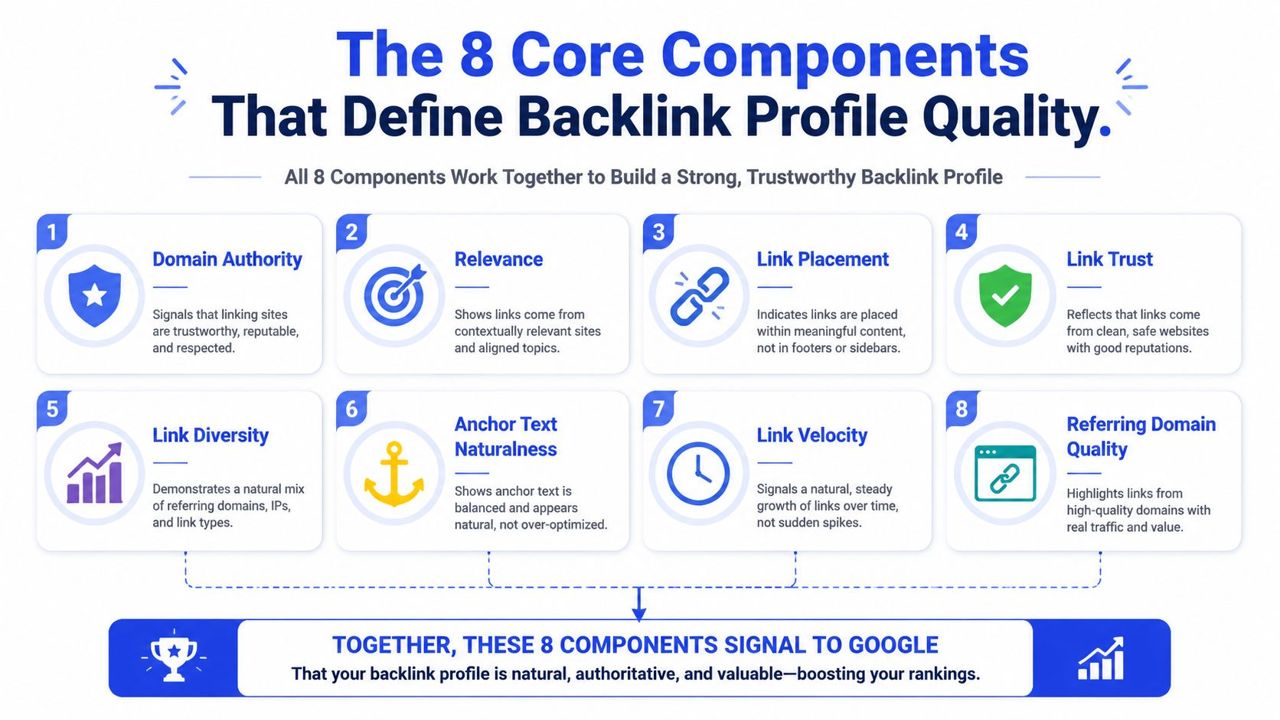
The useful way to assess profile quality is to review the signals search engines can infer from your links as a system, not as isolated wins. These eight components are the ones I check first because they shape ranking durability and, by extension, revenue potential.
Referring domains
Start with referring domains, the number of unique websites linking to you.
Ten links from a single site can help with discovery or reinforcement, but they do not create the same breadth of trust as links from ten separate sites. A wider base of referring domains usually signals that your brand, product, or content has earned attention across a market, which is why this metric tends to matter more than raw link count.
In practical audits, I care less about the absolute total than the pattern. A local business may need a modest set of credible local and industry citations. A SaaS company competing on category terms often needs sustained growth from relevant publishers, review sites, integration partners, and product-led content placements. An eCommerce brand usually needs authority spread across category, product, and editorial content, not a pile of links to the homepage alone.
Link authority
Authority answers a simple question. Do the linking sites have enough credibility to strengthen your rankings?
Third-party metrics such as DR and DA are still proxies, but they are useful sorting tools. A link from an established trade publication, respected software directory, industry association, or trusted local news outlet usually carries more weight than a link from a low-effort site built to sell placements.
Trade-offs matter. A mid-authority link from a tightly relevant site often outperforms a higher-scoring but loosely related mention, especially for commercial pages. Founders often overpay for flashy placements that look impressive in a slide deck and do little for the keywords tied to pipeline or sales.
Link diversity
Healthy profiles show variety.
That variety comes from source types, page contexts, and acquisition methods. Editorial mentions, partner pages, niche directories, local citations, digital PR, resource pages, podcasts, communities, and expert commentary all create a more credible footprint than repeating one tactic at scale.
Repetition creates risk. If nearly every new link comes from guest posts with similar formatting, similar anchor text, and similar publication quality, the profile starts to look manufactured. It also becomes fragile. If that one acquisition channel weakens or gets discounted, performance can slide fast.
Anchor text distribution
Anchor text shows how other sites describe your pages, and it is one of the easiest signals to misuse.
Point Visible's backlink profile overview says healthier profiles tend to keep anchor text around 40% branded, 30% naked URL, 20% generic, and under 10% keyword-targeted. The same source notes that profiles with more than 70% keyword anchors can trigger spam signals and reduce link equity transfer by up to 60%.
The operational takeaway is straightforward. If a large share of external sites link with the exact commercial term you want to rank for, the pattern looks controlled. Branded, URL, and natural phrase anchors usually create a safer profile and a more believable distribution.
Dofollow and nofollow balance
A healthy profile includes both dofollow and nofollow links.
Point Visible's benchmark above describes an 80:20 dofollow:nofollow ratio as a strong target. That aligns with what strong profiles usually look like in the wild. Real brands pick up links from places that do and do not pass direct equity.
Nofollow links still have business value. They can send qualified referral traffic, support discovery, reinforce brand signals, and put your company in front of buyers on forums, communities, social platforms, and media sites. If every link in a profile is engineered to pass authority, that pattern deserves a closer look.
Topical relevance
Topical relevance asks whether the linking page and site make sense for your business.
For SaaS, that often means software publications, comparison sites, partner ecosystems, integration pages, and workflow content. For eCommerce, it can mean product review sites, gift guides, niche publications, creator mentions, and category-relevant editorial coverage. For local businesses, relevance often comes from local news, chamber listings, neighborhood guides, and service-specific directories.
This component affects more than rankings. Relevant links tend to bring better visitors. Better visitors are more likely to subscribe, request a quote, book a demo, or buy.
Link velocity
Link velocity is the pace at which your site earns new links over time.
What matters is consistency and context. A steady pattern of new referring domains usually reflects real marketing activity such as PR coverage, linkable content, partnerships, or brand growth. Sharp spikes from similar sites, using similar anchors, over a short period can create an obvious footprint.
That is why bulk link packages are a poor bet for serious businesses. They may inflate reports for a month, but they often leave behind cleanup work and unstable rankings.
Spam and toxic signals
Every profile needs a risk review.
Look for irrelevant referring sites, low-quality blogs with heavy outbound linking, duplicate anchor patterns, hacked pages, foreign-language mismatches, parasite pages, and links pointing from obviously expired or repurposed domains. Any one of these may be harmless in isolation. A cluster of them changes the picture.
Use this table as a fast screening framework:
| Profile trait | Usually healthy | Usually risky |
|---|---|---|
| Source quality | Editorially controlled sites | Thin sites built to place links |
| Anchor pattern | Mostly branded, URL, generic | Heavy exact-match repetition |
| Growth pattern | Gradual and varied | Sudden spikes from similar domains |
| Relevance | Clear topic alignment | Off-topic placements |
| Link mix | Mixed formats and attributes | One tactic repeated at scale |
The founders who get the most value from link building usually stop asking, "How many links did we get?" and start asking, "Did our profile become stronger in ways that help money pages rank?" That shift leads to better audits, better campaigns, and fewer expensive mistakes.
Why Your Profile Is a Direct Driver of SEO Revenue
A founder usually notices backlink quality only after revenue slips. Rankings stall on product, service, or feature pages. Branded traffic holds up, but non-branded leads flatten. Paid search gets more expensive because organic never takes pressure off acquisition. In many of those cases, the profile is not a side issue. It is one of the constraints on growth.
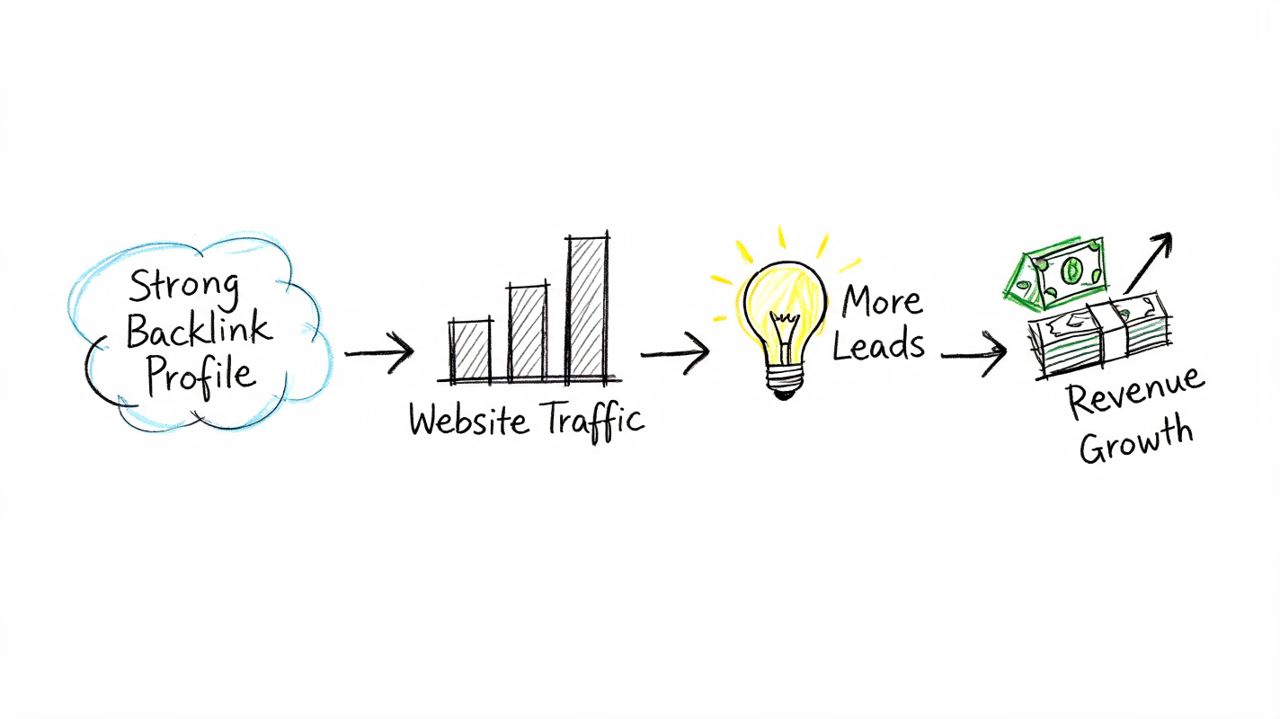
Authority changes what pages can rank
Backlinks influence how much competitive ground a site can realistically take. Stronger profiles give category pages, service pages, and commercial landing pages a better shot at ranking for high-intent terms. That does not guarantee position one. It does raise the ceiling.
The practical question is simple. Can your pages compete for queries that bring buyers, not just browsers?
If the answer is no, the revenue effect is direct. Lower visibility on money terms means fewer qualified sessions, fewer demos, fewer calls, fewer checkouts. Teams often try to solve that with more content or higher bids. Sometimes the bottleneck is authority, and no amount of on-page polishing changes that.
Good links improve visitor quality
The best backlinks do more than support rankings. They also put your brand in front of people who already trust the source sending them.
A mention on an industry publication, partner directory, respected review site, or local news outlet can send visitors who are much closer to action than the average blog reader. They arrive with context. They understand the category. They are more likely to compare, book, or buy.
That is why cheap link volume is such a poor business trade-off. It can make a monthly report look busy while doing little for revenue pages, referral quality, or long-term search strength.
A good backlink supports ranking potential and introduces your brand to the right audience at the same time.
Strong profiles make the rest of SEO work harder
This is the part many teams miss.
A healthy profile improves the return on work you already pay for. Internal links pass more weight when the underlying pages have real authority behind them. New pages gain traction faster. Digital PR outreach lands more often because editors and partners have seen your brand before. For AI search visibility, citation patterns and trust signals also carry more weight when they come from relevant, credible sources.
I have seen this play out differently by business model. eCommerce brands feel it in category-page rankings and margin pressure from paid media. SaaS companies feel it in demo volume from feature and comparison pages. Local businesses feel it in service-area visibility, map-adjacent trust, and lead consistency. Same mechanism. Different revenue line.
If your team needs a shared framework before making budget decisions, start with understanding backlink data. It helps non-specialists read the signals that affect rankings and pipeline.
A quick explainer is worth watching if your team needs a shared mental model for off-page SEO before making budget decisions:
Backlinks are part of your revenue infrastructure. When the profile is strong, SEO compounds. When it is weak, every other channel has to work harder to make up the gap.
How to Conduct a Strategic Backlink Audit and Remediation
A strategic backlink audit answers one business question first. Which links help pages that make money, and which ones waste authority or create risk?
That framing changes the whole process. Founders do not need another spreadsheet full of domain metrics. They need a clear list of actions that can raise rankings for pages tied to sales, demos, or qualified leads.
Start with exports you can act on
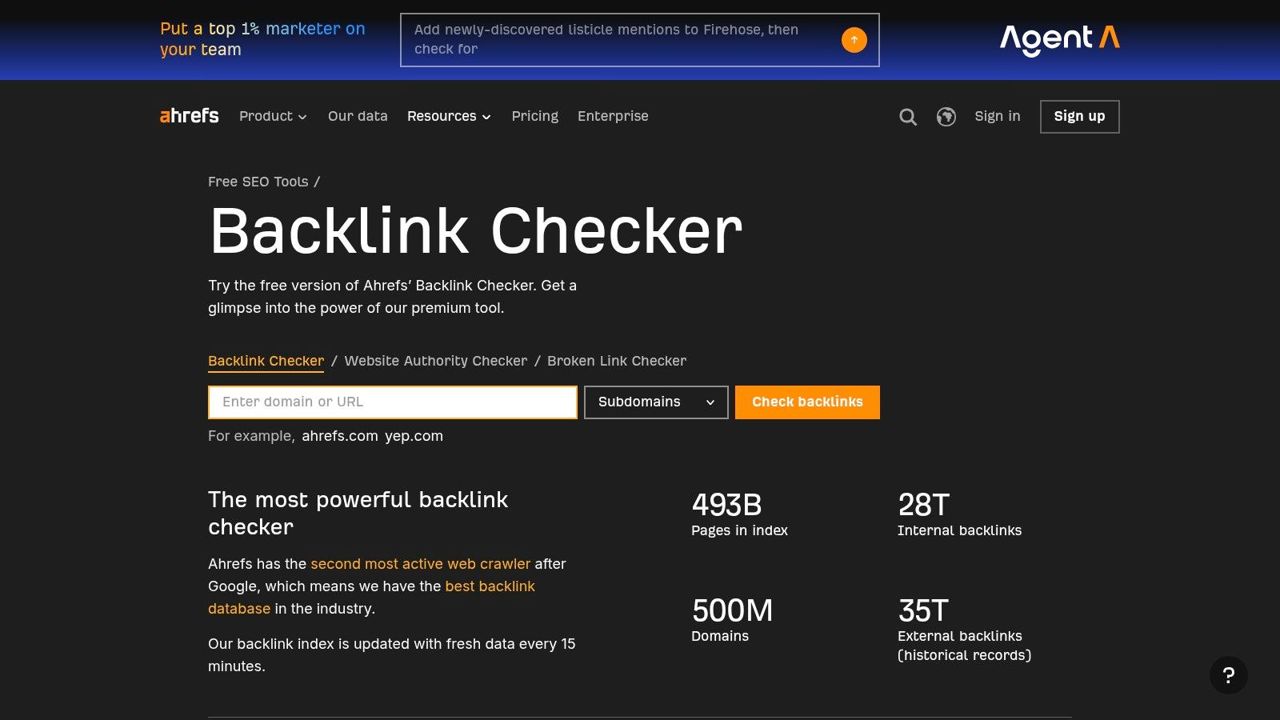
Use Ahrefs, Semrush, and Google Search Console if you have access to them. No single tool sees the whole profile, and the gaps matter when you are deciding whether to clean up risk or push authority toward revenue pages.
Export these fields at minimum:
- Referring domain: This shows how many unique sites vouch for you.
- Target page: This reveals whether authority reaches commercial URLs or gets trapped on low-value content.
- Anchor text: This is usually where manipulation shows up first.
- Link attribute: Separate dofollow, nofollow, sponsored, and UGC links where possible.
- First seen and recent: Timing helps you spot unnatural bursts, lost links, and momentum changes.
If your team needs a refresher on how to read those fields, understanding backlink data is a useful reference.
Audit revenue pages before cleanup work
A common mistake is spending hours reviewing junk links while high-intent pages sit with weak authority.
Start with the URLs closest to revenue. For eCommerce, that usually means category pages, collections, and product-led buying guides. For SaaS, it is often feature pages, integration pages, comparison pages, and demo paths. For local businesses, focus on service pages and location pages.
Then work through this sequence:
- List your priority pages by revenue impact, not by traffic alone.
- Map referring domains to each page so you can see where authority lands.
- Compare those pages against search competitors that rank for the same commercial terms.
- Review anchor patterns to catch over-optimization on pages you cannot afford to lose.
- Check link growth over time to separate steady acquisition from suspicious spikes or long periods of stagnation.
Earlier sections covered quality signals in the abstract. Here, the practical question is narrower. Are the right pages getting enough support to compete?
A simple prioritization matrix helps keep the audit tied to outcomes:
| Audit finding | Business impact | Priority |
|---|---|---|
| Money pages have few quality referring domains | High | Fix first |
| Anchor text on key pages is over-optimized | High | Fix first |
| Strong links point to low-value pages only | Medium | Rebalance with internal linking and new outreach |
| Low-quality legacy links with no clear impact | Medium to low | Review before acting |
Sort findings into reclaim, ignore, and risk-control
Remediation gets messy when every weak link is treated like an emergency. In practice, there are three buckets.
- Reclaim: Recover broken backlinks, outdated destination URLs, and unlinked brand mentions. These are often the fastest wins because the authority already exists.
- Ignore: A lot of low-tier links are just noise. They are unattractive, but they do not justify a cleanup campaign.
- Disavow or request removal: Reserve this for manipulative patterns, obvious paid schemes, hacked placements, or anchor text abuse from earlier campaigns.
The disavow tool is risk control, not monthly maintenance.
I usually look for pattern and intent before recommending action. Ten random scraper links rarely matter. A cluster of exact-match anchors from irrelevant sites, pointed at a commercial page, deserves a closer look because it can suppress rankings right where revenue is generated.
Build the remediation plan around business model
The same audit method produces different fixes depending on the company.
For eCommerce, the first issue is often authority pooling on the homepage or blog while category pages remain weak. The remediation plan should reclaim links to retired product URLs, redirect them properly, and start earning links that support collections and buying guides.
For SaaS, the gap is often relevance, not volume. Brands collect links to thought-leadership articles, but product pages, integration pages, and bottom-funnel comparisons stay underlinked. The fix is to redirect outreach toward assets that can influence signups, not just impressions.
For local businesses, audits often expose inconsistent authority across service areas. One city page has links and rankings. The rest have thin support. The right response is usually a mix of citation cleanup, link reclamation, and local relationship-based links to the pages that drive calls and form fills.
Use outside review when the profile has history
If the site has legacy link building, aggressive anchor targeting, or inherited SEO work from multiple vendors, a second opinion can save time. A specialist review or a service such as SEOBRO® can assess referring domains, relevance, authority, anchor concentration, and spam patterns when the internal team lacks capacity.
A practical remediation cycle looks like this:
- Week 1: Export, segment, and score the profile by page type and business value.
- Week 2: Reclaim broken value, fix redirects, and flag risky anchors or domains.
- Week 3: Decide what to ignore, what to remove, and whether disavow is justified.
- Week 4 and beyond: Build links to the commercial pages that were underpowered in the audit, then review changes monthly.
A backlink audit is finished when the next actions are obvious. The spreadsheet is only useful if it leads to better rankings for the pages that affect revenue.
Backlink Strategies for eCommerce SaaS and Local Businesses
The right link strategy depends on the business model. Generic advice usually fails because the pages that matter, the buyer journey, and the trust signals are different.
eCommerce
For eCommerce, the mistake is sending every link to the homepage or blog while category pages stay underpowered.
A stronger approach starts with the commercial middle of the funnel. Category pages, collection pages, buying guides, and comparison assets often deserve the most authority support because they sit closer to revenue.
Common opportunities include:
- Supplier and brand relationships: Ask manufacturers, distributors, and retail partners to link to stockist, partner, or featured seller pages.
- Product-in-use coverage: Pitch products for editorial roundups, gift guides, or niche recommendation lists where a category or collection page can earn the link.
- Commerce content assets: Create useful buying guides and sizing, compatibility, or use-case resources that help publishers cite you naturally.
The link isn't just “for SEO.” It should strengthen the page that influences transactions.
SaaS
SaaS companies often overinvest in thought leadership posts that attract impressions but don't support demos or signups.
The better route is authority with product context. Build links to feature hubs, integration pages, use-case pages, and category-defining content. Data-led studies, benchmark content, free tools, partner pages, and software ecosystem mentions usually outperform generic guest posting.
One useful read on current tactics is these insights from Agency Platform on link building, especially if you're trying to separate durable outreach from tactics that now leave obvious footprints.
SaaS link building works best when the link helps explain why the product matters, not when it only points at a blog article with broad informational traffic.
Local businesses
Local businesses need relevance in a narrower geography. That's a different game from national content-led link building.
For local SEO, the practical goal is to earn links and mentions that reinforce location, service type, and legitimacy. Good opportunities include local news coverage, chamber and association listings, sponsorship pages, neighborhood guides, vendor relationships, and strong citation consistency around the business entity.
A local profile also benefits from a natural mix of forum, community, and user-generated references because these often mirror how real customers talk about local providers online.
Here's the core distinction:
| Business type | Best link targets | Typical payoff |
|---|---|---|
| eCommerce | Category pages, collections, buying guides | More product discovery and sales support |
| SaaS | Feature pages, integrations, data assets | More qualified demos and signups |
| Local | Location pages, service pages, citations | Better local pack visibility and lead flow |
What works is rarely glamorous. It's usually relevance, credible sources, and links pointed at pages that matter commercially.
Frequently Asked Questions About Backlink Profiles
Do nofollow backlinks still matter
Yes. They still matter for profile naturalness, brand discovery, referral traffic, and broader trust signals. According to Semify's overview of modern backlink profiles, post-EEAT updates, nofollow and UGC links can pass influence signals, and profiles with a natural mix, including up to 40% nofollow or UGC links, can see ranking uplifts. That's especially relevant for local brands and businesses seeking visibility in AI-driven search.
How long does it take to see results from link building
There isn't a fixed timeline you can bank on. Results depend on your starting authority, the competitiveness of the query set, the quality of the links, and whether the linked pages are already technically sound. In practice, link building works best as a compounding channel, not a short campaign.
Is buying backlinks worth the risk
Usually, no. The cheap version is almost always obvious. The expensive version can still create footprints if anchor text, placement patterns, or velocity get manipulated. Founders should treat paid links as a risk decision, not a shortcut. If a tactic can't survive scrutiny in an audit, it isn't a strong long-term asset.
Is Domain Authority the same as a backlink profile
No. Domain Authority and similar metrics are third-party estimates. A backlink profile is the underlying reality those tools are trying to model. Use DA or DR for prioritization, but don't confuse a score with the actual quality, relevance, and distribution of your links.
If your rankings feel capped, a strategic backlink review is often where the answer sits. SEOBRO® helps eCommerce, SaaS, and local businesses audit link profiles, identify authority gaps, clean up risk, and build search strategies around revenue pages instead of vanity metrics. Consider a strategic SEO audit if you want clarity on what link work is worth doing, what to ignore, and how to turn authority into qualified traffic and sales.