Are your competitors leveraging AI more effectively than you are? If you're using AI tools but can't directly connect them to reduced costs, increased leads, or higher revenue, you're not alone. The gap between simply using AI and optimizing it for profit is where businesses are winning or losing right now.
AI optimization isn't about chasing the latest tech trend. It's the strategic discipline of refining your AI models, data, and processes to drive measurable business outcomes. Think of it as tuning a high-performance engine. You don't just buy the engine; you fine-tune it to win races. In business, this means turning your AI investment from a cost center into a powerful growth engine that cuts customer acquisition costs and boosts profit margins.
Why AI Optimization Is a Revenue-Driven Discipline
If you’re worried about competitors getting ahead with AI, you should be. The real risk isn’t missing a trend—it’s getting outmaneuvered on efficiency, customer acquisition, and ultimately, profit. AI optimization is what separates dabbling from dominating.
This is the critical step that turns an AI tool from a line-item expense into a genuine growth engine. For any business owner, founder, or CMO, this is how you make sure your investment in technology actually pays for itself and then some.
From Hype to Measurable ROI
We’ve moved past the initial hype. AI optimization is now a practical discipline focused on making AI work better at scale. Big players are already seeing the benefits; a staggering 87% have put cognitive solutions to work, focusing on process automation (76%) and deep data analytics (68%).
The motivation is purely financial. Businesses that successfully integrate generative AI are reporting an average return of $3.70 for every dollar spent, with top performers seeing returns as high as $10.30. It’s not just the business, either—employees using these tools report boosting their own performance by as much as 40%.
AI optimization isn’t about chasing technology. It’s about building a strategic advantage by making your AI-powered systems deliver more accurate, scalable, and profitable results. It connects technology directly to your bottom line.
How Optimization Translates to Business Growth
For our clients, this is where the rubber meets the road. We’re not talking about vanity metrics; we’re talking about revenue.
- For eCommerce: It means tweaking product recommendation engines to boost average order value or using AI-driven forecasting to slash inventory waste.
- For SaaS: This is all about refining lead-scoring models so your sales team only gets high-quality demos, or personalizing user onboarding to keep customers from churning.
- For Local Businesses: It’s as simple as automating Google Business Profile responses to grab more local leads or using AI to create hyper-targeted content for your specific service area.
This mindset of tuning systems for commercial results is also a huge part of modern search strategy. To get a better handle on this, it's worth taking the time to understand AI content optimization and how it aligns your website with the new world of AI-powered search.
Ultimately, AI optimization is what ensures your tech spend builds a real, defensible moat around your business.
The Five Pillars of AI Optimization
To get a real handle on AI optimization, we need to break it down. This isn't about becoming a machine learning engineer overnight. It's about understanding the key areas where you can make changes that directly boost revenue, bring in more leads, and keep your customers happy.
Think of AI optimization as having five core pillars. Each one represents a different lever you can pull to make your AI tools faster, cheaper, and a whole lot smarter for your specific business.
Pillar 1: Model Fine-Tuning
Most of the big AI models out there, like GPT-4, are jacks-of-all-trades. They know a little about a lot. Model fine-tuning is the process of turning that generalist into a highly trained specialist for your company.
You're essentially teaching the AI to speak your language. By training it on your own data—your product descriptions, your support tickets, your marketing copy—the model learns your brand's voice, your customers' needs, and the specific nuances of your industry.
- eCommerce Example: An online fashion brand can fine-tune a model on its past product descriptions and customer reviews. This new, specialized model can then generate on-brand copy for new arrivals in seconds, cutting down on the manual work of writing content.
- SaaS Example: A software company could feed a model all of its technical guides and past support chats. The result? An internal chatbot that gives developers instant, accurate answers to their questions, freeing up your support team for more complex issues.
Pillar 2: Inference Optimization
Once a model is trained, "inference" is what happens when it's actually doing its job—making a prediction, answering a question, or generating text. Inference optimization is all about making that process as fast and cheap as possible.
This is the nuts and bolts of running AI at scale. Through techniques like model quantization (making the model file smaller) or using specialized computer chips, you can dramatically lower your API costs and ensure your users aren't left staring at a loading screen.
In short, if fine-tuning makes the AI smarter, inference optimization makes it faster and more efficient. You need both to run AI profitably.
Pillar 3: Data-Centric AI
There's an old saying in computing that's more relevant than ever: garbage in, garbage out. The smartest AI model in the world will give you junk results if you feed it messy, incomplete data.
Data-centric AI flips the script. Instead of endlessly tweaking the AI model itself, the focus shifts to obsessively improving the quality of the data it learns from. This means cleaning, labeling, and organizing your datasets so they are a perfect reflection of your business reality. A model trained on a pristine "diet" of information will produce far more trustworthy and reliable results.
Pillar 4: Prompt and Retrieval Optimization
This pillar is all about getting better answers by asking better questions. Prompt optimization, or prompt engineering, is the art and science of crafting the perfect input to guide an AI toward the exact output you want. It's the difference between a vague request and a clear, detailed instruction.
This is often paired with a technique called Retrieval-Augmented Generation (RAG). Think of RAG as giving the AI an open-book test where you've provided the book. You give the model a curated, up-to-date knowledge base to "retrieve" information from, ensuring its answers are based on your specific facts, not its general knowledge.
- Local Service Example: A plumbing company can use RAG to give its website chatbot a document with its exact service areas, pricing list, and emergency protocols. When a customer asks, "How much for a clogged drain in Springfield?" the AI pulls the correct answer from the provided data instead of guessing.
Pillar 5: MLOps and Automation
Finally, none of this matters if your AI model is just a one-off experiment sitting on a developer's laptop. MLOps (Machine Learning Operations) is what turns that experiment into a reliable, automated business tool.
MLOps is the operational backbone that connects everything. It's about building a system to deploy, monitor, and maintain your AI models in a live environment. It ensures your AI solutions are robust, scalable, and consistently delivering value long after the initial launch. Without a solid MLOps framework, even the best models can't deliver a long-term impact.
To tie this all together, it helps to see how each pillar serves a distinct purpose and delivers a specific business outcome.
Core Pillars of AI Optimization and Their Business Impact
| Pillar of Optimization | Primary Goal | Example Business Impact |
|---|---|---|
| Model Fine-Tuning | Improve model accuracy and relevance for a specific task. | A fine-tuned chatbot understands customer intent better, leading to a 25% increase in successful resolutions without human intervention. |
| Inference Optimization | Reduce the cost and latency (speed) of AI responses. | A faster-loading AI product recommendation engine improves user experience, resulting in a 10% lift in conversion rates. |
| Data-Centric AI | Enhance the quality and consistency of the training data. | Cleaning and labeling sales data leads to a more accurate forecasting model, improving inventory management and reducing waste. |
| Prompt & Retrieval | Get more precise and factually correct outputs from the AI. | Using RAG with an internal knowledge base reduces employee time spent searching for information by 30%. |
| MLOps & Automation | Automate the AI lifecycle for reliability and scale. | An automated monitoring system detects model performance degradation in real-time, preventing a drop in customer satisfaction. |
Ultimately, these five pillars provide a clear roadmap for moving beyond simply using AI to strategically optimizing it for tangible business growth.
How AI Optimization Impacts Modern SEO
If you think SEO is still just about ranking on a page of blue links, you’re already falling behind. The techniques behind AI optimization aren't just for internal projects anymore—they're at the very heart of modern search visibility. You’re no longer just competing for a top spot; you're fighting to become a trusted, citable source for AI-powered search engines like Google's AI Overviews and Perplexity.
This has given rise to a whole new discipline, often called Generative Engine Optimization (GEO) or Answer Engine Optimization (AEO). The entire game is to make your content so clear, well-structured, and authoritative that AI models can easily grab it, process it, and cite you in the answers they generate. It's about preparing your website's information for machine consumption first.
At SEOBRO®, this is our reality. We're structuring pages, entities, FAQs, and schema so that language models from Google, ChatGPT, and others can make sense of them instantly. This is how you stay visible in a world where roughly 60% of searches now yield no clicks.
Becoming a Citable Source for AI
To stand out in this new era, your content needs to be built for direct quotation and summarization. AI models don't "read" a page the way we do. They break it down into data points and logical chunks. Your job is to make those chunks as clean, authoritative, and easy to digest as possible.
The core concepts that make an AI system work are the same ones we now need to master to get noticed in search.
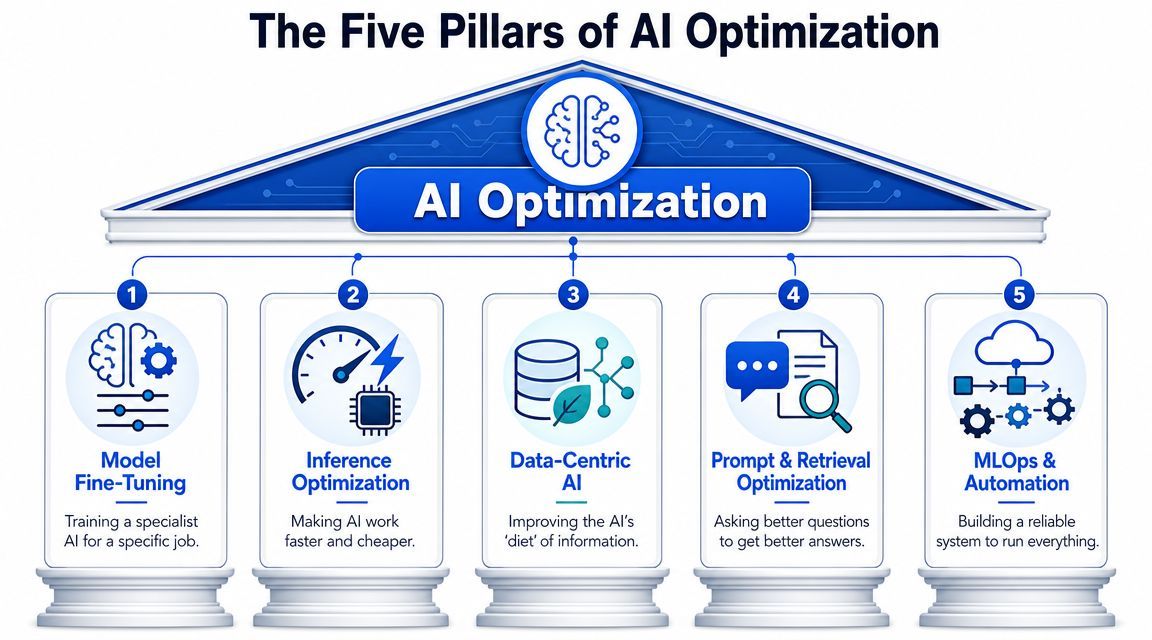
As you can see, AI thrives on high-quality information, efficient processing, and structured data—exactly what makes a piece of content citable.
This isn't some far-off trend; it's happening right now. Recent data shows 51% of marketers are already using AI to optimize content, and traffic from AI-driven search has shot up by around 8x in the past year alone. The path forward is clear: if you optimize your site for AI visibility, you'll be the one earning the citations, traffic, and conversions. You can dive deeper into how AI is impacting marketing over at SE Ranking.
Key Adjustments for AI Search Visibility
Getting your content ready for AI search doesn't mean throwing out your old SEO playbook. It just means getting hyper-focused on a few key technical and content details.
- Structure for Easy Quoting: Break down big topics into small, bite-sized pieces. Use clear H2s and H3s, bullet points, and dedicated FAQ sections. AI Overviews and other generative answers are literally built from these "snippets."
- Build Entity Authority: Think beyond keywords. You need to create a deep, interconnected web of information around your core topics. Strong internal linking and consistent language help establish your site as an expert on specific entities (like a person, product, or concept).
- Use Precise Schema Markup: Don't make the AI guess. Use specific schema types like
Product,FAQPage, andArticleto explicitly tell search models what your content is about. This removes any confusion and makes your data a reliable source for them.
The goal has fundamentally changed. It's no longer just about ranking #1. It's about becoming the definitive, citable source that AI models trust to answer user questions, driving qualified traffic even when a user doesn't click a traditional link.
Practical AI Optimization Strategies for Your Business
Understanding the theory behind AI optimization is one thing, but putting it into practice is where the real wins happen. Let's move past the high-level ideas and look at concrete playbooks you can actually use to connect AI with business growth.
The trick is to stop thinking about AI in the abstract and start applying it directly to your business model. Whether you're running a massive eCommerce operation or a local service company, the goal is always the same: make AI work for your bottom line.
AI optimization isn't a single, monolithic project. Think of it as a series of focused sprints, each designed to move the needle on a specific KPI. Find a clear business problem, then pick the right optimization technique to solve it.
AI Optimization for eCommerce Brands
If you're in eCommerce, AI optimization is all about improving the customer experience and tightening up your operations. It’s a direct line to selling more products while spending less to do it.
- Supercharge Your Product Recommendations: Go beyond just showing "related items." A well-tuned AI can dig into a customer's browsing habits, past purchases, and even return history to serve up recommendations that feel personal. You can even tune the model to push high-margin products or clear out excess inventory, directly boosting your profit on every sale.
- Get Smarter with Inventory Forecasting: Basic forecasting often misses the mark on subtle market shifts. By feeding an AI model with data on seasonality, your own marketing campaigns, and even what your competitors are doing, you can get a much clearer picture. This helps you avoid running out of hot items and getting stuck with costly overstock on slow-movers.
AI Optimization for SaaS Companies
For a SaaS business, growth is a game of efficient acquisition and retention. Here, AI optimization is about smoothing out the entire customer journey, from the first touchpoint to becoming a long-term, happy user.
Your first step is to figure out where your revenue is leaking. Are your sales reps wasting time on junk leads? Are new users dropping off after their first month?
- Fine-Tune Your Lead Scoring Models: The default lead score in your CRM is a decent starting point, but it’s built for everyone. You can fine-tune a model with your own customer data to identify what really predicts a sale. Maybe it’s a specific job title or a certain company size that has the best lifetime value. This focus helps your sales team spend their time on demos that are 80% more likely to close.
- Personalize the Onboarding Experience: Watch how your most successful customers use your platform in their first 30 days. Use AI to analyze that behavior and then optimize the onboarding flow for new users. Instead of a rigid, one-size-fits-all tutorial, serve up tips and feature highlights that are relevant to what they are trying to do right now. This is a powerful way to cut down on early-stage churn.
AI Optimization for Local Businesses
Even for local businesses, AI can be a game-changer. It can help you dominate your service area and automate customer service, giving you more time to focus on the actual work. It’s all about winning the local search battle at scale.
- Automate Your Google Business Profile Responses: Use AI to give instant answers to common questions people ask on your GBP. You can feed a model with your hours, service list, pricing, and specific service areas (using a technique called Retrieval-Augmented Generation) to provide accurate answers 24/7. You'll be capturing leads while your competitors are still asleep.
- Create Geo-Targeted Content Effortlessly: Manually writing a unique service page for every single town you serve is a nightmare. A fine-tuned AI model can generate high-quality, distinct landing pages for each location—think "emergency plumber in Springfield" versus "drain cleaning in Shelbyville." This lets you scale your local SEO and reach more customers without sacrificing quality.
Measuring the Business Impact of AI Optimization
Let's be honest—an AI optimization project is worthless if it doesn't deliver real business results. Forget the abstract technical achievements; the only metrics that truly matter are the ones you can tie directly to revenue, efficiency, and growth. The goal here is to build a clear business case that frames this work as a strategic investment, not just another line item on the IT budget.
This means looking past vanity metrics and focusing on what actually moves the needle for your business. Before kicking off any AI optimization project, you have to define your key performance indicators (KPIs) upfront. This ensures everyone, from your data scientists to the C-suite, is aligned on what success actually looks like.
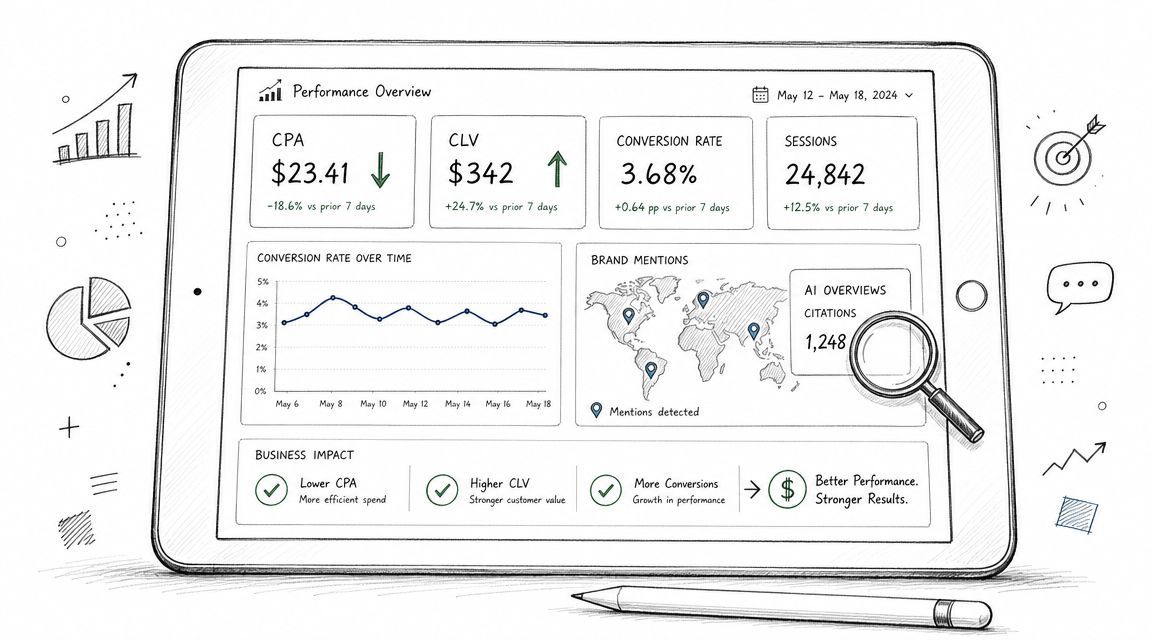
Key Revenue-Driven Metrics to Track
To prove the ROI of your efforts, your performance dashboard should be tracking concrete financial and operational outcomes. Here’s what matters most:
- Cost Per Acquisition (CPA): Are your finely-tuned AI models helping you acquire new customers more cheaply? This is a direct, undeniable measure of your marketing efficiency.
- Customer Lifetime Value (CLV): Is AI-driven personalization and retention leading to more valuable customers over time? A rising CLV shows you’re not just acquiring customers, but keeping them happy.
- Conversion Rate Improvements: Whether you’re tracking demo sign-ups, product sales, or lead submissions, you need to measure the percentage lift that can be attributed directly to your AI initiatives.
- Lead Quality Score: For SaaS and B2B companies, this is huge. Track how AI optimization improves the quality of leads going to your sales team, which should translate into higher close rates and shorter sales cycles.
Measuring Visibility in AI-Powered Search
Beyond your internal dashboards, you also need to monitor your brand’s presence in the new world of generative search. Showing up in Google’s AI Overviews and other answer engines is the next frontier of organic growth.
The real goal is to track how often your brand, products, or content are cited as a primary source in AI-generated answers. Every citation acts as a powerful endorsement, driving high-intent traffic from users who now see you as the definitive authority.
The case for AI optimization becomes undeniable when you look at the market. With 77% of companies already using or exploring AI, the real competitive advantage goes to those who can make it work efficiently. Investors see it, too; generative AI alone attracted a staggering $25.2 billion in 2023, part of a broader AI market expected to eclipse $1.8 trillion by 2030. If you want to dive deeper into the numbers, you can check out this detailed market analysis from Magnet.
These figures aren't just hype. They show that companies are building their long-term operations around AI, and optimization is the bridge between investment and tangible results. Learning from successful AI deployments for efficiency can give you a proven framework. This is exactly how you prove that your AI optimization efforts deliver a measurable, defensible return.
Building Your AI Optimization Roadmap
Jumping into AI optimization without a clear plan is like trying to build a house without a blueprint. You might end up with something, but it probably won't be what you wanted. A solid roadmap turns guesswork into a deliberate process, connecting your tech, data, and content directly to your most important business goals.
First things first: you need to know where you stand. This means taking a hard look at your current setup with a full audit. What AI tools are already in play? Which of your data sources are clean and ready to use, and which are a complete mess? This gives you a baseline and shines a light on the biggest opportunities.
Once you have that baseline, you can set specific, measurable goals. Don't just say you want "more traffic." Get granular. Are you trying to slash your customer acquisition cost, boost the quality of your leads, or maybe dominate the top spots in AI-driven search results? Prioritize the actions that will move the needle most on these key metrics.
The final piece is creating a continuous loop of building, testing, and measuring.
Tying AI features to actual business growth isn’t about just plugging in the latest tech. It's about building a plan for visibility and efficiency that is laser-focused on revenue. Making sense of it all often means finding a partner who gets how the technical details translate into real financial results.
If you want to make sure your investment truly pays off, working with an experienced SEO strategist can help you build a roadmap that puts your business objectives at the very center of your AI strategy.
Frequently Asked Questions About AI Optimization
Let's tackle some of the most common questions we hear from business owners about putting AI optimization into practice.
What Is the Difference Between Using AI and AI Optimization?
Think of it this way: "using AI" is the starting line. It’s when you draft an email with ChatGPT or ask an AI tool for a few blog post ideas. You're exploring the technology.
AI optimization, on the other hand, is about turning that tool into a core part of your business engine. It's about systematically refining your AI systems to improve their performance, lower costs, and boost accuracy—all tied to a specific business goal. It’s the difference between dabbling with AI and making it a predictable machine for growth, like using it to improve lead quality by 20%.
How Much Does It Cost to Start with AI Optimization?
The investment can range from nearly zero to a significant line item, and it all depends on your goals. You can start with low-cost, high-impact strategies like mastering prompt engineering or structuring your website to appear in AI-powered search answers.
At the other end of the spectrum, you might invest in fine-tuning a custom model to handle a critical business process.
The most practical first step is a strategic audit. This helps identify the highest-ROI initiatives that fit your budget, ensuring you invest in work that actually moves the needle on revenue or efficiency.
Can Small Businesses Really Benefit from AI Optimization?
Absolutely. This isn't just a game for large enterprises with massive budgets. In fact, some of the most effective strategies are incredibly accessible and can deliver immediate value. For a deeper dive into common questions, you can also check out resources like this guide to Ekipa's AI solutions.
Here are a few practical examples perfect for small businesses:
- Optimizing your website content to get cited as a source in AI search results.
- Using AI-powered SEO tools to automate and scale the creation of local content.
- Implementing an AI chatbot trained on your own business data to automate customer support and answer questions instantly.
Ultimately, AI optimization is about being smarter and more efficient with the resources you already have.
Ready to move beyond just using AI and start optimizing it for real business growth? SEOBRO® builds search and visibility strategies centered on revenue, not vanity metrics.
Schedule a discovery call to build your AI optimization roadmap