Teams frequently don't run into a content problem first. They run into a scale problem.
The keyword research looks promising. There are hundreds or thousands of variations tied to products, use cases, integrations, locations, categories, attributes, and comparisons. Each query may be small on its own, but together they represent serious commercial intent. The problem is that publishing all of those pages manually is too slow, too expensive, and usually too inconsistent.
That's where programmatic SEO enters the conversation.
Done well, it gives a business a repeatable way to turn structured data into useful landing pages that capture long-tail demand. Done badly, it creates a giant pile of near-duplicate URLs that waste crawl budget, fail to rank, and can drag down overall organic performance. If you're looking into what is programmatic seo, that trade-off matters more than the definition.
This is also why broad advice on content production isn't enough. Leaders need systems thinking. If you want a useful broader lens on scaling search responsibly, LucidRank's guide to modern SEO tactics for marketing leaders is worth reading because it frames SEO as an operating model, not a publishing checklist.
Introduction The Content Scaling Wall Most Businesses Hit
A founder sees thousands of searches around product combinations. A SaaS team spots demand around integrations, alternatives, and industry-specific workflows. A multi-location service business knows there's local intent beyond its main city pages. Then the same problem appears. The team can't build enough useful pages fast enough to capture that demand.
Manual SEO breaks at that point.
You can keep assigning page briefs, writing by hand, and publishing one URL at a time. That works for cornerstone content, core service pages, and strategic category pages. It doesn't work when the opportunity depends on pattern-based demand across hundreds or thousands of combinations.
Programmatic SEO is the operating system for that situation. It lets you build pages from structured inputs instead of treating every page like a separate editorial project. But the goal isn't volume. The goal is to capture relevant, conversion-capable traffic in places where manual publishing can't keep up.
Three business realities make this useful:
- Long-tail intent compounds: Individual keyword variants may look small, but the aggregate opportunity can be large.
- Search behavior is specific: Buyers don't always search broad head terms. They search attributes, integrations, comparisons, and local modifiers.
- Revenue sits in the edges: Some of the best organic opportunities live outside the obvious category and service pages.
Practical rule: If you can't describe the business model behind the page set, you're not ready for programmatic SEO.
The companies that benefit most don't treat this as an automation stunt. They treat it as a structured acquisition channel tied to qualified traffic, assisted conversions, demos, sales, bookings, or product discovery.
What Is Programmatic SEO Beyond the Buzzword
A team sees thousands of relevant searches sitting just outside its current site structure. The product catalog is broad, the use cases are specific, and buyers search with modifiers that never make it into manually written pages. Publishing page by page won't cover that demand at the speed the business needs.
That is the practical answer to what is programmatic seo. It is a method for building search landing pages from structured inputs, fixed logic, and reusable templates so a business can target repeatable intent patterns at scale. The mechanics matter, but the business case matters more. A good pSEO system creates pages only where search demand, page usefulness, and commercial relevance overlap.
A simple pattern might look like {product} + {feature} + {location} or best {category} for {use case}. The page is generated from data, but it still has a job to do. It needs to satisfy a specific query, support the next conversion step, and stay accurate as products, features, pricing, inventory, or service availability change.
It works as a business system
Teams get into trouble when they treat programmatic SEO as a publishing shortcut. It performs best when it is tied to a clear revenue model.
For eCommerce, that usually means product discovery, compatibility, category refinement, or comparison demand. For SaaS, it often means integration pages, alternative pages, use-case pages, or workflow-specific entries. For local businesses, it can mean service plus city, neighborhood, or category combinations, but only if each page reflects real service coverage and local relevance.
The operating parts are straightforward:
| Element | What it does | Why it matters |
|---|---|---|
| Keyword pattern | Defines the repeatable search opportunity | Keeps page creation tied to real demand |
| Dataset | Supplies the facts, attributes, and variables | Controls relevance, accuracy, and differentiation |
| Template | Shapes the page experience and on-page SEO | Determines whether the page is genuinely useful |
| Automation | Publishes and updates pages efficiently | Keeps the system maintainable as the site grows |
The trade-off is clear. Scale lowers the cost of publishing each page, but it raises the cost of getting the system design wrong. If the query pattern is weak, the pages target demand that never converts. If the data is thin or stale, the pages become duplicates with minor substitutions. If the template cannot express meaningful differences between records, the site starts to look manufactured to users and to search engines.
Precision decides whether pSEO helps or hurts
Programmatic SEO fails when teams confuse variable replacement with value creation. Swapping a city name, feature, or tool into the same thin layout does not produce a useful page. It produces indexable clutter.
Because of this, modern pSEO has to overlap with content design, technical SEO, internal data quality, and entity clarity. That matters even more now that search engines and AI systems summarize products, features, and comparisons directly in results. Structured, precise page inputs improve your odds of appearing in those surfaces. The same discipline also supports optimizing product content for AI overviews if your templates target commercial queries.
Good programmatic SEO maps a repeatable demand pattern to a repeatable page system with real informational value, operational controls, and a clear path to revenue.
The Three Pillars of a Programmatic SEO System
A pSEO system breaks in predictable ways. The data is incomplete, the template cannot carry real intent, or the publishing layer pushes low-value pages at scale. Any one of those failures can turn a revenue opportunity into an index bloat problem.
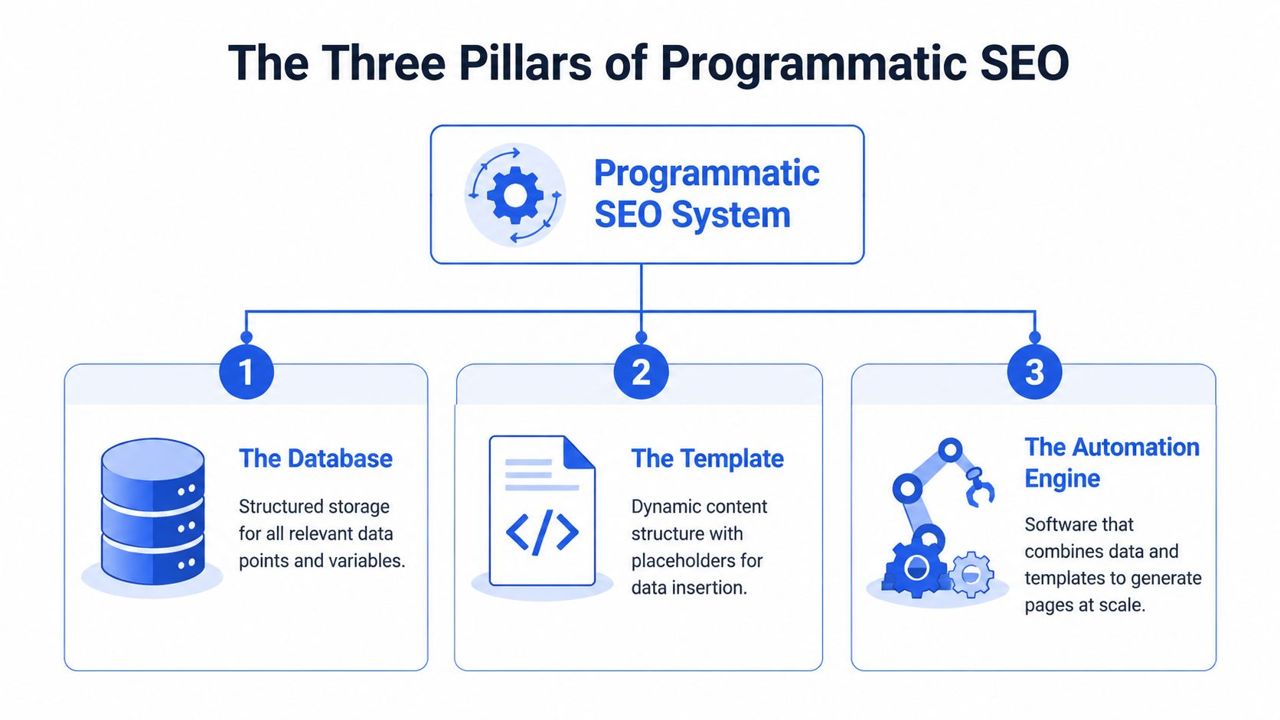
The database
The database sets the ceiling for everything that follows. If the records are thin, outdated, or inconsistent, the pages will inherit those weaknesses no matter how polished the template looks.
The strongest pSEO programs use data the business already owns and can maintain. That usually includes product attributes, service coverage, inventory status, integration details, pricing qualifiers, customer use cases, and support-driven FAQs. For local businesses, it can include neighborhoods served, technician availability, review signals, and service-specific constraints. For SaaS, it often means feature mapping, competitor overlap, workflow fit, and integration pairings. For eCommerce, it usually comes from structured catalog data that buyers search against.
A scraped spreadsheet rarely holds up because it does not create defensible pages. It also creates operational risk. If the source is wrong, every page is wrong at once.
Useful datasets often include:
- Internal product data: specs, compatibility, feature sets, stock status
- Service or market data: cities, neighborhoods, coverage limits, category availability
- Customer-driven fields: objections, use cases, jobs to be done, implementation patterns
- Editorial fields: summaries, comparisons, limitations, FAQs, trust signals
Precision starts here to protect the site. Clear field definitions, validation rules, and update ownership reduce the chance of duplicate pages, misleading claims, and stale indexable content.
The template
The template decides whether each page deserves to rank.
A weak template swaps variables into the same copy block and calls it scale. A strong template changes what the page shows based on intent, available data, and the commercial job the page needs to do. That distinction matters because search engines evaluate usefulness at the page level, even when the system is built at scale.
The practical test is simple. If 100 pages built from the template would feel interchangeable to a user, the template is too thin. If those 100 pages would help different users make different decisions, the structure is doing real work.
High-performing templates usually combine fixed sections with conditional modules such as:
- Comparison tables: useful for alternatives, integrations, and product selection
- Dynamic FAQs: built from recurring objections or support questions
- Location-specific proof: service constraints, local inventory, testimonials, response times
- Attribute summaries: fit, compatibility, limitations, use cases
- Related-page pathways: variants, parent categories, alternatives, supporting content
The right template also changes by business model. An eCommerce page for a filtered product combination needs buying guidance and availability context. A SaaS integration page needs workflow clarity, setup expectations, and adjacent tools. A local service page needs service-area proof and signals that the business can fulfill the job in that location.
That is why template design is not a content chore. It is a revenue decision.
The automation engine
The automation layer turns the dataset and template into a controlled publishing system. Control matters more than speed.
Teams can run this through a CMS, a no-code stack, or custom scripts. The stack is less important than the rules around it. Slugs, titles, canonicals, schema, internal linking logic, indexation rules, refresh triggers, and QA checks all need to be defined before pages go live. Otherwise, automation just spreads errors faster.
Operating principle: automate only after the quality checks, indexation logic, and update rules are in place.
In practice, the workflow usually follows three steps:
- Group search demand into repeatable patterns that match how people search and how the business makes money
- Build and clean the source dataset so each field supports a useful page element
- Create modular templates and publishing rules that change by intent, not just by variable
As noted earlier, SEOclarity outlines a similar operating model for programmatic SEO, including repeatable query structures and template-driven page creation. The bigger point is strategic: pSEO works when the system maps cleanly to a business model and includes safeguards against thin, duplicative, or unmaintained pages. Without that discipline, scale becomes the risk.
Real-World ROI for eCommerce SaaS and Local Businesses
A revenue team approves 500 new pages. Six months later, rankings are flat, conversions are weak, and the cleanup work costs more than the original build. That outcome is common when programmatic SEO gets treated as a publishing shortcut instead of a business system tied to margin, sales velocity, and service coverage.
The upside is real, but only when the page set matches how the company makes money. Used with that level of precision, pSEO can turn long-tail demand into product discovery, demo requests, and booked jobs. When implemented correctly, websites using programmatic SEO report an average 40% increase in organic traffic within the first six months, a 25% higher conversion rate from organic search compared to traditional SEO methods, and content creation time reduced by up to 70%, according to BlogHunter's published statistics for 2026 trends and insights (programmatic SEO traffic, conversion, and efficiency benchmarks).
Those numbers are directionally useful. They are not a guarantee. ROI depends on whether the template captures commercial intent, whether the dataset supports useful differentiation, and whether the pages deserve to be indexed in the first place.
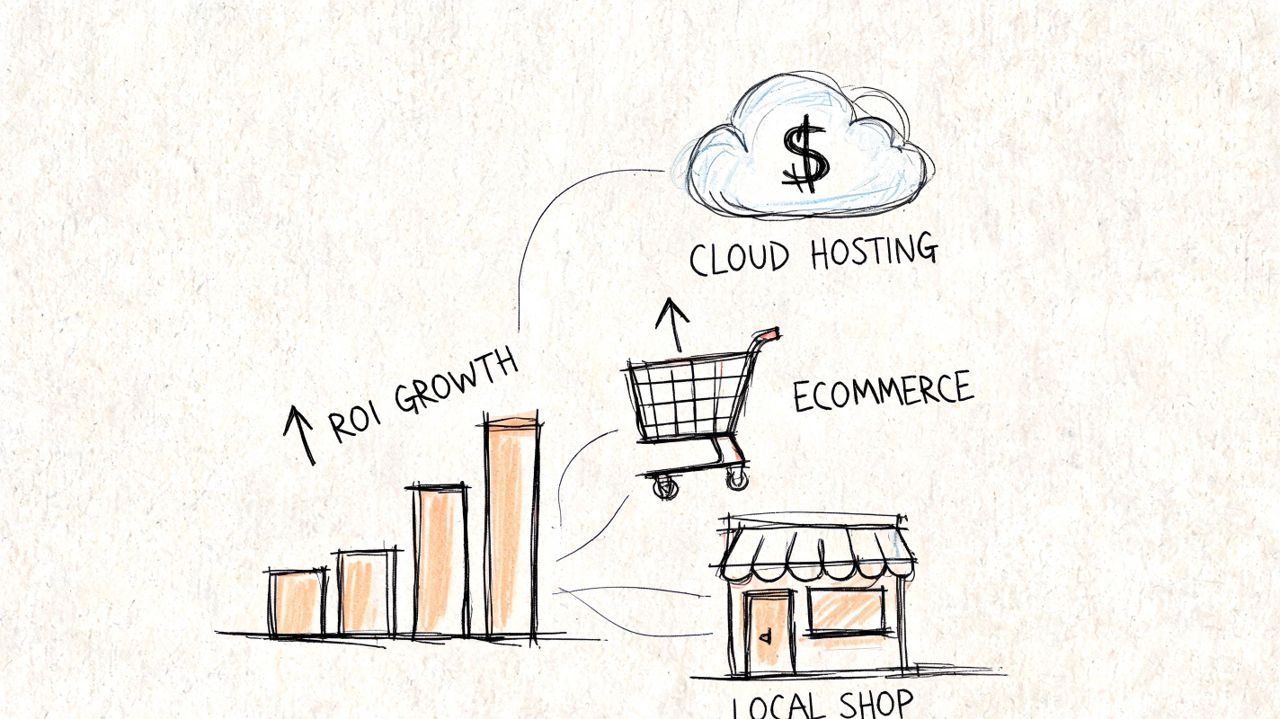
eCommerce
eCommerce gets strong returns from pSEO when search behavior lines up with catalog structure and inventory reality.
The pages that work usually sit close to a purchase decision:
- Attribute pages: material, size, color, compatibility, occasion
- Use-case pages: products for a task, audience, or environment
- Comparison pages: alternatives within a category
- Brand-model fit pages: especially where compatibility matters
A footwear store does not need a page for every color and size combination. It needs pages for combinations people search, products that are in stock, and a layout that helps someone choose. That often means adding buying guidance, fit notes, compatibility details, product groupings, review signals, and structured data instead of relying on faceted navigation alone.
The trade-off is straightforward. More pages can increase search coverage, but low-signal combinations create index bloat, duplicate intent, and weak conversion paths. The profitable version of eCommerce pSEO is selective.
SaaS
SaaS companies usually have high-intent pSEO opportunities because buyers search by workflow, integration, role, and alternative.
Common page types include:
- Integration pages
- Alternative pages
- Use-case pages by role or industry
- Workflow pages tied to jobs to be done
The highest-performing SaaS pages usually sit between product marketing, sales enablement, and light documentation. An integration page should explain what the connection does, what data moves between systems, who benefits, what setup looks like, and what the next step is. If the page cannot answer those questions, it is unlikely to drive qualified signups no matter how many variants get published.
I have seen SaaS teams overproduce “X integration” pages with nearly identical copy and no real product context. Those pages may get indexed for a while, but they rarely become durable acquisition assets. The stronger model is narrower and more deliberate. Publish fewer pages, support each one with real workflow detail, and connect it to a clear conversion action such as signup, demo, or sales contact.
Local businesses
Local pSEO works when service-area pages reflect actual operational coverage and real local demand.
The highest-value patterns often include:
- Service + neighborhood
- Service + city
- Service + problem type
- Service + urgency modifier
For a plumbing company, “emergency plumber in [neighborhood]” can be a strong page type if that neighborhood is served, response times are credible, and the page includes details that match the search. That can include service availability, common property types, nearby landmarks, local proof, and the specific emergency jobs handled in that area.
The risk is higher in local than many teams assume. Thin location pages are easy to generate and hard to defend. If every page says the same thing with a city name swapped in, the business is building clutter, not demand capture. Some location variants should stay unpublished, some should be noindexed, and some deserve a fully developed page because they map to revenue and real delivery capacity.
That is the broader ROI test across all three models. Programmatic SEO pays off when it expands qualified search coverage without lowering page quality, conversion intent, or trust. If the system cannot maintain that standard at scale, the pages become a liability before they become an asset.
A 6-Step Programmatic SEO Implementation Roadmap
A team exports 20,000 keyword combinations, wires them into templates, hits publish, and waits for growth. Three months later, half the URLs are ignored, some clusters compete with each other, and the pages that do rank bring in weak traffic that does not convert. That is the failure pattern this roadmap is built to avoid.
Programmatic SEO works when each step protects revenue. The order matters because every mistake gets multiplied across the page set.
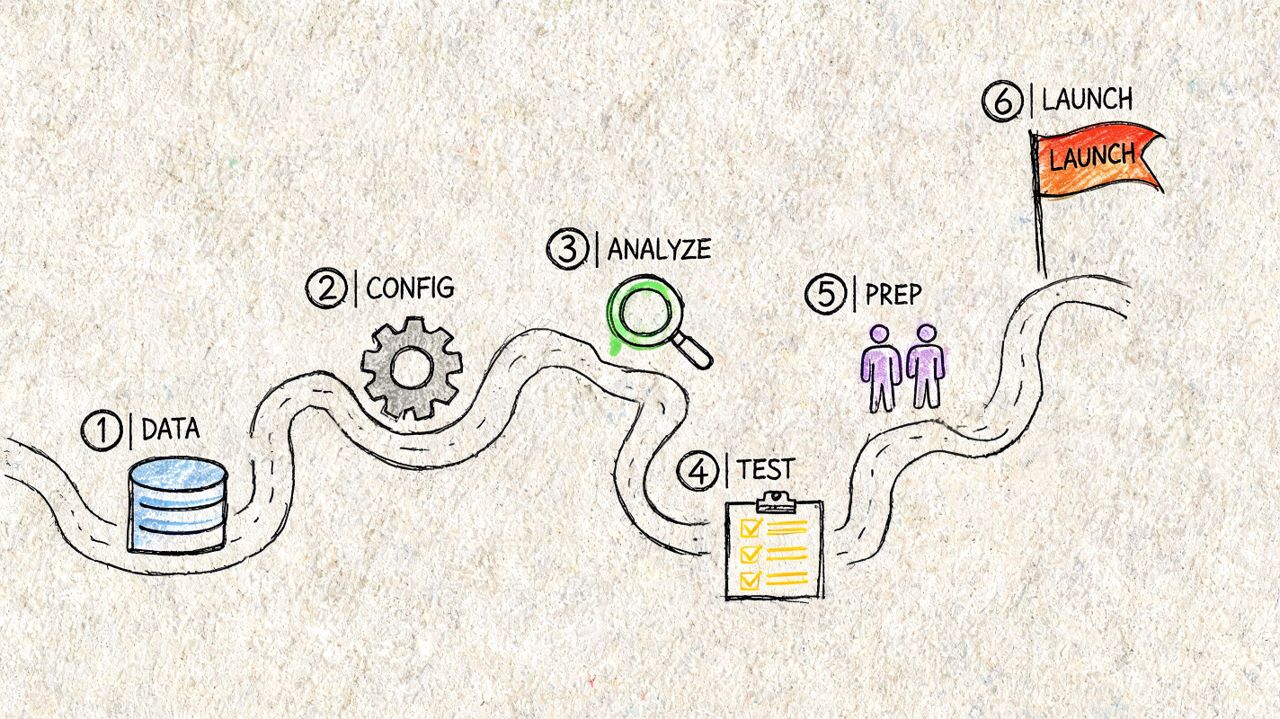
1. Find a scalable keyword pattern
Start with a repeatable query pattern where the search intent stays consistent across variants.
Examples that often hold up include product + feature, service + location, software + integration, and category + audience. Patterns break when different variants really need different page types, different offers, or different depth. That is where pSEO shifts from scale advantage to duplication risk.
Review the SERP by hand before you build anything. If one variant returns comparison pages, another returns category pages, and another returns local packs, that pattern is not stable enough for a single template.
2. Build the dataset before the pages
Weak pSEO projects usually expose themselves at this stage.
A page system is only as good as the data behind it. If the dataset only contains a keyword, a slug, and a city name, the output will read like spun content even if the design looks polished. Revenue-focused pSEO needs enough structured information to support decision-making, trust, and conversion on every URL.
A practical dataset usually includes:
- Primary entity fields: product, city, tool, service type
- Supporting attributes: features, pricing context, compatibility, availability
- Unique descriptors: summaries, notes, differentiators
- Taxonomy fields: parent category, related pages, intent type
- QA flags: index or noindex, canonical target, completeness status
If the field is missing in the data layer, it will be missing at scale on the site too.
3. Design a template with actual value
Templates need to do more than swap variables. They need to answer the query well enough that the page deserves to rank and clear enough that the visitor knows what to do next.
That usually means defining the H1 logic, title and meta rules, body modules, schema fields, internal link logic, and conversion modules before production starts. For eCommerce, that may mean structured comparisons, availability, and product-level trust signals. For SaaS, it often means workflow detail, integration specifics, and strong demo paths. For local businesses, it means real service coverage, proof, and operational detail that a generic location page cannot fake.
Common template blocks that hold up across page sets include:
| Template block | Best for | Why it helps |
|---|---|---|
| Summary section | All page types | Gives context fast |
| Comparison or feature table | eCommerce and SaaS | Supports decision-making |
| Local trust elements | Local SEO | Improves relevance |
| Dynamic FAQs | Most patterns | Captures objections and variants |
| Related links | All page sets | Strengthens site architecture |
Technical controls belong in the template stage, not after launch. Seomatic notes that programmatic setups need rigorous indexing controls to ensure 80-90% of generated pages rank viably, including noindex/nofollow on variants with fewer than 10 searches, canonicals for overlapping intent, and dynamic Product schema that can improve CTR by 20-30% (programmatic SEO indexing controls and schema best practices).
Teams also need to plan for optimizing for AI search visibility, especially when large page sets depend on structured data, entity clarity, and answer-first formatting.
After you've mapped the template logic, this walkthrough can help clarify the production mindset behind page generation:
4. Set technical rules before publishing
Programmatic SEO multiplies technical mistakes fast.
Set indexation rules, canonical rules, URL conventions, structured data logic, internal linking rules, and staging protections before any large rollout. If similar pages can both be indexed without a clear canonical strategy, they will compete. If thin variants are left open by default, crawl budget gets wasted on pages that never had ranking potential. If schema is injected carelessly, markup errors spread across the entire cluster.
This is risk control, not cleanup.
5. QA a sample before generating the full set
Launch a sample that is large enough to reveal failure points and small enough to fix without pain.
Review the pages on mobile and desktop. Check schema output, metadata, internal links, duplicate sections, factual accuracy, conversion elements, and rendering speed. Then review the sample like a skeptical buyer. If the page feels templated, vague, or interchangeable, scaling it will produce more low-confidence URLs, not more qualified demand.
Publish a small batch, inspect how Google handles it, then expand. Controlled rollout beats mass release.
6. Launch in controlled waves and iterate
The strongest pSEO programs behave like product systems. They launch in stages, monitor performance at the cluster level, improve what works, and retire what does not.
Start with the highest-confidence page groups. Watch Search Console, indexation rates, engagement signals, assisted conversions, and sales feedback. If a cluster brings impressions but no commercial movement, revisit the intent match, the offer, or the page type itself. If a variant adds no value, cut it or noindex it. Protecting bad pages because they took time to build is how teams drift into traffic inflation without revenue impact.
The Essential Programmatic SEO Tech Stack
The right stack depends less on hype and more on who will maintain it. A founder-led team with no developer support should not build the same system as an in-house engineering org. Simpler infrastructure often wins because it's easier to govern.
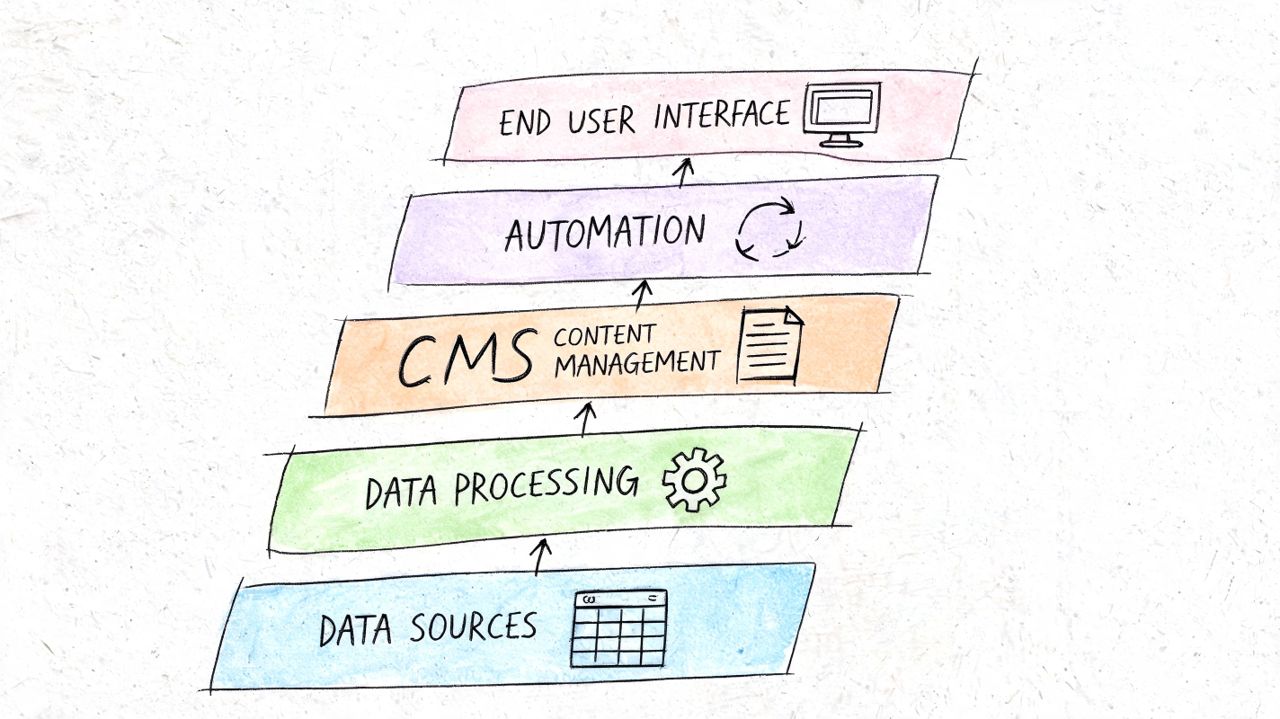
Data and enrichment
For data collection and management, the most practical options are often:
- Airtable: strong for relational content operations and collaborative editing
- Google Sheets: useful for small pilots and lightweight workflows
- BigQuery or internal databases: better for enterprise-scale structured data
- APIs and scrapers: helpful when the page set depends on external data sources
Airtable is often the sweet spot for marketing-led teams because it supports field structure without requiring full engineering ownership.
CMS and frontend choices
Your template layer usually lives in one of these setups:
- Webflow: good for no-code and marketing-owned collections
- WordPress with custom fields: flexible when you need editorial control
- Next.js or another custom framework: strong when engineering wants full control
- Shopify plus custom collection logic: practical for catalog-led eCommerce
Choose based on content model complexity, not brand preference. If the team can't safely update fields, templates, and publish logic, the stack is too fragile.
Automation and publishing workflows
The automation layer typically includes:
- Zapier or Make: to move data between sources and CMS platforms
- Whalesync: useful for syncing Airtable and front-end systems
- Custom scripts: best for more advanced transformation and validation logic
- Google Search Console and analytics tools: for monitoring page-set performance
You also need a review process. Even if publishing is automated, governance cannot be fully hands-off.
For teams thinking beyond standard blue links, QuickSEO's perspective on optimizing for AI search visibility is useful because it ties tool choice to how pages surface in AI-driven experiences.
Your stack should make it easy to improve page quality, not just easy to produce more pages.
A good rule is simple. If your team can't explain how a page moves from row data to live URL, you don't yet have an operational stack. You have a black box.
Avoiding the Traffic Cliff Common Pitfalls and Mitigation
A pSEO system can look healthy for six months, then lose a large share of its traffic in weeks. The usual cause is not publishing too slowly. It is scaling pages that never had enough unique value to survive tighter quality evaluation.
Programmatic SEO implementations fail at a 60% rate without proper methodology, traffic cliffs affect 1 in 3 deployments, and 93% of failures in penalized sites were tied to lack of differentiation and reliance on simple template variation rather than unique data assets, according to Passionfruit's analysis of pSEO failures and recoveries (programmatic SEO failure rates and traffic cliff analysis).
That pattern shows up across business models, but the failure mode looks different in each one. eCommerce teams often create near-identical collection or attribute pages that compete with each other. SaaS companies publish integration, alternative, or use-case pages built from the same copy blocks with only a few swapped nouns. Local businesses generate city or neighborhood pages with no real proof of local relevance, service differences, or operational coverage.
The shared problem is weak differentiation. Google does not reward page count. It rewards pages that resolve a specific query better than the alternatives and do it consistently across a site.
Why so many projects fail
Teams get into trouble when the production system is stronger than the content model. Publishing works. Ranking durability does not.
A few failure modes show up repeatedly:
- Thin pages: the URL exists, but the page does not help a user make a decision, compare options, or complete a task
- Intent overlap: multiple pages target the same query pattern with minor wording changes
- Dirty source data: missing fields, stale attributes, inconsistent naming, and mismatched entities create low-trust pages at scale
- Template dependence: the page relies on layout and token replacement instead of page-specific evidence
- Over-indexation: every generated variant gets indexed, including pages with no demand, no differentiation, or both
Revenue teams often find themselves misled. A page set can generate impressions before it proves its quality. If those pages fail to satisfy intent, conversion rates stay weak, engagement signals deteriorate, and the site carries more low-value inventory than it can defend.
How to lower the risk
Risk control starts before publishing.
For eCommerce, that usually means using product, inventory, pricing, compatibility, or availability data that competitors cannot easily copy, then restricting indexation to combinations with real search demand and meaningful choice. For SaaS, it means building pages around actual product differences, workflow depth, integration behavior, or implementation detail, not just keyword permutations. For local businesses, it means tying each page to real service delivery, coverage constraints, proof, and conversion paths, rather than mass-producing location text.
The practical rule is simple. Strengthen the data layer first, then decide which pages deserve to exist.
A mitigation checklist that holds up in production looks like this:
- Use differentiated inputs: first-party catalog data, service constraints, proprietary workflows, coverage details, or user-generated signals
- Match templates to intent: comparison pages, integration pages, location pages, and category pages should not share the same logic
- Set indexation thresholds: require minimum content completeness, demand, and uniqueness before a page can be indexed
- Consolidate overlap early: if two URLs answer the same intent, combine them before they compete
- Review page samples by segment: inspect winners, borderline pages, and weak pages separately to catch systemic quality issues
- Prune on a schedule: remove, noindex, or merge URLs that do not earn traffic, links, or conversions over time
One decision matters more than teams expect. Publish fewer pages than your system can generate.
That restraint protects the site while you validate quality at the page-set level. It also makes it easier to spot which combinations create revenue, which ones only create crawl load, and where the template or source data needs work.
Programmatic SEO works when it is run like an operating system with QA, indexation control, and clear economic thresholds. Without that discipline, it becomes a fast way to manufacture risk.
Conclusion Is Programmatic SEO Right For You
Programmatic SEO is not a shortcut. It's a highly effective publishing and acquisition system for businesses that already have three things: structured data, repeatable search patterns, and the discipline to control quality at scale.
If you run an eCommerce catalog with meaningful product attributes, a SaaS platform with integrations and use-case depth, or a local business with real service-area complexity, programmatic SEO can turn the long tail into a real growth channel. If you don't have differentiated inputs, or if your team wants automation mainly to avoid thinking about content quality, it will likely create more problems than it solves.
That's the definitive answer to what is programmatic seo.
It's not mass page creation. It's the systemized production of pages that deserve to rank because they answer specific intent with structured, relevant, and technically sound content. The businesses that win with it treat it like infrastructure. They connect keyword patterns, information architecture, page design, schema, internal linking, and conversion paths into one operating model.
If you're considering it, ask better questions before building anything:
- Do we have unique data or just generic inputs?
- Is the search pattern scalable?
- Can we create templates that help users decide?
- Do we have the technical control to manage indexation and duplication?
- Will these pages support leads, sales, demos, or bookings?
If the answers are weak, stop and fix the foundation first. If the answers are strong, programmatic SEO can become one of the most efficient ways to expand qualified organic visibility.
If you want a senior second opinion before investing in a large-scale rollout, consider working with SEOBRO®. The right move is usually a strategic audit first, then a roadmap that ties templates, technical SEO, and revenue goals together so programmatic SEO becomes a growth system instead of a page-generation experiment.