Your rankings can hold steady while pipeline weakens. That isn't a reporting error. It's what happens when buyers get the answer before they ever reach your site.
One guide reports that zero-click Google searches rose from 56% in 2024 to 69% in 2025, while ChatGPT was serving 800 million users weekly in the same period, according to CXL's guide to answer engine optimization. For a CMO, that changes the job. Search visibility is no longer only about earning the click. It's about becoming the source an AI system chooses to cite inside the answer.
That's why an answer engine optimization strategy matters now. Not as a trendy add-on to SEO, but as a practical response to shrinking click opportunities, noisier attribution, and longer B2B buying journeys. If your team still measures success mainly by sessions, you'll miss what's changing upstream in discovery.
The commercial impact shows up downstream. Fewer informational clicks can mean fewer first-touch visits, weaker retargeting pools, and less obvious influence on demo requests or revenue. That's where measurement discipline matters. Teams adapting their content programs also need stronger conversion systems for the traffic they do win, which is why resources like Orbit AI's conversion framework are useful alongside search strategy.
Introduction Why Your Traffic Is Flat but Your Revenue Is Down
A lot of teams are seeing the same pattern. Rankings look acceptable. Non-brand traffic hasn't collapsed. But lead quality feels weaker, assisted conversions are harder to explain, and revenue from organic doesn't track the way it used to.
The reason is simple. The old search funnel assumed a visit. AI search often doesn't.
An effective answer engine optimization strategy starts with accepting that search behavior has changed. Buyers ask a question in Google, ChatGPT, Perplexity, or another answer surface. The platform synthesizes a response. Your brand either appears in that answer, or it doesn't exist in that moment of discovery.
Practical rule: In AI search, visibility has shifted from page rank to source selection.
That changes content priorities. Intro paragraphs full of brand throat-clearing don't help. Pages that delay the answer don't help. Thin category copy, generic SaaS feature pages, and local service pages built only around keyword variants don't help.
What works is clearer. Direct answers near the top. Verifiable facts. Strong information hierarchy. Content blocks that can stand alone when a retrieval system pulls a single section instead of reading the whole page.
For B2B companies, the consequences are significant because the lost click is only part of the problem. The harder issue is lost influence. If the answer engine keeps your expertise but strips away your visit, your analytics understate your role in pipeline creation. That's why this work has to be tied to revenue strategy, not vanity traffic.
The AEO Mindset From Keywords to Verifiable Answers
A lot of marketers treat AEO as a separate channel. That's the wrong frame. It's better understood as SEO adapted to how AI systems retrieve, interpret, and cite information.
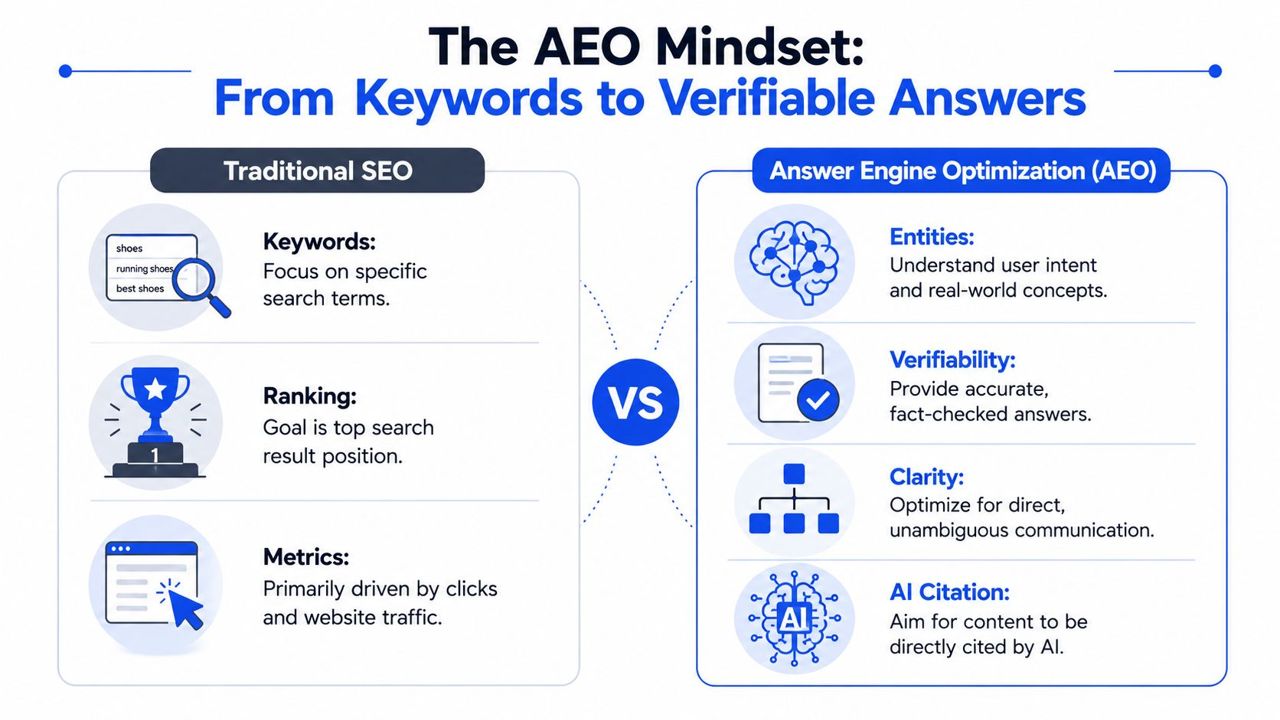
Why AEO is an SEO evolution, not a replacement
Forrester describes marketers using AEO to map content to shopper questions, and HubSpot reported that its beta customers drove 20% more traffic from AI than customers not using the tool, while HubSpot itself reported a 1,850% increase from its AEO strategy, as cited in Forrester's overview of answer engine optimization. That's enough to treat AEO as a measurable acquisition channel, not an experiment.
The strategic implication is straightforward. Keep your SEO fundamentals. Expand the brief. A page now has to satisfy both ranking logic and citation logic.
That means the content brief changes from:
- “What keyword are we targeting?”
- “How long should the page be?”
- “Can we outrank the current top result?”
To questions like:
- What exact question is the buyer asking
- What answer can be quoted cleanly
- What facts on this page are specific enough to cite
- What part of the page proves authority without requiring full-page reading
Teams that already understand search intent optimization usually adapt faster because AEO rewards pages that match the underlying question, not just the phrase.
What changes inside the content brief
Keyword targeting still matters. But keywords now sit inside a broader entity and evidence model.
A stronger answer engine optimization strategy pushes writers and SEOs to define terms cleanly, reduce ambiguity, and support claims with evidence. That same discipline also matters outside search. If your brand operates in regulated or claims-sensitive markets, the standards used in preparing for EU Green Claims Directive are a useful example of how evidence-backed statements outperform vague marketing language.
The page doesn't need to sound robotic. It needs to be easy for a machine to trust.
Traditional SEO often tolerates fluffy intros, loose claims, and weak structure if the page still ranks. AEO is less forgiving. If the model can't quickly identify the answer, the supporting facts, and the source entity, another page will be easier to cite.
Your Content Framework for AI Citation
Many teams don't need more content. They need content that can be extracted cleanly.
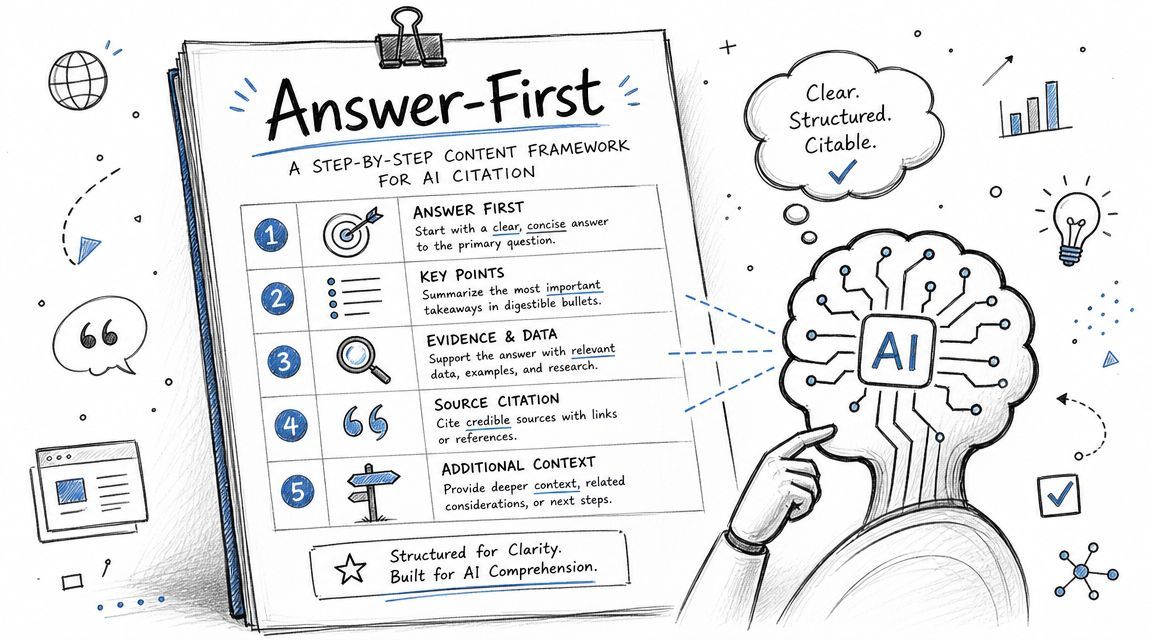
Build every section as a standalone answer
One practical source recommends increasing verifiable fact density, keeping sections at 200 to 400 words, adding a data point every 150 to 200 words, and ensuring at least 5 named, verifiable facts per page. The same source reports that 68.7% of pages cited by ChatGPT follow a clean H1→H2→H3 hierarchy, and nearly 80% use complete-sentence lists, according to Erlin AI's AEO content research.
That lines up with what works in practice. AI systems don't consume a page the way a human does. They often retrieve a section. So each section has to function as a usable answer on its own.
Use this pattern:
- Lead with the answer: The first sentence under a heading should answer the implied question directly.
- Add supporting facts: Follow with specific details, definitions, examples, or constraints.
- Keep one idea per block: Don't mix definition, process, pricing logic, and objections in the same chunk.
- Use complete-sentence lists: They're easier to parse than fragments.
- Close with a qualifier when needed: If the answer depends on product type, industry, location, or use case, say that plainly.
Here's the difference between weak and strong structure.
| Approach | Weak version | Strong version |
|---|---|---|
| Heading | “Platform capabilities” | “What does the platform automate for finance teams” |
| Opening | Brand-led intro | Direct answer in the first sentence |
| Body | Mixed features and benefits | One focused answer block with scannable proof |
| Formatting | Long paragraphs | Ordered headings, lists, and concise sections |
What this looks like for SaaS, eCommerce, and local
A SaaS company should stop hiding core answers inside feature grids. Create pages that explain what a feature does, who it's for, where it fits in the workflow, what data it uses, and what limitations apply. Pricing comparisons, implementation requirements, and integration pages often become strong citation assets when written clearly.
An eCommerce brand should treat category and product pages as answer surfaces, not just merchandising pages. Buyers ask compatibility questions, material questions, sizing questions, and comparison questions. The page should answer those directly before the user has to scroll through sales copy.
A local service business should build geo-specific pages around real service questions. Not “best plumber in city.” Instead: what emergency plumbing includes, which problems require same-day work, what areas are served, and what steps a customer should take before the technician arrives.
If a sales rep answers the same question every week, that answer probably belongs on a page designed for citation.
A practical content checklist
Before publishing, review each page against a short operational checklist:
- Question-led headings: Write H2s and H3s around real customer questions.
- Answer-first openings: Make the first line useful on its own.
- Evidence over adjectives: Replace “powerful,” “leading,” and “robust” with specifics.
- Structured summaries: Use comparison tables, FAQs, and step lists where they help comprehension.
- Internal reinforcement: Link related pages so the topic cluster is obvious to crawlers and users.
For FAQ blocks, structured implementation matters as much as the copy. If your team uses them heavily, this guide to FAQ schema markup is worth folding into the production process.
Technical SEO for Machine Readability
Well-written content won't matter if the right systems can't access, render, or interpret it.
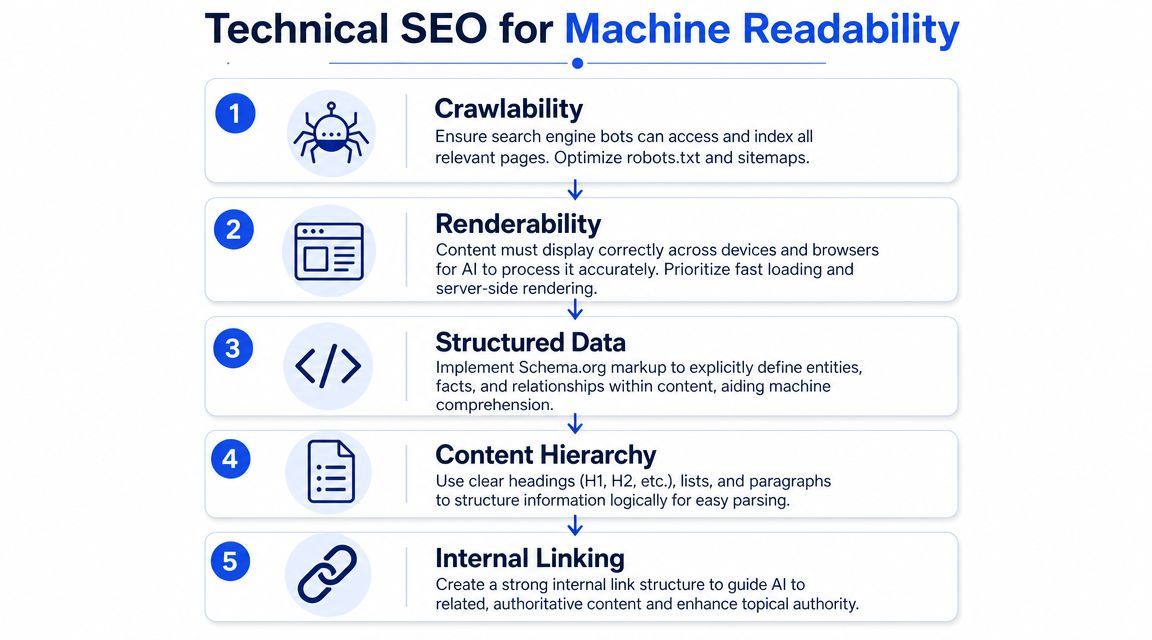
Crawlability comes before markup
Many AEO discussions jump straight to schema. That's a mistake. If the page is hard to crawl, delayed by client-side rendering, buried in weak internal linking, or blocked accidentally, markup won't save it.
Start with the basics:
- Accessible HTML content: Important text shouldn't depend entirely on heavy rendering.
- Clean internal links: Your most citable pages should be easy to discover from hubs, navs, and related resources.
- Consistent indexation signals: Reduce duplication and avoid sending mixed messages about canonical targets.
- Fast retrieval paths: Keep your key pages close to important category, solution, or help-center hubs.
This matters a lot for large sites. SaaS documentation, eCommerce faceted navigation, and multi-location local sites often create discoverability problems long before anyone gets to AEO formatting.
Schema helps, but only when the page is understandable
Structured data still matters. Article, FAQPage, HowTo, Product, and Organization markup all help machines interpret page type and content relationships. But the common failure is treating schema like decoration.
Use markup to clarify a page that is already strong. Don't use it to compensate for weak hierarchy, bloated intros, or generic copy.
A reliable pattern looks like this:
| Technical element | What it should do | Common mistake |
|---|---|---|
| Article schema | Clarify page type and publishing context | Added without improving the content itself |
| FAQPage schema | Support explicit question-answer pairs | Marking up weak or repetitive FAQs |
| HowTo schema | Structure procedural guidance | Using it on pages that aren't true processes |
| Internal linking | Reinforce topic relationships | Linking only for navigation, not relevance |
For pages built to win short-form SERP real estate as well as AI citations, this guide on how to optimize for featured snippets fits naturally into the same workflow.
Crawler policy is now part of AEO
One of the most overlooked parts of an answer engine optimization strategy is access control. Writer notes that teams should review robots.txt to allow legitimate AI crawlers while blocking problematic bots, and that AI visibility now depends on whether the right systems can access and interpret content, as explained in Writer's guide to GEO and AEO optimization.
That introduces a real trade-off. Some brands want visibility in AI answers but don't want unrestricted scraping. Others allow broad access without understanding which bots create value and which only consume resources.
For retail and DTC teams, the operational side is becoming especially important. Product data, category content, and comparison pages can be useful citation assets, which is why tactical resources like the DTC AI search visibility guide are useful when reviewing crawler access alongside merchandising and SEO priorities.
Better markup can help. But bad crawl governance can quietly erase the opportunity.
Building Authority with Entities and Citations
Answer engines don't just cite the cleanest page. They also prefer the source that looks most trustworthy.
Entity clarity reduces ambiguity
Your brand, products, spokespeople, locations, and service lines should be named consistently across the site. That sounds basic, but many organizations create confusion through inconsistent naming, overlapping product terms, and vague authorship.
A few examples:
- A SaaS company uses one product name on pricing pages, another in documentation, and a third in sales decks.
- A local business changes service labels across location pages.
- An eCommerce brand has manufacturer terminology on product pages but category-level aliases elsewhere.
That inconsistency weakens entity clarity. It makes it harder for search systems to connect mentions, relationships, and authority signals across the site.
A stronger setup includes:
- Consistent naming: Use official product and service names everywhere.
- Clear authorship: Attribute expert content to real people with relevant expertise.
- Entity reinforcement: Connect product, service, brand, and category pages through internal links and schema-supported relationships.
- Location clarity: For local businesses, keep core business details aligned across site pages and profiles.
Off-page trust still matters
AEO hasn't replaced authority building. It has made it more important.
Backlinks, brand mentions, press coverage, citations, reviews, partner listings, and industry references still help establish that your brand deserves to be cited. For local companies, citation hygiene and a complete Google Business Profile remain foundational. For B2B and SaaS brands, strong mentions from respected industry publications, communities, and associations support trust.
Many AI content programs fail by over-focusing on formatting and underinvesting in reputation. A perfectly structured page from a weak or unclear entity often loses to a slightly less polished page from a more established source.
The practical takeaway is simple. Build pages worth citing, then build a brand worth trusting.
Measuring AEO Success Beyond Clicks and Traffic
The biggest mistake in AEO reporting is treating reduced clicks as reduced value. Sometimes that's true. Sometimes it isn't.
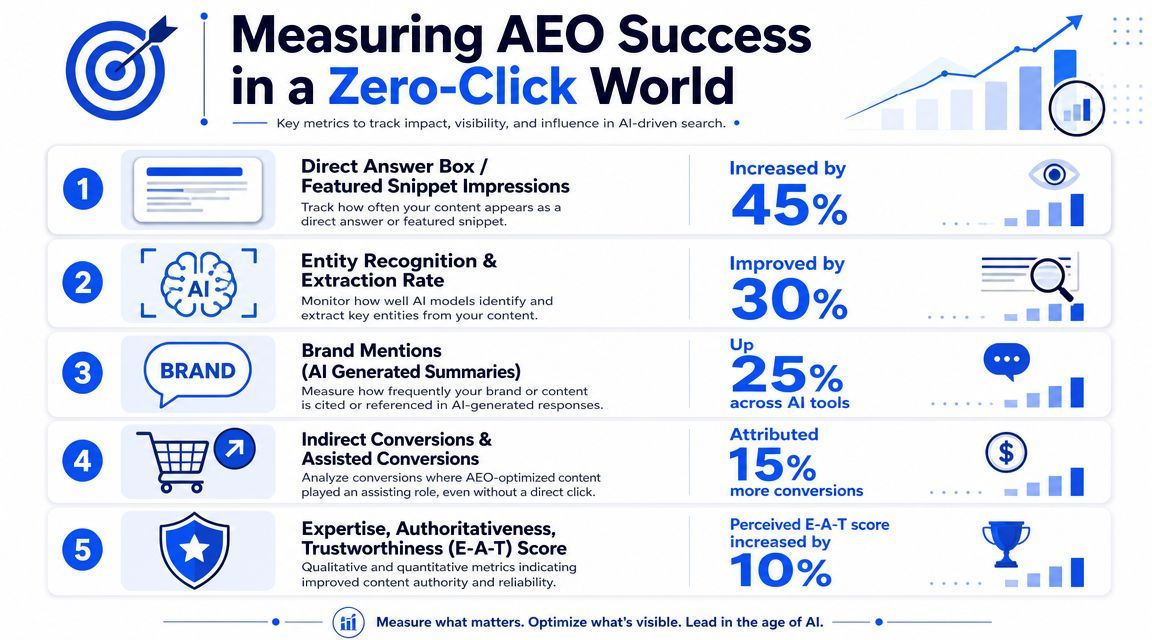
What to track when clicks are no longer the full story
Forrester recommends tracking brand visibility in answer-engine results, and a commonly suggested operational target is to earn 1 to 2 mentions in answer engines for a topic cluster within about three months, according to Forrester's guidance on mastering AEO.
That doesn't mean every cluster will behave the same way. It does mean CMOs need a reporting model that starts before the click.
A practical AEO dashboard should include:
- Answer-engine mentions: Track whether your brand or page appears in AI responses for priority queries.
- Citation frequency by cluster: Group prompts by topic, not only by keyword.
- Referral traffic from AI-powered sources: This won't capture the whole picture, but it still matters.
- Featured snippet and answer-surface presence: Some classic SERP features support the same answer-first strategy.
- Branded search lift: If answer surfaces increase awareness, branded demand often reflects it later.
- Assisted conversions: Look for pages that influence pipeline without acting as last-touch entries.
AEO reporting should answer one commercial question: did visibility create more qualified demand, even when the click path became less direct?
How to connect visibility to revenue
Attribution is the weak spot in most AEO playbooks. You probably won't get a clean one-to-one line from an AI mention to closed revenue. That doesn't mean measurement is impossible.
Use a layered model:
- Visibility layer: Mentions, citations, answer-surface appearances.
- Engagement layer: AI referrals, on-site behavior, return visits, branded searches.
- Pipeline layer: Demo requests, contact forms, qualified leads, assisted conversions.
- Revenue layer: Opportunities and closed business influenced by organic and AI-discovery content.
This is especially useful in B2B, where buyers often discover a vendor in one session and convert much later through direct, branded, or sales-assisted routes.
If your current reporting only values last-click SEO traffic, your answer engine optimization strategy will look weaker than it is. Consider a strategic SEO audit or work with an experienced consultant who can build an attribution model around visibility, influence, and revenue instead of just sessions.
Frequently Asked Questions About AEO
Is AEO different from SEO
AEO is best treated as an extension of SEO. Traditional SEO helps pages rank and get discovered. AEO improves the odds that the content is selected and cited in AI-driven answers. The strongest programs do both.
Is AEO the same as GEO
They're closely related. Many teams use GEO as the broader category for visibility in generative AI systems, while AEO focuses more specifically on becoming the cited source in answer-driven interfaces. In practice, the workflows overlap.
How long does an answer engine optimization strategy take to show results
It depends on your authority, technical foundation, and topic coverage. Some pages become more citation-friendly quickly after restructuring. Broader topic-level visibility usually takes longer because authority, internal linking, and content depth all affect outcomes.
Can one strategy work across Google AI Overviews and ChatGPT
Yes, if the foundation is solid. Clear answers, clean structure, strong crawlability, consistent entities, and trustworthy facts travel well across platforms. You may still adjust formatting and page types by use case, but the core strategy should be unified.
If you want an answer engine optimization strategy tied to qualified leads, demos, and revenue instead of vanity traffic, SEOBRO® can help. The right approach usually starts with a strategic audit, a prioritized roadmap, and hands-on implementation across technical SEO, content structure, internal linking, schema, and measurement.