Your content might still rank in Google, yet your brand can be missing from ChatGPT, Perplexity, Claude, and Google's AI answers. That gap matters when buyers stop browsing ten blue links and start accepting summarized recommendations. If competitors get cited and you don't, they gain the authority, the attention, and often the lead.
That's why a Generative Engine Optimization Audit matters now. It's the process of checking whether your site is easy for AI systems to crawl, understand, extract from, and trust. The upside is already tangible. HubSpot reports that 67% of digital marketers say GEO tracking is important, and that answer-engine visitors convert at 4.4x the rate of traditional organic search in HubSpot's GEO statistics roundup.
A good audit doesn't stop at “did we get mentioned?” It builds a repeatable operating system for AI visibility. That means scoping prompts, testing multiple engines, tightening technical access, rewriting weak content into citable content, and measuring mention quality over time. If you need a primer before going deeper, start with what AI optimization is and how it differs from classic SEO.
Why Your Business Is Disappearing from AI Answers
A familiar scenario plays out in audits. The site ranks for commercial terms, branded search is healthy, and organic traffic looks stable. Then the buying conversation shifts into ChatGPT, Google AI Overviews, or Perplexity, and the brand barely appears.
That gap usually comes from an extraction problem, not just a ranking problem. Generative systems look for clear facts they can restate with confidence. If your pricing model is vague, your service scope is buried, your product details conflict across pages, or third-party validation is weak, the model has little reason to cite you. It will pull from a competitor that made the answer easier to assemble.
I see this across eCommerce, SaaS, and local business sites. Category pages often describe products in merchandising language instead of plain attributes a model can quote. SaaS companies publish feature pages but fail to explain who the product is for, what jobs it does, and where it fits against alternatives. Local businesses often have decent service pages but inconsistent location signals, uneven reviews, and thin proof. Each issue reduces the odds of being named in an AI answer, even when traditional rankings are still acceptable.
Practical rule: If AI cannot extract your best facts cleanly, it cites the business that states them more clearly.
The mistake is treating GEO as a lighter SEO checklist. A useful audit has to answer harder business questions. Which prompts influence pipeline. Which pages support those prompts. Which entities and claims show up consistently enough to earn citations. Which fixes are worth doing first because they can change visibility in high-intent conversations.
That is why the audit framework matters. The goal is not just to get mentioned. The goal is to build a repeatable system that ties AI visibility to revenue, lead quality, and sales opportunity creation. That requires measurement governance and prioritization from the start, not after the fixes go live.
One useful outside perspective is this guide to Geo SGE and LLM strategies, which reinforces the shift toward explicit, answer-ready content that models can quote and attribute.
The business risk is straightforward. If AI answers become the first serious touchpoint and your competitors are named there again and again, they gain trust before the buyer ever visits a website.
Audit Phase 1 Scoping Your GEO Baseline
Most GEO audits fail before they start. Teams jump into schema changes, FAQ blocks, or content rewrites without knowing which prompts matter, which engines matter, or whether they were visible at all before the work began.
A proper baseline comes first.
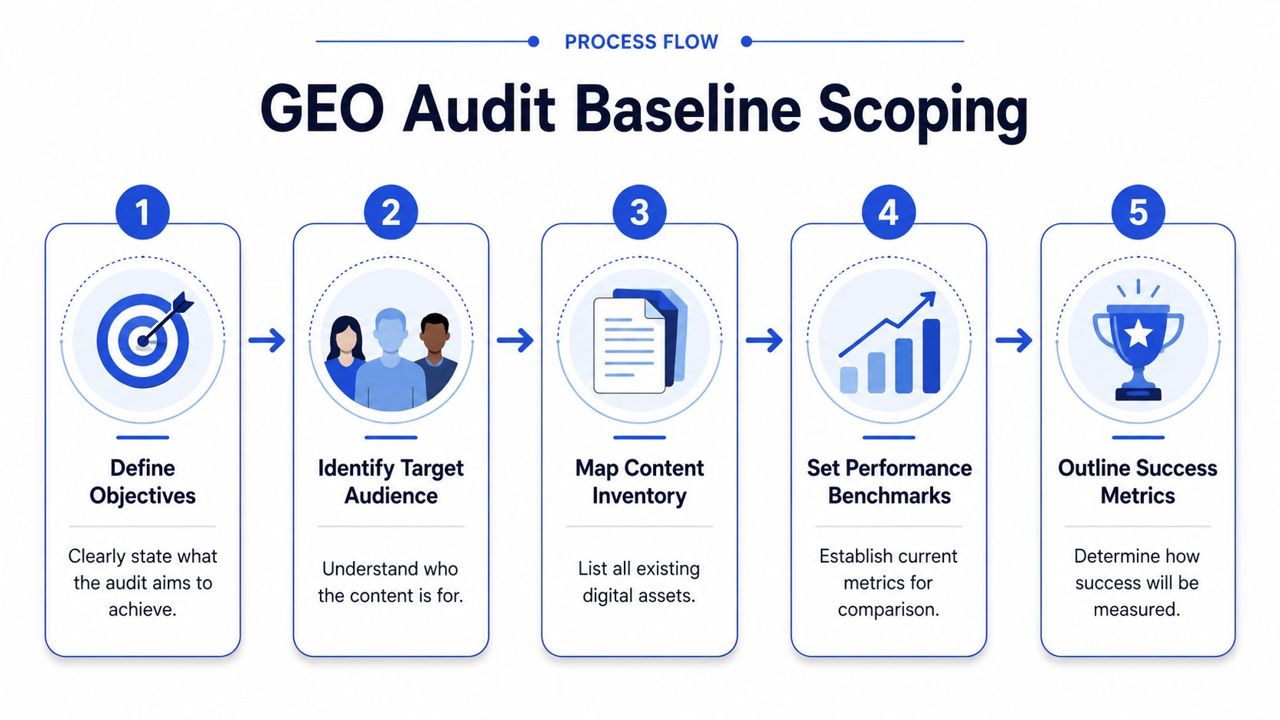
Start with commercial prompts, not vanity prompts
Mersel AI recommends testing at least ChatGPT, Perplexity, Claude, and Google AI Overviews, and says a manual baseline of 10–15 prompts per platform is usable in its guide to running a GEO audit. That's enough to spot patterns without pretending one engine behaves like another.
Don't start with broad prompts like “best software” or “top agency.” Start with the prompts that match revenue intent:
- Buyer comparison prompts like brand-vs-brand or category-vs-category queries
- Problem-aware prompts tied to urgent pain points
- Feature or use-case prompts that map to your product or service pages
- Local intent prompts for service-area and near-me style queries
- Trust prompts where users ask who's credible, reliable, or recommended
If you audit a SaaS company, test prompts around integrations, use cases, pricing context, onboarding, security, and alternatives. For eCommerce, use product type, brand comparison, fit, specs, and category advice prompts. For local businesses, use service + city, emergency intent, cost framing, and provider selection prompts.
Pick a baseline you can repeat
The first pass shouldn't be fancy. It should be repeatable.
Track each prompt in a simple sheet with fields like:
| Field | What to capture |
|---|---|
| Prompt | The exact question asked |
| Engine | ChatGPT, Perplexity, Claude, or Google AI Overviews |
| Mention | Was your brand or page referenced |
| Positioning | Were you primary, secondary, or absent |
| Citation quality | Was the source accurate and relevant |
| Competitors named | Which competing brands appeared |
A messy baseline is still useful. No baseline means every future improvement claim is guesswork.
For teams building a process, this resource on a systematic AI SEO workflow is useful because it pushes you to document prompts and outputs instead of relying on memory.
What works here is discipline. What doesn't work is optimizing pages before you've identified the prompts that influence pipeline.
Audit Phase 2 Technical Foundations for AI Crawlers
A surprising number of GEO problems are still plain technical SEO problems. If AI crawlers can't reach, render, or trust the page, they won't cite it consistently.
That's why the technical pass should be blunt. Can the page be crawled? Can the page be indexed? Does the page load cleanly on mobile? Is the core content available in rendered HTML without depending on fragile scripts? Is the internal linking path obvious?
What to check before touching content
Start with the same essential elements you'd check in a serious SEO audit, but judge them through an AI visibility lens.
- Crawl access: Review robots directives and page-level indexation controls so important content isn't blocked or de-prioritized.
- Render clarity: Check whether the primary answers, specs, definitions, and FAQ content appear without heavy client-side dependence.
- Internal discovery: Confirm that key pages are linked from category hubs, service hubs, navigation, and contextual modules.
- Mobile readiness: AI systems often rely on the same web reality users do. If the mobile page is weak, slow, or incomplete, trust drops fast.
- URL and template consistency: Clean, stable templates make entity understanding easier than bloated, duplicated, parameter-heavy structures.
If crawl efficiency is already a problem, fix that before debating prompt strategy. This guide on crawl budget optimization goes deeper into how to reduce waste and strengthen discovery of pages that matter.
What usually breaks AI visibility
In practice, the biggest failures are boring:
- Hidden primary content inside tabs, accordions, or scripts that don't expose meaningful copy cleanly
- Thin template pages with almost no factual differentiation
- Duplicate intent pages competing with each other and diluting authority
- Outdated pages that still rank for long-tail queries but contain stale claims, old positioning, or weak entity signals
If your best answer sits behind weak architecture or broken rendering, content quality won't save it.
What works is making important pages dead simple to access, render, and parse. What doesn't work is assuming AI systems will compensate for technical debt because Google sometimes does.
Audit Phase 3 Content and Entity Analysis
Once the technical floor is stable, the audit gets more interesting. Here, you check whether your pages contain information AI can reliably lift, summarize, and attribute.

Entlify advises prioritizing fixing inaccuracies first, then filling visibility gaps by strengthening headings, schema markup, and third-party references in its GEO audit guidance. That order matters. A well-structured wrong answer is still wrong. AI systems favor clear definitions and externally validated mentions, so the first pass is factual cleanup.
Audit for extractable facts
Read the page as if you were an answer engine looking for a direct response. The fastest way to spot weak content is to ask, “What sentence on this page would a model quote?”
If the answer is “none,” the page needs rewriting.
Look for these citable units:
- Single-sentence definitions near the top of important sections
- Headings that state topics clearly instead of using vague, clever wording
- Bulleted summaries for features, use cases, benefits, service inclusions, and limitations
- Named entities such as product lines, service types, industries served, locations, founders, integrations, and methodologies
- Updated facts that match what the brand currently sells and supports
For example:
| Business type | Weak format | Stronger GEO format |
|---|---|---|
| SaaS | Feature paragraph with marketing language | Short feature definition, supported by use-case bullets |
| eCommerce | Dense product description | Spec block, compatibility notes, materials, fit, FAQ |
| Local service | Generic service page | Clear service area, service scope, hours, trust signals |
Check whether each page teaches the model who you are
Most content teams write for persuasion first. GEO pages need persuasion and extraction. That means every important page should answer three things with very little ambiguity:
- What is this page about
- Who is this for
- What facts can be cited safely
A category page should define the category. A SaaS feature page should explain the feature in plain language before trying to sell it. A local service page should state service area, problem solved, and service specifics before expanding into credibility copy.
This walkthrough is useful if you want to see how practitioners discuss AI-readable content structure in action:
What usually doesn't work is bloated intro copy, soft claims without clear supporting facts, and pages that hide the answer beneath branding language.
Audit Phase 4 Schema Markup and Authority Signals
Clear content gives AI something to extract. Schema and authority signals tell AI what that content means and whether the wider web supports it.
That combination is where a lot of mature GEO programs separate from surface-level checklists.
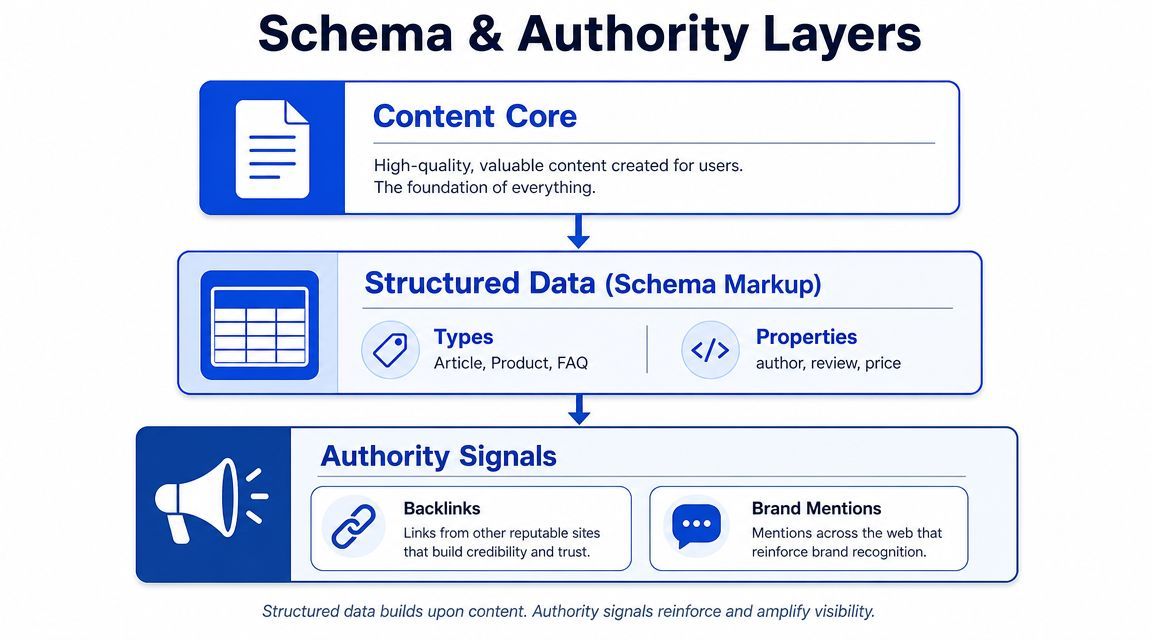
Schema clarifies meaning
Audit schema markup for usefulness, not for volume. A page doesn't become more trustworthy because it has more JSON-LD stuffed into it. It becomes clearer when the markup reflects the page accurately and supports entity disambiguation.
The most valuable schema types usually include:
- Organization schema to define the brand, site, and core business identity
- Person schema where expert authorship, founders, or key contributors matter
- Product schema for product detail pages and structured product attributes
- FAQPage schema when the questions are visible on-page and map to real buyer concerns
The important test is consistency. Your on-page copy, metadata, internal links, and schema should describe the same thing the same way. If your page calls something a platform, your schema shouldn't label it like a generic blog article and leave the product entity unclear.
For teams refining answer-ready content, this guide to FAQ schema markup is useful because FAQ structure often becomes the bridge between a readable page and a citable page.
Authority signals confirm the story
Generative systems don't rely only on your own website. They also infer trust from third-party references. That means the audit should inspect your off-site footprint, not just your templates.
Look at whether your brand is consistently described across:
- Industry publications
- Relevant directories
- Partner pages
- Community discussions
- Expert profiles and contributor bios
Clean schema helps AI interpret your page. External mentions help AI believe it.
What works is alignment. Your brand promise, product naming, service scope, and expertise should match across owned and earned sources. What doesn't work is publishing polished product pages while the broader web barely confirms that your company is a credible source in the category.
Audit Phase 5 Measurement and Prioritization
Often, most GEO content gets thin. Teams are told to optimize for AI visibility, but not how to prove progress or decide what to fix first.
A serious GEO program needs measurement governance. The audit should produce a reporting layer that a founder, CMO, or client can effectively use.
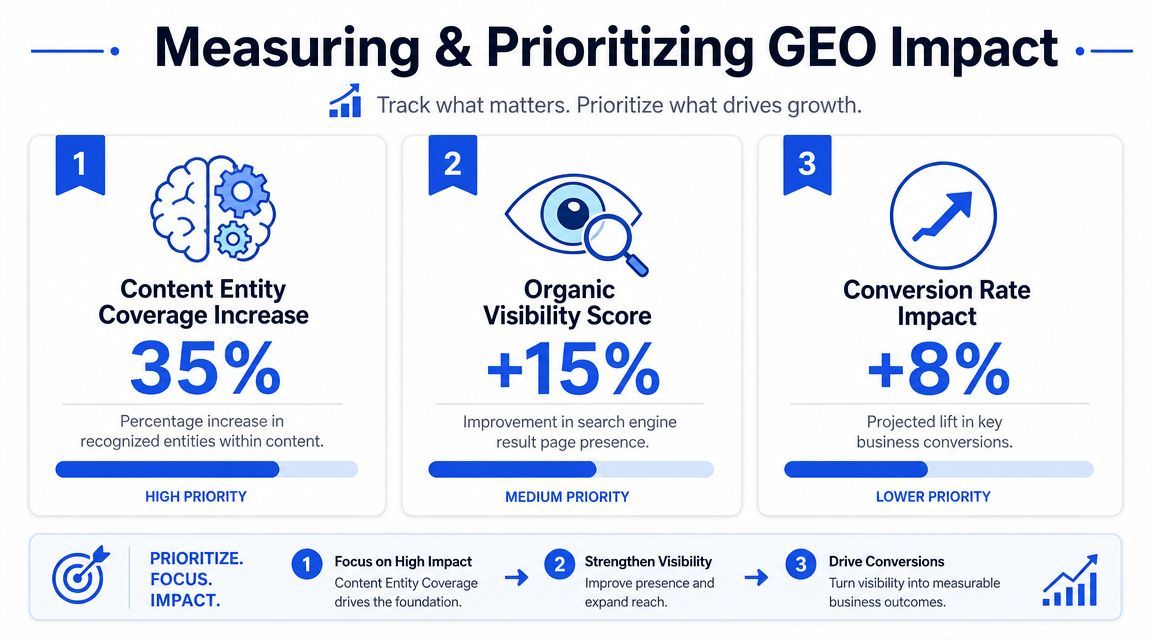
GeoReport notes that the operating cadence is moving toward a quarterly review, and frameworks now track indicators such as mention rate, positioning score, attribution quality, query coverage, and semantic similarity in its discussion of the modern GEO audit process. That's the right direction. GEO isn't a one-off page review. It's an ongoing visibility system.
Track the right GEO metrics
A useful dashboard doesn't try to mimic traditional rank tracking. It tracks whether your brand appears, how often, where, and with what quality.
Focus on metrics like:
- Mention rate: How often your brand appears across target prompts
- Query coverage: How many of your important prompts trigger a mention or citation
- Positioning score: Whether you're central to the answer or a passing reference
- Attribution quality: Whether the cited page is the right page and the description is accurate
- Outcome linkage: Which prompts and mentions seem connected to qualified traffic, leads, demos, or sales conversations
For teams building reporting habits, this AI search monitoring playbook is a useful companion because it treats AI visibility as something to observe repeatedly, not as a static audit result.
Prioritize by business impact
Not every GEO fix deserves immediate work. Prioritize with a simple matrix:
| Priority type | Typical examples | Action |
|---|---|---|
| High revenue, low effort | Rewriting definitions, fixing product facts, adding FAQ blocks to key pages | Do first |
| High revenue, higher effort | Template changes, structured data rollout, page consolidation | Plan next |
| Lower revenue, low effort | Support content refreshes, tertiary prompt pages | Batch later |
| Low revenue, high effort | Broad speculative content projects | Challenge hard |
A lot of teams waste time chasing broad mentions that don't influence pipeline. The better move is to improve citation quality on pages tied to purchase intent.
Frequently Asked Questions About GEO Audits
How is a generative engine optimization audit different from a traditional SEO audit
A traditional SEO audit asks whether search engines can crawl, index, rank, and understand your pages. A generative engine optimization audit asks something more specific: can an AI system extract, summarize, and attribute your content confidently inside an answer.
That changes the focus. You still check crawlability, internal linking, duplication, page quality, and technical health. But you also audit for direct definitions, quote-ready facts, entity consistency, schema clarity, prompt coverage, and third-party validation.
In plain terms, SEO audits are often page-performance diagnostics. GEO audits are page-performance diagnostics plus citation-readiness diagnostics.
How often should you run a GEO audit
Quarterly is the most practical cadence for most businesses. The reason isn't just that your site changes. The models and answer engines change too.
Current GEO frameworks increasingly treat audits as recurring checks that verify whether content is still being cited, whether brand memory shifted, and whether new prompt gaps opened after model updates. That's why a repeatable baseline and reporting layer matter more than a one-time checklist.
Which pages should be audited first
Start with pages closest to revenue:
- SaaS: feature pages, solution pages, alternatives pages, integration pages, and demo-intent FAQs
- eCommerce: top category pages, top product pages, product comparison content, and buyer guides that answer pre-purchase questions
- Local businesses: core service pages, location pages, emergency or urgent-intent pages, and trust-building FAQs
Don't begin with low-stakes blog posts unless those posts dominate high-intent prompts in your category.
Can GEO work for eCommerce, SaaS, and local businesses
Yes, but the content patterns differ.
For eCommerce, AI systems need clean specs, compatibility, dimensions, materials, use cases, and return or shipping context when relevant. For SaaS, the strongest pages usually define features plainly, explain who they're for, and connect the feature to a business problem. For local businesses, service area, availability, core services, reputation signals, and operational facts matter more than long-form thought leadership.
The common denominator is clarity. AI systems cite what they can interpret quickly and trust.
Can GEO hurt traditional SEO or conversion rate
It can, if handled badly.
One of the biggest under-discussed trade-offs in GEO is that answer-ready content can drift toward overexposure or oversimplification. A page packed with concise FAQs may become easier to cite, but if it strips away differentiation, proof, or conversion context, it can become weaker for actual buyers. The same problem appears when brands expose too much proprietary insight just to increase citation probability.
The right question isn't “how do we get cited more?” It's “which citations support revenue, qualified leads, and brand positioning?” Sometimes the best GEO decision is not maximum exposure. It's selective exposure on the prompts that help the business.
Better citations beat more citations when the goal is pipeline, not vanity visibility.
What should a client or CMO expect from GEO reporting
Expect a system, not a score.
A strong reporting model should show:
- Which prompts matter by business line
- Which engines are being tracked
- Where the brand is mentioned or absent
- Which URLs are being cited
- Whether citations are accurate
- What changed since the last review
- Which actions are likely to influence visibility and revenue next
Therefore, measurement governance becomes essential. Many guides talk about formatting and schema. Far fewer explain how to benchmark multiple engines, attribute changes to specific work, and report progress in a way leadership can trust. That KPI layer is what turns GEO from an experiment into an operational channel.
Conclusion Turning Your Audit into Action
A Generative Engine Optimization Audit is no longer optional for brands that depend on search visibility to drive leads and revenue. If AI systems are already shaping consideration in your category, your site needs to be more than indexable and well-written. It needs to be citable, accurate, structured, and supported by a measurement system you can repeat.
The strongest audits don't chase vanity mentions. They identify where AI visibility affects commercial outcomes, tighten the technical foundation, turn weak pages into extractable knowledge assets, and measure change over time. That's how you build a search strategy around business impact instead of noise.
If your team is seeing competitors appear in AI answers while your brand gets ignored, don't start with random optimizations. Start with a disciplined audit, a realistic baseline, and a prioritization model tied to revenue.
If you want a senior SEO partner to turn AI visibility into a practical growth plan, SEOBRO® helps eCommerce, SaaS, and local businesses build search strategies around qualified traffic, leads, and revenue.