A familiar technical SEO problem looks like this. You find broken internal links on money pages, missing schema on a new product range, or a bad canonical pattern across template pages. The issue is clear, the fix is clear, and the commercial risk is clear. Then it sits in a dev backlog for two weeks while rankings, clicks, leads, and revenue opportunities leak out.
That gap between diagnosis and implementation has always been one of the biggest weaknesses in SEO operations. Traditional crawlers are good at finding problems. They are not good at getting problems fixed. The typical process still involves running some version of audit, creating tickets, waiting for engineering, re-checking, and then repeating the process next month.
That's why AI agents have become so relevant to technical SEO. They change the workflow from passive reporting to active execution. In practical terms, that means an agent can monitor a site, identify a class of issues, decide what action fits the rules you set, and push or queue the fix far faster than a manual process usually allows.
Used well, AI agents for technical SEO remove grunt work. Used badly, they can create faster mistakes.
The difference comes down to governance, QA, and whether the team measures business outcomes instead of congratulating itself for closing tickets. That's the true line between useful automation and expensive noise.
What Exactly Are AI Agents for Technical SEO
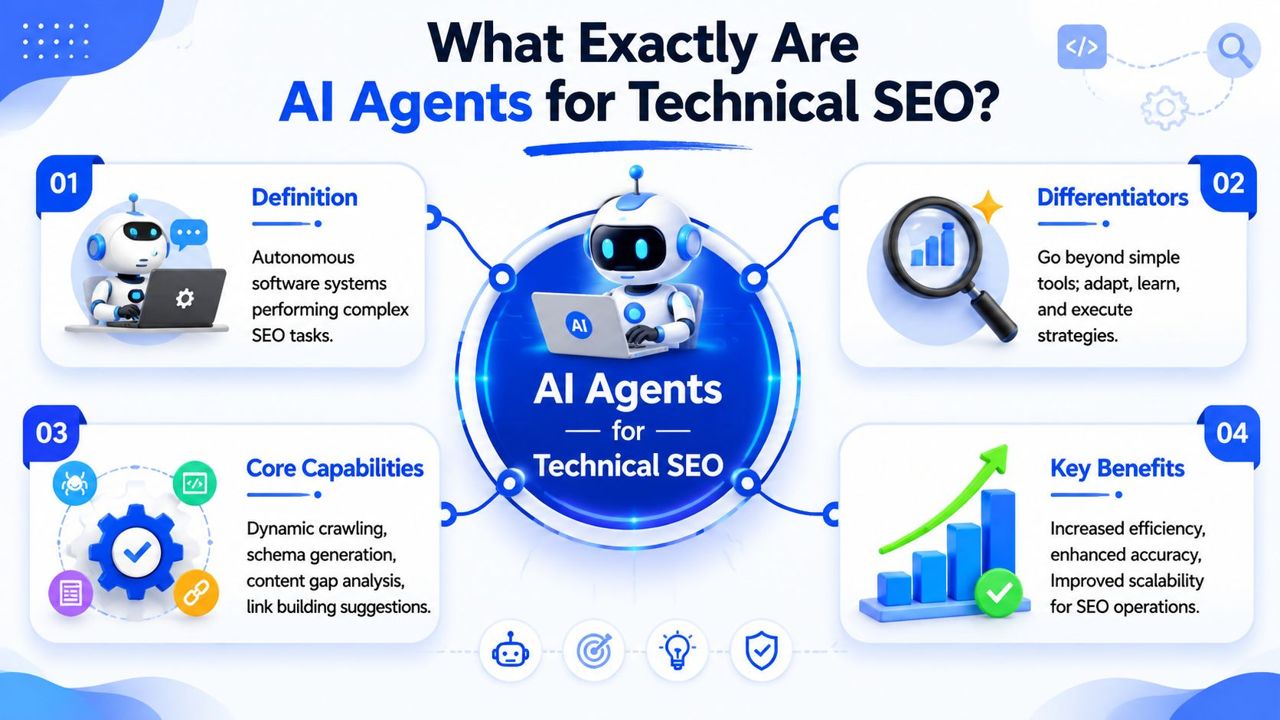
AI agents for technical SEO are software systems that can monitor, reason, and take action across multi-step SEO tasks. They don't just report that something is broken. They can pull data from connected tools, decide the next step, and execute a workflow.
The simplest way to think about an agent
A traditional SEO tool is like a calculator. It gives you outputs when you ask for them.
An AI agent is closer to an accountant. It can review records, identify a problem, prepare the action, and complete the task if you've given it permission.
That difference matters because technical SEO is full of repetitive, high-volume work that depends on multiple data sources. Ahrefs describes agents as most effective for crawl analysis, indexation triage, internal linking, keyword clustering, and performance monitoring, because they can ingest live data, decide next steps, and execute workflows end to end instead of stopping at analysis or copy generation in its guide to AI agents for SEO.
What makes them different from standard SEO software
Most agents combine three parts:
- Reasoning layer that interprets the goal, such as cleaning up internal linking on recently published pages
- Tool access to systems like Google Search Console, analytics platforms, CMS data, crawl outputs, logs, or scripts
- Workflow engine that chains actions together instead of waiting for a new prompt at every step
That's why they're useful in technical SEO and not just content production. An agent can detect orphan pages, compare them with conversion pages, generate internal linking suggestions, apply rules, and send exceptions for review.
Practical rule: If the task is repetitive, sequential, and dependent on live data, an agent is usually a good fit. If the task changes business rules, affects indexation, or needs context from pricing, legal, or brand strategy, a human should stay in charge.
A good example is documentation-heavy SEO work. Teams often need to analyze exported crawl files, technical specs, dev notes, and old audits before deciding what should be automated. Tools built for Gpts for document analysis can help structure that messy input so an agent has cleaner context before it acts.
The important point is this. An agent isn't “smart” because it writes fluent text. It's useful because it can operate inside a defined system without creating another layer of manual busywork.
High-Value Technical SEO Use Cases to Automate
The best automation targets work that is high-volume, repetitive, and expensive to leave unfinished. That usually means tasks spread across hundreds or thousands of URLs, not one-off strategic decisions.
Industry coverage of autonomous technical SEO describes how the old workflow of audit → ticket → dev sprint → release can be compressed into minutes when agents identify issues like broken links, missing schema, duplicate content, and page-speed problems, then deploy fixes without waiting for the usual queue in this review of AI agents for technical SEO.
Where automation earns its keep
Here are the use cases where agents usually create the most value.
Continuous crawl monitoring
Agents can watch for new 404s, redirect chains, canonical conflicts, orphan pages, and indexability problems instead of waiting for the next monthly crawl. That matters most on ecommerce sites, large SaaS knowledge bases, and sites with frequent content publishing.Log-based crawl analysis
Technical SEO teams still miss problems because they only look at crawler reports and not real bot behavior. Agent workflows can help process logs, compare bot access against important page groups, and flag whether search engines and AI crawlers are reaching priority content. If crawl efficiency is a current issue, this pairs naturally with a focused review of crawl budget optimization.Schema generation and validation
Product, FAQ, organization, and how-to markup often breaks at scale because templates change. Agents are useful for generating markup, checking required properties, and spotting inconsistencies across page groups.Internal linking operations
On content-heavy sites, agents can identify weakly connected pages, map contextual opportunities, and queue link placement suggestions. This is one of the few tasks where automation can improve both crawl efficiency and user navigation if the rules are tight.Protocol and status issue cleanup
HTTP/HTTPS inconsistencies, mixed internal references, and bad redirect logic can quietly undermine site quality. A practical reference on SEO HTTP HTTPS is useful when you're designing the rules an agent should follow.
One adjacent workflow worth using before deployment is competitor pattern analysis. If you need to analyze SEO competitors to see how they structure internal links, templates, or schema coverage, that external benchmark helps you automate the right things instead of just automating your existing mess.
Manual versus agent-driven 404 resolution
| Stage | Manual Process (1-3 weeks) | AI Agent Process (15-30 minutes) |
|---|---|---|
| Detection | Monthly crawl finds the issue | Continuous monitoring flags the issue |
| Prioritization | SEO team exports URLs and sorts by template or traffic value | Agent groups affected URLs by rule and priority |
| Handoff | Team creates dev ticket with examples | Agent prepares or applies approved fix |
| QA | Team waits for release, then re-crawls | Agent validates output immediately and flags exceptions |
| Closure | Ticket closed after manual confirmation | Workflow closes only after rule-based verification |
Fast automation is only valuable if the rule is correct. A bad redirect pattern applied quickly is still a bad redirect pattern.
What doesn't work well for automation? Ambiguous canonicals, merger-related URL changes, faceted navigation policy, and any fix where SEO intent conflicts with product, UX, or engineering priorities. Those still need judgment.
A Strategic Framework for Deployment and Governance
Most AI failures in SEO don't come from weak software. They come from poor operating rules. Teams give an agent broad access, skip QA design, and assume speed equals progress.
That's risky, especially now that AI adoption is already widespread. One survey-based roundup reported that 86.07% of SEO professionals had added AI to their strategy, 65% of businesses said AI improved SEO results, 68% of marketers said AI helped them achieve higher ROI, and companies using AI published 47% more content each month according to Seoprofy's AI SEO statistics roundup. More output doesn't guarantee better outcomes. It just means the cost of a weak process rises faster.
Use an observe decide act loop
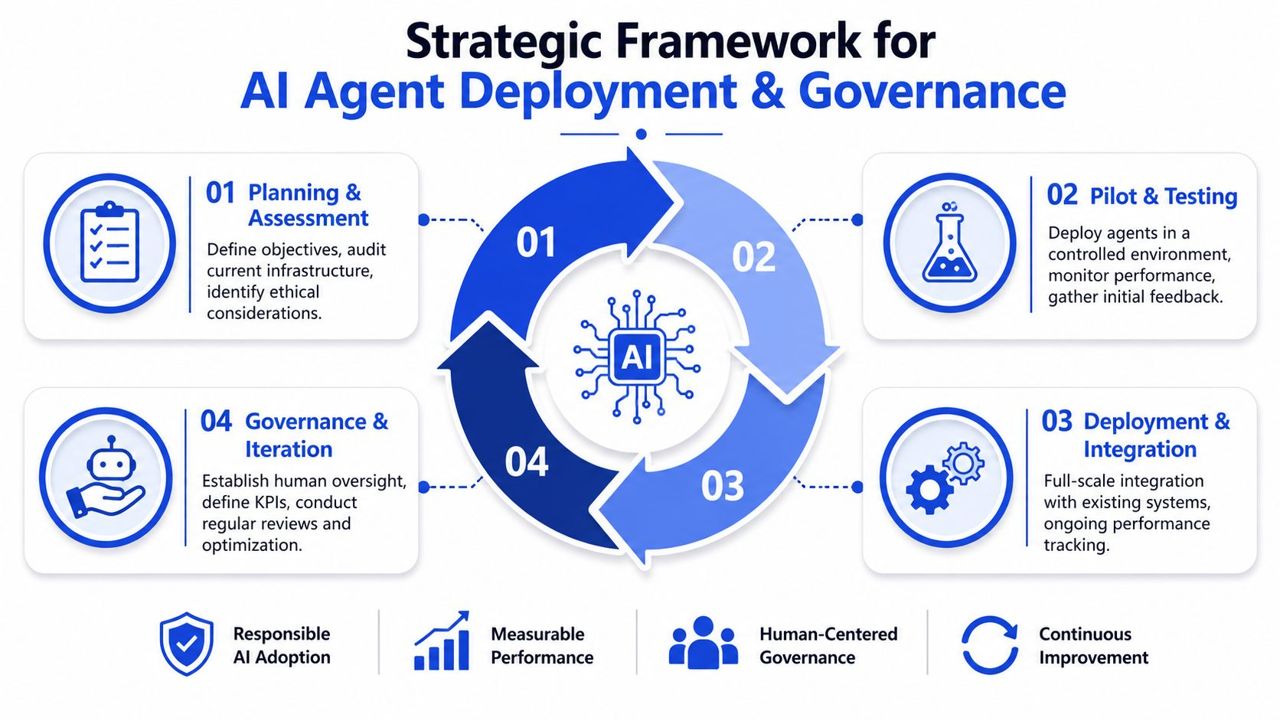
The most reliable deployment model is simple.
Observe
Connect the agent to crawl data, analytics, Search Console, template inventories, and other core systems. At this stage, the agent only monitors and classifies issues.Decide
The agent proposes actions based on predefined rules. Example: add missing schema to approved page templates, suggest redirects for removed URLs with close matches, or flag pages with no internal links.Act
Low-risk actions can run automatically. Medium-risk actions should require approval. High-risk actions should stay human-led.
This sounds basic, but it keeps automation tied to operating discipline.
What humans should still control
Some areas should never be handed over casually.
Robots and indexing directives
Changes to robots.txt, noindex tags, canonicals, and pagination logic can affect the entire site.Template-level SEO rules
Agents can execute rules. Humans should decide the rules. That includes title logic, faceted handling, internal link thresholds, and structured data policy.Revenue prioritization
An agent may fix the largest issue set. A strategist should decide whether that issue set matters commercially.Final QA on sensitive deployments
Especially when fixes touch rendering, JavaScript output, schema eligibility, or internal navigation.
Good governance keeps agents in the execution layer, not the strategy seat.
One practical skill gap here is context design. The difference between a useful agent and a chaotic one often comes down to how well you frame business rules, exceptions, and allowed actions. That's why reading about how prompt engineering impacts deep work is useful. In technical SEO, context engineering is usually the more important discipline.
For teams that want outside support, this is also where a strategic operator matters. A firm like SEOBRO® can handle the audit, roadmap, prioritization, and implementation oversight so automation is tied to commercial goals rather than just task completion.
Measuring the ROI of AI-Driven Technical SEO
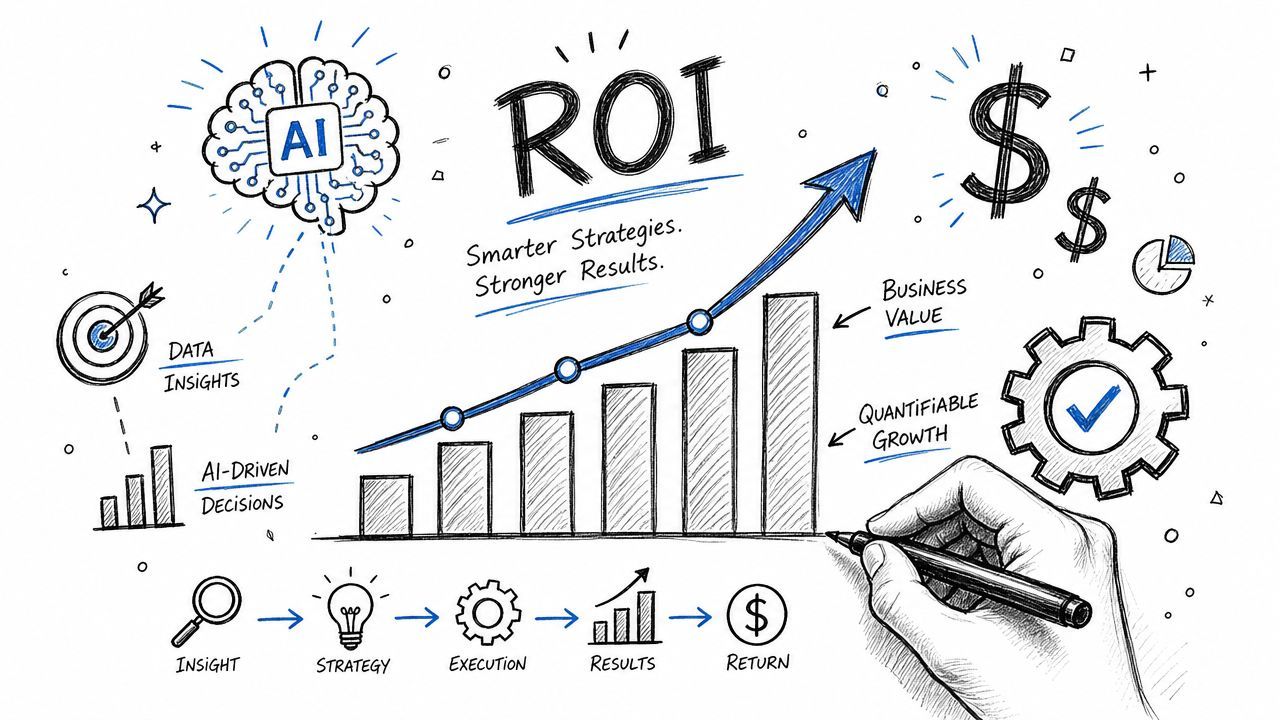
Most teams measure AI-driven SEO the wrong way. They track how many issues were closed, how many pages were updated, or how many schema blocks were added. That tells you activity. It doesn't tell you value.
A more useful standard is business impact. That gap is still underexplained in the market. MEGA AI notes that many tools describe features like schema generation and internal linking but don't offer a rigorous way to attribute incremental organic revenue or conversion lift to agent-driven fixes in its guide to AI SEO agents.
Measure operational gains first
Start with metrics that show whether automation is making the SEO function more efficient.
Time to resolution
How long does it take to move from detection to validated fix?Backlog reduction
Are recurring technical issues staying open, or being resolved as they appear?QA pass rate
How often do agent-applied changes pass validation without rework?Coverage by template or issue class
Which technical problems are now continuously managed instead of periodically patched?
These are not final ROI metrics, but they matter because operational drag has always limited technical SEO.
Then connect fixes to commercial outcomes
Effective measurement is page-type based. Don't try to prove ROI at the whole-site level first. Tie fixes to templates or URL groups that matter.
For example:
- Product pages with new schema and cleaner internal linking
- SaaS feature pages with improved indexation and structured content
- Local landing pages with stronger entity clarity and extraction-ready markup
Then compare those actions with downstream metrics such as qualified organic traffic, demo requests, lead submissions, or ecommerce revenue trends on the affected page groups. The goal isn't to pretend every movement came from one fix. The goal is to build a credible chain between implementation and business outcomes.
If an agent saves your team time but doesn't improve qualified traffic, conversion potential, or crawl access to important pages, it's an ops win, not an SEO win.
Video can also help align internal teams on what ROI discussion should look like beyond issue counts:
One more practical point. AI visibility has made this harder, not easier. You're no longer only asking whether a page ranked. You're asking whether the underlying technical improvements increased extractability, citation readiness, and answer-engine visibility for commercially important topics.
Implementation Checklists by Business Type
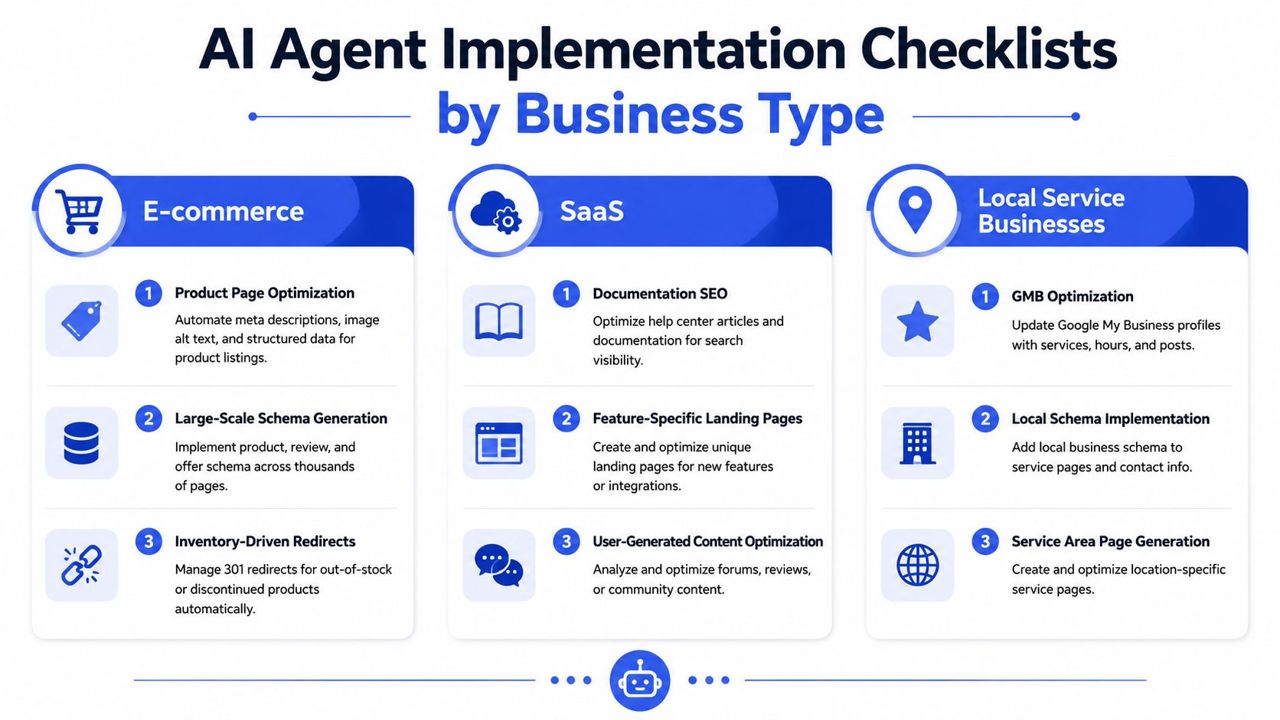
Different business models break in different places. That means the first AI agent workflows you deploy should follow commercial reality, not a generic “technical SEO automation” template.
For AI visibility specifically, technical guidance from Search Engine Land recommends semantic HTML, explicit robots.txt rules for specific crawlers like GPTBot, concise entity signals such as Organization plus sameAs, and structured data like FAQPage or HowTo so systems can parse facts with less truncation risk in its article on technical SEO for generative search.
Ecommerce
Large catalogs create repetitive technical debt fast.
- Automate product schema monitoring so template changes don't strip markup from key pages undetected.
- Watch faceted navigation closely because agents can surface crawl waste, duplicate patterns, and URL proliferation early.
- Queue redirect decisions for inventory changes rather than letting product removals create avoidable dead ends.
- Monitor category-page internal linking so new products and high-margin ranges aren't buried.
- Review extraction readiness for product facts, policies, availability details, and brand entities.
SaaS
SaaS sites usually need better control over documentation, integrations, feature pages, and programmatic content.
- Track template groups separately for feature pages, docs, blog content, and solution pages.
- Use agents to support internal links from educational content into demos, integrations, and solution pages.
- Audit programmatic pages with strict rules around duplication, indexability, and thin variations. If this is a major growth channel, review what programmatic SEO is before automating at scale.
- Monitor semantic structure so key entities are easy for search systems to extract.
- Check AI search readiness on conversion pages if your team is investing in AI search optimization services.
Local service businesses
Local sites often have fewer pages, but the technical mistakes are costly because each location or service area can affect lead flow.
- Generate and validate LocalBusiness schema across location and service pages.
- Watch NAP consistency signals across the site so updates don't create trust issues.
- Monitor service-area page quality to avoid weak duplication across near-identical locations.
- Use semantic HTML and concise entity signals so business details are easier to parse.
- Review crawler controls carefully if you run separate subfolders, microsites, or multi-location templates.
What usually fails here is over-automation. Local pages, SaaS solution pages, and ecommerce categories all need human review for conversion intent, offer clarity, and search intent alignment. An agent can scale the maintenance layer. It can't decide what your most profitable offer should say.
Conclusion Augment Strategy Not Replace It
AI agents for technical SEO are useful because they remove friction from work that has always been slow, repetitive, and easy to neglect. They can monitor site health continuously, handle structured workflows, and reduce the time between finding an issue and fixing it.
That doesn't make them a replacement for technical SEO strategy.
Humans still need to decide what matters, what is risky, what affects revenue, and which changes deserve automation in the first place. They also need to QA outputs, control permissions, and judge whether technical improvements are improving qualified traffic and conversions instead of just generating cleaner dashboards.
The strongest setup is a hybrid one. Let agents handle the operational layer. Keep strategy, prioritization, exception handling, and commercial measurement with experienced people.
That's especially true if your site has complex templates, ecommerce inventory logic, SaaS programmatic pages, or multi-location local architecture. In those environments, automation without governance creates faster confusion.
If your current SEO process is stuck between audits and implementation, consider a strategic SEO audit and operating plan before adding more tools. The businesses that get value from AI don't just automate tasks. They build a search system around revenue, QA, and clear ownership.
Frequently Asked Questions
Are AI agents for technical SEO the same as SEO tools with AI features
No. A standard tool usually analyzes data and gives you recommendations. An agent can connect systems, evaluate rules, and execute a multi-step workflow. That's the meaningful difference.
What technical SEO tasks should not be fully automated
Robots.txt changes, canonical policies, noindex decisions, major redirect mapping, and any template rule that affects large parts of the site should stay under human review. These are high-impact controls.
Are AI agents useful for smaller sites
Yes, but only if they solve a real operational problem. Smaller sites usually don't need heavy automation everywhere. They benefit more from targeted workflows such as schema QA, broken link monitoring, internal linking suggestions, or local page validation.
How do AI agents help with AI search visibility
They can support the technical conditions that make content easier for AI systems to parse. That includes structured data, semantic HTML, clean internal linking, entity clarity, and crawler access controls. They don't guarantee citations, but they can improve technical readiness.
Can AI agents replace a technical SEO consultant
No. They can reduce manual workload and speed up execution. They can't own business prioritization, interpret trade-offs across SEO, UX, product, and engineering, or decide how technical fixes fit into a broader revenue strategy.
How should a business choose an AI agent workflow first
Start with a narrow, repetitive process that already has clear rules. Good first candidates include broken-link management, schema validation, internal linking on defined templates, or issue triage from crawl monitoring. Avoid broad permissions until the QA process is proven.
If you want a practical plan for automation without losing strategic control, SEOBRO® can help you audit technical bottlenecks, prioritize fixes by business impact, and build an SEO workflow that supports rankings, leads, and AI search visibility instead of just producing more tasks.