Your SEO lead spots a crawl issue on Monday. The content team ships comparison pages on Wednesday. A competitor rewrites title tags across key categories on Thursday. By Friday, the reporting deck still says “investigating.”
That's the operational problem behind most SEO programs today. There's too much surface area, too many moving parts, and too much lag between signal and response. Teams still rely on disconnected audits, one-off scripts, spreadsheets, and manual QA for a channel that changes every day.
That's why SEO agent architecture matters. Not because “AI for SEO” is a shiny idea, but because modern search operations now need systems that can continuously monitor, prioritize, execute, and verify work across technical SEO, content, internal linking, schema, and reporting. For a CMO, this is less about novelty and more about maximizing operational impact. The question isn't whether automation can do parts of SEO. It already can. The key question is whether your team has a structured way to turn search data into controlled action.
Used well, an SEO agent becomes an operating layer for organic growth. It can watch for ranking shifts, identify crawl waste, recommend content updates, prepare drafts, flag broken templates, and route the right decisions to the right humans. Used badly, it becomes a faster way to publish mistakes.
Architecture matters. Good architecture defines what the system sees, what it remembers, what tools it can use, what it's allowed to change, and how a human reviews risk before anything important goes live.
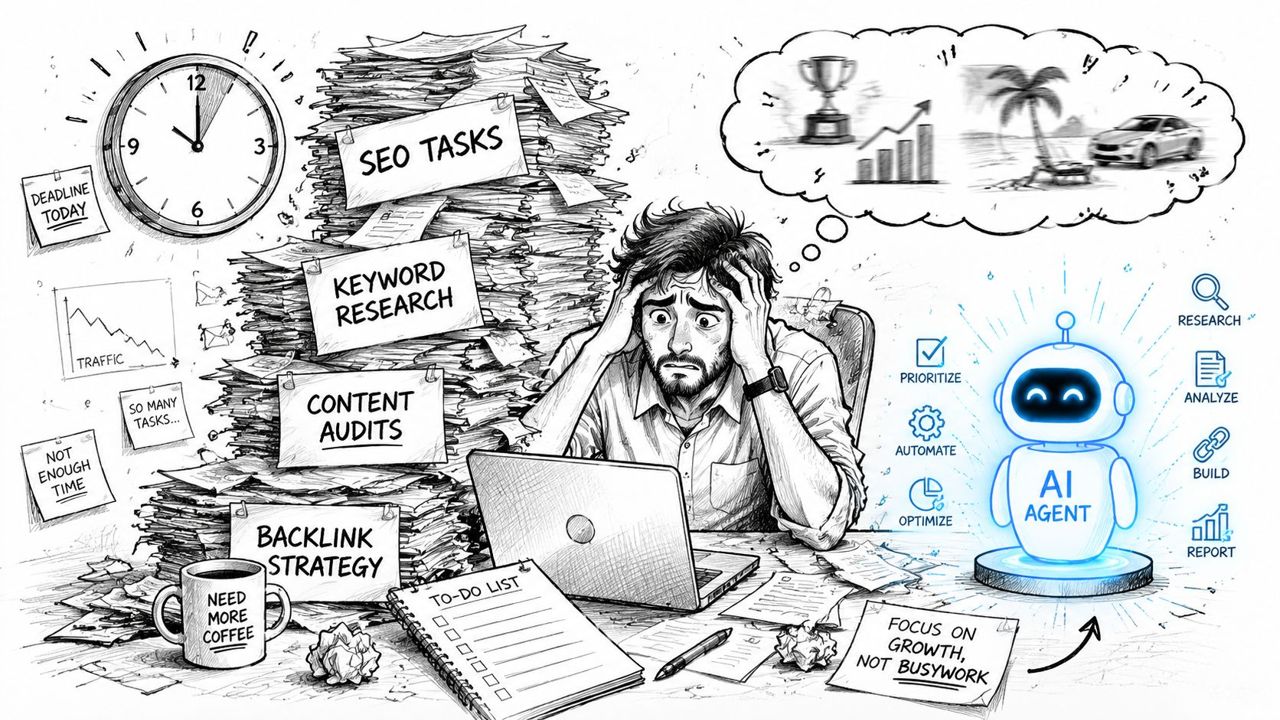
Introduction The End of Manual SEO Overload
Many organizations don't have an SEO talent problem. They have an SEO operating model problem.
A capable strategist can identify what matters. A capable developer can fix templates. A capable writer can improve weak pages. But when the business has thousands of URLs, multiple stakeholders, and constant search movement, manual coordination becomes the bottleneck. Important fixes sit in backlog. Reporting arrives after the opportunity. Content briefs go stale before publication.
That's why the old pattern breaks down. Quarterly audits and ad hoc implementation don't match the speed of modern search. The result is familiar. Technical debt accumulates, content production drifts away from intent, and leadership gets visibility into activity instead of business impact.
Practical rule: If SEO work depends on someone noticing an issue in a dashboard and manually creating a task every time, the system won't scale.
An SEO agent is a practical response to that overload. It doesn't replace strategy. It gives strategy an execution layer. Instead of waiting for a person to pull reports, compare patterns, decide next steps, and assign work, the agent can perform parts of that loop continuously.
For business leaders, that changes the conversation. You stop asking only, “What should we optimize next?” and start asking, “What can the system monitor and handle safely on its own, and where do we want human review?”
That's the lens worth using throughout this topic. SEO agent architecture isn't just a technical stack. It's the structure that turns organic search from a reactive function into a controlled, always-on capability.
Defining the Autonomous SEO Agent
A script follows instructions. An agent handles uncertainty
A lot of teams call anything automated an AI agent. That muddies the decision.
A script is linear. It does what you told it to do, in the order you defined. Export Search Console data. Find missing title tags. Push rows into a sheet. Useful, but narrow. If the environment changes, the script doesn't rethink the job.
An autonomous SEO agent works differently. It has a goal, access to tools, awareness of context, and the ability to choose among actions. It doesn't just execute a fixed task. It interprets inputs, decides what matters, and then checks whether the action produced the intended result.
That distinction matters because search is not stable. LaunchMind notes that roughly 15% of Google searches are new every day in its explanation of why agentic systems rely on a closed loop rather than static rules (LaunchMind on AI SEO agents and architecture).
The loop that makes it work
The simplest useful mental model is this:
- Observe the environment through rankings, crawl data, analytics, content signals, and SERP changes
- Diagnose what likely caused the issue or opportunity
- Plan the next best action based on business goals and constraints
- Act through tools, workflows, or recommendations
- Verify whether the action improved the outcome
That loop is what makes an SEO agent different from a one-click automation.
A content generator can produce copy. An SEO agent can notice a page losing visibility, compare it with competing pages, identify an intent mismatch, create a brief, draft revisions, route them for approval, publish the approved update, and then check whether rankings and clicks respond. That's a business process, not just a prompt.
Here's the practical test.
| System type | What it does well | Where it fails |
|---|---|---|
| Simple automation | Repeats defined tasks consistently | Breaks when inputs or priorities change |
| Standalone AI content tool | Produces drafts quickly | Lacks context, memory, and verification |
| SEO agent | Connects monitoring, decisioning, action, and validation | Requires governance, tool access, and good architecture |
An SEO agent isn't valuable because it writes faster. It's valuable because it closes the gap between detection and response.
That's why the term SEO agent architecture matters. The architecture defines whether the system is just generating outputs, or instead supporting operational SEO.
The Core Architectural Blueprint
An effective SEO agent system looks less like a chatbot and more like a managed operations stack. The best way to understand it is by business function. Each layer enables a capability leadership cares about, such as faster issue detection, better prioritization, safer deployment, or clearer reporting.
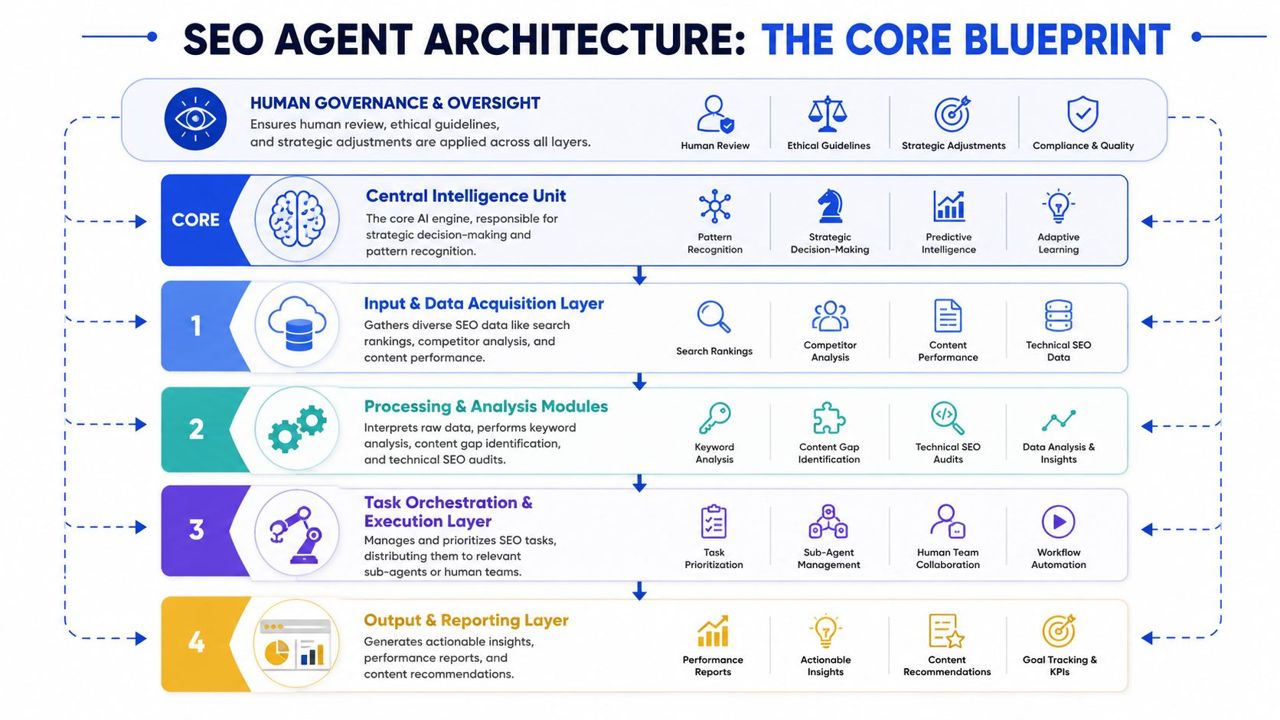
Data sources and ingestion
An agent can't reason well if it sees only part of the picture. The input layer usually combines data from tools such as Google Search Console, Google Analytics 4, crawling platforms, CMS data, product feeds, and rank tracking systems.
For SEO, the core job of this layer is normalization. Search data comes in different formats and cadences. Crawl data behaves differently from analytics data. CMS records often carry the commercial context that SEO tools miss, such as template type, inventory status, or canonical rules. If the system can't unify those signals, its recommendations stay shallow.
Crawling architecture's commercial relevance emerges. A well-designed agent doesn't just run a technical crawl. It can tie crawl findings to business priority, indexation health, and internal linking pathways. If crawl efficiency is a known issue, a deeper look at crawl budget optimization becomes useful.
Knowledge and state management
Most weak AI workflows fail here. They can process a task, but they don't retain enough context to make good decisions over time.
TechnoDrifter describes modern multi-agent SEO systems as specialized and distributed, and Atlan's related context guidance frames persistent context as a stack of five layers: system context, session context, memory, artifacts, and on-demand retrieval (TechnoDrifter on multi-agent SEO architecture). In practice, this means the agent needs to remember brand rules, previous fixes, template constraints, no-go topics, approval history, and what happened after past changes.
Without memory, the system repeats itself. It reopens resolved issues, proposes content that conflicts with existing positioning, and forgets that your product team rejected a schema pattern for legitimate reasons.
A useful memory layer usually stores things like:
- Brand and editorial rules that shape tone, claims, and prohibited wording
- Technical constraints such as canonical logic, indexation rules, and template dependencies
- Historical decisions including approved fixes, rejected recommendations, and rollback events
- Performance context so the agent can compare outcomes before and after implementation
For leaders, efficiency turns into governance. The system doesn't just know what SEO best practice says. It knows what your business allows.
A good external read on why memory matters across marketing systems is this piece on AI marketing strategies for 2026, which frames decision memory as an operational advantage rather than a technical extra.
Orchestration and execution
This is the layer that converts intelligence into work. It decides which tasks to trigger, in what order, with which tools, and under what approval rules.
LaunchMind describes production-grade agent systems as layered with distinct goal, planner, tool, memory or knowledge, execution, and evaluation layers, which is a useful model for thinking about SEO operations at scale, as noted earlier in the article. That layered separation is what allows an agent to do more than produce suggestions. It can crawl, prioritize fixes, update metadata, open tickets, generate briefs, and evaluate results.
For business teams, orchestration is where priorities get protected. A mature system should know the difference between:
- fixing broken internal links on low-value blog pages
- revising titles on core money pages
- drafting a support article update
- publishing a new category page
- deploying schema changes sitewide
Those actions don't carry the same risk, and they shouldn't pass through the same workflow.
Operational view: Architecture is what determines whether AI creates a to-do list or actually runs a safe SEO process.
Feedback and monitoring loop
The last layer is the one teams often skip. They automate action but not verification.
A real SEO agent should check what happened after implementation. Did indexation improve? Did the affected pages regain visibility? Did CTR move after metadata changes? Did the update create a secondary issue, such as duplicated titles or broken canonicals?
This closes the loop between execution and business value. Without it, the system becomes a recommendation machine that generates activity without accountability.
A practical blueprint for monitoring usually includes:
- Pre-change baseline for affected pages or templates
- Post-change validation for technical correctness
- Performance observation tied to the original objective
- Escalation logic if results don't match expectations
- Rollback rules for high-risk actions
That final point matters more than most vendors admit. Good SEO systems don't just automate deployment. They automate caution.
Implementation Patterns and Real-World Workflows
A retailer with 40,000 SKUs does not need an AI system that can do everything. It needs one that can identify a broken category-page template before rankings and revenue slip, route the issue to the right team, and avoid touching high-risk pages without approval. That is the difference between an impressive demo and an operating model a CMO can trust.
For that reason, the strongest SEO agent setups are modular. Separate agents handle distinct jobs such as crawling, content analysis, schema validation, internal linking, and reporting. That structure mirrors how mature SEO teams already work, and it gives leadership clearer control over permissions, accountability, and failure risk.
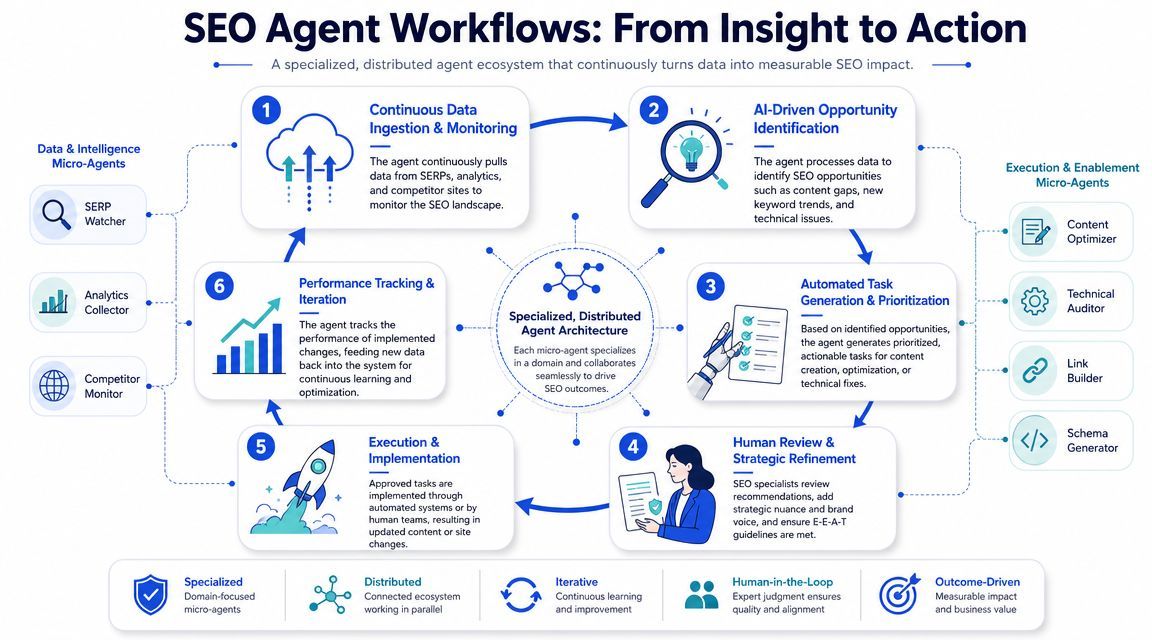
Why multi-agent systems usually beat one giant SEO bot
A single general-purpose agent tends to blur priorities. It has to reason across technical issues, content quality, internal links, and business context all at once. That usually leads to noisy recommendations, broad permissions, and weak audit trails.
A multi-agent model is easier to manage because each agent has a defined scope.
- A crawl agent inspects templates, redirects, canonicals, and indexation signals.
- A content agent works from approved briefs, source material, and editorial rules.
- A schema agent validates markup changes before they reach production.
- A reporting agent measures impact and flags exceptions without publishing anything.
That separation improves control in practical ways. Teams can grant limited access by function. They can isolate failures. They can also see which part of the system made a recommendation, approved a change, or triggered an escalation. For business leaders, that means lower operational risk and fewer black-box decisions.
If you're comparing orchestration approaches across functions, this overview of scalable AI agent design patterns is useful because it explains why modular systems are easier to extend, test, and govern.
This video gives a useful visual reference point for how these workflows can be structured in practice:
What this looks like in eCommerce SaaS and local SEO
Implementation gets clearer when tied to business models, because the right workflow depends on how the company makes money.
eCommerce workflow
In eCommerce, the highest-value pattern usually starts with feeds, templates, and merchandising signals. An agent monitors product availability, category changes, faceted navigation, structured data, and internal linking shifts. It then decides whether the issue is informational, revenue-relevant, or urgent enough to escalate.
Typical actions include:
- Schema checks for product and category templates before release
- Internal link suggestions when new collections or product lines launch
- Metadata updates where stock status changes affect search performance
- Escalation rules for category pages tied to high-value commercial queries
The trade-off is speed versus control. Automatic updates can save hours on large catalogs, but overly aggressive changes can create duplicate titles, poor indexation choices, or inconsistent page intent across templates.
SaaS workflow
SaaS companies usually get more value from agents that connect search demand to pipeline goals. An agent can monitor competitor comparison pages, feature-related queries, support content gaps, and shifts in page intent. It can then recommend updates to bottom-funnel pages, content clusters, or conversion-focused landing pages.
The risk is volume without relevance. If the system is not constrained by audience stage, product priorities, and revenue goals, it will produce a long queue of content ideas that do not help trials, demos, or expansion. That is why disciplined search intent optimization belongs inside the workflow logic, not just inside the editorial process.
Local SEO workflow
For local brands and multi-location businesses, the workflow centers on consistency and change detection. Agents watch location pages, Google Business Profile updates, service-area coverage, and location-specific entity signals. They can draft updates, flag mismatches, and identify when offline operational changes have made on-site information stale.
That sounds simple. It is not. Local SEO often breaks when dozens or hundreds of pages drift out of sync with real-world operations, and no one notices until rankings and lead quality fall.
The best SEO agent workflow matches the company's revenue model, content risk, and approval structure.
Where human review still belongs
Human review should stay attached to decisions with brand, legal, or commercial consequences. Agents are well suited to repetitive monitoring, issue grouping, first drafts, and pre-publish checks. They are less suited to making final calls on high-impact page edits or sensitive claims.
A practical model looks like this:
| Workflow type | Better handled by agent | Better handled by human |
|---|---|---|
| Recurring monitoring | Yes | Only for exceptions |
| Issue prioritization | Yes, with business rules | Final override when needed |
| First-draft content briefs | Yes | Final strategic direction |
| High-impact page edits | Assist only | Yes |
| Sitewide schema deployment | Prepare and validate | Approve before publish |
This is the operating principle that matters at the executive level. Good SEO agent architecture reduces manual workload without creating unmanaged publishing risk.
The Human Layer Governance and E-E-A-T
Most conversations about AI agents focus on capability. Smart teams focus on control.
The under-discussed issue in agentic SEO is governance. SearchAtlas describes agentic SEO as autonomous execution inside human-defined boundaries, with approval thresholds and rollback conditions, and argues that the core architectural question is what should remain human-controlled, especially for metadata changes, schema deployment, and content publication (SearchAtlas on agentic SEO governance).
That's the right framing for any CMO or founder. If an agent has enough access to change your site, it needs to be treated like a privileged operator.
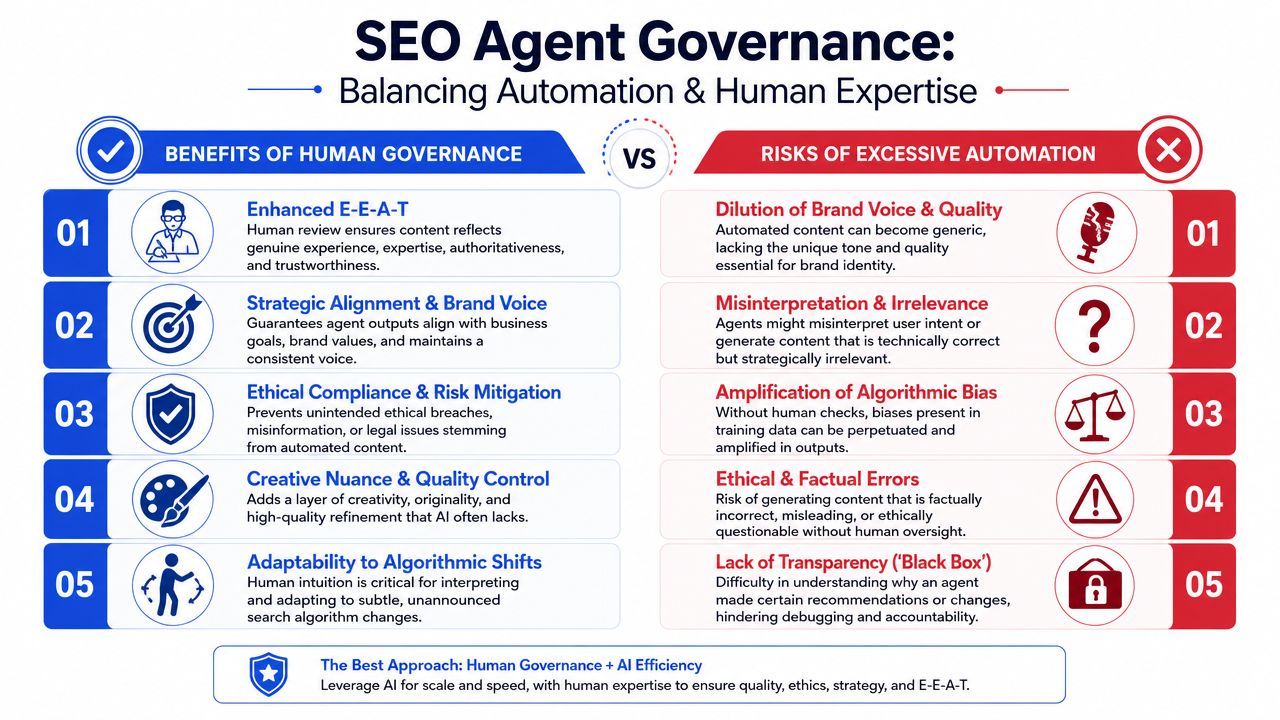
Set decision rights before you automate
A lot of avoidable SEO damage comes from automating first and setting rules later.
Before deployment, define who approves what. A broken link report may require no approval. A recommendation to revise titles across key category pages should require review. A schema change touching templates should need both SEO and development signoff. A content publishing workflow for regulated or high-trust topics should include editorial review and factual validation.
A practical governance model includes:
- Risk tiers that classify actions by business impact
- Approval thresholds based on page type, template scope, or market sensitivity
- Rollback conditions that determine when changes should be reversed
- Audit trails so teams can see what changed, why, and by whom
- Permission boundaries that prevent one agent from accessing everything
Governance is not friction. It's what allows automation to scale without creating expensive cleanup work.
This matters even more on enterprise, eCommerce, and regulated sites. A weak change on a low-traffic post is annoying. A weak change on a core category, product template, or service page can create real commercial loss.
How governance supports E-E-A-T
E-E-A-T isn't something an agent can “toggle on.” It's the result of credible inputs, sound review, and accountable publishing.
An agent can help surface expert material, identify missing support content, enforce structural consistency, and prepare drafts that are easier for specialists to review. But experience, expertise, and trust still come from humans who know the product, the customer, the market, and the claims the brand can responsibly make.
That's why governance and E-E-A-T belong in the same conversation.
- Experience improves when subject-matter experts review outputs grounded in real customer problems.
- Expertise strengthens when specialists validate recommendations instead of accepting generic AI phrasing.
- Authoritativeness grows when your site publishes consistent, defensible information across templates and topics.
- Trustworthiness depends on approval, fact-checking, and the ability to explain why a change was made.
A useful rule is simple. Let agents accelerate analysis and preparation. Keep final accountability with people who own the business outcome.
Frequently Asked Questions About SEO Agents
What's the difference between an SEO agent and using AI to generate content
AI content generation solves a narrow task. It takes an input and returns a draft.
An SEO agent has a broader role. It works toward a goal, uses tools, keeps context, and can evaluate whether its action achieved the result. That's why content generation can be one tool inside an SEO agent, but it isn't the same thing as agent architecture.
If your workflow starts and ends with “write this article,” you're using AI writing. If your workflow includes monitoring, diagnosis, planning, approval, publishing, and verification, you're moving into agent territory.
Should you build an SEO agent or buy one
Most companies don't need to build everything from scratch.
If your team needs help with monitoring, workflow orchestration, and repeatable execution, buying or combining existing systems is often the smarter first move. Building makes more sense when you have unusual data needs, large-scale site complexity, strict governance requirements, or internal engineering support.
A practical buying test is whether the solution can handle your real operating constraints:
- Can it use your data sources without losing important business context?
- Can it remember decisions instead of restarting each task cold?
- Can it enforce approvals for high-risk actions?
- Can it show what changed and whether the change worked?
If the answer is no, you're not buying an agent system. You're buying a faster content or audit tool.
How do you measure ROI from SEO agent architecture
Measure it the same way you should measure any SEO investment. Tie the work to business outcomes, not just output volume.
Start with operating metrics such as issue detection speed, implementation velocity, content refresh cadence, and reduction in repetitive manual work. Then connect those improvements to SEO outcomes like stronger landing page coverage, cleaner technical execution, better conversion pathways, and more reliable reporting. From there, tie the work to leads, pipeline, or revenue where your attribution model allows.
For content-heavy programs, this guide on how to measure content marketing ROI is a good framework because it keeps the conversation focused on business impact instead of vanity metrics.
Can SEO agents help with AI search visibility too
Yes, if they're configured for structured, citation-friendly output.
The same architecture that helps with search monitoring and content operations can also support AI visibility by improving entity clarity, FAQ coverage, internal linking logic, schema consistency, and content formatting that's easier for answer engines to interpret. That matters if your strategy includes visibility beyond traditional blue links.
For teams exploring that overlap, this overview of AI search optimization services gives a useful commercial perspective on where classic SEO and AI search visibility now intersect.
Conclusion Building Your Strategic Advantage
SEO agent architecture isn't a shortcut. It's an operating model.
When it's designed well, it helps a business detect change faster, prioritize work more intelligently, execute repeatable SEO processes, and keep humans in control of risk. When it's designed poorly, it just speeds up bad decisions.
That's why the winning approach is rarely “automate everything.” It's to build a system that knows what to watch, what to recommend, what to do, what to escalate, and what to verify afterward. The strategic advantage comes from that discipline. Not from the label.
For CMOs, founders, and marketing leaders, the useful question is simple. Where is your SEO program still dependent on manual effort that should be systemized, and where does judgment still need to stay human? The businesses that answer that well will move faster without losing control.
If you want a search strategy built around qualified traffic, lead generation, and revenue, consider working with SEOBRO®. Roman Sydorenko helps eCommerce, SaaS, and local businesses connect technical SEO, content strategy, and AI visibility into one accountable growth system.