Your SEO dashboards still show impressions. Rankings might even look stable on a slice of priority terms. But the traffic behind those positions can weaken anyway.
That's the problem many teams are dealing with right now. Informational queries that used to feed blog traffic, assisted conversions, retargeting audiences, and branded search lift no longer behave the same way. Users ask Google a fuller question, Google assembles an answer, and fewer people need to click. If your reporting still treats organic success as a straight line from ranking to session to conversion, you'll miss what's changed.
AI Mode SEO isn't a side tactic. It changes keyword research, content architecture, technical priorities, and how you prove ROI. The old goal was to win the click. The new goal is broader. You need to become a source Google can parse, trust, and cite, while also building a measurement model that doesn't collapse when CTR drops.
Introduction Why Your Organic Traffic Is Suddenly Changing
A lot of organic programs were built on a reliable pattern. Publish useful content, map pages to intent, improve rankings, and turn traffic into pipeline over time. That model still matters, but Google's answer layer is changing how demand gets captured.
AI Mode and AI Overviews shorten the path between question and answer. For many queries, Google doesn't just return links. It synthesizes information from multiple pages and gives users a conversational result directly in search. That creates a harder environment for publishers whose reporting depends on click growth from top-of-funnel content.
The commercial impact is easy to underestimate. A drop in informational traffic doesn't just affect blog sessions. It can reduce assisted conversions, weaken remarketing pools, and make branded demand look softer later in the funnel.
Practical rule: If your organic traffic is down on informational terms but brand interest and sales conversations haven't fallen at the same rate, don't assume the content stopped working. The way users consume the answer may have changed before your attribution model did.
AI Mode SEO thus becomes a strategic discipline, not a trend label. You need stronger content structure, cleaner technical eligibility, tighter entity signals, and a new reporting model that tracks visibility beyond the click.
What Is Google's AI Mode
Google's AI Mode changes what it means to win a search. Instead of sending the user to a ranked list and making them compare pages, Google generates a direct response and cites supporting sources inside that experience.
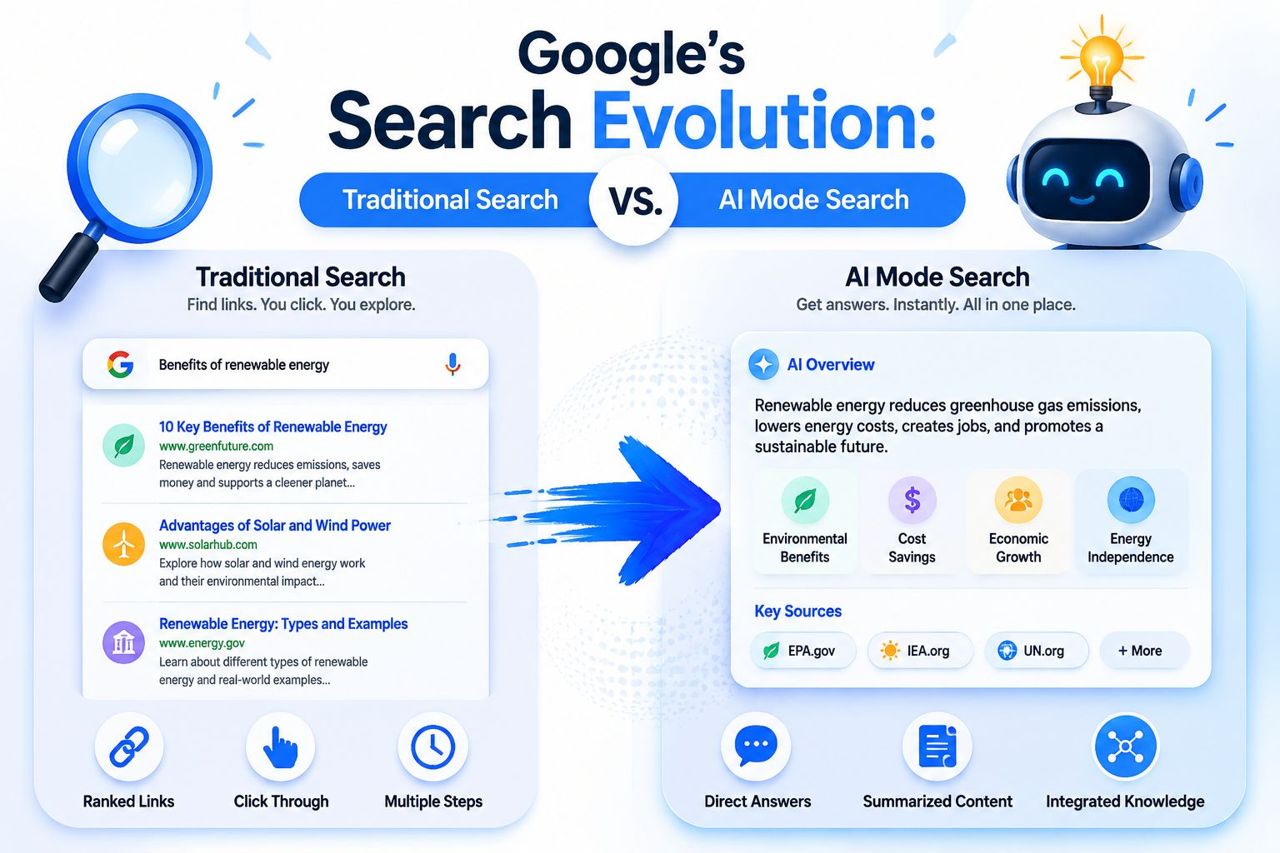
For SEO teams, the practical shift is simple. A page can shape the answer and still lose the click. That changes both content strategy and reporting, especially for publishers and B2B brands that relied on informational traffic to build pipeline over time.
AI Mode still depends on the web index. Google is not treating this as a separate acquisition channel with a separate optimization system. It is using indexed pages, extracting relevant passages, and assembling them into a conversational result that can handle follow-up questions inside the same session.
Traditional search versus AI Mode
| Search model | Primary user experience | What SEO was optimizing for | What AI Mode SEO changes |
|---|---|---|---|
| Traditional Google search | Ranked list of links and snippets | Ranking higher for target keywords | Becoming a citable source within synthesized answers |
| AI Mode | Conversational answer built from multiple sources | Click-through from result pages | Content chunks that answer sub-questions clearly |
The strategic consequence is revenue-related, not just interface-related. If your content is being used to inform the answer, it may still be influencing branded searches, demo requests, and assisted conversions even when top-of-funnel clicks decline. I would not treat lower traffic alone as proof that SEO value disappeared. The measurement model often breaks before the channel does.
There is also a technical reality behind the feature. Pages need to be crawlable, indexable, and eligible to appear in standard search results before Google can use them as supporting sources in AI-driven results. In practice, that keeps the foundation familiar. Strong internal linking, clean rendering, and visible on-page content still matter because Google cannot cite what it cannot reliably access or interpret.
The New Rules Core Strategic Shifts for AI Mode SEO
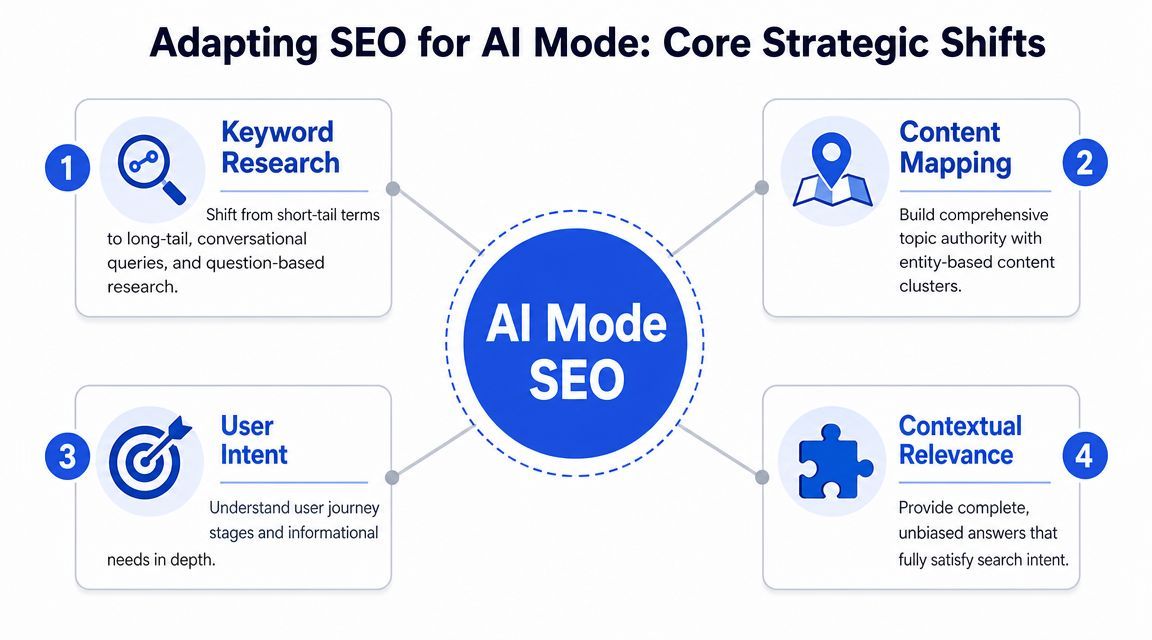
The biggest mistake teams make is treating AI Mode like a formatting update. It isn't. It changes how keyword research should be done and how content should be mapped across the site.
Search behavior is getting more specific
In Semrush's clickstream study, AI Mode's share of Google search sessions rose from 0.25% in early May to just over 1% by early July, roughly a 4x increase, and the typical AI Mode query was 7.22 words versus 4.0 words for a traditional query. The same study found AI Mode sessions averaged only 2 to 3 searches per session. You can review those figures in Semrush's analysis of Google AI Mode SEO impact.
That combination matters more than the headline growth number. Users are asking longer, more specific questions and resolving their needs with fewer refinements. In practical terms, that weakens a content strategy built around short, isolated keyword targets.
A page aimed only at “CRM pricing” is less resilient than a page that also covers implementation constraints, contract considerations, hidden costs, integrations, migration questions, and team-fit concerns in clearly separated sections.
Topic coverage beats isolated keyword pages
AI Mode is designed to synthesize answers from multiple sources, which shifts optimization away from single-keyword ranking and toward query fan-out coverage and machine-readable structure. Analysis published by Making Science recommends building pages around complete question coverage, semantic HTML, schema, and clearly labeled topical sections so AI systems can map content chunks to sub-questions. Their write-up on what AI Mode means for SEO is useful reading.
That has direct implications for content planning:
- Keyword research becomes question mapping. Don't stop at head terms. Expand into modifiers, objections, comparisons, prerequisites, and edge cases.
- Content briefs need sub-question architecture. A brief should define what must be answered on-page, not just what phrase belongs in the title.
- Internal linking needs to reflect topic relationships. Connect guides, use cases, comparisons, product pages, and FAQs so both users and crawlers can follow the subject.
- Intent segmentation gets sharper. Informational queries are more exposed to AI synthesis. Transactional and highly specific commercial queries may behave differently, so don't flatten them into one content strategy.
One useful operating model is to stop asking, “What keyword should this page rank for?” and start asking, “What decision or question cluster should this page fully resolve?”
For teams revisiting their research process, a tighter intent framework helps. In this context, search intent optimization becomes more valuable than raw keyword expansion.
The page that wins in AI Mode often isn't the page with the broadest topic label. It's the one with the clearest answer architecture.
How to Create Content That Gets Cited in AI Overviews
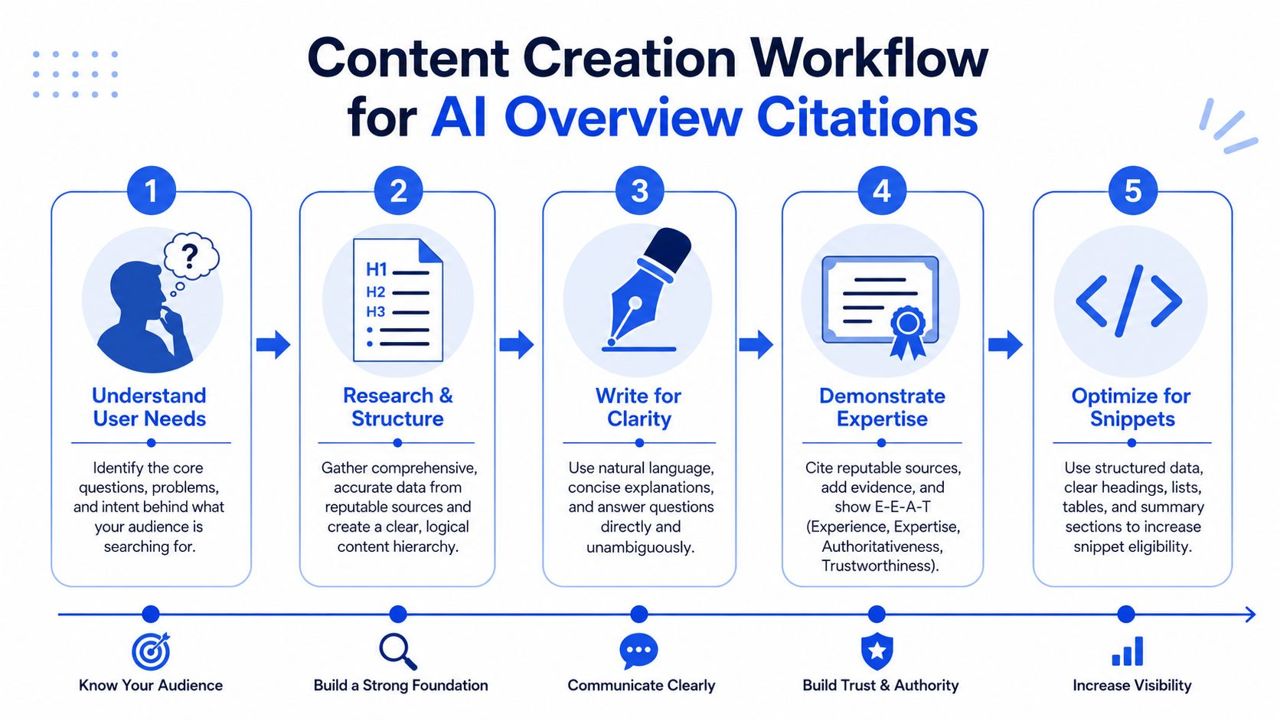
Content that gets cited usually does two things well at the same time. It satisfies a human reader quickly, and it gives machines clean sections they can extract without guessing.
Build pages that answer the whole question set
Start with the primary question, then map the related questions a buyer asks before they can act. That means definitions, comparisons, trade-offs, implementation issues, timing, cost drivers, and common mistakes.
A strong page structure often looks like this:
- Direct answer first. Open with a short, plain-language response to the core question.
- Expanded explanation second. Add nuance, caveats, and context once the direct answer is clear.
- Sub-question sections. Break out comparisons, use cases, objections, and edge scenarios under descriptive H3s.
- Decision support elements. Use tables, checklists, FAQs, and examples to reduce ambiguity.
This aligns with how AI systems assemble responses across sub-questions rather than just matching one phrase to one page.
Google's AI interfaces also reward clarity over flourish. If a sentence can be misunderstood, rewritten, or detached from context, it becomes harder to cite accurately. Write in clean declarative language. Name the product, audience, condition, or limitation directly.
For teams producing first drafts at scale, a structured drafting tool can help speed up early ideation, especially if the output still goes through editorial review. A tool like AI Article Generator can be useful for building initial outlines around question clusters, but the final page still needs subject-matter review, factual discipline, and strong on-page structure.
Use formats machines can extract cleanly
Here's what consistently works better than dense prose:
- Short answer blocks under descriptive headings
- Comparison tables for alternatives and trade-offs
- Bullet lists for steps, criteria, or mistakes
- FAQ sections for phrasing variation and long-tail coverage
- Schema markup that matches visible content
Here's a simple example of a citation-friendly content block:
| User question | Weak format | Stronger format |
|---|---|---|
| Which platform is better for a mid-market SaaS team? | Long narrative with no clear answer | One-paragraph answer, then a comparison table by fit, pricing model, onboarding, and reporting |
| How do I choose local SEO software? | Generic list of tools | Criteria-based section with business type, location count, review workflow, and GBP needs |
Later in the workflow, supporting assets matter too. This guide on how to optimize for featured snippets is still relevant because many of the same formatting habits overlap with AI extraction.
A useful visual explainer sits well here:
Adapt the workflow by business model
The same structure principle applies across verticals, but the content angle should change.
- For SaaS focus on jobs-to-be-done, integrations, onboarding friction, team fit, and use-case comparisons.
- For eCommerce build category and product support content around selection criteria, compatibility, sizing, materials, maintenance, and comparison logic.
- For local businesses answer service-area questions, urgency scenarios, pricing expectations, qualification criteria, and trust signals like licenses or service process.
- For service firms create pages that explain process, deliverables, timelines, who the service is for, and when an alternative is better.
If you're formalizing this workstream, AI search optimization services and a broader view of what AI optimization is are useful next reads.
Technical SEO Foundations for AI Visibility
Teams often spend weeks refining copy for AI answers while the pages themselves remain hard to crawl, slow to render, or poorly connected internally. That work rarely pays back. In AI search, eligibility comes first because Google has to access, index, and interpret the page before it can use it.
Eligibility comes before authority
Pages surfaced in AI experiences still depend on standard search foundations. If a URL is weakly linked, blocked from crawling, rendered unreliably, or muddled by duplicate versions, it is less likely to be considered no matter how strong the writing is.
This matters more than many teams expect.
I often see strong commercial pages buried behind filters, tabs, or JavaScript components that look fine in the browser but create an incomplete picture for search engines. I also see schema added as a cleanup step when the larger problem is architecture. Markup can help interpretation. It does not fix a page Google struggles to reach or trust.
Clean technical implementation does not guarantee citation. Weak technical implementation can remove you from consideration.
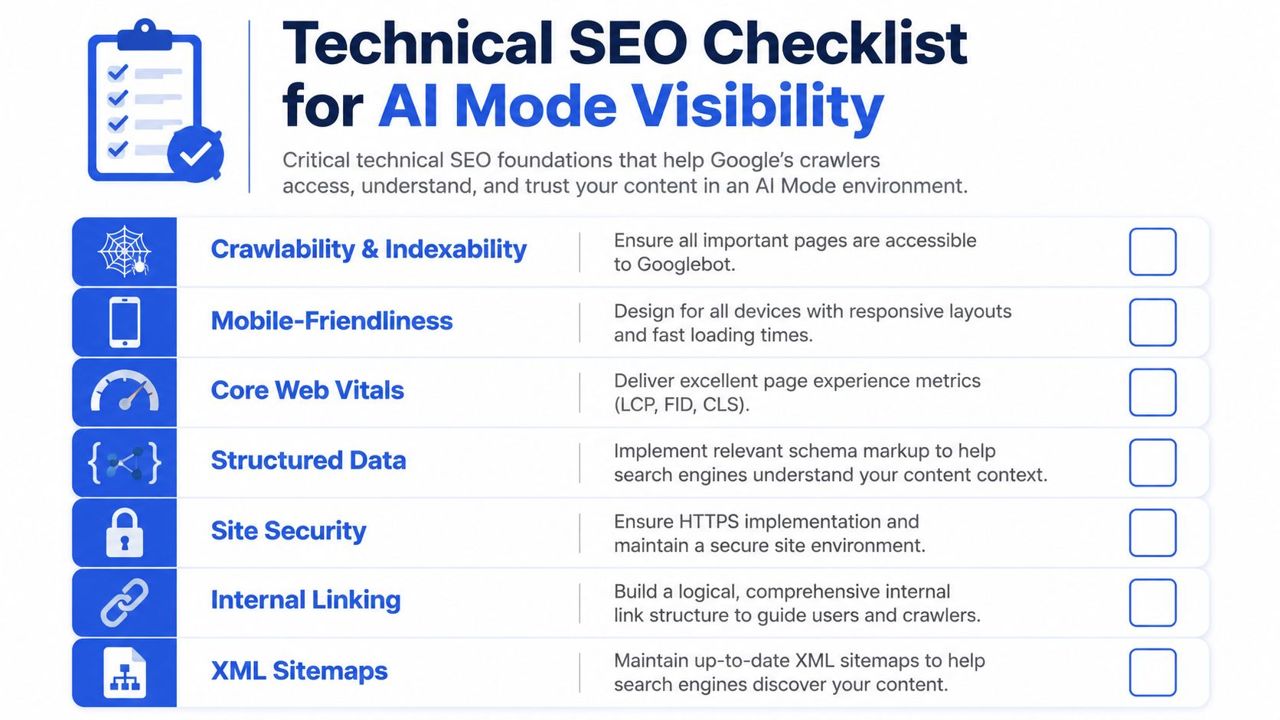
A practical technical checklist
Use this checklist in an AI visibility audit, but tie each item back to revenue pages and citation targets, not just sitewide hygiene scores.
- Indexability review. Confirm priority pages are indexable, canonicalized correctly, and not blocked by robots directives, noindex tags, or template mistakes.
- Internal link paths. Make sure key informational and commercial pages are linked from navigation, relevant hubs, and adjacent pages that clarify the topic relationship.
- Rendered content checks. Test whether the primary answer, supporting copy, and important page elements load reliably without depending on fragile client-side rendering.
- Page experience fixes. Improve templates that load slowly, shift layout, interrupt reading, or force users to scroll past clutter before the main answer appears.
- Structured data alignment. Use schema where it adds clarity, but keep every marked-up fact consistent with the visible page text.
- Content chunking. Organize pages into clear sections with descriptive headings so systems can connect answer blocks to specific questions or subtopics.
- Sitemap hygiene. Keep XML sitemaps focused on canonical, valuable URLs instead of thin archives, search-result pages, or low-value parameter variants.
The trade-off is straightforward. Perfecting every template on the site can consume a quarter without changing business outcomes. Start with the pages that influence pipeline, qualified leads, booked demos, or high-intent category demand. If those pages are technically clean, clearly structured, and well connected, they have a better chance of being cited and a better chance of assisting revenue even when the click never comes.
Two mistakes show up repeatedly. Teams add more schema while leaving weak internal linking untouched. Or they publish strong comparison and FAQ assets that sit several clicks deep, disconnected from product, category, or service pages that establish commercial relevance.
For AI Mode SEO, technical SEO is no longer a support function that sits behind content. It determines whether your best information can enter the retrieval layer at all, and that has direct measurement implications. If visibility grows but clicks do not, the first question is no longer just "Did rankings improve?" It is "Were the right pages eligible, understandable, and connected to the journeys that produce revenue?"
Mitigating Risks Hallucinations and Brand Safety
AI visibility creates upside, but it also creates a real control problem. Google may summarize your content in a way you didn't phrase. It may pull adjacent claims from multiple pages and compress them into a shorter answer. If your content is vague, contradictory, or outdated, the risk goes up.
Reduce ambiguity at the source
The safest approach is defensive clarity. Write statements that can stand alone without losing meaning. Define who a recommendation applies to. Add limits and exceptions where needed. Keep product names, feature descriptions, service areas, and policy details consistent across the site.
This matters most on pages that are likely to be cited for buying decisions, health or safety implications, pricing expectations, implementation requirements, and local service claims.
A few practices help immediately:
- Use explicit qualifiers. Say who the advice is for, and when it doesn't apply.
- Standardize important facts. Keep names, categories, and service details consistent across templates and supporting content.
- Update volatile sections. Refresh pages where availability, process, feature sets, or regulations change often.
- Support claims visibly. If you use structured data, make sure the same fact appears clearly on the page.
Create a monitoring habit
Brand safety in AI search is partly a monitoring discipline. Regularly test your core commercial queries, branded queries, comparison queries, and common pre-sales questions. Look for three things. Whether your brand is cited, whether the answer is accurate, and whether competitors are being framed more clearly than you are.
If AI search keeps misreading a page, the problem usually isn't only the model. It's often a signal that the page leaves too much room for interpretation.
When you find inaccuracies, tighten the source page first. Clarify the sentence structure, headings, and supporting context. If the issue appears in Google's interface, use available feedback mechanisms as part of your QA process. Teams that treat AI visibility like a publish-and-forget channel usually spot problems late.
Measuring Success and ROI in a Zero-Click World
Most AI Mode SEO strategies typically break down. Teams spend time trying to get cited, then discover their usual dashboards can't show what that visibility is worth.
Industry analysis notes a major measurement gap here. AI Mode can create zero-click behavior where being cited matters more than being clicked, while direct AI Mode performance data in Search Console is initially limited. That attribution challenge is central to understanding how AI Mode works.
Stop relying on CTR as the whole story
CTR still matters. Sessions still matter. Conversions still matter. But they're no longer enough on their own for top-of-funnel search reporting.
If Google answers more of the question on the results page, your organic program can influence pipeline without capturing the session in the same way it used to. That means reporting needs to separate at least three layers:
| Layer | What to watch | Why it matters |
|---|---|---|
| Visibility | Mentions, citations, branded recall, assisted discovery | Shows whether your content enters the answer set |
| Engagement | Branded searches, direct traffic trends, return visits, multi-touch paths | Captures downstream behavior after answer exposure |
| Conversion | Lead quality, demo intent, assisted revenue, offline influence | Connects visibility to business outcomes |
For B2B SaaS, this often shows up as stronger branded demand or higher-quality demo conversations even when blog traffic is flat. For eCommerce, it may show up in branded product searches, category revisit behavior, or improved conversion on users who return later. For local businesses, it can influence calls, map actions, and branded searches after informational discovery.
A practical attribution model for AI visibility
A workable model starts with baseline snapshots before large content or technical changes. Track branded search demand, direct traffic trends, assisted conversions from organic landing pages, and recurring query sets where AI answers appear frequently.
Then add qualitative monitoring:
- Citation tracking by query set. Maintain a controlled list of commercial, informational, and comparison queries.
- Message consistency checks. Review how your brand is described in AI-generated answers.
- Path analysis. Look for growth in branded and direct return visits after informational visibility work.
- Sales feedback loops. Ask sales and support teams what prospects already “know” before they arrive.
For teams thinking beyond last-click reporting, this guide to AI product discovery is useful because it frames how discovery shifts when AI systems mediate the shortlist before a site visit happens.
The reporting conversation with stakeholders also needs to change. Don't promise that every gain in AI visibility will show up as more clicks. Frame the channel around influence, discoverability, and assisted demand generation. Then connect that influence to business outcomes over a longer path.
AI Mode SEO FAQ
Is AI Mode SEO different from traditional SEO
Yes, but not in the way many vendors frame it. The fundamentals still matter. You still need strong technical SEO, relevant content, internal linking, and authority signals. The change is that content must be easier for Google to extract, connect, and cite within conversational answers.
Should I rewrite all existing content for AI Mode
No. Start with pages that already matter to revenue or assisted conversions. Improve structure, clarify answers, expand sub-question coverage, and fix weak internal linking before creating new content from scratch.
Which pages are most likely to be affected first
Informational pages, comparison content, and early-stage research content usually feel the change first. Highly specific transactional pages can still perform well, especially when they solve a narrow commercial need clearly.
Does schema guarantee citation in AI results
No. Schema improves clarity, but it doesn't guarantee visibility. It works best when the page is indexable, well linked, factually consistent, and structured around clear question-answer sections.
How should I prioritize AI Mode SEO work
Use business impact first. Start with high-intent topics, commercially important informational queries, and pages that influence demos, calls, or product discovery. Then align content improvements with technical cleanup and reporting updates.
If your organic channel is losing clarity because AI-driven search is changing user behavior, SEOBRO® can help you audit the gap, prioritize the right fixes, and build an SEO strategy around revenue, qualified leads, and durable search visibility instead of vanity traffic.