Organic traffic drops while rankings barely move. Search Console still shows impressions. Your top educational pages still sit near the top of the SERP. But leads soften, assisted conversions flatten, and your team can't explain why.
For many CMOs and SEO leads, that's the first real encounter with Google's AI Overviews. The query still exists. Your content may still rank. The click just never happens because Google answers enough of the question before the user reaches your site.
That changes how an AI Overviews SEO strategy should work. The job is no longer just to rank pages and wait for visits. It's to decide where citation visibility is worth pursuing, where click preservation matters more, and how to measure influence when discovery happens on the SERP instead of on your site.
The companies adapting fastest aren't treating AI Overviews as a separate channel with mysterious rules. They're tightening technical SEO, restructuring content for extraction, sharpening entity clarity, and reporting on business outcomes instead of vanity traffic. That's the practical shift.
If you're building SEO around pipeline, revenue, and qualified demand, this is the moment to rebuild your playbook around how search works now. For a broader view of revenue-led SEO execution, review the approach on SEOBRO®.
Introduction
AI Overviews are often noticed indirectly. A glossary page, comparison article, help guide, or category education page loses traffic first. Rankings stay respectable, branded demand looks stable, and nothing obvious appears broken in the CMS or on the site. Yet fewer visitors arrive from the exact pages that used to introduce buyers to your brand.
That's why AI Overviews deserve strategic attention from marketing leadership, not just the content team. They affect the earliest stage of demand capture. For SaaS, that can mean fewer problem-aware visitors entering demo funnels. For ecommerce, it often hits product research and category education. For service businesses, it can reduce the volume of users who would have clicked through to evaluate credibility before contacting sales.
A useful response starts with two questions.
- Which pages should win citations because the query is informational and the value comes from brand exposure, assisted discovery, and audience capture later?
- Which pages should protect clicks because the query sits close to purchase, signup, booking, or lead submission?
Those questions push SEO back where it belongs. Into business strategy.
Practical rule: Treat AI Overview visibility as a commercial prioritization problem first, and a formatting problem second.
The rest of the work follows from that logic. You need content that answers clearly, technical SEO that removes ambiguity, and reporting that connects visibility with pipeline impact rather than only sessions.
The Business Impact of AI Overviews on Search Traffic
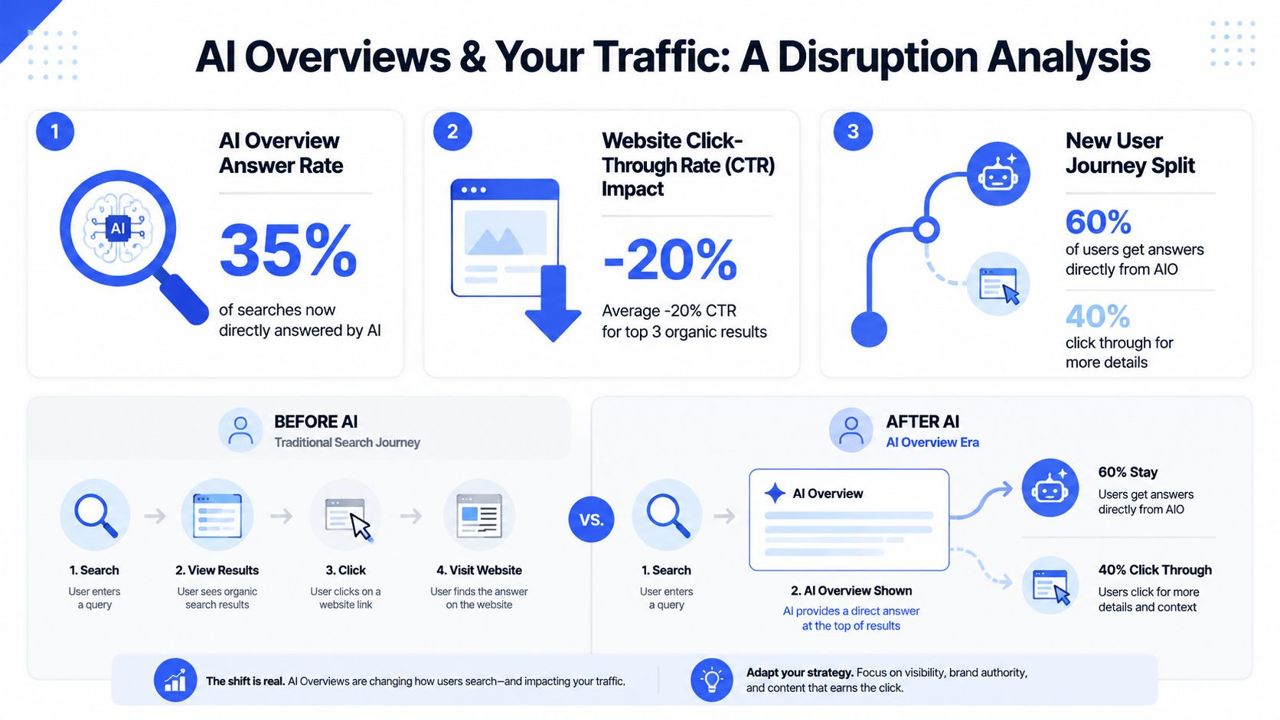
AI Overviews compress the traditional search journey. Users ask Google a question, Google assembles the response, and your page may contribute to the answer without receiving the visit. That breaks the old assumption that strong rankings naturally turn into traffic.
Early 2026 reporting found that organic click-through rates can drop from 34% to 61% when AI Overviews appear for affected queries, while some sites saw search traffic declines of 20% to 40% after AI Overviews launched. The same reporting also noted that 58% of Google searches now end without any clicks according to Reusser's analysis of how Google's AI Overview is reshaping SEO.
What this means for revenue teams
If your reporting still treats rankings as the primary success metric, you'll miss the actual issue. The SERP has become a partial destination.
Here's how that plays out across business models:
| Business model | Typical exposure | Commercial risk |
|---|---|---|
| B2B SaaS | Problem-solving searches, educational comparisons, workflow questions | Top-of-funnel traffic shrinks before users ever reach your demo path |
| Ecommerce | Product research, buying guides, feature explanations, category education | Fewer visits from users who previously moved from research to product pages |
| Local and service businesses | “How much,” “what to expect,” service explainer queries | Early trust-building visits may disappear before a contact form or call |
A CMO should read that as a funnel issue, not just an SEO issue. If discovery is mediated by AI-generated summaries, then the value of a page may shift from direct session generation to influence on later branded demand, direct return visits, or conversion from a different touchpoint.
Visibility can still matter, but it doesn't pay the same way
Some informational queries were never your best converters. They introduced the category, framed the problem, and seeded the brand. In those cases, being cited inside the answer can still be useful.
But not every page should accept click loss.
- Protect bottom-funnel assets: Product, service, pricing, and commercial comparison pages still need strong blue-link performance.
- Treat informational pages differently: They may deserve answer-first formatting and citation-friendly structure even if CTR weakens.
- Separate exposure from traffic: A page can become more visible in search while attracting fewer sessions.
When AI Overviews appear, rank position still matters. It just doesn't guarantee the same business outcome as it used to.
That's the strategic reset. SEO isn't only about winning a position anymore. It's about deciding what kind of win each query should deliver.
Core Principles of an AI Overviews SEO Strategy
A good AI Overviews SEO strategy isn't built on secret tricks. It's built on the same fundamentals that already make a page useful, crawlable, and trustworthy. The difference is the output you're optimizing for. Not just ranking, but answer extraction.
Google's own documentation says a page must already be indexed and eligible to appear in Google Search with a snippet to be eligible as a supporting link in AI Overviews. Google also says there are no additional technical requirements beyond standard Search requirements, as explained in Google's documentation on AI features in Search.
Principle one: Optimize to be the answer
Many teams still write pages like essays. They delay the direct answer, warm up with generic context, and bury the practical explanation halfway down the page. That structure is weak for users and worse for AI extraction.
A stronger approach puts the answer near the top, then expands with detail, examples, objections, and next steps.
For example:
- Weak structure: Long introduction, vague subheads, broad commentary, delayed conclusion.
- Strong structure: Clear question-led heading, direct answer paragraph, supporting bullets, expanded explanation, internal links to related depth.
This also improves search intent optimization because the page starts with the exact job the query is trying to complete.
Principle two: Reduce ambiguity
AI systems don't reward clever writing if the meaning is muddy. Pages that perform well for AI visibility usually make a few things obvious:
- What the page is about
- Which question each section answers
- Who the content is for
- What entity or topic the brand has authority on
That means cleaner headings, simpler phrasing, stronger on-page semantics, and less filler between the search question and the answer.
Operator mindset: If a machine had to quote one paragraph from the page, would it find a complete answer or just introductory noise?
Principle three: Build verifiable authority
Authority in AI-driven search still starts with traditional SEO signals. If a page can't rank, it usually won't earn citation visibility either. Strong organic positions, topical relevance, internal link support, original insight, and trust signals still matter.
In practice, that means:
- Fix technical barriers first: Crawl waste, thin duplicate pages, weak canonicals, and orphaned content all reduce eligibility.
- Support topics with clusters: One isolated article rarely carries enough topical weight on its own.
- Show expertise clearly: Use expert bylines, clear editorial ownership, and content that reflects actual experience.
What doesn't work is treating AI Overviews like a separate channel that can be hacked with schema alone. Schema helps clarify content. It doesn't replace authority, relevance, or indexability.
How to Structure Content for AI Citations
Content that earns AI citations usually looks more disciplined than clever. It answers fast, labels sections clearly, and gives Google extractable blocks of meaning. If your page reads like a conference transcript, it's harder to cite. If it reads like a well-organized decision resource, it's easier.
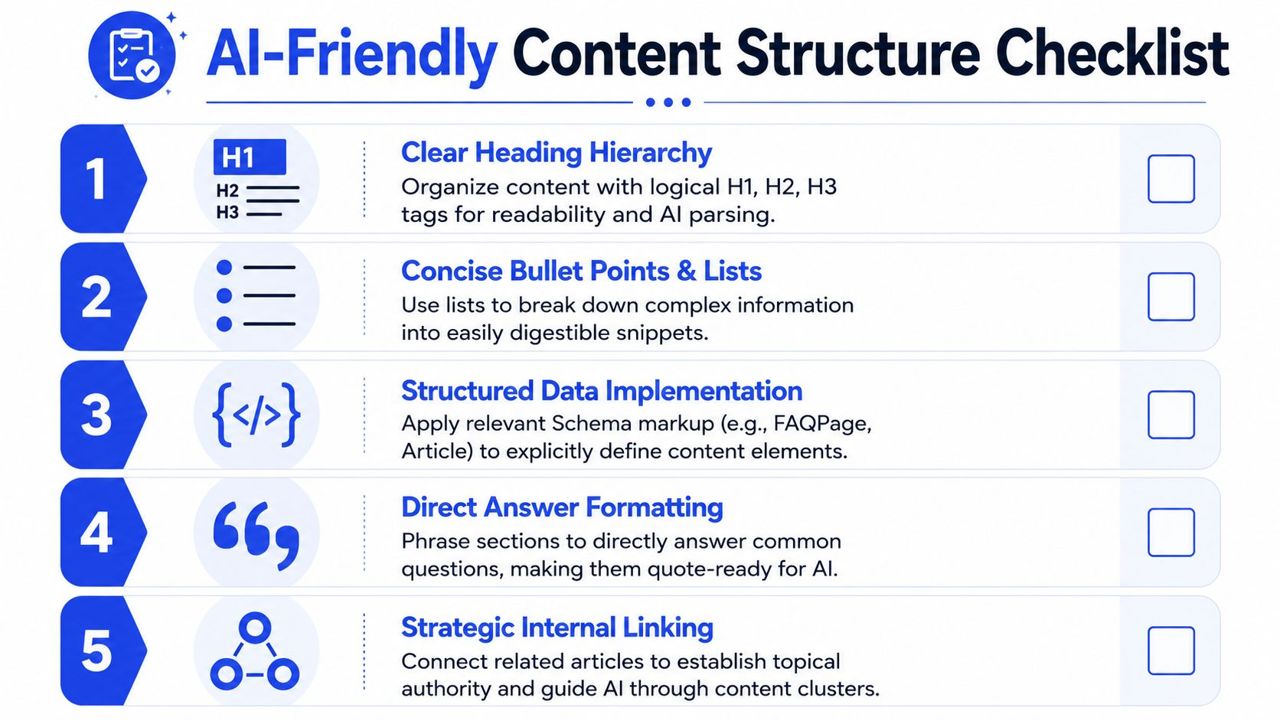
Lead with a direct answer
Start major sections with a short paragraph that directly answers the heading. Don't make users or machines infer the conclusion.
A simple pattern works well:
- State the answer clearly
- Define any important qualifier
- Expand with examples or edge cases
Example:
| Weak version | Better version |
|---|---|
| “Brands should think carefully about content structure because search is changing quickly and users now expect concise experiences.” | “To improve citation potential in AI Overviews, place a direct answer immediately under the heading, then support it with short explanatory paragraphs, bullets, or a table.” |
That second version is far easier to summarize, quote, or cite.
Use headings that describe the question being solved
Good H2s and H3s act like labels for retrieval. They tell Google what each section covers without requiring interpretation.
Use headings such as:
- How AI Overviews affect SaaS demo funnels
- When to optimize informational pages for citations
- What schema helps clarify FAQ content
Avoid vague headings like “Key insights” or “Things to know.” They don't signal enough.
If your team also produces audio or video content, the same structure applies to transcripts and summaries. Well-formatted supporting assets such as crafting SEO-friendly podcast notes can turn unstructured spoken content into citable text blocks that reinforce topical authority.
Break dense prose into extraction-friendly formats
AI systems tend to work better with explicit structure than with long narrative blocks. Use the format that best matches the intent of the section.
Try these patterns:
- Bullets for criteria: Best when listing traits, requirements, or warning signs.
- Numbered steps for processes: Best for implementation sequences.
- Tables for comparisons: Best for trade-offs between page types, query types, or tactics.
- Short paragraphs for explanations: Best for nuance and context.
A page doesn't need to sound robotic. It needs to make the answer easy to isolate.
Here's a practical formatting checklist:
- Answer-first intros: Give each major section a quotable opening.
- Tight paragraph control: Keep most paragraphs short and single-topic.
- Consistent terminology: Don't rename the same concept three different ways on one page.
- Visible hierarchy: H2 for the main topic, H3 for sub-questions, lists for supporting detail.
- Internal context: Link to supporting resources when the reader needs depth, not randomly.
A classic overlap exists here with snippet optimization. If you already know how to shape content for concise extraction, many of those habits transfer directly. This guide on how to optimize for featured snippets is useful because the formatting logic is closely related.
A video walkthrough can also help teams visualize what answer-first formatting looks like in practice:
Advanced Technical SEO for AI Visibility
Once the page structure is solid, technical SEO decides whether Google can reliably interpret, trust, and prioritize the right version of that content. This isn't about chasing obscure AI settings. It's about removing ambiguity from the site itself.
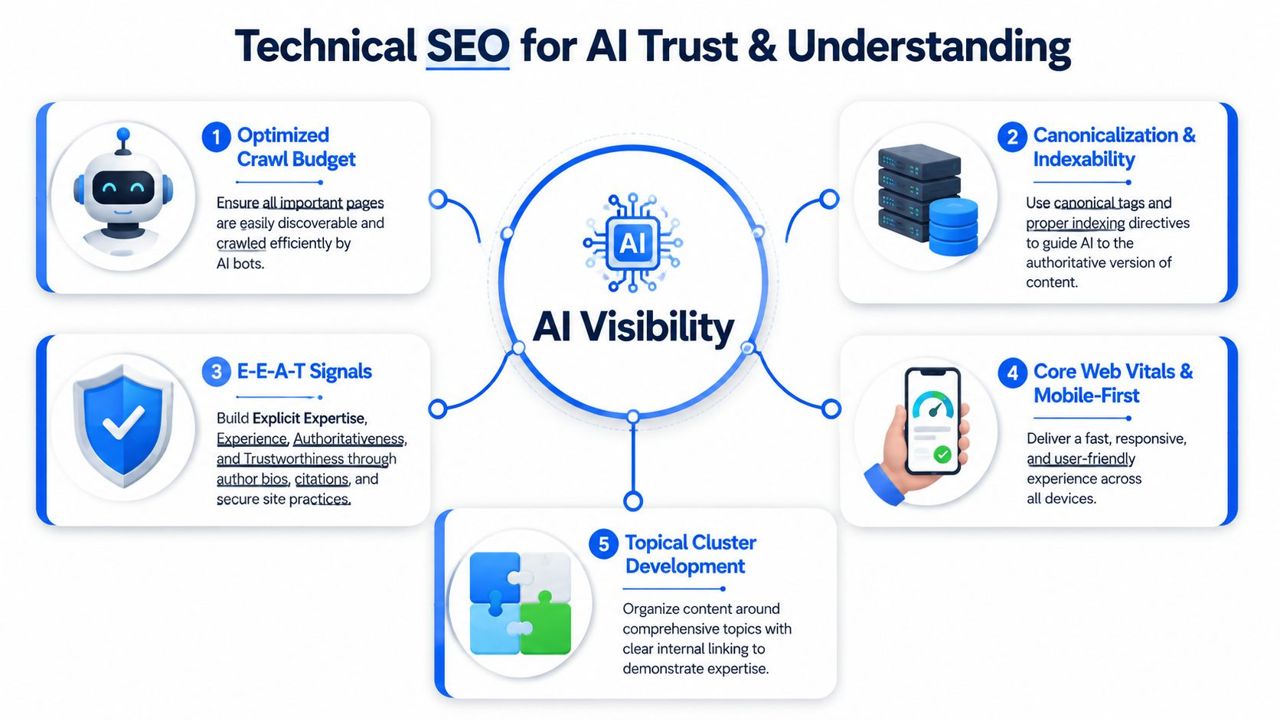
Start with indexability and canonical control
If Google sees duplicate, near-duplicate, parameter-heavy, or weakly canonicalized versions of the same topic, your authority gets split. That hurts standard organic performance and makes citation selection less predictable.
Audit for:
- Index bloat: Tag pages, filters, internal search results, or duplicate CMS archives competing with core assets.
- Canonical confusion: Pages signaling one canonical tag while internal links point elsewhere.
- Thin alternates: Light rewrites of the same topic across blog, help center, and resource sections.
- JavaScript dependency: Important explanatory content that doesn't render clearly in HTML.
A strong AI visibility setup usually starts with fewer, better-defined URLs.
Use structured data to clarify the page
Structured data doesn't make weak content strong. It helps Google interpret content that's already useful.
The most practical schema types here are:
| Schema type | Best use | Why it helps |
|---|---|---|
| Article | Editorial pages, explainers, strategy guides | Clarifies page type, authorship, and publication context |
| FAQPage | Pages with genuine question-and-answer sections | Makes explicit which questions are being answered |
| HowTo | Step-based instructional content when appropriate | Gives process structure where the content fits that format |
For implementation details and common mistakes, this guide on FAQ schema markup is the most relevant companion resource.
The key rule is simple. Structured data should match visible content. If the page doesn't contain the question, answer, author, or step, don't mark it up as though it does.
Strengthen entity clarity and topical clusters
AI Overview citations tend to favor pages that sit inside a credible topic ecosystem. One strong article helps. A connected cluster helps more.
That means your site should make these relationships obvious:
- The core entity: Your brand, its services, products, category, and specialty areas
- The supporting entities: Tools, methods, locations, product attributes, buyer problems
- The content relationships: Which pages define, compare, explain, solve, and convert
A SaaS company might connect workflow education pages to product use cases, integration pages, feature pages, and demo pages. An ecommerce brand might connect buying guides to category pages, comparison content, FAQs, and product collections. A local service business should tie city pages, service explainers, trust pages, and contact intent pages together clearly.
Technical reality: Internal links do more than pass authority. They help Google understand which documents belong to the same expertise graph.
Build trust signals into the page template
Trust isn't only a backlink conversation. On-page trust cues shape how credible a page feels and how easy it is to verify.
Useful signals include:
- Author attribution: Real subject-matter ownership, not anonymous publishing.
- Editorial dates: Clear publishing and update information where relevant.
- About and contact paths: Obvious business identity and site accountability.
- Consistent brand language: The same entity names, service names, and product naming across the site.
What doesn't work is layering schema over a weak page architecture. Technical SEO supports clarity. It can't replace it.
Measuring and Testing Your AI Overviews Strategy
Much AI Overview advice often falls short. Teams are told to optimize for citations, monitor visibility, and keep an eye on Search Console. That's directionally right, but it doesn't solve the reporting problem a CMO truly has.
If clicks drop while AI exposure rises, what should count as success?
By 2026, AI Overviews were reported to appear in nearly 55% of all Google searches, with around 50% of U.S. queries generating an AI Overview response. The same reporting set said 58% of surveyed users had performed at least one Google search in the past month that produced an AI Overview, 81% of searches triggering AI Overviews were on mobile, and 88% of keywords triggering AI Overviews were informational intent, according to Heroic Rankings' reporting on Google AI Overview statistics.
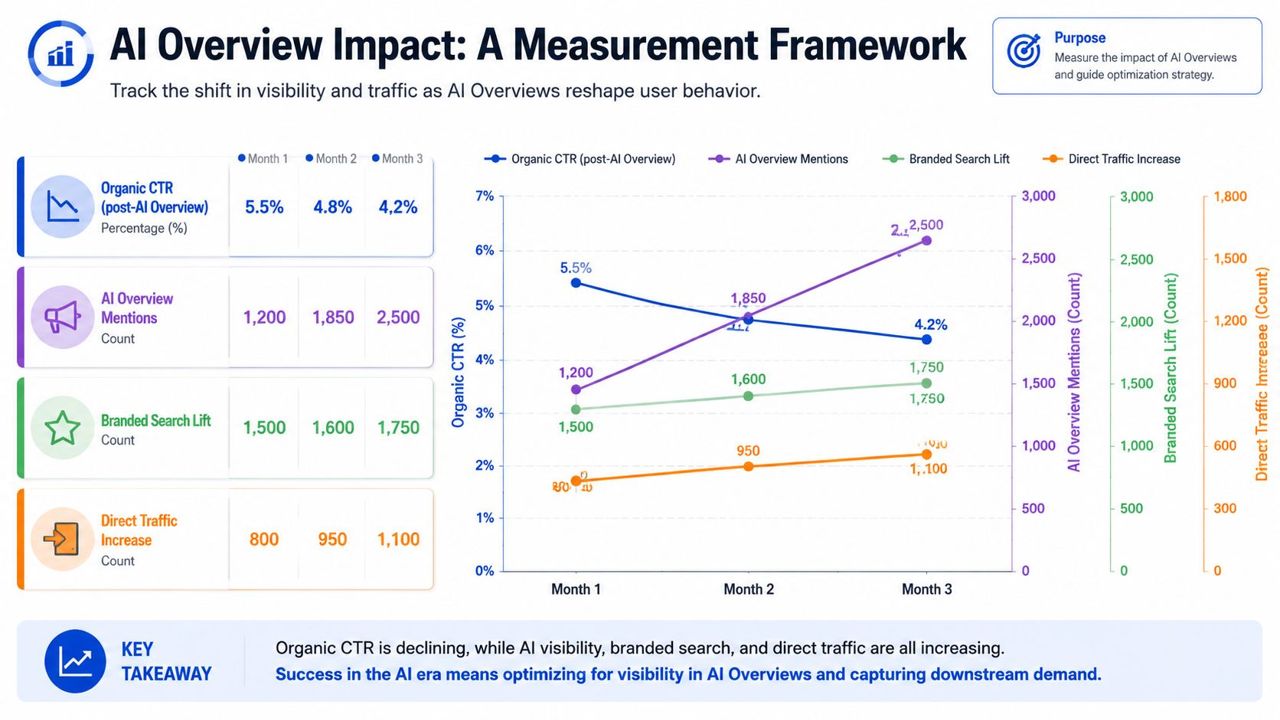
Replace single-metric reporting
Organic CTR alone no longer explains performance well enough. You need a measurement stack that separates visibility, assisted demand, and conversion.
Track performance in four layers:
Query layer
- Which queries appear to trigger AI Overviews
- Whether those queries are informational, comparative, or transactional
- Whether the page should prioritize citations or clicks
Page layer
- Impressions and average position trends
- CTR changes after SERP shifts
- Downstream assisted conversions for affected landing pages
Brand layer
- Branded search trends
- Direct traffic quality
- Sales feedback on “heard of you through Google” behavior
Revenue layer
- Demo requests, lead submissions, qualified calls, or transactions influenced by informational content
- Assisted path contribution, not just last-click attribution
Build a page-by-page decision model
Not every visibility gain is valuable. Some queries deserve citation capture. Others deserve click defense.
Use a simple operating model:
- Citation-first pages: Educational guides, definitions, process explainers, broad problem framing content
- Click-first pages: Commercial comparisons, service pages, product pages, pricing, high-intent category pages
- Hybrid pages: Mid-funnel assets where brand visibility matters but conversion paths must remain obvious
This is also where stronger analytics discipline matters. If your team needs a cleaner framework for event setup and downstream attribution, this guide for CRO specialists on conversion tracking is a useful companion for tightening measurement logic around assisted conversions and lead actions.
Test for business impact, not vanity impact
One of the biggest gaps in current industry coverage is measurement and attribution. As noted in Webfor's discussion of how Google's AI Overviews are changing SEO, many guides focus on how to get cited but don't resolve how to report leads, demos, or revenue when AI visibility mediates discovery and CTR becomes less reliable.
That's why testing should revolve around commercial outcomes.
Compare changes in:
- Branded search behavior after citation-focused content updates
- Lead quality from informational landing page cohorts
- Direct and returning traffic to pages linked from AI-exposed content
- Sales-assisted mentions of educational resources during the buying cycle
If you need outside help building that reporting model, it's worth reviewing specialized AI search optimization services instead of forcing an old SEO dashboard to answer a new search problem.
Frequently Asked Questions About AI Overviews SEO
Should every page be optimized for AI Overviews
No. That's usually the wrong move.
Recent coverage often misses the core prioritization question. AI Overviews don't affect every query equally, and reporting cited by SE Ranking's guide on how to optimize for AI Overviews notes that 99.5% of AI Overview sources come from the top 10 organic results. The same discussion highlights a practical split. Top-of-funnel informational queries may justify citation capture, while bottom-funnel pages should usually focus on preserving rankings and conversions.
Are backlinks still important
Yes. AI visibility doesn't replace authority building. If anything, it makes authority more important because Google still needs confidence in the source it surfaces. Strong backlinks, internal linking, topical depth, and on-page trust signals still support the pages most likely to be cited.
Is this different from traditional SEO or just a rebrand
It's an evolution of traditional SEO, not a replacement. The foundation remains ranking, indexing, relevance, and authority. What changes is the output you optimize for. Some pages need clicks. Some pages need citations. Many need both.
What kinds of pages are best suited for citation-first optimization
Question-led guides, definitions, process explainers, glossary content, educational category pages, and FAQ-driven resources are usually the best fit. These are the assets most likely to support discovery even when the click doesn't happen immediately.
What usually fails in AI Overview optimization
Two things fail most often. First, teams apply answer-first formatting to every page without considering conversion trade-offs. Second, they chase schema and formatting while ignoring weak rankings, thin authority, and poor internal architecture.
If your organic traffic is shifting and your current reporting can't explain the impact of AI-driven search, SEOBRO® can help you build a practical strategy around revenue, qualified leads, technical clarity, and AI visibility. Consider a strategic SEO audit if you need to decide which pages should win citations, which should protect clicks, and how to measure the business value of search in Google's new results.