Teams dealing with AI search right now are stuck between two bad options. They either leave the site wide open and let every bot take what it wants, or they block everything and wonder why their brand barely appears in AI-generated answers.
That binary thinking is the problem.
AI crawler optimization is really about control. You want the pages that drive pipeline, product discovery, and branded demand to stay accessible for legitimate search visibility. At the same time, you may want tighter restrictions on proprietary documentation, gated assets, pricing intelligence, partner content, or large catalog datasets that you don't want absorbed into model training with little commercial return.
The companies that handle this well usually aren't chasing AI hype. They're tightening technical SEO, deciding which content deserves AI exposure, and putting crawl rules in place that reflect business value.
Establish Your Technical Foundation for AI
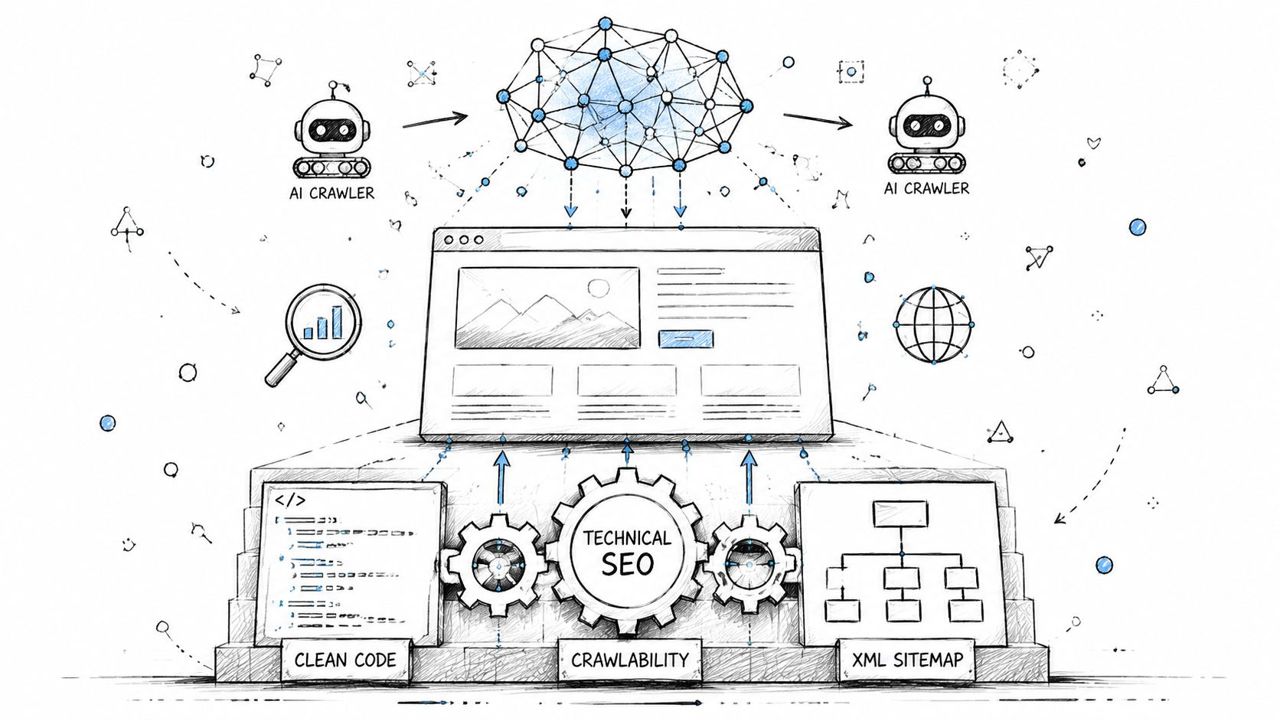
AI visibility still sits on top of technical SEO. Google said in its May 2025 AI Search guidance that pages should return an HTTP 200 status, avoid blocking Googlebot, and keep structured data aligned with visible content. It also called out controls such as nosnippet, data-nosnippet, max-snippet, and noindex for managing how content appears in AI formats.
If your site can't reliably serve clean, accessible pages, none of the higher-level AI tactics matter much. Answer engines and AI-enhanced search features still need a stable document they can fetch, parse, and trust.
Start with crawlable, indexable pages
Review your money pages first. For most B2B sites, that means service pages, core product pages, solution pages, comparison pages, demo pages, and high-intent educational content.
Check these basics:
- HTTP status health: Key URLs should return a clean 200 response, not redirect chains, soft 404s, or broken canonical targets.
- Robots alignment: Make sure important sections aren't accidentally blocked to the crawlers you want to reach them.
- Canonical discipline: Canonicals should support the preferred URL, not point AI-relevant pages somewhere else by mistake.
- Protocol consistency: Mixed HTTP and HTTPS behavior still creates confusion. If you need a broader cleanup process, this guide on HTTP vs HTTPS SEO implications is worth reviewing.
A lot of AI crawl problems are still old technical SEO problems wearing new clothes. JavaScript-heavy templates, fragmented canonicals, thin rendered HTML, and messy internal redirects all reduce how confidently machines can interpret a page.
Machine readability is what makes content usable
A technically reachable page still isn't enough if the content is hard to parse. Structured HTML, clear headings, consistent templates, and visible text that matches schema all make the page easier for machines to process.
Practical rule: If a bot lands on your page and has to guess what the primary entity, offer, or answer is, you've already made AI visibility harder than it needs to be.
For local and service businesses experimenting with AI-assisted visibility, there are also adjacent workflow ideas in this piece on AI for local search optimization, especially if your team is trying to connect technical foundations with lead generation.
Page speed and usability matter here too. Faster, cleaner pages reduce crawl waste and improve the odds that bots can fetch and interpret the content without friction. That's not just a technical win. It protects the pages that contribute to qualified leads and revenue.
Mastering Crawl Access and Indexing Controls
The biggest mistake I see is treating every AI bot the same. That approach is too blunt for any business with valuable content.
Cloudflare reported that by mid-2025 nearly 80% of AI crawling was for training, 18% for search, and 2% for user actions, which is why selective controls matter if you want visibility without giving everything away to model training according to Cloudflare's breakdown of crawler purpose.
Blocking access and limiting usage are not the same thing
This distinction matters.
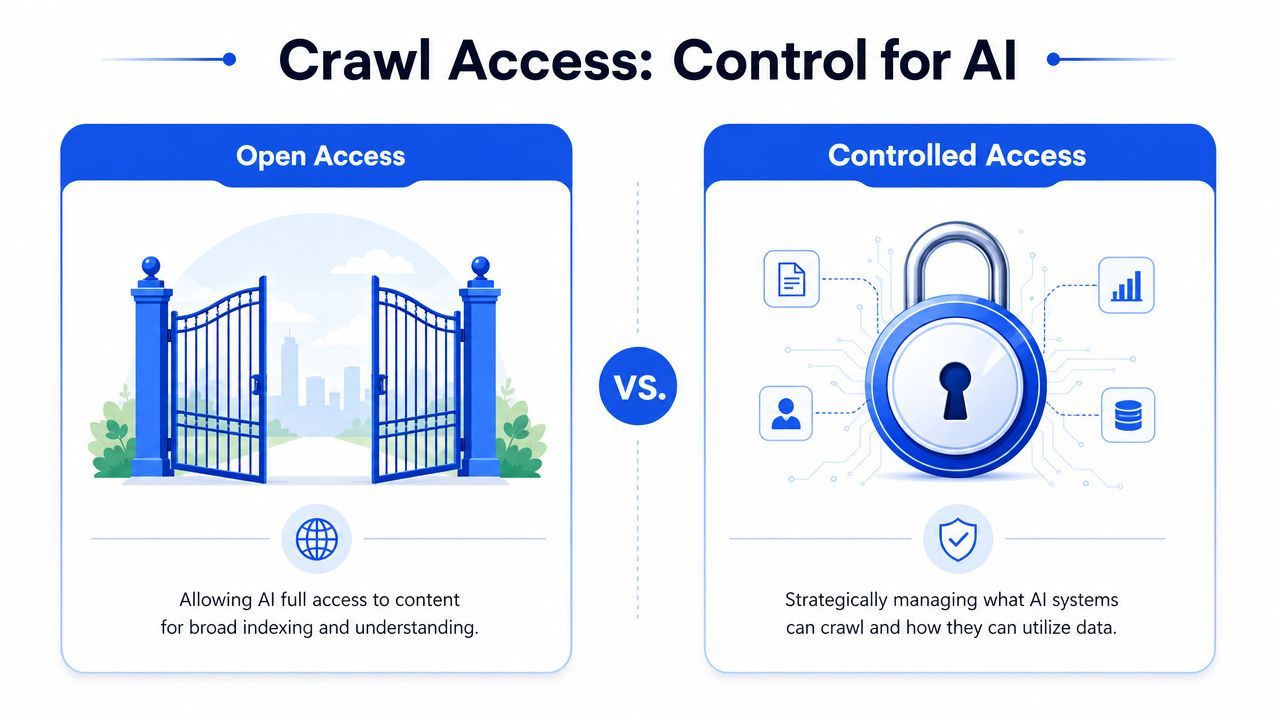
Robots.txt is mainly about crawl access. It tells compliant bots what they can or can't request. That's useful when you want to reduce unnecessary crawling of low-value folders, internal search results, faceted clutter, or sensitive content areas.
Meta robots and snippet controls influence indexation and content usage more directly. Depending on the system, controls like noindex, nosnippet, data-nosnippet, and max-snippet can help you preserve visibility where you want it while limiting how much of a page can be reused in AI summaries.
That gives you a more flexible playbook:
- Allow discovery of strategic pages: Keep core commercial and high-authority educational pages accessible where citation and answer-engine presence matter.
- Restrict low-value extraction: Limit access to assets that create infrastructure load or expose proprietary material without helping acquisition.
- Control how much gets quoted: Use snippet-related controls when the issue isn't crawl access, but how much content can be surfaced.
Blanket blocking usually solves the wrong problem. It reduces exposure and control at the same time.
Use different rules for different content types
A smarter setup usually follows content economics, not bot ideology.
| Content type | Better default approach | Business reason |
|---|---|---|
| Blog guides and glossary pages | Generally allow crawl and citation-focused access | These pages can support brand discovery and top-of-funnel visibility |
| Product and service pages | Allow access, maintain strong schema and snippet review | These pages influence demos, leads, and sales conversations |
| Proprietary research libraries | Tighter controls and selective snippet limits | You may want authority signals without full extraction |
| Large ecommerce catalogs | Segment by value and uniqueness | Commodity pages don't need unlimited bot activity |
| Gated resources and client-only content | Restrict aggressively | Protect assets that drive lead capture or contract value |
For larger sites, this quickly overlaps with crawl waste and prioritization. If your platform already struggles with duplicate parameters, faceted URLs, or deep archive sprawl, tighten that first. This guide to crawl budget optimization connects well with AI crawler control because both problems start with deciding what deserves bot attention.
Structure Content for AI Comprehension and Citation
Once access is in place, the next question is simple. Can an AI system understand what your page is about quickly and cite it with confidence?
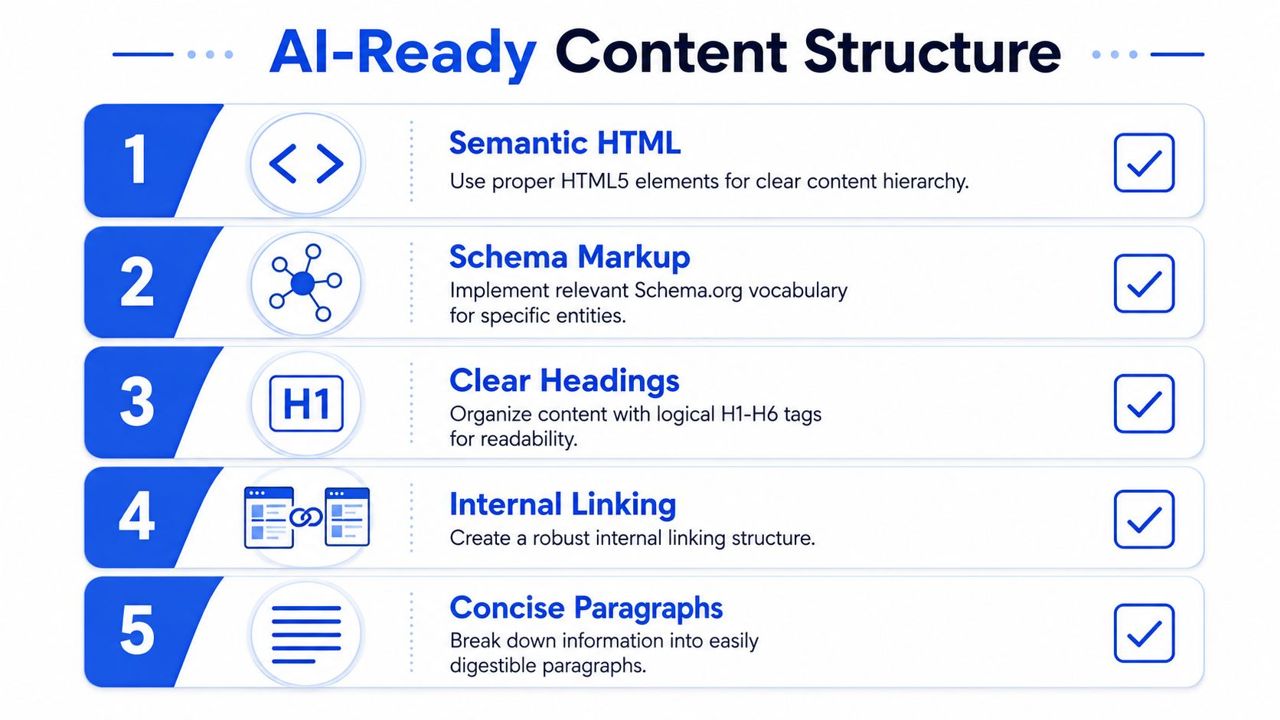
That usually comes down to structure, entity clarity, and content formatting. Guidance from crawling-focused SEO tooling recommends prioritizing pages within 3–4 clicks of the homepage, reinforcing them with strong internal linking, and publishing a complete XML sitemap so crawlers can discover key URLs efficiently. The same guidance also stresses schema markup, fast server responses, and structured HTML because they help bots parse relationships and reduce wasted crawl effort, as noted in this Similar.ai guide on AI web crawlers and SEO.
Make key pages easy to discover
If an important page sits too deep in the site, gets only weak internal links, or isn't represented cleanly in the sitemap, crawlers will still find it less efficiently. That matters more when you're trying to push a clear set of pages into AI-driven discovery.
For most B2B sites, I'd focus first on:
- Commercial intent pages: Product, service, industry, and solution pages should be prominently linked from navigation, hubs, and related content.
- Decision-stage assets: Comparison pages, implementation pages, pricing context, and use-case pages often deserve stronger internal prominence than generic blog content.
- Authority pages: Founder bios, editorial policy, about pages, and customer proof pages help machines connect expertise with the commercial content around them.
Build pages that answer engines can parse
Think less about “writing for AI” and more about reducing ambiguity.
A good AI-friendly page usually has:
- a precise H1
- short opening paragraphs that define the topic directly
- descriptive subheadings
- lists and tables where comparison or process matters
- schema that reflects the actual visible content
- concise internal anchors to related pages
Different business models apply this differently.
SaaS example: A feature page should define the capability plainly, show who it's for, explain the workflow, and link to integrations, pricing context, and comparison pages.
Ecommerce example: A category page should clarify product type, buying criteria, use cases, and differentiators instead of relying only on filters and thin intros.
Local service example: A service-area page should state the service, location, proof of expertise, and next step without burying the answer under generic sales copy.
Clear structure does two jobs at once. It improves extraction for AI systems and removes friction for human buyers who skim before they convert.
If your team is working through broader terminology and strategy shifts around AI visibility, this explainer on what AI optimization means in practice is a useful companion.
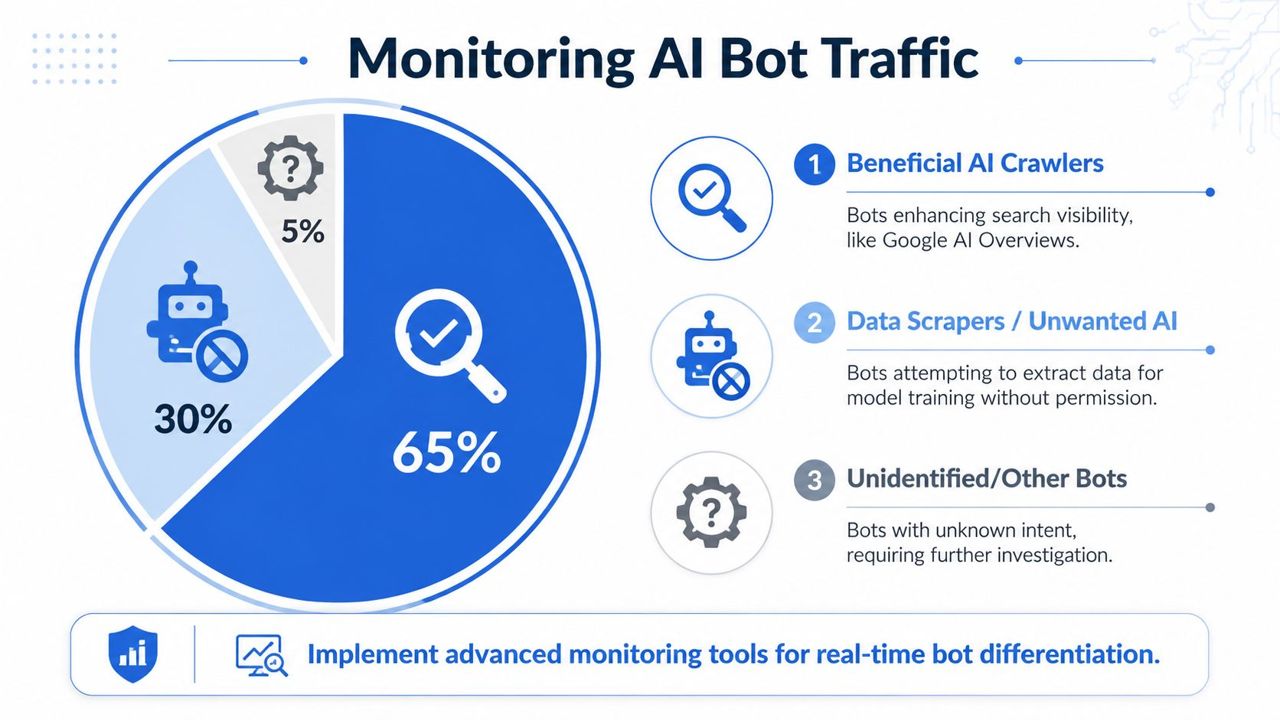
Implement Advanced Monitoring and Bot Differentiation
At this point, AI crawler optimization stops being theory and becomes operational.
In 2025, Cloudflare reported that AI bot traffic grew 18% year over year, and Fastly found that AI crawlers made up almost 80% of AI bot traffic. Fastly also reported that Meta's AI bots accounted for 52% of AI crawler traffic, ahead of Google at 23% and OpenAI at 20%, according to this data-driven analysis of AI crawling and publisher impact.
That volume changes the conversation. You're not just deciding whether AI is interesting. You're managing who consumes bandwidth, which assets they hit, and whether the commercial trade-off is acceptable.
Watch logs, not assumptions
Server logs tell you what bots do. Marketing dashboards usually don't.
Look for patterns such as:
- repeated requests to low-value archives or filter combinations
- aggressive crawling of media files or documentation libraries
- concentration on product feeds, inventories, or large knowledge bases
- changes in crawl behavior after content launches or platform migrations
Then separate bot classes by likely value. Some are tied to search visibility or answer retrieval. Others behave more like high-volume extractors. That distinction should influence rate limits, path restrictions, and verification rules.
Treat bot traffic like an asset protection issue
For publishers, ecommerce brands, and SaaS companies with proprietary material, bot management overlaps with content governance.
A practical review framework looks like this:
| Question | Why it matters |
|---|---|
| Which bots hit commercial pages most often? | These pages may justify access if visibility is the goal |
| Which bots heavily request proprietary assets? | Those paths may need tighter restrictions |
| Are valuable pages being crawled efficiently? | If not, internal linking and sitemap logic may need adjustment |
| Are unknown bots creating load without benefit? | WAF rules or rate limits may be appropriate |
If you can't distinguish beneficial fetchers from extractive crawlers, you can't make a rational policy decision.
This is also where teams often need infrastructure help, not just SEO advice. Log analysis, CDN rules, bot verification, and selective throttling are operational tasks. They deserve the same seriousness as conversion tracking or analytics governance.
For brands trying to strengthen AI visibility while keeping that operational discipline, it helps to think beyond publishing tactics alone. A more complete approach to AI search optimization services should include crawl policy, technical SEO, content structure, and monitoring together.
Your Go-Forward AI Optimization Workflow
The right operating model isn't a one-time audit. It's a repeatable review cycle.
Run AI crawler optimization as an operating rhythm
Keep the workflow simple:
- Review logs monthly: Check for new user agents, path-level crawl spikes, and unusual access patterns.
- Audit strategic pages: Confirm core commercial URLs still return clean responses, remain indexable, and present consistent visible content and schema.
- Refine controls by section: Adjust robots directives, snippet controls, and edge-layer protections based on business value.
- Monitor AI visibility trends: Watch which pages are being cited, summarized, or surfaced in AI-driven experiences.
- Reassess after launches: Migrations, redesigns, faceted navigation changes, and CMS updates often subtly break AI readiness.
A lot of teams now need the same mindset they already apply to cloud operations. This piece on AI Day2 Ops and operational complexity is useful because it frames the broader issue well. AI systems create ongoing management work after implementation, not before.
If you're serious about organic growth, build AI crawler optimization into your technical SEO process. The companies that win here usually don't chase every new crawler. They protect important assets, make strategic pages easy to consume, and keep adjusting the rules as the ecosystem shifts.
AI Crawler Optimization FAQs
The hard part isn't learning the terminology. It's deciding what to allow, what to restrict, and what affects pipeline.
Cloudflare's analysis highlights why this is nuanced. Training traffic accounts for nearly 80% of AI-bot crawling, which means blanket blocking can hurt brands that want AI search visibility without giving away all content for model training, as explained in Cloudflare's analysis of AI crawler traffic by purpose and industry.
Frequently Asked Questions
| Question | Answer |
|---|---|
| What is AI crawler optimization? | AI crawler optimization is the process of making your site easier for AI systems to access, read, interpret, and selectively use, while keeping control over what different bots can do. It combines technical SEO, crawl management, structured content, and policy decisions. |
| Is AI crawler optimization the same as traditional SEO? | No, but it builds on traditional SEO. If a page has weak technical foundations, poor internal linking, or confusing structure, it usually performs worse for both classic search and AI-driven discovery. AI adds an extra layer around citation, summarization, and content-use control. |
| Should we block all AI crawlers? | Usually no. Blanket blocking is often too aggressive. It can reduce the chance that your content appears in answer engines or AI-powered search experiences. A better approach is to separate bots by likely purpose and apply rules based on content value. |
| What's the difference between allowing crawl and allowing reuse? | They are related but not identical. Crawl directives affect whether compliant bots can access content. Snippet and indexing controls affect how that content may appear or be limited in search and AI formats. That distinction is where most strategic control lives. |
| Which pages should stay most accessible? | Start with pages that influence revenue or qualified lead generation. That often includes product pages, service pages, solution pages, pricing-adjacent pages, comparison content, and authoritative educational assets that support buying decisions. |
| Which pages deserve tighter restrictions? | Proprietary datasets, premium research, gated assets, internal search results, duplicate archives, thin filter combinations, and content that creates high crawl load with little acquisition value usually deserve more control. |
| How do ecommerce sites handle this well? | They segment the catalog. High-margin, differentiated, and strategically important category or product pages usually deserve stronger accessibility and better structure. Large sets of near-duplicate URLs, weak filter pages, and non-performing combinations often need stricter crawl rules. |
| What about SaaS companies with documentation and knowledge bases? | SaaS teams should decide whether docs are a growth asset, a support asset, or a proprietary asset. Public help content can support discoverability. Internal-only implementation detail, customer-specific material, or sensitive product logic may need more protection. |
| Does schema help AI crawlers? | Yes, when it's accurate and aligned with the visible page. Schema helps machines understand entities, relationships, products, services, FAQs, and business details more clearly. It doesn't replace strong content or clean HTML, but it makes interpretation easier. |
| How often should we review bot activity? | Monthly is a practical baseline for most sites, with additional reviews after major content releases, site migrations, architecture changes, or unusual infrastructure load. The point is consistency, not sporadic cleanup. |
| What does a good first audit include? | Check server logs, robots rules, indexability, response status, sitemap coverage, internal linking, rendering quality, schema accuracy, and which content sections create the biggest tension between visibility and protection. |
| When should a CMO care about this? | When AI summaries start influencing category discovery, when server load rises from non-human traffic, when proprietary content has commercial value, or when organic strategy is shifting from pure clicks to a mix of clicks, citations, and brand mentions. |
The practical takeaway is simple. AI crawler optimization isn't about saying yes or no to AI. It's about deciding which systems get access to which content, under which conditions, and for what business return.
If that decision hasn't been made deliberately, then your site is probably running on defaults. Defaults are rarely aligned with revenue goals or data protection.
If you want a senior second opinion on crawl policy, technical SEO, AI visibility, and which pages should stay open versus restricted, SEOBRO® can help you turn that into a clear roadmap. The best results usually come from a strategic audit first, then implementation tied to lead generation, qualified traffic, and long-term organic growth.