If you're already publishing strong content and still watching competitors get cited in AI answers, the problem often isn't topic coverage. It's structure.
A buyer asks ChatGPT, Perplexity, or Google's AI Overviews a high-intent question. The answer mentions a competing brand, links to their page, and summarizes their product, service, or advice cleanly. Your page might be more detailed, more accurate, and more useful for a human reader, yet it gets ignored because the machine has less confidence in what your page is about.
That's where schema markup for AI search has moved from optional cleanup work to core search infrastructure. In 2025 to 2026, one industry guide reports that pages with proper schema markup have a 2.5x higher chance of appearing in AI-generated answers, and that sites with complete Tier 1 schema can see up to a 40% lift in AI visibility, with effects often showing after 2 to 4 weeks as systems re-index content, according to Stackmatix on structured data for AI search.
That doesn't mean schema is a magic switch for citations. It does mean your site needs to be readable by machines, not just persuasive to humans.
Your Competitors Are Being Cited by AI Are You
The pattern is easy to recognize in live SERPs and AI interfaces. A prospect searches for a product comparison, a local service, or a software recommendation. The AI answer pulls a clean summary from one brand, cites their page, and moves the user closer to a shortlist. Another brand with similar or better content gets no mention at all.
That gap usually isn't explained by copy quality alone. It often comes down to whether the site gives machines a clear description of entities, relationships, product details, business identity, and page purpose.
Human-readable isn't enough anymore
Traditional SEO trained teams to think about titles, links, content depth, and rich snippets. Those still matter. But AI systems also need a reliable way to interpret what they're reading without guessing.
Schema does that job. It tells a machine, with far less ambiguity, whether the page is about a product, an organization, a local business, an article, a question set, or a review. It also helps connect those pieces.
Practical rule: If your site only explains things in prose, you're forcing machines to infer too much.
For commerce brands, that problem shows up fast in AI-assisted product research. If you're mapping strategy around product discovery and merchant visibility, this resource on AI visibility for online stores is a useful companion to schema work because it looks at the broader visibility layer, not just markup in isolation.
What businesses get wrong
A lot of teams still treat structured data like old-school SEO decoration. They add a plugin, generate minimal markup, and assume the job is finished.
It isn't.
What usually works better is simpler and stricter:
- Define the business clearly: Use schema that identifies who you are, where you operate, and what the page represents.
- Match schema to the page: Mark up what is visible, not what you wish the page communicated.
- Support commercial intent: Product, service, FAQ, review, and article pages need markup that reflects their role in the buying journey.
If your competitors are getting cited and you're not, schema won't solve everything by itself. But skipping it is one of the fastest ways to stay invisible in AI-mediated search.
How AI Search Actually Consumes Structured Data
Traditional search engines often used schema to power visible enhancements such as ratings, pricing, or event details. AI search uses it more like a semantic input layer.
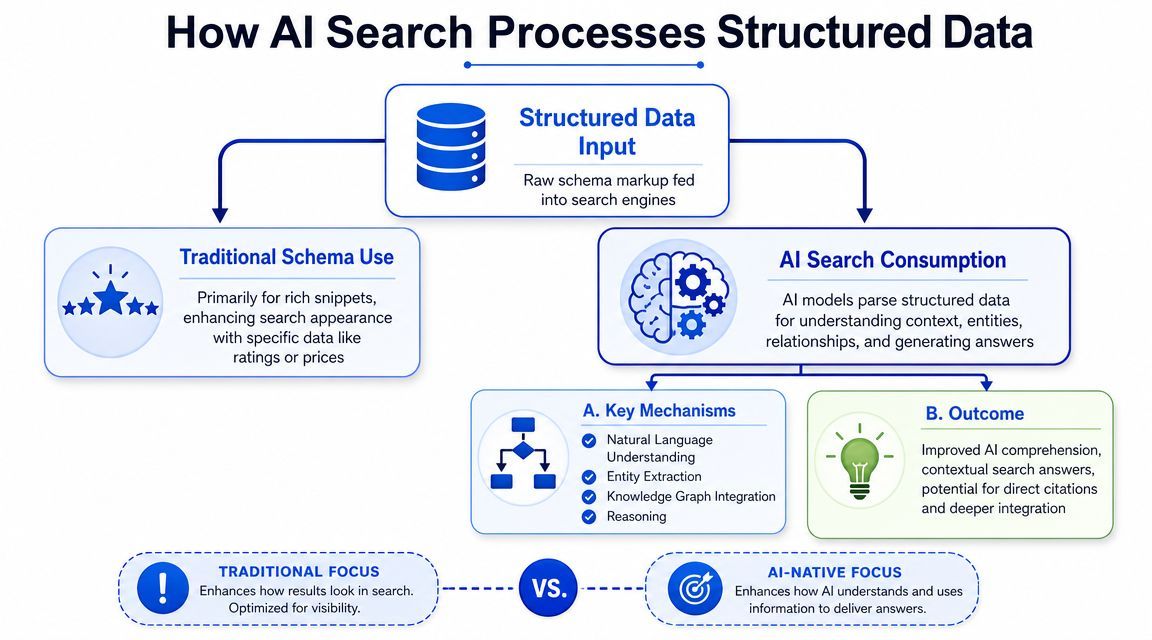
Structured data works like a machine-readable label
The simplest way to think about schema is this. Your page has prose for people and metadata for machines. Schema is the part that reduces ambiguity.
Google explains that it uses structured data to understand page content and gather entity-level information about things like people, books, and companies, and it recommends validating with the Rich Results Test and checking markup through URL Inspection in Google's structured data guidance.
That matters because AI systems don't "read" a page the way a buyer does. They parse signals, compare entities, look for relationships, and try to decide whether the page is specific enough to support an answer.
If you've worked around document automation or extraction systems, the mechanics feel familiar. This overview of how intelligent document processing works is useful context because it shows how machines convert messy human information into structured, usable data.
What AI systems look for in practice
AI search doesn't just want a page with keywords. It wants context.
A strong schema layer helps machines answer questions like these:
| AI question | What schema helps clarify |
|---|---|
| Who is this brand | Organization or LocalBusiness |
| What is this page about | WebPage, Article, Product, FAQPage |
| What is being offered | Product, Offer, Service |
| Who created this content | Person, Organization, author relationships |
| How do these items connect | @id references and nested entities |
That shift is why schema is no longer just about rich results. One recent analysis notes that schema.org contains 811 schema types, while many platforms only support roughly 20 to 30 common markups out of the box. The same analysis recommends JSON-LD for new implementations and stresses that schema should match visible page content in CMSWire's analysis of Schema.org in the AI era.
Clean schema doesn't replace content quality. It makes content quality easier for machines to verify.
In practical SEO work, this changes how you prioritize pages. Instead of asking only, "Can this page rank?" the better question is, "Can a machine confidently identify the entity, intent, and supporting facts on this page?" That's the bridge between old snippet optimization and modern answer visibility. It also overlaps with the logic behind featured snippet optimization, where clarity, structure, and extractable formatting increase reuse.
Essential Schema Types for AI Search Visibility
Not all schema types carry equal weight. For AI search, the most useful markup is the kind that reduces ambiguity and makes extraction easier.
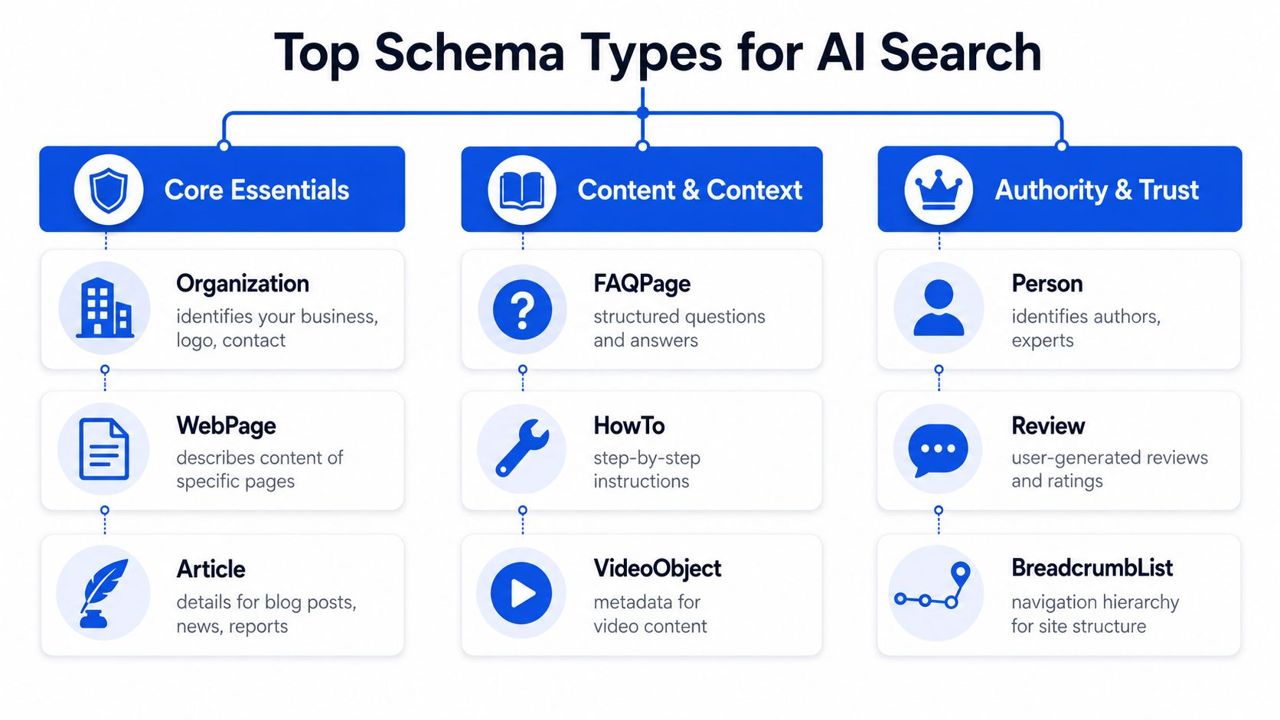
For AI visibility, sources consistently point to a practical group: Organization and LocalBusiness for identity, plus FAQPage, HowTo, Product, Article, and Review for reusable content structures. They also note that FAQ markup still helps AI extraction even where Google has reduced FAQ rich results, as explained in SEOptimer's guide to schema markup for AI search.
Core entity schema
Start with the schema that tells machines who you are.
Organization is the baseline for most brands. It helps define your business name, site identity, and brand entity. On local sites, LocalBusiness adds location-specific context that AI systems need for geographic intent.
WebPage is often overlooked. It doesn't sound glamorous, but it helps define what a specific URL is. On larger sites, that matters because AI systems need more than a generic brand signal.
A simple priority stack for most sites looks like this:
- Homepage: Organization or LocalBusiness
- Core commercial pages: WebPage plus Service or Product where appropriate
- Editorial content: Article with author and publisher relationships
- Support content: FAQPage or HowTo when the page uses those formats
Content schema that gets reused in answers
Some schema types are naturally aligned with how answer engines compose responses.
FAQPage is useful because it mirrors the structure of the query itself. A user asks a question. The page contains a clear question and answer pair. That's highly reusable.
HowTo works on instructional content, but only when the page has steps. Forced HowTo markup on a generic landing page is one of the fastest ways to create invalid or misleading implementation.
To make this more concrete, here's a useful video overview before you build or expand your markup stack:
Product becomes critical when the page answers commercial questions. Buyers ask AI systems about specs, comparisons, pricing context, and reviews. Product schema gives machines a clearer path to those facts.
If you're working through FAQ implementation in detail, this guide on FAQ schema markup is worth reviewing because FAQ is still one of the most practical formats for machine-readable extraction.
Trust and support schema
This is the layer many teams underuse.
Review can help attach sentiment and evaluation context to an offer or product. BreadcrumbList helps define site hierarchy and page relationships. Person can strengthen authorship and expertise signals when the author matters to trust.
Use schema to clarify what's already true on the page. Don't use it to manufacture authority.
A lot of sites go wrong by chasing obscure schema types too early. Start with the types tied to identity, commercial details, and extractable content. That's where most of the value sits.
The Debate Direct vs Indirect Impact on AI Citations
Here, the conversation needs some honesty.
Many guides imply that adding schema directly increases AI citations. That's a clean marketing message, but the evidence is messier.

What the direct-citation claim gets wrong
Independent testing by OtterlyAI found that schema did not appear to measurably change AI Search citation behavior on most platforms, and 6 out of 7 AI Search systems could not fetch or correctly interpret schema when asked directly, according to OtterlyAI's testing on schema and AI citation behavior.
That matters because it changes the way you set expectations with founders and marketing teams. If someone says, "Add schema and ChatGPT will cite us," that's too simplistic.
Schema is not a guaranteed citation lever. It is a clarity and eligibility layer.
Where schema still matters a lot
The indirect value is still substantial.
Schema can improve machine readability, reinforce page intent, support rich-result eligibility, and strengthen the underlying SEO signals that AI systems may use as a proxy for source quality. In other words, schema often helps the assets that get discovered, indexed, understood, and trusted. That can influence whether your content becomes part of the pool AI systems draw from, even if the markup itself isn't directly parsed in every answer experience.
That's why the right position isn't "schema doesn't matter." The right position is "schema matters, but not in the simplistic way many people claim."
For businesses investing in answer-engine visibility, schema belongs inside a broader operational system that includes technical SEO, indexing health, strong commercial content, internal linking, and authority building. If you're evaluating that broader layer, AI search optimization services should be framed around whole-site readiness, not one markup tactic.
Implementation Best Practices Using JSON-LD
A lot of schema work fails for a simple reason. The code gets added, but the page model is wrong.
Use JSON-LD as the default format unless the CMS or platform forces a different setup. It is usually the cleanest way to deploy markup at scale, keep it separate from front-end code, and audit changes without digging through rendered HTML. For SEO teams working across product templates, location pages, blog content, and support docs, that matters.
Why JSON-LD is usually the right implementation choice
JSON-LD is easier to template, easier to QA, and easier to maintain across redesigns. It also reduces the chance that developers accidentally break schema while updating visible page elements.
That does not mean every JSON-LD implementation is good.
The core work is in the mapping. A product page needs markup that reflects the product entity, commercial details, and supporting context on that URL. A local service page needs a different entity model. A SaaS feature page often needs tighter alignment between Organization, SoftwareApplication, Service, FAQ, or Article markup depending on search intent and what is present on the page.
A practical JSON-LD example
Here is a clean example for an Organization entity:
{
  "@context": "https://schema.org",
  "@type": "Organization",
  "@id": "https://example.com/#organization",
  "name": "Example Company",
  "url": "https://example.com/",
  "logo": "https://example.com/logo.png",
  "sameAs": [
    "https://www.linkedin.com/company/example-company/"
  ],
  "contactPoint": {
    "@type": "ContactPoint",
    "contactType": "sales",
    "url": "https://example.com/contact/"
  }
}
This example is simple, but the structure is right.
- Creates a stable entity:
@idgives the organization a reusable identifier. - Defines identity clearly: name, URL, and logo help search systems associate the page with a real entity.
- Supports connected markup: the same
@idcan be referenced across Article, Product, Service, or WebPage markup on other templates.
Implementation rules that prevent wasted effort
Bad schema usually comes from over-marking pages, copying plugin defaults, or publishing fields the page does not support. Those mistakes waste development time and make reporting noisy.
Use this checklist before rollout:
- Match visible content: If users cannot see it on the page, do not mark it up.
- Complete the useful properties: Required fields are the floor. Recommended fields often provide the context that improves entity clarity.
- Reuse
@idvalues consistently: This helps connect entities across the site instead of leaving them as isolated blocks. - Map schema to page purpose: Product pages, comparison pages, help articles, and location pages should not share the same template logic by default.
- Validate rendered output: Check the live URL in Google's Rich Results Test and URL Inspection, not just the raw template.
- Control deployment carefully: Tag managers can work for some cases, but template-level implementation is usually more reliable for large sites.
A practical workflow looks like this:
| Stage | What to do |
|---|---|
| Audit | Find existing schema, conflicts, plugin bloat, and template gaps |
| Map | Assign schema by page type, search intent, and business value |
| Deploy | Add JSON-LD through templates, CMS fields, or controlled modules |
| Validate | Test rendered markup and confirm Google can fetch it |
| Monitor | Review indexing, rich result eligibility, and page-level performance after rollout |
One trade-off is worth stating clearly. Teams often spend weeks perfecting low-value markup on pages that do not drive pipeline or sales. Revenue pages should go first. For eCommerce, that usually means product and category templates. For local businesses, location and service pages. For SaaS, core solution, feature, and high-intent comparison pages usually matter more than the blog archive.
One practical option for teams that need strategy plus implementation is SEOBRO®, which handles schema as part of broader technical and revenue-focused SEO work. Schema works better when it is tied to page mapping, crawl control, and content alignment, not treated as a standalone fix.
Prioritizing Schema for Your Business Model
The worst schema advice is generic. An eCommerce catalog, a SaaS company, and a local service business shouldn't all start with the same markup stack.
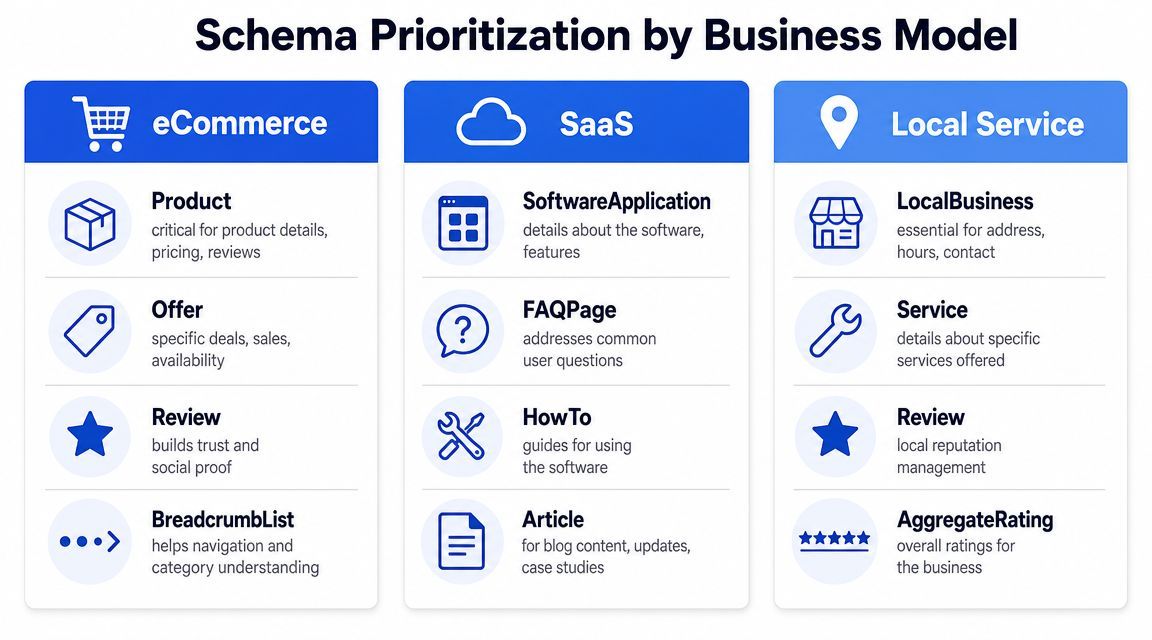
One useful industry observation is that most guidance still doesn't prioritize schema by business outcome. The more interesting trend is the shift from isolated tags toward connected entity graphs using @id linking to improve AI visibility and reduce hallucination risk, as discussed in WPRiders on schema types that get cited in AI search.
eCommerce priorities
For online stores, markup should support product discovery and buying intent.
The highest priority usually sits with:
- Product: defines what the item is
- Offer: clarifies availability and commercial details
- Review: adds evaluation context
- BreadcrumbList: helps machines understand category relationships
Often, teams overdo homepage markup and underdo product-page markup. Revenue usually sits on product and category URLs, not on the brand homepage. If you're refining those assets, this guide to product page optimization fits naturally alongside schema work.
SaaS priorities
SaaS companies need markup that supports evaluation, not just visibility.
Organization is still foundational, but the more useful additions often sit on pages that answer pre-sales questions. FAQPage can support pricing, onboarding, integration, and security concerns. HowTo can support use-case content and onboarding resources. Article can support category education and comparison content.
A practical SaaS lens is this:
| Page type | Useful schema direction |
|---|---|
| Homepage | Organization |
| Product or platform page | Software-related entity where relevant, plus WebPage |
| Feature or use-case page | FAQPage or HowTo if the format supports it |
| Blog or resources | Article with clear authorship |
Local business priorities
Local brands need schema that removes confusion about geography, services, and trust.
LocalBusiness should usually come first. Then layer in service-specific markup where the page describes a service, plus reviews where the implementation is valid and page-aligned.
The local SEO version of schema isn't about adding more types. It's about making address, service area, opening context, and business identity unambiguous.
This matters most for multi-location businesses and service-area businesses, where messy location signals create conflicting machine interpretations. In those cases, consistent IDs and location-specific entity markup usually matter more than adding decorative schema types.
Frequently Asked Questions About Schema and AI
What is the difference between Schema.org and JSON-LD
Schema.org is the vocabulary. It defines the entity types and properties available for markup.
JSON-LD is the implementation format. It is the method used to publish that vocabulary on the page, and it is the cleanest option because it keeps markup separate from the visible HTML.
That distinction matters in practice. Teams sometimes say they "added schema" when they really mean they installed JSON-LD, but the core question is whether the underlying entity model is accurate. Clean syntax does not help if the page is describing the wrong thing.
How do you measure ROI from schema markup
Measure schema the way you would measure any technical change tied to revenue. Start with the pages that matter commercially, record the publish date, then watch for changes in both visibility and conversion behavior.
Useful indicators include:
- Organic visibility on the URLs where markup changed
- Rich result eligibility where Google supports the schema type
- AI answer presence for prompts and queries tied to those pages
- Lead or revenue contribution such as purchases, demo requests, calls, or form submissions
Do not evaluate schema as an isolated win or loss. On its own, markup rarely creates demand. What it does is reduce ambiguity, improve machine readability, and strengthen eligibility for search features and AI retrieval patterns. For eCommerce pages, that can support product discovery. For SaaS, it often helps evaluation content get interpreted correctly. For local businesses, it can reduce identity and location confusion that suppresses visibility.
Results usually lag implementation. As noted earlier, changes often show up after reprocessing and re-indexing, not immediately after deployment.
Can you use multiple schema types on one page
Yes, if the entities are real and the relationships are clear.
A product page can validly include Product, Offer, Review, BreadcrumbList, and Organization. An article can include Article, Person, Organization, and FAQPage if the FAQ content appears on the page. A local service page might use LocalBusiness, Service, and BreadcrumbList together.
The trade-off is simple. More markup can improve clarity, but only when it reflects the page faithfully. Once teams start stacking schema types that do not match the content, the implementation turns into decoration. That is where effort gets wasted, and in some cases trust signals get weaker because the structured data no longer aligns with the visible page.
Does schema directly cause AI citations
Sometimes indirectly is the more honest answer.
Schema can help AI systems and search engines interpret entities, attributes, and page purpose with less guesswork. That improves the odds that your content is understood correctly. It does not guarantee a citation in AI answers, and anyone promising a direct one-to-one effect is overselling it.
The practical view is this: schema supports citation eligibility by making content easier to classify, connect, and trust. Citation selection still depends on the underlying page quality, topical relevance, authority signals, and how the answer system chooses sources for a given prompt.
Which schema should you prioritize first
Prioritize the markup tied to revenue pages and decision-stage content.
For eCommerce, start with Product, Offer, Review where valid, and BreadcrumbList.
For SaaS, start with Organization, product or software-related entity markup where relevant, then FAQPage or HowTo on pre-sales and onboarding content.
For Local, start with LocalBusiness, then service and location-specific markup that removes ambiguity about who you are, where you operate, and what you offer.
That order works better than chasing every supported schema type. The goal is better interpretation of high-value pages, not maximum markup volume.
If your business depends on qualified leads, product discovery, or branded trust in AI-driven search, schema deserves a strategic audit instead of another plugin install. SEOBRO® helps eCommerce, SaaS, and local brands connect technical SEO, structured data, content, and authority work around revenue, not vanity traffic.