If you're leading SEO in 2026, you're probably dealing with the same frustrating pattern as everyone else. Rankings still look decent in parts of the portfolio, but click volume is softer, branded search behavior is shifting, and executive teams want to know why “visibility” isn't translating as cleanly into pipeline as it used to.
That tension is real. Organic search hasn't died. But the mechanics of winning it have changed. An effective AI SEO strategy in 2026 isn't about publishing more blog posts or sprinkling schema on old pages. It's about building a search system that earns citations in AI-generated answers, proves trust at the entity level, and connects that visibility to revenue.
Many organizations are still treating AI visibility like an extension of content marketing. That's too shallow. The fundamental shift is operational. You need tighter technical control, clearer topic ownership, stronger proof signals, and a reporting model that doesn't collapse the moment users stop clicking blue links.
The New Reality of AI Search in 2026
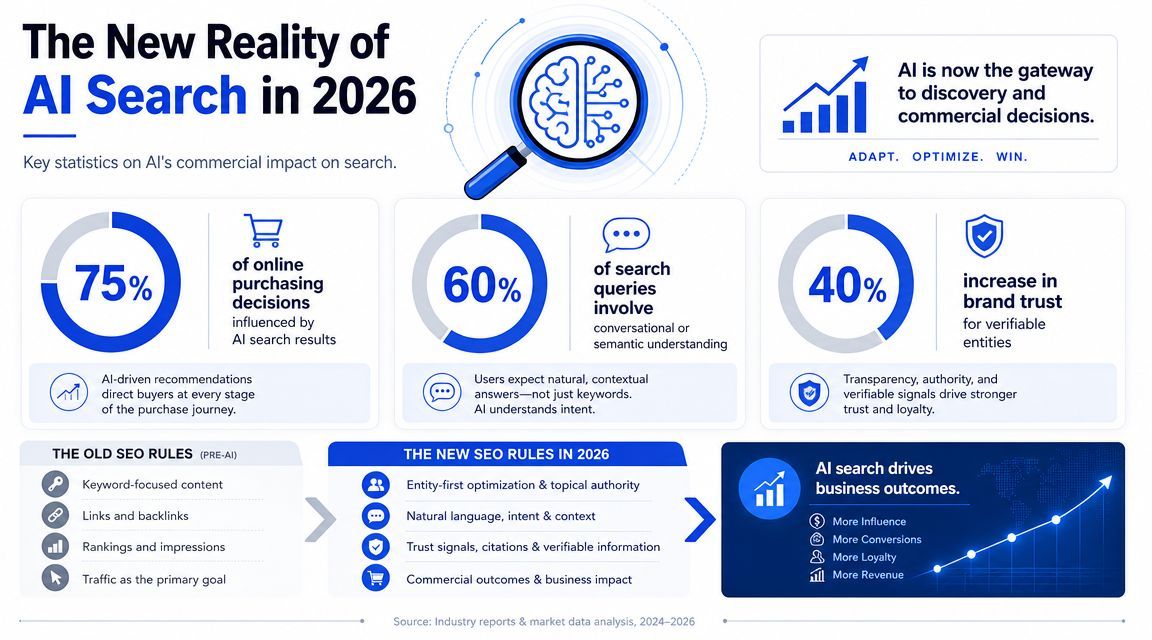
The economics of search have changed. If your strategy still assumes ranking equals traffic, you're planning against an outdated model.
Multiple industry summaries report that AI search traffic growth reached 527% year over year, AI Overviews appear in up to 47% of Google search results depending on query type and location, and roughly 60% of searches now yield no clicks. Evergreen Media also estimates AI Overviews reduce organic clicks on the top result by an average of 34.5%. That combination should reset how you think about search visibility, not just refine it slightly, according to AIOSEO's SEO statistics summary.
Clicks are no longer the whole game
The old SEO model rewarded page-level ranking improvements with a fairly predictable click upside. That relationship is weaker now. Users increasingly get enough of the answer directly inside AI-generated summaries, then either stop searching or move straight to branded evaluation.
That means your brand can lose even when your rank tracker says you're doing fine.
Practical rule: If your pages aren't being extracted, summarized, and cited cleanly, ranking improvements alone won't protect revenue.
This is why teams are investing in structures that help them dominate AI answers. Not because blue links disappeared, but because blue links no longer capture the full value chain.
AI adoption has already changed the operating model
This isn't experimental anymore. Independent industry summaries report that 61% of marketers see AI as a key part of their strategy, 86.07% of SEOs have added AI to their workflow, 65% of businesses say they've seen better SEO results with AI, and 68% of marketers report higher ROI after using AI in SEO, as compiled in Seoprofy's AI SEO statistics.
The operational takeaway is straightforward:
- Research is faster because teams use AI to support topic discovery and search demand analysis.
- Production is broader because AI is used for SEO content, text-based content creation, and automation workflows.
- Execution pressure is higher because competitors can publish, update, and test faster than teams relying on manual processes.
If you're in SaaS, eCommerce, or local lead generation, the risk isn't just losing traffic. It's losing answer-surface visibility at the exact moment buyers form shortlist opinions.
Building the Technical Foundation for AI
Your team ships new pages, rankings hold, and traffic looks stable. Then AI answers start citing competitors with weaker brands and thinner content. The problem usually sits in the stack, not the copy. If your pages are hard to crawl, hard to parse, or inconsistent in structure, AI systems will extract from someone else and your content investment will fail to convert into visibility.
Technical SEO now carries an operations burden. It does not just support discovery. It determines whether your content can be reused inside answer surfaces, whether attribution survives summarization, and whether AI visibility can be measured with any confidence. Google's documentation on crawlable links and rendering and JavaScript SEO basics makes the practical point clear. If key content depends on rendering paths or link patterns that crawlers handle poorly, retrieval reliability drops.
What your developers need to fix first
Start with revenue pages. Service pages, product categories, feature pages, comparison pages, and location pages should be technically clean before you expand output. Otherwise you scale waste.
Use this order:
- Indexation control: Revenue pages need correct canonicals, indexable status, and internal links that make discovery obvious.
- Render clarity: Key claims, definitions, pricing context, and differentiators should appear in accessible HTML, not only after heavy client-side rendering.
- Schema accuracy: Use schema that matches the page type and validate it. Broken or irrelevant markup creates ambiguity instead of helping extraction.
- Sitemap hygiene: XML sitemaps should reflect canonical, live, indexable URLs. Nothing else.
- Template consistency: Repeating core fields and page sections across templates improves extraction, comparison, and monitoring.
This is a revenue protection issue. If AI systems cannot reliably read your commercial pages, they will not quote them, summarize them, or send qualified users into your funnel.
The minimum viable AI-ready audit
Many technical audits still overvalue cosmetic issues and underweight extractability. Fix that. Audit pages based on whether an AI system can find the page, interpret the page, and reuse the page without losing the commercial context.
| Audit area | What to verify | Business reason |
|---|---|---|
| Crawl access | Important pages are reachable through standard HTML links and not blocked | Hidden pages lose discovery and citation opportunities |
| Indexation | Commercial pages are eligible for indexing and mapped to the right canonical URL | Retrieval starts with the right URL being available |
| Structured data | Markup is valid, relevant, and consistent with visible page content | Better attribution and cleaner machine interpretation |
| Internal linking | Supporting content points clearly to commercial destinations | Authority and context need direction to affect revenue pages |
| Content rendering | Key facts appear in the initial HTML or render reliably for crawlers | AI systems cannot cite details they fail to read consistently |
Treat this audit as a measurement setup, not just a cleanup project. If templates vary wildly, if canonicals conflict, or if product facts are exposed inconsistently, your team will struggle to explain why some pages get cited and others disappear. That reporting gap is one of the biggest operational failures in AI SEO right now.
For teams evaluating broader technical playbooks, this overview of future AI SEO strategies is a useful supplemental perspective. If you need a working definition of the broader discipline, what AI optimization means in practice is a useful framing for aligning technical work with visibility goals.
Shifting from Keywords to Verifiable Entities
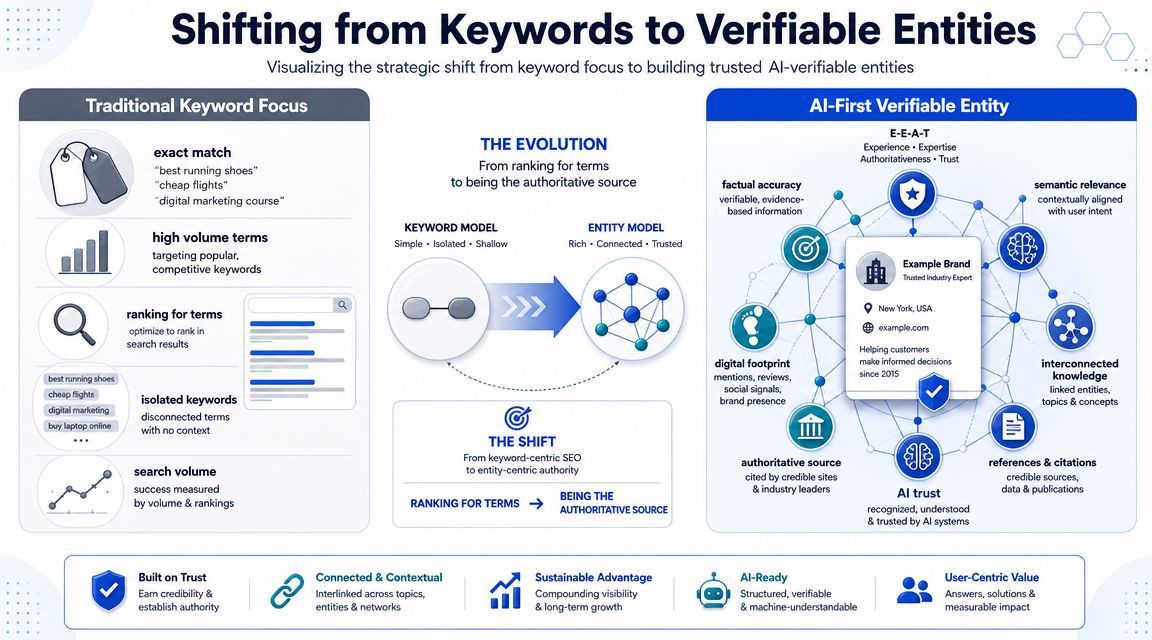
Keyword targeting still matters. But it's no longer the strongest layer of defensibility. AI systems don't just ask whether your page mentions the right phrase. They ask whether your brand, author, product, location, and claims look real, consistent, and trustworthy across the web.
That's the strategic jump many teams still haven't made.
Current coverage often underplays the trust signals that appear to matter most in AI-driven search: verifiable author credentials, consistent entity signals, first-party reviews, and transparent pricing or service details. Industry commentary also suggests AI assistants are building reputation graphs and relying on trust signals beyond classic keyword targeting. The practical implication is blunt: build proof, not just pages, with named experts, citations to authoritative sources, consistent NAP or entity data, and review velocity, as discussed in RankMax's analysis of AI SEO strategy.
Authority now needs proof
A generic “about” page won't solve this. Neither will stuffing author bios onto informational posts while your service pages stay vague.
Your entity footprint needs consistency across several surfaces:
- On-site expert signals: Real author pages, clear ownership, credentials, and topical relevance.
- Commercial transparency: Clear service descriptions, deliverables, locations served, and where relevant, pricing logic.
- Third-party reinforcement: Reviews, citations, mentions, and linked references that support the same identity claims.
- Local consistency: For local and multi-location brands, NAP consistency still matters because identity confusion undermines trust.
If an AI system can't confidently connect your website, your experts, your reviews, and your business identity, it won't treat you like the safest answer source.
What verifiable entity building looks like in practice
In this scenario, most SEO teams either build a moat or stay replaceable.
A B2B SaaS company should make product ownership, feature depth, implementation expertise, and named specialists visible across feature pages, docs, comparison assets, and expert bios. An eCommerce brand should tighten brand-story consistency, product expertise, review collection, return-policy clarity, and category authority. A local service company should align website claims, Google Business Profile details, service area language, and review themes.
Use this checklist to pressure-test your trust layer:
- Named people: Are there visible subject-matter experts attached to important topics?
- Consistent entity references: Does your business appear the same way across your site, profiles, and mentions?
- First-party evidence: Do you publish reviews, examples, service specifics, and real-world proof?
- Citations out: Do your pages reference authoritative standards, definitions, or relevant sources where appropriate?
- Commercial clarity: Can a buyer understand what you do, for whom, where, and at what level of engagement?
If you're still planning around “target keyword plus supporting article,” you're underbuilding. The stronger model is topic ownership plus identity verification.
Content Structures that Win AI Overview Citations
Formatting isn't the strategy. But formatting does determine whether your work is easy to extract and reuse.
For an effective AI SEO strategy in 2026, the most useful operational model is to build around entity clarity and intent clusters rather than isolated keywords. One core “money page” should anchor each service or topic, then supporting content should answer adjacent questions and connect back through strong internal links. Guidance collected by LocalMighty also recommends that each core page include concise definitions in the first lines, nearby follow-up questions, and schema such as FAQ, Breadcrumb, or Article markup so machine systems can extract and attribute the page more easily. The same guidance warns that fragmented content without clear entity or cluster structure weakens both comprehension and AI citation potential in LocalMighty's AI SEO checklist.
Build around money pages and intent clusters
Stop treating blog content as a separate SEO universe. In an AI-first environment, supporting content should strengthen the page that drives demos, purchases, or leads.
A practical cluster looks like this:
- Primary page: One commercial page for the main solution, category, or service.
- Supporting explainers: Articles that answer use cases, comparisons, objections, implementation questions, and buyer concerns.
- Internal link discipline: Supporting content should point back to the money page with context, not random navigation links.
- Definition-first structure: Put the short answer near the top. Don't bury it under a brand manifesto.
If you need a cleaner way to map this, search intent optimization is the right lens. Intent is what determines whether content supports revenue or just consumes budget.
Three page patterns that actually help
Different page types need different extractable structures.
For SaaS pages
Lead with a compact definition of the feature or solution. Follow with use-case questions, implementation details, integration context, and comparison blocks. AI systems can work with that because the hierarchy is explicit.
For eCommerce category pages
Don't leave the page as a product grid with a thin intro. Add a short category definition, buying considerations, compatibility notes, FAQs, and comparison elements where relevant. This creates reusable context above the listings.
For local service pages
Clarify the service, geography, service scope, trust signals, and inquiry path immediately. If pricing can't be fully public, explain pricing factors clearly. Ambiguity kills trust.
Good AI-citable pages answer the first question fast, then expand into the next likely questions without forcing the user to hunt.
A few page elements consistently improve extractability:
- Concise opening answer in the first lines.
- Question-led subheads that mirror adjacent search intent.
- Short factual blocks instead of long, abstract intros.
- Structured lists and tables where comparisons matter.
- Relevant schema that matches the actual page content.
For pages designed to capture summary-style visibility, the same principles that help optimize for featured snippets still matter. Clear answers, strong formatting, and explicit topical focus continue to pull weight.
Measuring What Matters in an AI-First World
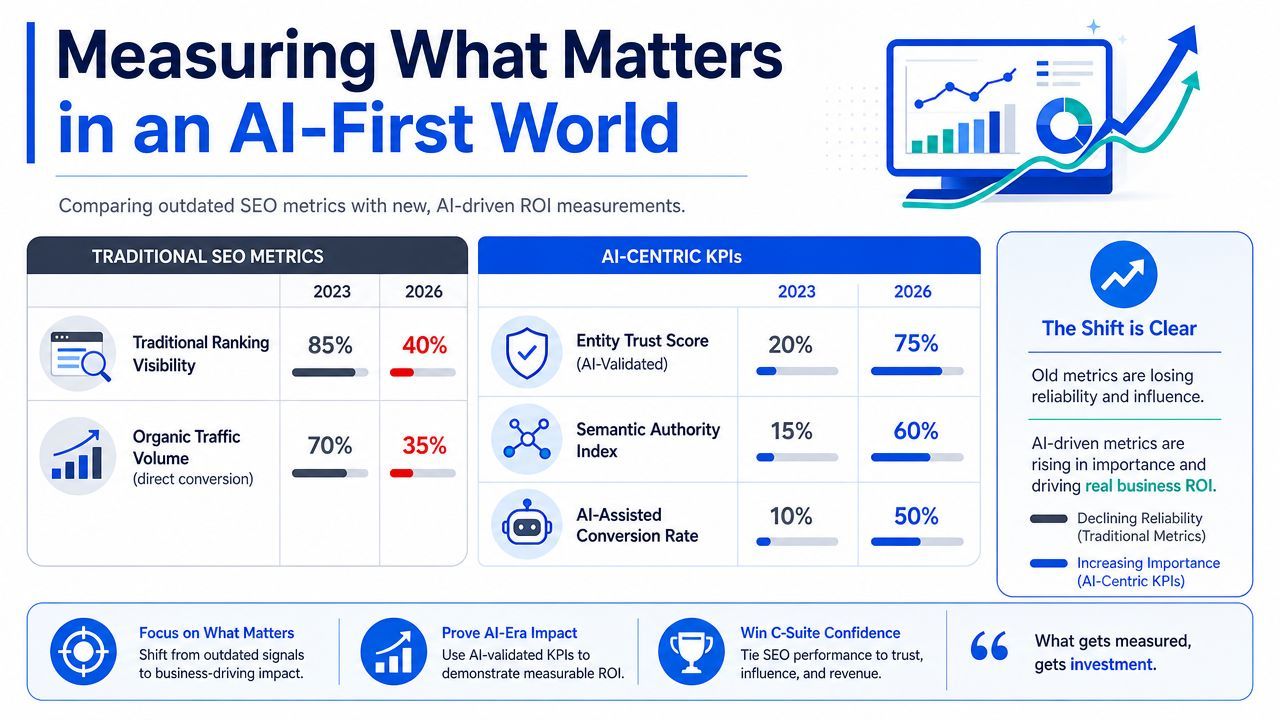
The standard SEO report is losing decision value. Rank movements and organic sessions still matter, but they no longer tell the full commercial story.
A major gap in current guidance is measurement. Most advice focuses on winning citations inside AI answers, but far less explains how to measure whether those citations create revenue. A stronger 2026 approach connects AI citations to downstream outcomes such as branded search lift, assisted conversions, demo-start rate, category-page revenue, and location-level lead volume, rather than treating AI visibility as a vanity metric, as argued in Evergreen Media's guide to SEO this year.
Old SEO reporting is losing decision value
Here's the problem. A buyer can see your brand in an AI summary, search your brand later, return via direct traffic, and convert through a branded query or sales-assist path. Traditional reporting often misses that influence or underweights it.
So when teams say, “AI visibility doesn't convert,” what they often mean is, “our attribution model isn't built to see it.”
Track visibility where discovery happens:
- AI citation presence: Are your core pages being referenced in answer surfaces?
- Prompt-level share: When you test commercial and informational prompts, which competitors appear most often?
- Brand mention growth: Are more users searching your brand after AI visibility improves?
- Assisted conversion influence: Are non-last-click paths picking up more value?
A better KPI stack for 2026
A CMO doesn't need more dashboard clutter. They need a KPI model that connects search visibility to qualified demand.
Use a reporting stack like this:
| KPI | What it tells you | Why leadership should care |
|---|---|---|
| AI citation share | Presence in answer engines and AI summaries | Measures visibility where clicks may not happen |
| Branded search lift | Increased brand recall after discovery | Strong signal of market awareness and buying intent |
| Assisted conversions | Influence across multi-touch journeys | Captures hidden contribution to pipeline and revenue |
| Demo-start rate | Conversion quality for SaaS and service pages | Ties SEO visibility to sales opportunity creation |
| Category-page revenue | Revenue impact for eCommerce collections | Keeps focus on commercial pages, not vanity traffic |
| Location-level lead volume | Lead flow by service area | Useful for local and multi-location operators |
Report AI visibility like a demand-generation input, not like an old-school ranking trophy.
If you want a practical operating model for this layer, AI search optimization services should be evaluated by how they connect citation gains to pipeline metrics, not by how many AI screenshots they can show you.
The 90-Day AI SEO Implementation Plan
A quarter from now, your CEO will not ask whether your team published more AI-friendly content. They will ask which pages gained qualified demand, which ones influenced pipeline, and what should get more budget. Build this plan around that standard.
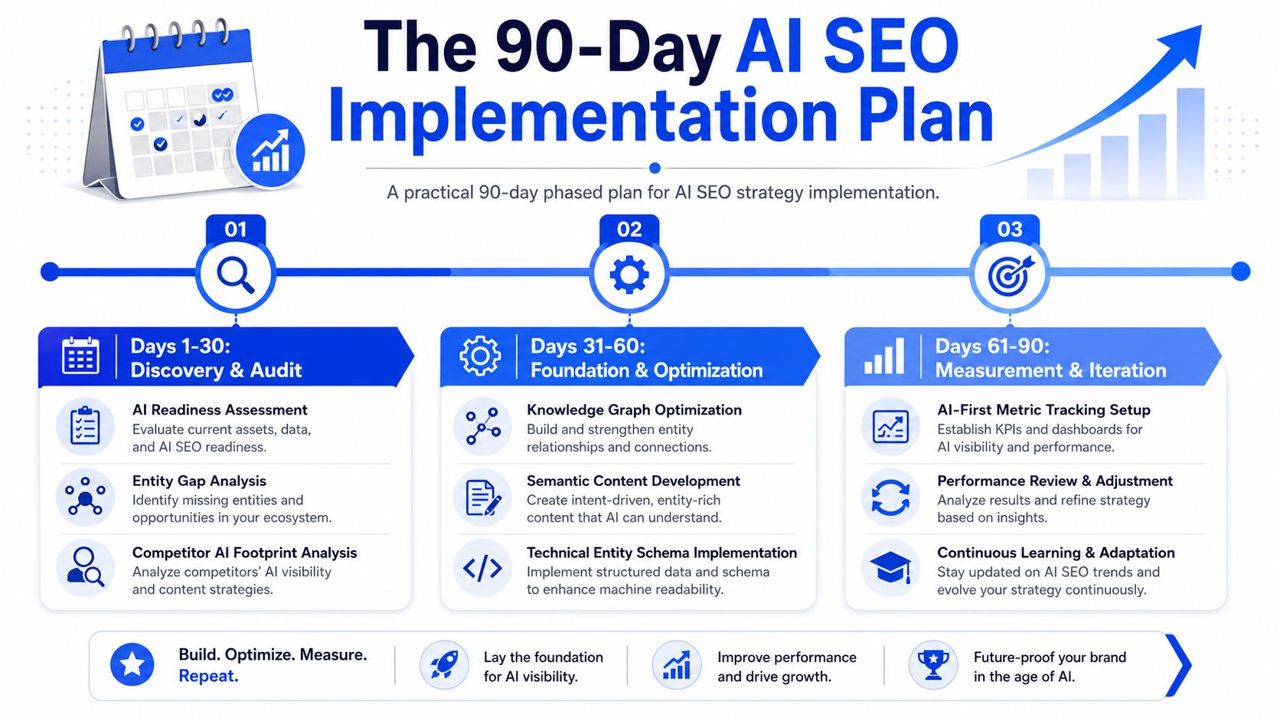
Use a 90-day cycle because it forces operational discipline. It gives marketing, SEO, content, analytics, and web teams a fixed window to ship changes, measure impact, and decide what earns another round of investment. As noted earlier, the goal is not broad AI visibility. The goal is revenue-linked visibility on pages that matter.
Days 1 to 30 audit and prioritization
Start with commercial exposure, not editorial ambition.
Map every high-intent URL first: service pages, category pages, feature pages, comparison pages, and bottom-funnel guides. Then score them against three questions. Can this page be cited easily by AI systems? Does it support a revenue event such as a lead, demo, or sale? Does the business have enough proof to deserve trust on the topic?
Focus the audit on:
- Page inventory: Separate revenue pages from supporting content so the team does not waste the quarter on low-value updates.
- Visibility mapping: Identify pages that already show strong snippet behavior, answer-style relevance, or brand mention potential in AI results.
- Entity gaps: Review author identity, expert attribution, business details, reviews, citations, and consistency across the web.
- Technical blockers: Fix indexation, rendering, sitemap, canonical, and schema problems on priority URLs before content work begins.
Month one should end with a ranked list of pages, owners, and expected business impact. If a page cannot influence revenue or support a clear customer journey, it does not belong in the first sprint.
Days 31 to 60 implementation and page upgrades
Use the second month to improve pages that already sit close to money.
That usually means rewriting openings so the core answer appears immediately, expanding pages with objection-handling question blocks, tightening internal paths from informational content into commercial pages, validating schema on templates that drive demand, and adding proof that reduces buyer hesitation. Strong pages make facts easy to extract and trust easy to confirm.
This is also where workflow quality starts to matter. Teams that manage AI SEO in docs and scattered tickets move too slowly. One operational option is the SEOBRO® platform, which supports website analysis and optimization as part of broader SEO execution. The true test isn't the interface. It's whether the workflow helps your team prioritize pages tied to revenue.
Assign one owner for page production, one for technical QA, and one for measurement. Without that structure, the sprint turns into content activity with no financial readout.
Days 61 to 90 measurement and iteration
The last month determines whether the program deserves scale.
Review performance at the page level, not in a blended SEO report. Check which upgraded URLs appear more reliably in prompt testing, which ones correlate with branded search lift or repeat visits, and which ones influence demos, leads, or category sales. Then compare that output against the effort required to produce it.
Use this review set:
- Prompt test results: Which pages now surface more consistently across AI interfaces for commercial and comparison queries?
- Brand response: Are branded searches, direct returns, or sales-assist conversations increasing after visibility improves?
- Commercial outcomes: Which updated pages influence pipeline creation, qualified leads, demo starts, or revenue?
- Content gaps: Which unanswered buyer questions still leave room for competitors to become the cited source?
The best 90-day plans make important pages easier to trust, extract, and convert from.
Then run the next cycle with tighter focus. Keep the winners in motion, cut low-yield work quickly, and treat AI SEO as an operating model for demand capture, not a publishing exercise.
AI SEO Strategy FAQ
| Question | Answer |
|---|---|
| Should we reduce investment in traditional SEO and move budget into AI SEO? | No. Treat AI SEO as an evolution of SEO, not a separate channel. Technical SEO, internal linking, authority building, and commercial page quality still do the heavy lifting. The shift is in how you structure content, strengthen entity signals, and measure influence. |
| What's the first page type to prioritize? | Start with pages closest to revenue. For SaaS, that's usually solution, feature, and comparison pages. For eCommerce, category and high-margin product-adjacent pages. For local businesses, core service and location pages. |
| Is AI-generated content enough to compete? | No. AI can speed up research, drafting, clustering, and updates. It doesn't replace subject-matter expertise, proof, or editorial judgment. If everyone can generate similar text, trust and clarity become the differentiators. |
| How do we know if AI visibility is helping when traffic doesn't rise? | Look for downstream signals. Branded search demand, assisted conversions, demo starts, category-page revenue, and lead volume often show impact before raw organic sessions do. That's why attribution needs to mature. |
| Do we need new content or better structure on existing pages? | Usually both, but structure comes first on commercially important pages. A weak page with stronger formatting, clearer answers, and better schema often creates more value than publishing another generic blog post. |
| How important are reviews and author credibility? | Very important. AI systems appear to rely on trust signals that help verify expertise and legitimacy. Named experts, consistent business identity, first-party reviews, and transparent commercial details all strengthen sourceworthiness. |
| What should a CMO ask an SEO consultant about AI visibility? | Ask how they identify pages with citation potential, how they improve extraction readiness, how they measure AI visibility beyond traffic, and how they connect work to qualified leads or revenue. If they only talk about rankings, the model is incomplete. |
| How often should key pages be updated? | Key pages should be reviewed on a recurring cadence. In practice, the pages that drive revenue need regular refreshes for clarity, trust signals, internal links, and missing question coverage. Stale pages lose relevance faster in AI-shaped search environments. |
If your team is rethinking search visibility for 2026, consider working with SEOBRO® as a strategic SEO partner. The right approach isn't more content for its own sake. It's a tighter system that aligns technical SEO, entity trust, content structure, and measurement around revenue, qualified leads, and durable organic growth.