Most advice around llms.txt SEO skips the only question that matters to a business owner or CMO. Is this worth doing now, or is it another low-impact task dressed up as innovation?
My view is simple. llms.txt is not where most websites should expect meaningful SEO upside today. It won't fix weak content, poor internal linking, thin category pages, indexing problems, weak authority, or messy site architecture. It also doesn't replace the technical controls you already rely on for crawl management and indexation.
That said, dismissing it entirely is also the wrong move. If implementation is cheap, your content is already well structured, and you want to make your site easier for future AI systems to interpret, an llms.txt file can be a sensible add-on. The mistake is treating it like a priority before the fundamentals are under control.
The Hype vs Reality of AI Search Optimization
There's a pattern in search marketing whenever a new standard appears. Teams assume early adoption equals strategic advantage, then rush implementation before they know whether the thing influences visibility at all.
That's the wrong lens for llms.txt.
The current business case is weak if you're looking for short-term KPI movement. Contentful states there is no widely validated evidence that llms.txt improves AEO visibility, citation frequency, or referral traffic, and it also notes that SE Ranking's analysis found only 10.13% of nearly 300,000 domains had adopted the file and saw no citation lift from having it (Contentful on llms.txt and search visibility).
That matters because many companies are approaching AI visibility as if every new file format deserves immediate rollout. In practice, most websites still get more value from better information architecture, clearer service and product pages, stronger internal links, and better entity consistency. If you're still cleaning up indexing bloat, duplicate category filters, poor canonical logic, or thin commercial pages, llms.txt isn't your bottleneck.
Why the hype keeps spreading
AI search is changing discovery behavior, so the pressure is real. Founders, ecommerce teams, and SaaS marketers don't want to be late.
The problem is that "AI-friendly" often gets confused with "business-effective." Those aren't the same thing.
A useful framing comes from this AI search visibility guide, which looks at the broader visibility picture rather than reducing everything to one file. That's the right approach. llms.txt may eventually become one signal inside a larger AI search workflow, but it isn't the workflow itself.
Practical rule: Treat llms.txt as a minor experiment, not a strategic pillar.
What deserves budget first
If resources are limited, prioritize the work that already supports both traditional SEO and AI retrieval:
- Fix crawl paths first: Important pages should be easy to reach through internal links and clean navigation.
- Strengthen primary commercial pages: Your feature, service, category, and solution pages need clear intent alignment.
- Clarify entities and topical relationships: AI systems still rely heavily on well-structured, interpretable content.
- Reduce technical ambiguity: HTTPS consistency, canonicals, status codes, and structured content still matter more.
The upside of llms.txt is that it can be low effort. The downside is opportunity cost if it distracts from work that drives leads and revenue.
What Is llms.txt and How Does It Differ from Robots.txt
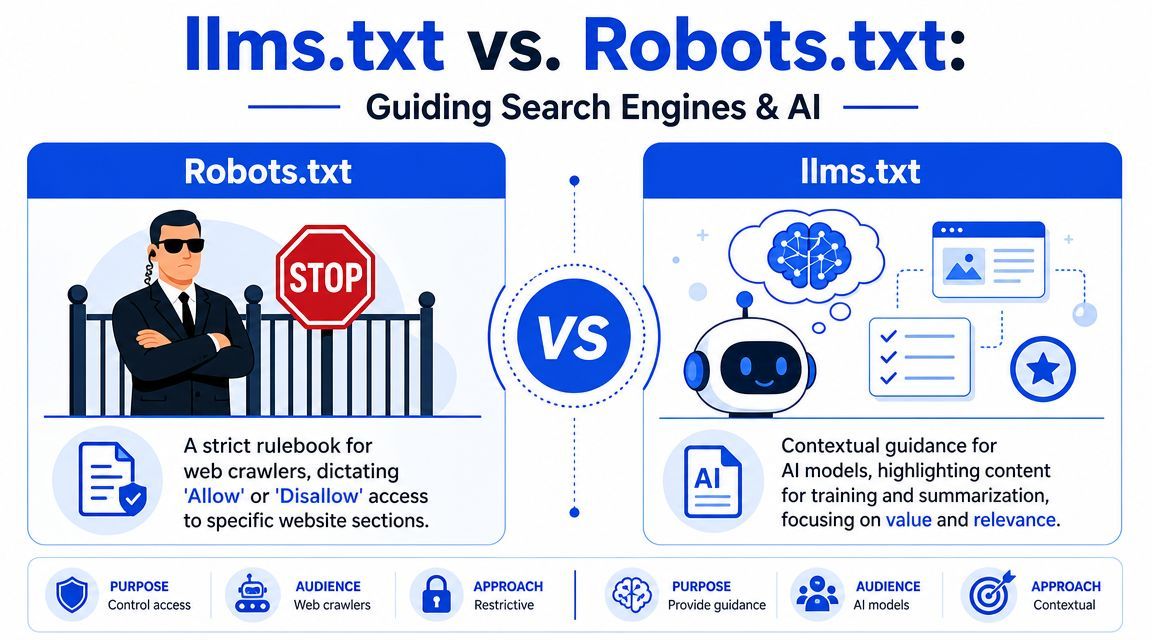
The cleanest way to understand llms.txt is this. robots.txt is a rule file. llms.txt is a recommendation file.
One controls crawler access. The other tries to highlight what an AI system should read first.
Robots.txt blocks and permits
With robots.txt, you're telling crawlers where they can or can't go. That's operational technical SEO. It affects crawl behavior and helps manage access to sections you don't want certain bots exploring.
If you're trying to preserve crawl efficiency, protect low-value faceted URLs, or keep staging-like sections out of bot pathways, robots.txt has a direct role. That's closer to gatekeeping.
llms.txt suggests and curates
llms.txt works differently. It's a Markdown-based, AI-oriented content map, not a crawl-control system. Industry analysis also notes that no major LLM provider currently supports it natively, and there is no evidence yet that it improves retrieval or traffic. Its present value is mostly in content structuring and future-proofing (Brainz on what llms.txt is).
So the better analogy is a concierge. It doesn't stop a visitor from walking elsewhere. It hands them a shortlist of pages that best represent the site.
That distinction matters because some teams are treating llms.txt like a new robots.txt for AI crawlers. It isn't.
| File | Main role | What it does today | Best use case |
|---|---|---|---|
| robots.txt | Access control for crawlers | Allows or disallows crawler paths | Crawl management, low-value URL containment |
| llms.txt | Curated guidance for AI systems | Highlights priority content in Markdown form | Future-facing content mapping |
Where people get confused
The common mistakes are predictable:
- Using llms.txt as a crawl budget tool: It doesn't replace proper crawl controls. If that's your goal, use assets like crawl budget optimization as part of your technical SEO process.
- Assuming it changes indexing: It doesn't function like a directive.
- Treating it as a complete sitemap replacement: It isn't a full-site inventory by default.
- Believing it can compensate for weak architecture: If your site is hard to understand, a recommendation file won't rescue it.
llms.txt can help you present a cleaner summary of your best content. It can't make poor technical SEO disappear.
There's also a sequencing issue. Before experimenting with AI-oriented files, make sure your foundational protocols are sound, including clean secure delivery. If your site still has avoidable protocol inconsistencies, address basics like HTTP vs HTTPS in SEO before spending time on fringe implementation layers.
The Real Impact of llms.txt on SEO in 2026
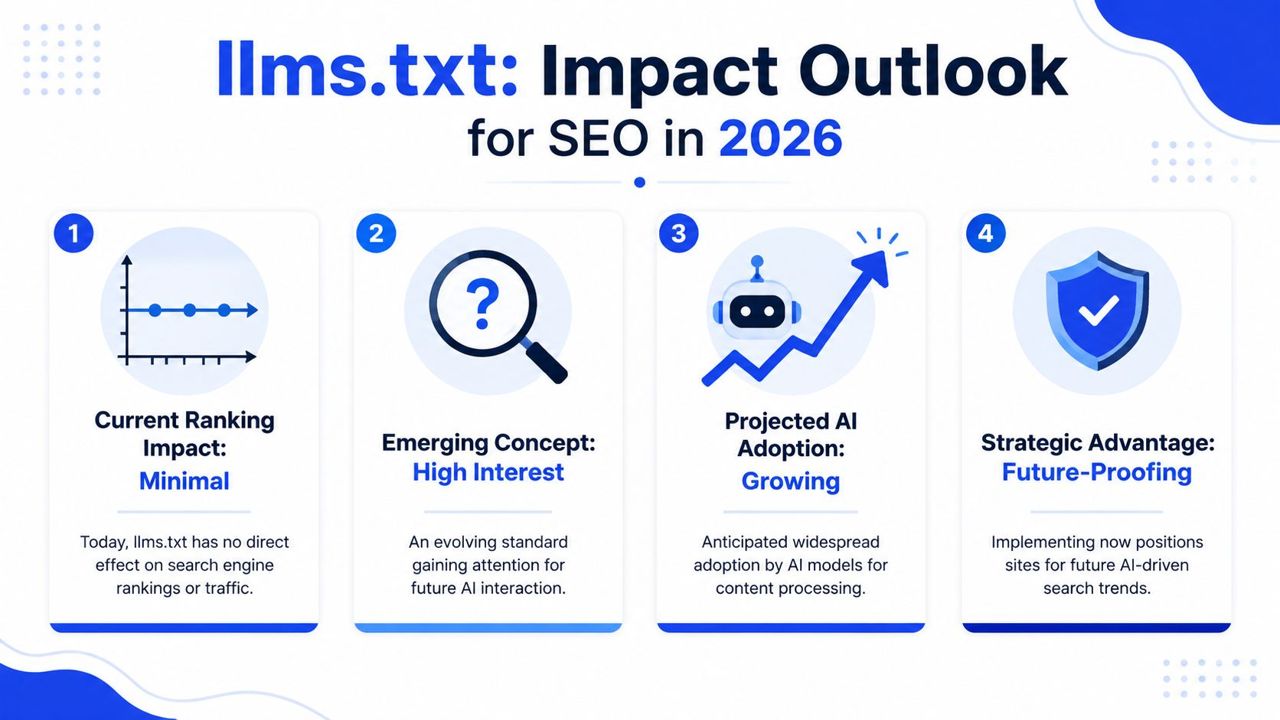
If you want a blunt answer, here it is. llms.txt is not a meaningful SEO lever today.
That doesn't mean it's useless. It means expectations need to match observed behavior rather than industry excitement.
Adoption is still early
A major usage study found that only 10.13% of nearly 300,000 domains had an llms.txt file, which means adoption was still close to 1 in 10 websites rather than a mainstream standard. The same analysis positioned llms.txt far behind mature SEO files like robots.txt and sitemaps, which makes it better understood as an emerging practice rather than standard operating procedure (SE Ranking analysis of llms.txt adoption).
For a strategist, that's useful context. Low adoption can mean early opportunity, but it can also mean a standard hasn't earned operational relevance yet.
Bot behavior is even less encouraging
The stronger signal comes from crawl behavior. OtterlyAI's independent experiment measured 62,100+ AI bot visits over 90 days and found only 84 requests to /llms.txt, or about 0.1% of all AI bot traffic. Their conclusion was straightforward. Mainstream AI crawlers were still discovering content through normal pages and site architecture rather than through the dedicated file (OtterlyAI experiment on llms.txt bot access).
That is the part many articles avoid. The issue isn't just that few sites use llms.txt. It's that bots barely appear to care.
If AI crawlers rarely request the file, you shouldn't expect traffic gains from publishing it alone.
What this means for ROI
The ROI case is narrow but still real in some situations.
Worth doing when:
- Your site already has strong technical foundations: You're not delaying more valuable work.
- You publish curated knowledge assets: Docs, help centers, feature explainers, buying guides, and glossary content benefit most from explicit organization.
- Implementation is almost free: A plugin or simple static file makes the cost negligible.
- You want optional future-proofing: You're making a small bet, not a major investment.
Not worth prioritizing when:
- You have unresolved core SEO issues: Broken internal linking, weak templates, duplicate pages, and index waste come first.
- You expect measurable visibility lift now: Current evidence doesn't support that expectation.
- Your team wants attribution clarity: Measurement is still murky. You won't isolate impact cleanly.
For teams that prioritize attribution, this is also a reminder to improve your measurement environment before chasing experimental inputs. If you're tightening analytics quality and server-side collection, this overview of secure first-party data tracking is a useful complement to broader search visibility work.
The practical interpretation
llms.txt sits in the same bucket as other low-cost future-facing assets. It's reasonable after the fundamentals are in place. It is not a substitute for them.
If someone tells you llms.txt should move to the top of the roadmap, ask a simple question. What proven visibility problem does it solve on your site right now?
Most of the time, there isn't a strong answer.
How to Implement llms.txt Practical Examples
Implementation is simple. The harder part is deciding what deserves inclusion.
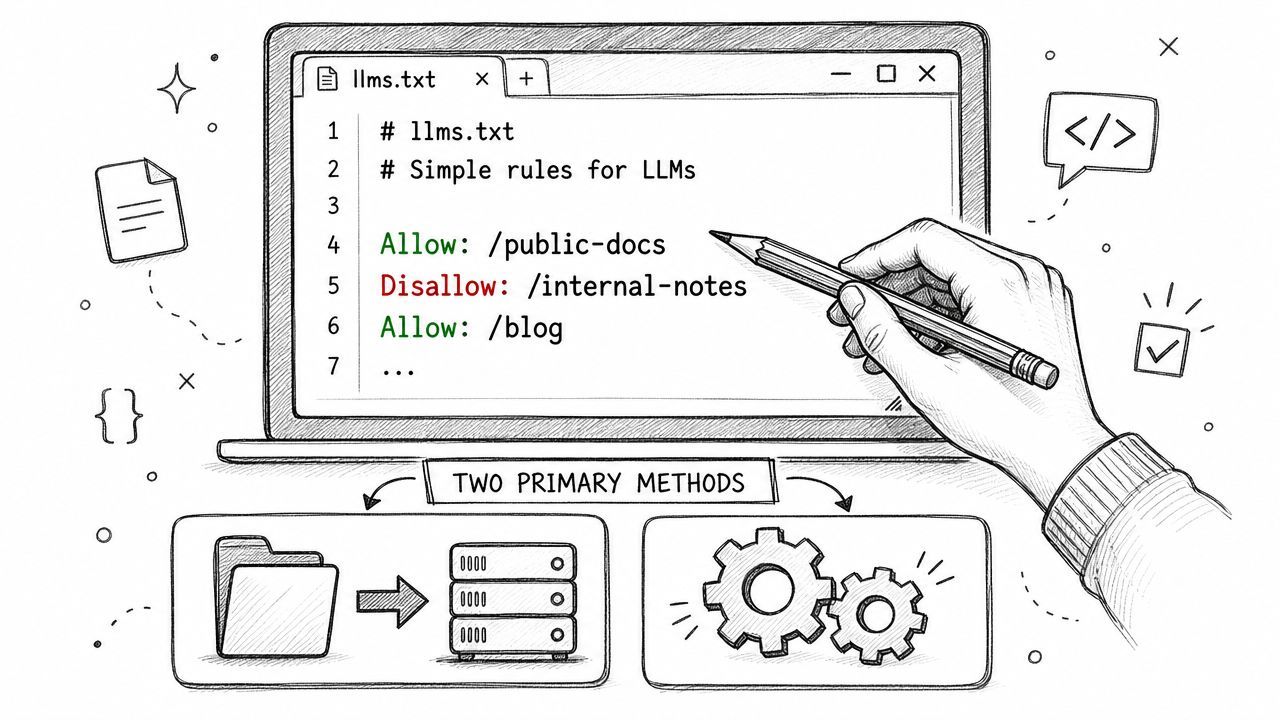
A useful rule is to think in terms of curation, not completeness. You are not trying to export your whole website. You are trying to highlight the pages that best explain your business, products, services, and expertise.
Manual setup for lean websites
For a small site, a manual file is enough.
Create a plain text file named llms.txt, place it at the root of the site, and format it in simple Markdown. Keep it readable. Group related URLs into logical sections. Favor canonical commercial and informational pages, not tag clutter or archive pages.
A lightweight structure usually includes:
- A clear title: Identify the site or content set.
- Section groupings: Products, services, documentation, guides, policies, or support.
- Priority URLs: Link only to pages you'd want cited or summarized first.
- Short descriptions: Help explain what each page covers and why it matters.
If you want a fast way to draft the structure before editing it manually, this Tool for AI visibility content can help generate a starting point. I wouldn't publish raw output without review, but it's useful for speeding up the first pass.
Using Yoast for low-maintenance implementation
WordPress users often want the easiest operational route. Yoast SEO already offers one.
According to Yoast's functional specification, its llms.txt feature creates the file at the website root, updates it on a weekly scheduled action, and populates it with the 5 most recently updated posts, pages, or custom post types published in the last 12 months, with cornerstone content prioritized first. It also includes the 5 taxonomies with the most attached content, which makes the file intentionally curation-driven rather than a full-site inventory (Yoast llms.txt functional specification).
That design choice is important. Yoast isn't trying to list everything. It's surfacing a selective subset of content.
Implementation note: Automated generation is useful, but don't assume automated curation matches business priorities. Review what the file includes.
Here is a walkthrough video if you want to see the concept in action before deciding whether to handle it manually or through a CMS workflow.
A simple starter template
You don't need a complicated schema. A plain, readable file is enough for an initial version.
# Example Company

## Core pages
- Home Main overview of the business
- Services Summary of core service offerings
- Pricing Commercial details and plan comparisons

## Expertise
- Case Studies Examples of outcomes and use cases
- Guides Educational resources and implementation advice

## Support
- Documentation Product or service documentation
- Contact Primary contact and sales route
A few practical rules improve quality fast:
- Lead with commercial intent: Include the pages that explain what you sell.
- Support with depth: Add the strongest guides, documentation, or explanatory pages.
- Leave out weak URLs: Don't include outdated articles, low-value taxonomy pages, or thin content.
- Review after site changes: When navigation, key pages, or content priorities shift, update the file.
If your team is already investing in broader AI discoverability, pair this with a more complete AI optimization overview so llms.txt stays in the right strategic context.
Strategic Recommendations for Your Business Model
The best llms.txt file is a shortlist, not a dump. It should reflect how your business creates value and how a machine should understand that value quickly.
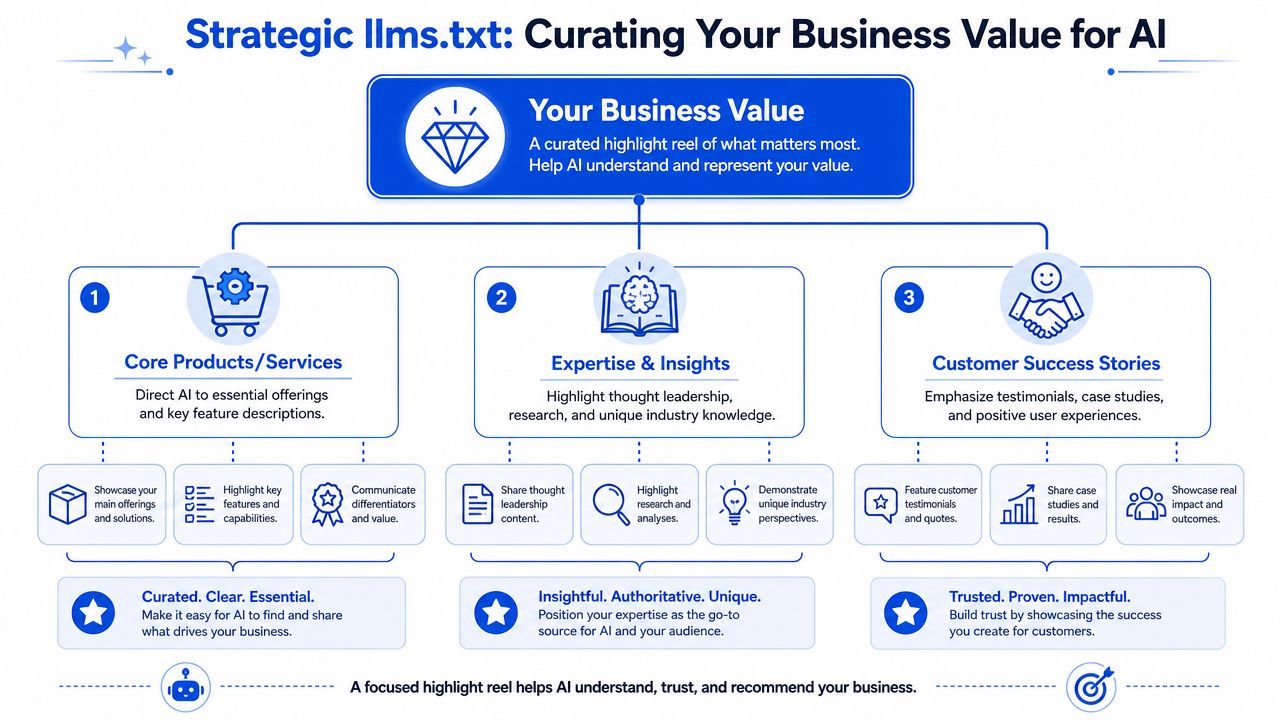
The right mix changes by business model. A SaaS company shouldn't curate the same way as a local service brand. An ecommerce store shouldn't structure the file like a documentation portal.
SaaS sites
SaaS companies often have a clarity problem. Features are fragmented across product pages, docs, blog posts, comparison pages, and help content.
Your llms.txt should help consolidate the story.
Include pages such as:
- Core product pages: The feature and solution pages that explain what the platform does.
- Pricing and plan pages: Commercial context matters for AI-generated comparisons and summaries.
- Integration or API documentation: Especially useful when buyers ask tools whether your product works with another system.
- Use-case pages: Good for intent like "best software for" or "how to solve" questions.
Skip content that confuses the product narrative. Thin release notes, outdated webinar pages, and low-value tag archives don't belong.
Ecommerce stores
Ecommerce sites need curation discipline because large catalogs create noise fast.
Don't try to include product inventory at scale. Focus on the assets most likely to help an AI system understand the brand, category relevance, and purchasing intent.
A useful ecommerce mix often looks like this:
| Priority area | What to include | Why it matters |
|---|---|---|
| Category pages | Core commercial categories | These explain product groupings and buying intent |
| Flagship products | Best-known or strategically important products | Useful when users ask for recommendations |
| Buying guides | Educational content tied to product decisions | Adds context that supports better summaries |
| Policy and trust pages | Shipping, returns, warranty, support | Helps establish practical buyer confidence |
If your store still struggles with crawl dilution, faceted clutter, or weak category architecture, address those first. llms.txt won't solve structural ecommerce SEO issues.
Local and service businesses
Local businesses should keep the file compact and credibility-focused.
A good local setup usually highlights:
- Primary service pages: The pages that describe your highest-value offerings.
- Main location pages: Especially if you serve distinct cities or regions.
- About or expertise pages: Useful when authority and trust influence lead quality.
- Proof content: Testimonials, reviews, or detailed case examples, if they exist as public pages.
Local buyers often ask AI systems practical questions before they click. This behavior influences their choices: they want to know who serves their area, what the company does, and whether the business looks credible.
For local brands, llms.txt should reinforce trust and service clarity, not act like a mini sitemap.
A quick decision framework
If you're deciding whether llms.txt belongs on this quarter's roadmap, use this filter:
- Strong foundation already in place: Yes, proceed.
- Easy implementation path through CMS or static file: Yes, proceed.
- No clear owner for content curation: Wait.
- Core SEO debt still unresolved: Wait.
- Expectation of immediate traffic lift: Don't proceed for that reason.
For companies taking AI visibility seriously, llms.txt makes more sense as one small layer inside a broader AI search optimization services strategy. It is not the strategy by itself.
Conclusion Is llms.txt a Priority for Your SEO Strategy
For most businesses, llms.txt is not a priority SEO task.
It doesn't replace crawl controls. It doesn't fix rankings. It doesn't solve authority gaps. It doesn't create measurable performance gains based on the evidence available today. If your site has unresolved technical issues, weak commercial pages, poor internal linking, or content that doesn't match search intent, those should stay at the top of the roadmap.
Still, llms.txt can be worth doing.
Why? Because it's low risk, cheap to implement, and potentially useful as a future-facing content signal. If your technical foundations are already strong, adding a curated AI-oriented content file is a reasonable polish step. That's especially true for SaaS companies with docs, ecommerce brands with strong category and guide content, and service businesses with clear high-value landing pages.
The correct business position is balanced. Don't ignore it because it's new. Don't overvalue it because it's associated with AI.
Treat llms.txt like a small optional enhancement after you've handled the work that drives qualified traffic, leads, demos, and revenue. If you're unsure where that line sits for your site, a strategic audit is usually more valuable than another isolated implementation task.
Frequently Asked Questions About llms.txt and SEO
Does llms.txt improve rankings
There's no evidence yet that llms.txt directly improves rankings, retrieval, or traffic. Right now, it should be treated as an experimental guidance file rather than a proven SEO lever.
Is llms.txt the same as robots.txt
No. robots.txt controls crawler access. llms.txt is a Markdown-based recommendation file that highlights content you want AI systems to read first.
Should every website create an llms.txt file
Not necessarily. If your site still has major SEO problems, fix those first. If implementation is easy and your foundations are strong, creating one can make sense as low-cost future-proofing.
What pages should go in llms.txt
Use a curated subset of your best content:
- Commercial pages: Services, product categories, solutions, or pricing
- High-signal informational assets: Guides, docs, help content, or buying resources
- Credibility pages: About, case studies, or trust-building resources where relevant
Don't dump every URL into the file. That defeats the point.
Is there any risk in adding llms.txt
The main risk isn't technical. It's strategic distraction. Teams sometimes spend time on experimental add-ons while ignoring architecture, indexing, content quality, and authority building.
How should I measure whether it helps
At the moment, measurement is indirect. You can monitor bot logs, AI referral patterns, citation trends, and visibility changes across AI surfaces, but you probably won't be able to isolate llms.txt as the clear causal factor. That's one reason not to oversell its value internally.
Is manual setup enough or should I automate it
Manual setup works for smaller sites and stable content sets. Automation works better when content changes frequently, especially on WordPress or large publishing environments. The key is review. An automatically generated file still needs editorial judgment.
Does llms.txt matter for AI search visibility at all
It may matter later more than it matters now. Today, its practical value is in cleaner content curation and possible future readiness. That's useful, but it should sit behind the fundamentals of technical SEO, content quality, and site structure.
If you want a revenue-focused view of what deserves priority on your site, SEOBRO® helps ecommerce, SaaS, and local businesses build SEO strategies around qualified traffic, technical clarity, and long-term growth, not vanity tasks. A strategic audit can show whether llms.txt belongs on your roadmap now or later.