An AI SEO strategy is a plan for earning visibility and citations in AI-generated answers (Google’s AI Overviews and AI Mode, ChatGPT, Perplexity) for the queries your buyers ask before they spend money. It sits on top of classic SEO, but it changes what you optimize (passages and sources, not just rankings), where you build authority (the third-party pages AI already cites), and what you measure (share of answer, not position). This guide lays out the whole plan in five steps, then sequences them into a 90-day rollout.
What an AI SEO strategy actually is
One disambiguation first, because the phrase means two different things and half the guides ranking for it answer the other one. “AI SEO” often describes using AI tools to speed up SEO work: drafting briefs, clustering keywords, generating meta descriptions. That is workflow automation. Sometimes useful, but it is not a strategy, and it does nothing about the real shift: your prospect may never see a results page again.
This article covers the second meaning: how a business stays visible when a language model writes the answer. That is the strategic problem, and it is the one most guides skip.
The foundation is already documented, which surprises people. Google’s AI features documentation states there are no additional requirements and no special optimizations needed to appear in AI Overviews or AI Mode: pages only need to be indexed and eligible for snippets, the standard Search bar. So the strategy is not secret markup or a fresh bag of hacks. It is the four things nobody hands you: knowing which queries to win, making your pages the raw material answers are built from, showing up in the sources AI trusts, and measuring any of it.
Those four problems map onto five steps:
- Build a commercial query set.
- Engineer your pages into citable sources.
- Wire up off-site trust.
- Open technical access for the right bots.
- Track share of answer on a fixed cadence.
Step 1: Build your commercial query set
Classic SEO starts with a keyword universe: thousands of terms sorted by volume. An AI SEO strategy starts smaller and sharper. Define the finite set of questions and prompts your actual buyers put to an AI before they spend money. This is our FLG (Focused Lead Generation) method applied to AI answers: fewer queries, higher intent, each one traceable to revenue.
Where the set comes from:
- Sales calls. The objections and comparisons prospects raise on a call are the prompts they typed the night before.
- Search Console. Your existing commercial queries, especially the long conversational ones that already read like prompts.
- Support and onboarding questions. These become the “can X handle Y” prompts AI fields daily.
- Competitor comparisons. “X vs Y”, “X alternatives”, “best [category] for [niche]”.
One mechanical detail changes how you build the set. Google’s AI features use what its documentation calls a query fan-out technique: the system issues multiple related searches across subtopics and assembles the answer from all of them, surfacing a wider and more diverse set of links than a single traditional query would. A prompt like “best CRM for solar installers” quietly spawns sub-queries about pricing, integrations, reviews, and alternatives. Your query set has to include those sub-questions, not just the head prompt, because any one of them can be the retrieval that puts you in the answer.
For most businesses, 30–100 queries is enough. The number matters: small enough to track by hand, large enough to cover a funnel. This set then does double duty: it is your content roadmap for step 2 and your tracking panel for step 5.
Step 2: Source engineering, becoming the page the answer is built from
AI answers are assembled from passages, not pages. A model retrieves a set of documents, pulls the fragments that address the sub-queries, and composes. Your job is to make your pages the fragments that survive that process:
- Answer first, context second. Open every section with the direct answer in two or three self-contained sentences. If a paragraph only makes sense with the three paragraphs above it, it gets skipped.
- One claim per passage. State the claim, the number, and the source in the same place, so the passage can be lifted whole without losing meaning.
- Attributed statistics and definitions. Models visibly prefer content that looks like evidence over content that looks like copywriting.
- Original data. A benchmark, a survey, a documented test: anything only you can be cited for.
- Clear entity signals. Who you are, where you operate, who you serve. Engines recommend brands they can identify without guessing.
A word on schema, because vendors oversell it. Google explicitly says you don’t need machine-readable files, “AI text files,” or any special structured data to appear in AI features. The snippet controls you already know (nosnippet, data-nosnippet, max-snippet, noindex) are what govern how your content shows up in AI Overviews and AI Mode. Schema still earns rich results and helps machines disambiguate entities, so keep using it for that. It is not an AI-visibility key.
This passage-level discipline has its own name and its own playbook: see our guide to what generative engine optimization is for the full mechanics, and how to rank in AI Overviews for the Google-specific tactics.
Step 3: Trust wiring, the off-site signals AI answers lean on
Ask ChatGPT for the best option in your category and look at what it cites: listicles, review platforms, Reddit threads, industry publications. For commercial queries, AI answers are assembled largely from third-party sources, not vendor sites. If your brand is absent from the pages the model retrieves, you are not in the answer, no matter how well-engineered your own site is.
So step 3 is deliberate placement. Run your query set through the engines, log which external pages get cited repeatedly, and get your brand named on them. In practice that means digital PR, contributing data or expert commentary to the publications that rank for your comparisons, earning spots in the recurring listicles, keeping review-platform profiles current, and participating honestly in the Reddit threads that keep resurfacing.
The channel justifies the effort now, not eventually. Semrush’s analysis of over 1 billion lines of US clickstream data found ChatGPT’s outbound referral traffic to websites grew 206% in 2025, with web search enabled on 34.5% of ChatGPT queries as of February 2026, down from 46% in late 2024. Assistants are fetching and citing live sources at scale, and sending real visitors to the sources they name.
There is a quiet efficiency here: the same placements that feed AI answers are links and mentions that move classic rankings. Trust wiring is not a new budget line. It is your existing authority work, re-aimed at the pages AI already reads.
Step 4: Technical access, letting the right bots read you
Crawler control is the layer most guides get wrong, usually by conflating training bots with search bots. Blocking the wrong user agent either does nothing or silently removes you from an answer engine. Here is the matrix that matters:
| Bot | What it actually controls | If you block it |
|---|---|---|
| Googlebot | Google Search, AI Overviews, AI Mode | You disappear from all of them |
| Google-Extended | Gemini training and grounding | Search and AI Overviews are unaffected |
| GPTBot | OpenAI model training | ChatGPT search visibility is unaffected |
| OAI-SearchBot | ChatGPT search index | You are not shown in ChatGPT search answers |
| PerplexityBot | Perplexity search results | You disappear from Perplexity answers |
| Perplexity-User | User-requested page fetches | Little effect: it largely ignores robots.txt |
The details, from the operators themselves. Google documents that Google-Extended only controls whether content trains and grounds future Gemini models: it “does not impact a site’s inclusion in Google Search nor is it used as a ranking signal,” so blocking it does not pull you out of AI Overviews. OpenAI documents the same split: sites opted out of OAI-SearchBot “will not be shown in ChatGPT search answers,” while GPTBot separately governs training. You can refuse to feed the model and still be visible in its search. Perplexity runs two agents: PerplexityBot indexes for search results and respects robots.txt, while Perplexity-User fetches pages on direct user request and generally ignores robots.txt rules.
One more access issue hides in your stack: most AI crawlers fetch raw HTML and do not execute JavaScript, so client-rendered content is invisible to them. We walk through the published evidence, including Vercel’s crawler testing, in our review of whether AI crawlers execute JavaScript. If your key pages render client-side, the fix is server-side rendering or prerendering: standard technical SEO work, and the highest-impact item in this entire step.
Step 5: Share-of-answer tracking, measuring a channel with no rank tracker
There is no rank tracker for a paragraph. That is why every competitor guide stops at tactics: the measurement layer has to be built, not bought. The metric to build it around is share of answer: of the AI responses to your query set, what percentage mention or cite you versus your competitors.
The method is unglamorous and it works:
- Run the panel on a fixed cadence. Monthly for most niches, biweekly where answers shift fast. Same queries, every time, across ChatGPT, Perplexity, and Google’s AI Overviews and AI Mode.
- Log four things per response. Are you mentioned? Are you cited with a link? How are you framed (recommended, listed, or caveated)? And where in the answer: first named or a footnote?
- Segment AI referrals in analytics. Traffic from chatgpt.com and perplexity.ai referrers is your ground truth that citations turn into visits. Watch the conversion rate on those sessions, not just the count.
- Track competitor share too. Share of answer is relative. Losing 10 points to a rival in one quarter is the signal a rank tracker would have given you in the old world.
If this feels like overhead, look at what happened to the metric you currently rely on. An Ahrefs study of 300,000 keywords found the presence of an AI Overview correlated with a 58% lower average click-through rate for the top-ranking page on December 2025 data, up from the 34.5% the same study measured in its April 2025 run. You can hold position 1 and still lose the click to an answer that never names you. Rankings alone no longer describe your visibility, and citation tracking is not optional.
The 90-day rollout
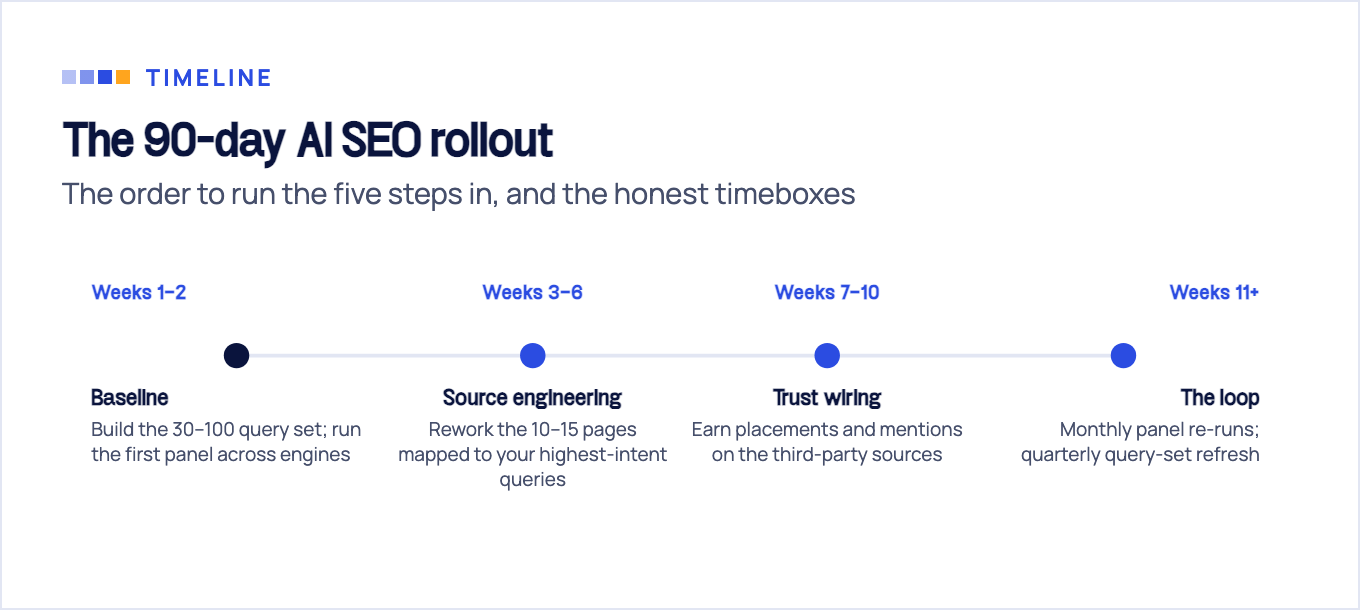
Strategy without sequencing is a wish list. Here is the order we run the five steps in, and the honest timeboxes:
| Phase | Weeks | The work |
|---|---|---|
| Baseline | 1–2 | Build the 30–100 query set; run the first panel across engines; record share of answer per query; audit robots.txt and rendering |
| Source engineering | 3–6 | Rework the 10–15 pages mapped to your highest-intent queries: answer-first passages, attributed claims, entity clarity |
| Trust wiring | 7–10 | Earn placements and mentions on the third-party sources your baseline showed AI already citing |
| The loop | 11+ | Monthly panel re-runs; quarterly query-set refresh; expand to the next ring of queries |
Set expectations correctly with your team. AI answer composition shifts faster than rankings ever did, so wins and losses both show up in weeks, not months. That cuts both ways: a single panel run is noisy, so judge the trend across three runs before declaring victory or crisis. And expect variance between engines. It is normal to grow share in Perplexity while AI Overviews lag, because the indexes and retrieval differ.
This sequence is exactly what our generative engine optimization service runs for clients, so if you want the reference implementation, that is where it lives.
Where this fits your existing SEO
Do not fork your program. The tempting move is a separate “AI SEO” budget, team, or agency running parallel to classic SEO, which builds two half-programs that share one substrate. Everything above rides on indexed, crawlable, snippet-eligible pages that already rank; Google’s own eligibility bar says as much. The correct structure is your existing SEO program extended with two additions: the commercial query set and the share-of-answer loop.
The strategic frame carries over from FLG unchanged. AI answers compress the funnel: by the time a prospect clicks through, the model has already summarized the category, compared the options, and named names. The visitors that arrive are fewer and warmer. So measure the channel the way it deserves, on leads and pipeline from AI-referred sessions rather than raw traffic, and accept the trade every lead-driven business should want: fewer clicks that convert harder, provided you are the brand the answer cites.
If you would rather hand the whole loop to a team that already runs it, our AI SEO service covers the full sequence (query set, source engineering, trust wiring, and share-of-answer reporting), built by the same team that has put 200,000+ keywords in the top 3 for 100+ clients across the USA, UK, and EU. Either way, start with weeks 1–2 this month. A baseline costs you a spreadsheet and an afternoon, and every later decision gets easier once you know your current share of the answers.
Sources & fact-check
Every factual claim in this article is checked against primary sources, not opinion. Written by Roman Sydorenko, Chief SEO & AI search. Last verified July 16, 2026.
- OfficialGoogle Search Central, AI features and your website (no special markup or AI text files needed to appear)
- OfficialGoogle Search Central, Google's common crawlers (Google-Extended controls Gemini training, not Search ranking)
- OfficialOpenAI, Crawler documentation (OAI-SearchBot governs ChatGPT search answers, GPTBot governs training use)
- OfficialPerplexity, Crawler documentation (PerplexityBot surfaces and links sites in search, not model training)
- Primary dataSemrush, ChatGPT traffic analysis from clickstream data (206% referral growth, 34.5% search-enabled share)
- Primary dataAhrefs, Update: AI Overviews Reduce Clicks by 58% (300,000-keyword Search Console study of AI Overview CTR)
