Ask Google how to rank in AI Overviews and it will tell you nothing special is required. Ask the citation data and you get a far more specific answer: 76% of AI Overview citations already rank in the organic top 10 for the query, per Ahrefs. Both statements are true, and the gap between them is where the tactics live. The short version: rank organically, structure passage-level answers an AI can lift whole, and build the brand signals that decide which of two equally good answers gets named.
What it takes to rank in AI Overviews (short answer)
First, the definition, since half the advice out there skips it. AI Overviews are the AI-generated summaries Google shows at the top of search results, composed from web sources and linked to them as citations. “Ranking” in an AI Overview means being one of those linked citations. There is no position 1 to hold, just a rotating set of sources the model chose to name.
Here is the entire playbook in one liftable paragraph. To rank in AI Overviews, get the page into Google’s organic top 10 for the target query or its related sub-queries, place a 40-80 word direct answer under a question-phrased heading so the model can quote it cleanly, and build brand mentions across sources Google already trusts. Cited pages overwhelmingly already rank. The AI Overview re-ranks proven results; it does not maintain a separate index you can enter through a side door.
Google’s official position, published on the Search Central blog in May 2025, is that “the underpinnings of what Google has long advised carries across to these new experiences.” Its AI features documentation is blunter: there are “no additional requirements to appear in AI Overviews or AI Mode, nor other special optimizations necessary.” The recommendations read like a 2015 checklist: unique content made for people, good page experience, crawlable pages, multimodal content where it fits, aiming for higher-quality clicks rather than raw volume, and structured data that matches what is visibly on the page.
Take that statement for exactly what it is. As a claim about markup, it holds: no AI meta tag, no secret file, no schema type buys you a citation. As strategy, it is incomplete, because every large dataset shows the model has strong preferences about which top-10 pages it quotes. The rest of this article is about those preferences.
What pages AI Overviews actually cite (the data)
Opinions about AI Overviews SEO are cheap, so let’s anchor on the largest studies available and read the AI overview ranking factors straight from them.
Cited pages are ranking pages. Ahrefs analyzed 1.9 million AI Overview citations and found 76% of them also rank in the organic top 10, with the median position of top-cited URLs at 2. SE Ranking’s research measures something looser at domain level: 92.36% of AI Overviews link to at least one domain ranking in the organic top 10, and 63.19% of the time they pull from a page that ranks top 10. The vendors do not agree on how tight the link is. Surfer’s smaller sample of 10,000 keywords found 67.82% of citations ranked in no top 10 at all, so read ranking as the dominant lever here, not a hard gate.
Questions trigger them. Across 146 million SERPs analyzed by Ahrefs, question-type queries trigger an AI Overview 57.9% of the time versus 15.5% for non-questions, with “why” queries leading at 59.8%. If your content answers questions, you are in this arena whether you opted in or not.
They travel with other SERP features. SE Ranking’s same dataset shows 99.25% of AI Overviews appear alongside at least one other SERP feature, and People Also Ask co-occurs 98.54% of the time. The skills that win featured snippets and PAA boxes transfer almost one-to-one.
And they are moving into commercial territory. Semrush data shows AI Overviews appear for around 12.95% of US searches, and the share of AIO-triggering keywords with informational intent fell from 89.03% in October 2024 to 57.16% in October 2025. That second number is why lead-gen businesses can’t dismiss this as a blog-traffic problem. The summaries are arriving on queries where buying decisions happen.
Step 1: Get into the classic top 10 first
Google’s own documentation confirms the prerequisite. Per the AI features documentation, a page only needs to be indexed and eligible to show a snippet to appear in AI Overviews. There are “no additional technical requirements,” and you don’t need machine-readable AI files or special markup. The same page carries the flip side almost nobody checks: snippet controls apply to AI features too. A leftover nosnippet directive or an aggressive max-snippet value silently disqualifies you from the answer box while your rankings look fine.
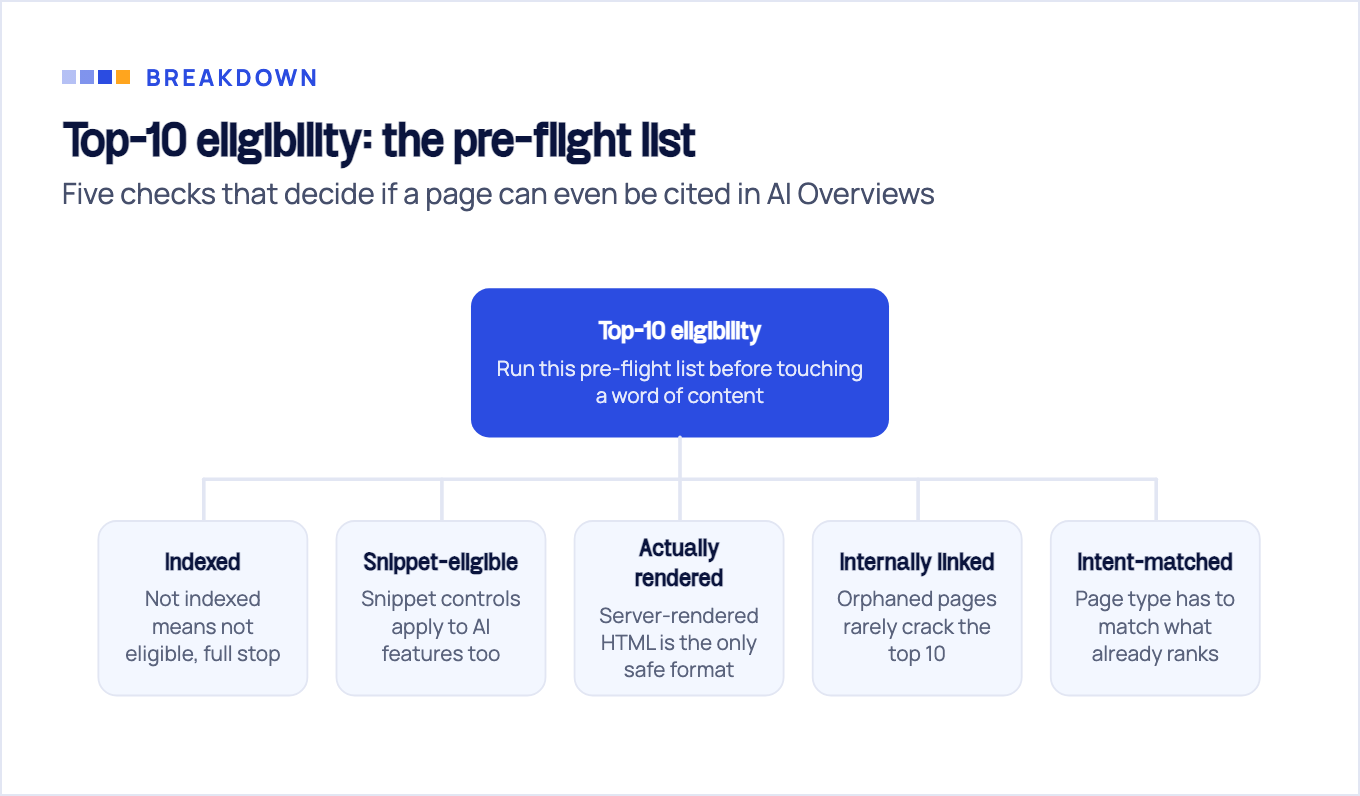
Run this pre-flight list before touching a word of content:
- Indexed. Obvious, still worth thirty seconds in URL Inspection. Not indexed means not eligible, full stop.
- Snippet-eligible. Audit
nosnippet,data-nosnippet, andmax-snippetacross templates. These were often set years ago for licensing reasons and forgotten. - Actually rendered. If your answers only exist after client-side JavaScript runs, you are gambling on the rendering pipeline. We tested how AI-adjacent bots handle this in our study of whether AI crawlers execute JavaScript; the short answer is that most don’t, and server-rendered HTML is the only safe format for content you want quoted.
- Internally linked. Pages orphaned three clicks from anywhere rarely crack the top 10, and top 10 is the entry fee.
- Intent-matched. The page type has to match what already ranks. A product page will not get cited on a “how does X work” query no matter how well it’s written.
You probably know all of this. The point is order of operations: if the page sits at position 25, passage optimization is rearranging furniture in a house nobody visits. Fix ranking first, which is ordinary technical SEO and on-page work, then move to the steps that are specific to how to show up in AI Overviews.
Step 2: Write passage-level answers AI can lift
Classic SEO competes at the page level. AI Overviews compete at the passage level: the model pulls individual paragraphs, not whole articles, and composes them into an answer. Your job is to write paragraphs that survive being lifted out of context.
Three mechanics do most of the work:
- Question-phrased headings that mirror real queries. Not “Our thoughts on timeline expectations” but “How long does SEO take to show results?” The heading is the retrieval hook.
- A 40-80 word direct answer immediately under the heading. First sentence answers outright. The next one or two add the number, condition, or caveat that makes the answer trustworthy standing alone. Depth comes after, not instead.
- Structure the model can parse. Lists for steps, tables for comparisons, one idea per paragraph. If a human can skim it, a model can extract it.
Here is the template worth copying into your CMS:
## [The question, phrased the way people actually type it]

[40-80 words. Sentence one answers the question outright.
Sentences two and three add the number, condition, or caveat
that makes the answer complete on its own.]

[Supporting depth: evidence, edge cases, a table or list
where the material is genuinely tabular.]
Now kill the instinct to bulk this up. The same Ahrefs study found the correlation between word count and AI citations is near zero, a Spearman coefficient of roughly 0.04. Longer content does not earn more citations. More liftable answers do. A tight 1,500-word page with eight clean answer blocks beats a 5,000-word wall every time the model goes shopping for passages.
The second half of this step is fan-out queries. Google decomposes a search into concurrent sub-questions and retrieves results for each of them, which means your page can be cited for queries nobody ever typed. Surfer measured the payoff across 173,902 URLs and 33,000 fan-out queries: pages that also rank across a query’s fan-out variants are 161% more likely to be cited in the AI Overview than pages ranking only for the primary term. Practically, that means mapping the sub-questions around your head term (cost, timeline, alternatives, “is it worth it”, common failure modes) and answering them on the page or across a tightly interlinked cluster, not leaving them to chance.
Step 3: Build entity and brand trust signals
Two sites can publish near-identical answer blocks and only one gets cited. The tiebreaker is usually brand weight: how confidently the model can associate your domain with the topic and trust what it finds.
The correlation data here is striking. In Ahrefs’ analysis, branded web mentions correlate at 0.664 with AI visibility, and YouTube mentions are the strongest single signal at 0.740, with YouTube itself the most-cited domain in AI Overviews. Correlation is not causation, but when the same pattern shows up across hundreds of thousands of queries, betting against it is expensive.
What this means in practice:
- Schema that matches reality. Consistent Organization and Person markup across the site, with Google’s explicit caveat from its AI search guidance in mind: structured data must match the visible content on the page. Markup that oversells the page is a trust leak, not a boost.
- Author pages with real credentials. A byline that resolves to an actual practitioner with a history on the topic reads differently to a model than “Admin.”
- Digital PR and mentions on pages Google already trusts. For AI visibility, an unlinked brand mention in an industry publication carries weight that a classic link-building audit would ignore. Mentions build the entity; links still build rankings; you want both.
- YouTube presence for money topics. Given the 0.740 correlation, a handful of genuinely useful videos on your core topics is cheap insurance, even at modest view counts.
This entity layer is the part of the discipline that genuinely goes beyond classic SEO, and it’s where most of the new work in generative engine optimization concentrates. We unpacked the full evidence base, including what doesn’t replicate, in our guide to generative engine optimization.
How to measure AI Overview visibility
Here is the uncomfortable fact most guides gloss over: Google gives you no report for this. Per Google’s own documentation, clicks and impressions from AI Overviews and AI Mode are folded into the “Web” search type in Search Console. No separate filter, no breakout. You cannot open GSC and see your AI Overview performance.
So measurement runs on proxies:
- CTR decay at stable positions. Pull queries where impressions and average position held steady but CTR sank quarter over quarter. That signature usually means an AI Overview arrived above you.
- Manual citation checks. For your 20-30 priority queries, check monthly whether an AIO shows and whether you’re cited in it. A spreadsheet is enough at this scale.
- Rank trackers with AIO detection. Most major rank-tracking tools now flag whether an AI Overview appears for a keyword and whether your domain is cited. Which tool matters far less than actually reviewing the flag weekly; treat it as presence monitoring, not a new ranking to obsess over.
- Branded impression growth. Being named inside answers seeds branded search. A rising branded-impression line in GSC is the slowest but most honest signal that AI visibility is compounding.
If you arrived here searching for AI Overviews tracking software: the proxy stack above is genuinely the state of the art. Anyone selling precision beyond it is extrapolating from sampled SERPs, which is useful, but it is sampling, not analytics.
The traffic math: fewer clicks, better clicks
Set expectations with the ugliest numbers first. Pew Research Center tracked 900 US adults across 68,879 real Google searches: when an AI summary appeared, users clicked a traditional result on just 8% of visits, versus 15% without one, and links inside the summary itself were clicked on only 1% of visits. Ahrefs measured the same effect from the ranking side across 300,000 keywords: the presence of an AI Overview correlated with a 58% lower CTR for the top-ranking page, comparing pre-rollout and post-rollout Search Console data. That is Ahrefs’ February 2026 re-run on December 2025 data; their April 2025 study put the same figure at 34.5%, so the click gap is widening, not settling.
Meanwhile the surface keeps growing. At I/O in May 2025, Google said AI Overviews drive more than a 10% increase in usage for the query types that show them in markets like the US and India.
Falling clicks on a growing surface sounds like a losing game, and it is, if you keep scoring it in pageviews. The scoring that still works is lead-based. An AI Overview citation on a comparison or problem query places your brand inside the answer at the exact decision moment. The 8% who still click through are further along than the average 2019 visitor ever was, and the rest saw your name attached to the answer they acted on. Optimize the queries that produce leads, and accept the traffic loss on the ones that never did.
When AI Overview optimization is worth it (and when it isn’t)
Nobody on page one of this SERP will tell you when to skip this work, so here is the decision framework we run with clients.
| Prioritize it when | Deprioritize it when |
|---|---|
| The query is question-phrased and sits in your funnel: questions trigger AIOs at 57.9% | The query has no plausible path to a lead, however big its volume |
| The query is commercial-investigation (“best”, “vs”, “alternatives”), where AIOs are expanding fastest | You rank outside the top 20 for it: fix ranking first, citation is not a shortcut |
| You already rank positions 4-10 and a citation would leapfrog the visible SERP | The SERP shows no AI Overview and the query type rarely triggers one |
| Your brand already has mentions and entity weight to build on | You have zero brand footprint on the topic: spend the budget on mentions first |
Two honest additions. If you rank position 1-2 on a query where an AI Overview shows, you are likely already cited; your job there is protecting the passage, not rewriting the page. And if your entire model depends on informational pageview volume (display ads, affiliate at scale), no amount of AI overview citations compensates for the click loss; that’s a business-model question, not an optimization one.
For everyone selling a service or product, the conclusion is calmer than the industry noise suggests. Getting cited in AI Overviews is standard lead-focused SEO with passage discipline and entity work layered on top: rank, answer directly, build brand, measure in leads. If you’d rather have that loop run for you, from ranking prerequisites through passage rework to citation monitoring, that’s exactly what our generative engine optimization service does. And if you’re still mapping the terrain, the rest of our AI search articles break down the individual pieces with the same data-first approach.
Sources & fact-check
Every factual claim in this article is checked against primary sources, not opinion. Written by Roman Sydorenko, Chief SEO & AI search. Last verified July 16, 2026.
- OfficialGoogle Search Central, Top ways to ensure your content performs well in Google's AI experiences on Search
- OfficialGoogle Search Central, AI features and your website (indexed and snippet eligible is the only requirement)
- Primary dataAhrefs, How to Rank in AI Overviews (76% of AI Overview citations already rank in the organic top 10)
- Primary dataSurfer, Ranking for Multiple Fan-Out Queries Dramatically Increases Your Chances of Getting Cited in AIOs
- Primary dataSE Ranking, How to Optimize for AI Overviews (92.36% of AI answers link to at least one top 10 domain)
- Primary dataAhrefs, Update: AI Overviews Reduce Clicks by 58% (300,000 keyword re-run, supersedes the earlier 34.5%)
