Generative engine optimization (GEO) is the practice of making your content more likely to be retrieved, cited, and recommended by AI answer engines: Google’s AI Overviews and AI Mode, ChatGPT, Perplexity, and Gemini. Where classic SEO earns you a ranking on a results page, GEO earns you a mention inside the answer itself. The two overlap far more than the GEO industry wants you to believe, and this guide separates the verified mechanics from the folklore.
What is generative engine optimization (GEO)?
The term comes from research, not from a marketing department. A 2023 academic paper by Aggarwal et al., later accepted to KDD 2024, coined “Generative Engine Optimization,” built a benchmark called GEO-bench, and showed that specific content changes can boost visibility by up to 40% in generative engine responses. That paper is still the foundational controlled study in the field, and later academic work continues to benchmark against the GEO-bench it published. We’ll come back to what it actually found.
In practice, GEO means three things:
- Making sure AI systems can technically read your pages.
- Writing passages an AI can lift and quote without losing meaning.
- Building enough authority signals, on and off your site, that engines treat you as a source worth naming.
One disambiguation before anything else, because it trips up half the people searching this term: GEO has nothing to do with geo-targeting, geolocation, or local SEO. “Geo” here is short for generative engine, not geography. If you were looking for map-pack rankings, this is the wrong article.
You will also meet the same discipline under different labels: answer engine optimization (AEO), AI SEO, or LLM SEO. Vendors invent names faster than the practice changes. Under the hood it is one job: get cited by machines that write answers.
The stakes are not niche anymore. Google announced at I/O 2025 that AI Overviews have scaled to over 1.5 billion users across 200 countries and territories. If your buyers search, a language model already sits between them and your site.
How AI search engines actually find and cite content
Every major AI search feature works on the same basic loop, usually called retrieval-augmented generation (RAG) or grounding. The model doesn’t answer from memory alone. It runs searches, fetches pages, and composes an answer from what it retrieved, citing some of those pages as sources.
Google describes its version plainly in its AI features documentation: AI Overviews and AI Mode use grounding plus “query fan-out,” defined as “a set of concurrent, related queries generated by the model to request more information and fetch additional relevant search results.” One user question becomes many background searches. Your page can be retrieved for a fan-out query nobody ever types.
The retrieval layer differs by platform, and this is where most GEO advice gets sloppy:
- Google AI Overviews and AI Mode ride Google’s normal index. There is no separate “AI crawler” to court. If Googlebot can crawl and rank you, the AI features can retrieve you.
- ChatGPT search runs on OpenAI’s own index, built by a dedicated crawler called OAI-SearchBot. Per OpenAI’s crawler documentation, sites that opt out of OAI-SearchBot “will not be shown in ChatGPT search answers,” though they can still appear as navigational links. Block it and you lose the citation, which is the part that matters.
- Perplexity maintains its own index via PerplexityBot, which Perplexity’s documentation says exists to “surface and link websites in search results” and “is not used to crawl content for AI foundation models.”
Because the crawler names look alike, robots.txt mistakes are common. Here is the map:
| Crawler | Operator | Purpose | If you block it |
|---|---|---|---|
| GPTBot | OpenAI | Training data for foundation models | Model-training opt-out; ChatGPT search is unaffected |
| OAI-SearchBot | OpenAI | ChatGPT search index | You lose citations in ChatGPT search answers; navigational links can remain |
| ChatGPT-User | OpenAI | Fetches pages a user asked about | Little effect; robots.txt “may not apply” to user-initiated visits |
| PerplexityBot | Perplexity | Perplexity’s search index | You disappear from Perplexity results |
| Perplexity-User | Perplexity | User-triggered page visits | Little effect; it “generally ignores robots.txt” |
| Googlebot | Search, AI Overviews, AI Mode | You disappear from Google entirely |
Two practical consequences. First, the popular 2023-era move of blocking GPTBot to “protect content” costs you nothing in ChatGPT search visibility, and unblocking it buys you none. Different bots, different jobs. Second, most of these crawlers read raw HTML and do not reliably run JavaScript, which we tested in detail in our study of whether AI crawlers execute JavaScript. More on that below.
GEO vs SEO: what actually changes (and what doesn’t)
The honest comparison looks like this:
| Traditional SEO | GEO | |
|---|---|---|
| Goal | Rank a page in a list of results | Get cited or recommended inside a generated answer |
| Unit of competition | The page | The passage: a paragraph an engine can lift whole |
| Primary metric | Positions and clicks | Citations, mentions, share of AI answers |
| Where it happens | Mostly your own site | Your site plus your footprint in sources engines trust: Reddit, reviews, industry press, YouTube |
| Feedback loop | Rank trackers, Search Console | Sparse: you sample AI answers and track referrals |
Now the part vendors skip. Google’s own guidance says the quiet thing out loud: “The best practices for SEO continue to be relevant because our generative AI features on Google Search are rooted in our core Search ranking and quality systems.” That is from the same Google AI features guide, and it settles the “GEO replaces SEO” debate. It doesn’t. Retrieval runs on the ranking systems SEO has always targeted. A page that can’t rank can’t be retrieved, and a page that can’t be retrieved can’t be cited.
What genuinely changes is the resolution. SEO optimizes pages; GEO optimizes passages. And GEO widens the surface: engines synthesize answers from Reddit threads, comparison posts, and review sites where your brand appears, not just from pages you control. Off-site reputation stops being a branding nicety and becomes retrievable input.
What actually moves AI citations: the evidence
Start with the controlled evidence, because there is strikingly little of it. The KDD 2024 GEO paper tested nine optimization methods across 10,000 queries. The winners were unglamorous: adding quotations from relevant sources, adding statistics, and citing sources boosted visibility in generative answers by up to 40% on GEO-bench. The losers matter just as much: keyword stuffing, the reflex move of bad SEO, did not help.
Read that finding for what it is. Engines reward content that looks like evidence (numbers, named sources, quotable claims) over content that looks like optimization.
On top of the research sits a practitioner layer. These patterns are observed across many campaigns, including ours, but nobody has run a controlled study on them, so treat them as strong hypotheses rather than proven levers:
- Self-contained passages. A paragraph that states the claim, the number, and the source in one place survives being quoted alone. Answers get assembled from fragments; fragments that need surrounding context get skipped.
- Entity clarity. Engines cite brands they can identify. A consistent name, a clear about page, and unambiguous descriptions of what you do make you a safer thing to recommend.
- Freshness. AI answers visibly prefer recently updated sources for anything time-sensitive.
- Off-site mentions. Being named in the Reddit threads, review sites, and industry publications that engines already cite in your niche raises the odds you appear in synthesized answers, even when your own page isn’t retrieved.
And now the myth-busting, courtesy of Google’s documentation again. The same guide is blunt about what you do not need: “You don’t need to create new machine readable files, AI text files, markup, or Markdown to appear in Google Search.” No llms.txt requirement. No obligation to chunk content into AI-sized blocks. Even structured data “isn’t required for generative AI search.” Schema still helps machines disambiguate entities and earns rich results, so we still use it, but as a helpful tool, not the secret handshake some vendors claim.
Notice the shape of the real levers: evidence-rich content, clear entities, mentions in trusted third-party sources. That is authority building. The same digital PR and citation-earning work that moved rankings for the last decade moves AI citations now, just measured differently.
The technical layer: AI engines can’t cite what they can’t read
This is the least discussed and most fixable GEO factor.
Most AI crawlers fetch raw HTML and move on. If your content renders client-side (a React SPA that ships an empty div and builds the page in the browser), many AI crawlers see nothing worth citing. Googlebot renders JavaScript; most of the others don’t do it reliably. Server-side rendering, static generation, or prerendering for your key pages is the single highest-leverage technical fix in GEO.
The rest of the technical layer is a checklist, not a project:
- Audit robots.txt against the crawler table above. Decide deliberately: blocking GPTBot is a training opt-out, blocking OAI-SearchBot or PerplexityBot removes you from those engines’ answers, and the user-triggered fetchers largely ignore the file anyway.
- Keep heading hierarchy clean. Retrieval systems use structure to find the passage that answers the fan-out query. One h1, descriptive h2s, no decorative heading soup.
- Stay fast and crawlable. Reasonable response times, no bot-hostile firewalls, no login walls in front of content you want cited.
None of this is exotic. It is the same discipline as a technical SEO audit, extended with a handful of AI-specific decisions. If your site already passes a serious technical audit, the GEO delta is an afternoon of robots.txt and rendering checks.
How to measure GEO (and why clicks are the wrong KPI)
Here is the uncomfortable context every GEO conversation should start with. An Ahrefs study of 300,000 keywords found that the presence of an AI Overview correlated with a roughly 34.5% lower desktop CTR for the position-1 result on informational queries. Traffic to informational content is falling industry-wide, and no amount of optimization brings the old click curve back.
So measuring GEO by sessions is measuring the wrong thing. What we actually track for clients:
- Citation frequency. Sample a fixed set of buying-relevant prompts monthly across ChatGPT, Perplexity, and Google’s AI features, and record how often you are cited or recommended versus competitors. This is your AI share of voice.
- AI referral sessions. GA4 already shows referrals from chatgpt.com and perplexity.ai. Small numbers, but watch the trend and the conversion rate on them.
- Brand mentions. New mentions in the third-party sources engines cite in your niche, because those mentions are retrievable input, not vanity.
A category of GEO tracking tools has grown up around exactly this, automating prompt sampling and share-of-voice reporting. Useful once you have real citation volume to monitor; unnecessary for a baseline, which you can build with a spreadsheet and an hour a month.
The metric that ultimately matters is leads per visit, not visits. A visitor who arrives after an AI engine summarized their options and named you is further down the funnel than a blue-link clicker: they show up pre-sold. Fewer clicks that convert harder is a trade a lead-driven business should happily take, provided you are the brand the answer names.
A practical GEO workflow to start this quarter
Everything above compresses into six steps, in order of leverage:
- Fix rendering. Confirm your key pages serve full content in raw HTML. If they don’t, prioritize server-side rendering or prerendering before touching anything else.
- Audit AI-crawler access. Walk your robots.txt through the crawler table and make every allow or block a deliberate choice.
- Rewrite money-adjacent pages into extractable passages. Lead sections with direct answers, add statistics with named sources, and make each key paragraph quotable on its own. Our guide on how to rank in AI Overviews covers the passage-level mechanics.
- Build entity clarity. A real about page, consistent brand facts everywhere they appear, and schema where it genuinely helps machines and humans identify you.
- Earn mentions where engines already look. Find the Reddit threads, listicles, review sites, and publications cited in AI answers for your niche, and get into them.
- Baseline and track monthly. Fixed prompt set, citation counts, AI referrals, and conversion rate on AI-referred visitors.
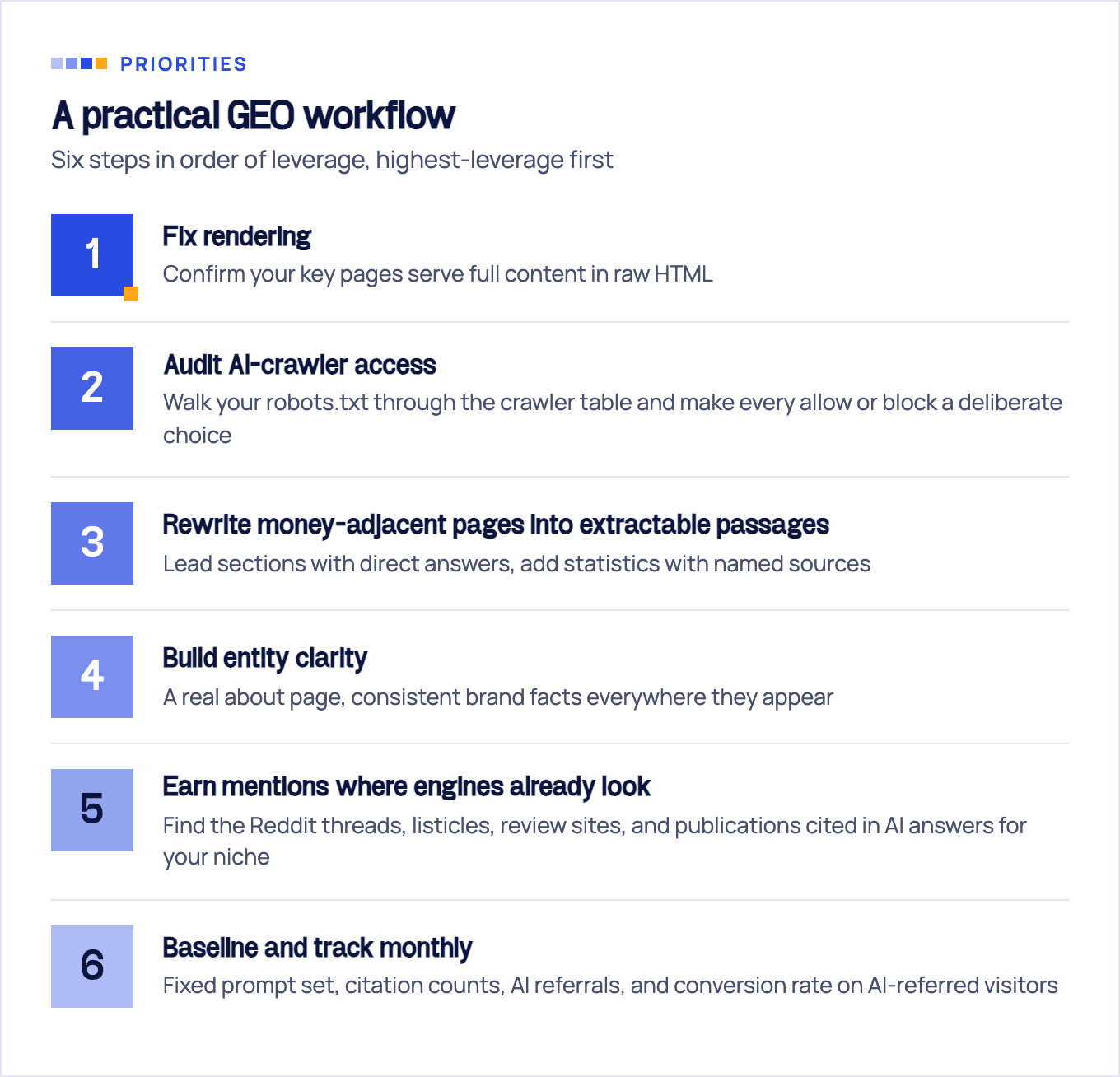
Steps 1 and 2 are days of work. Steps 3 through 5 are the ongoing practice, and they compound the same way SEO authority always has.
If you’d rather hand this off, this workflow is precisely what our generative engine optimization service runs, inside a broader AI SEO program when the whole search footprint needs the upgrade. Either way, start with steps 1 and 2 this week. They’re cheap, and they gate everything else.
Sources & fact-check
Every factual claim in this article is checked against primary sources, not opinion. Written by Roman Sydorenko, Chief SEO & AI search. Last verified July 16, 2026.
- OfficialGoogle Search Central, Optimizing your website for generative AI features (official AI-answer guidance)
- OfficialOpenAI, Bots and crawlers documentation (GPTBot vs OAI-SearchBot vs ChatGPT-User)
- OfficialPerplexity, Bots documentation (PerplexityBot indexes for search, not model training)
- OfficialGoogle, I/O 2025 keynote recap (source of the 1.5 billion AI Overviews users figure)
- Primary dataAggarwal et al., GEO: Generative Engine Optimization, KDD 2024 (coined the term; built GEO-bench)
- Primary dataAhrefs, AI Overviews Reduce Clicks by 34.5% (300,000-keyword CTR study, April 2025)
