ChatGPT SEO is the work of getting your site and brand cited and recommended when ChatGPT answers a question, rather than earning a blue link on Google. It runs on a different machine than classic search: ChatGPT reaches the web through a dedicated crawler of its own, then names a rotating set of sources inside a written answer. The tactics that win it are mostly mentions, retrievability, and entity trust, not raw link authority. This guide covers how ChatGPT picks sources, what its citations actually reward in the data, and a checklist to show up.
What Is ChatGPT SEO?
ChatGPT SEO is optimizing your website and your brand’s footprint across the web so ChatGPT cites and recommends you inside its answers and its search results. There is no position 1 to hold. You are trying to become one of the sources the model names when it responds to a query in your space.
One quick disambiguation, because this term points two ways. Half the people searching “chatgpt seo” want to rank in ChatGPT, which is this article. The other half want to use ChatGPT as an SEO assistant for drafting titles and clustering keywords. That is a real workflow and a fine one, but it is a productivity topic, not a visibility one, and we are staying on the visibility side here.
The reason to care is commercial, not novelty. 44% of U.S. adults have used ChatGPT, up from 34% a year earlier and more than double the 2023 share, including 61% of adults under 30, per Pew Research Center. And that traffic behaves differently once it lands: the average AI search visitor is 4.4x as valuable as the average traditional organic visitor by conversion rate, in Semrush’s analysis of 500+ digital-marketing topics. Fewer visitors, further along.
How ChatGPT Actually Picks Its Sources
Most guides skip the part that matters and go straight to “write quality content.” The useful starting point is OpenAI’s own crawler documentation, because OpenAI runs four crawlers and three of them shape what ChatGPT knows about you. (The fourth, OAI-AdsBot, only vets landing pages submitted as ads on ChatGPT.)
- GPTBot collects training data used to improve OpenAI’s foundation models. Its job is the model’s baseline knowledge, not live answers.
- OAI-SearchBot powers ChatGPT’s search features. Sites opted out of OAI-SearchBot will not be shown in ChatGPT search answers, per OpenAI, which adds that opted-out sites can still appear as navigational links. This is the crawler that decides whether you get named in a ChatGPT search answer.
- ChatGPT-User is the agent for user-initiated browsing, when someone asks ChatGPT to go fetch or check a specific page. OpenAI notes robots.txt rules may not apply to these user-triggered actions, because the user, not an autonomous crawl, initiated the request.
That split has a consequence people get wrong constantly, so it earns its own callout below. The pipeline itself is straightforward once you know the bots: a query gets rewritten and fanned out into related sub-queries, ChatGPT retrieves candidate pages for each one, and it synthesizes an answer with citations attached to the sources it leaned on.
Here is the myth worth killing. ChatGPT does not simply quote Google’s top ten. Nearly 90% of the webpages ChatGPT cites rank in position 21 or lower in traditional search, per Semrush. The retrieval layer is its own animal. A page invisible on page one of Google can still be the source ChatGPT names, which is exactly why treating this as a rankings game misreads the board.
What ChatGPT Citations Reward (the Data)
Opinions on this are cheap, so anchor on the largest correlation study available. In Ahrefs’ analysis of 75,000 brands, published December 2025, the signals that track with ChatGPT brand mentions rank in an order that should reset how you spend effort.
- YouTube mentions correlated 0.737 with ChatGPT brand mentions, the single strongest signal in the set.
- Branded web mentions correlated 0.664. Being talked about across the web, linked or not, tracks closely with being named by ChatGPT.
- Branded anchors correlated 0.511, and branded search volume 0.352. People searching your name is a real signal; it is just a weaker one than being mentioned.
- Domain Rating correlated only 0.266. Raw link authority, the metric classic SEO obsesses over, sits at the bottom of the list.
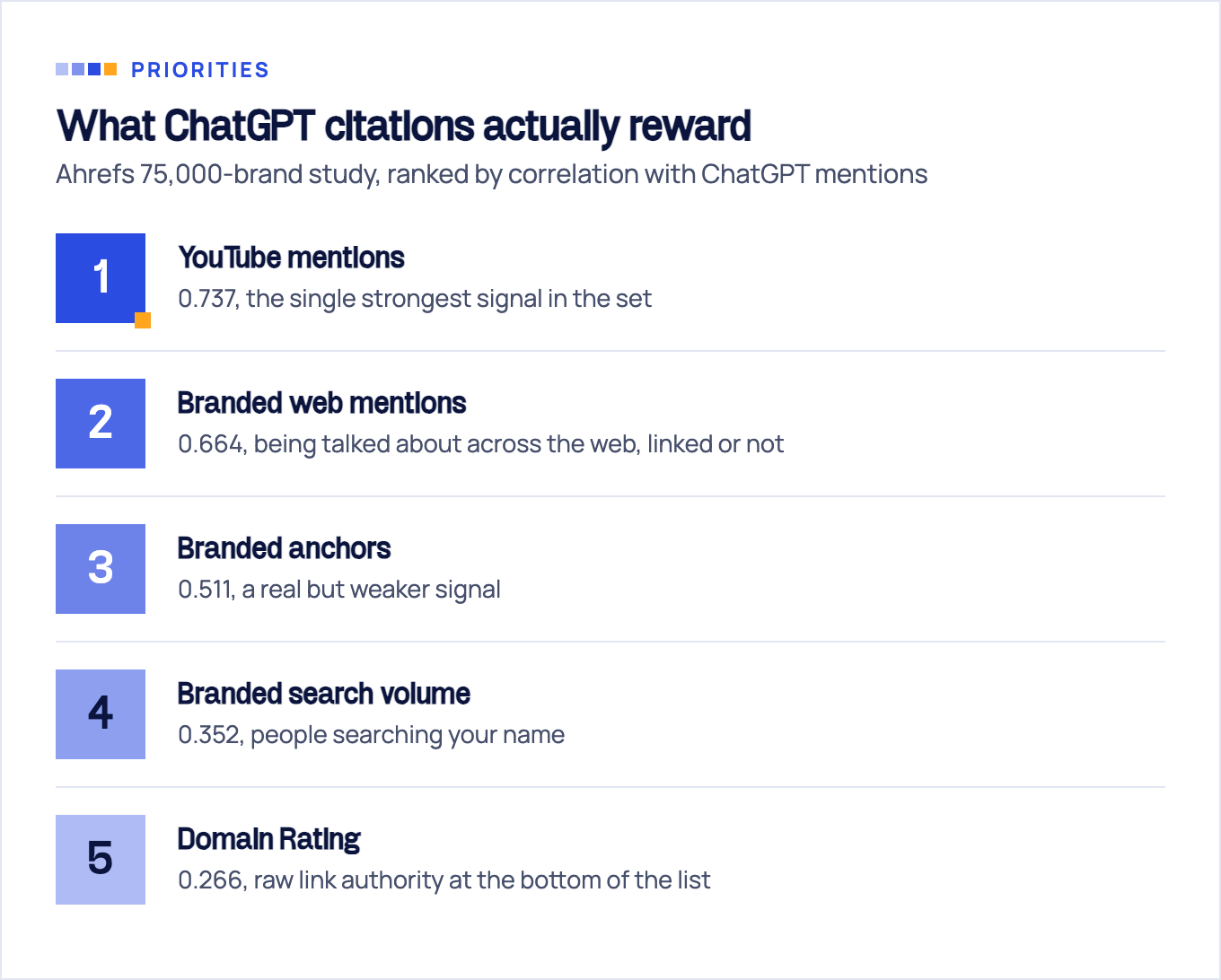
Read the shape, not just the numbers. Ahrefs found ChatGPT had the weakest correlations of the three AI assistants it studied for almost every traditional brand-authority signal. Mentions and entity presence beat link metrics here more decisively than anywhere else in AI search.
The honest caveat: this is correlation, and Ahrefs says so plainly. High-authority brands also get talked about more, so some of this overlaps. But when the same pattern holds across 75,000 brands, betting against it is the expensive move. The practical reading is that ChatGPT SEO is a mentions-and-retrievability game, and Domain Rating is close to a rounding error inside it.
ChatGPT SEO vs Google AI Overviews: What’s Different
These two get lumped together as “AI search,” but they run on opposite philosophies, and the differences change what you actually do.
| Google AI Overviews | ChatGPT search | |
|---|---|---|
| How to become eligible | Already handled by Search; no special setup | Allow OAI-SearchBot to crawl you; opt-out removes you |
| Special markup needed | None, per Google | None; access is the gate, not markup |
| How you control display | nosnippet, max-snippet, noindex | robots.txt directives per bot |
| Source pattern | Pulls from what ranks; Quora and Reddit dominate | ~90% of cited pages rank 21+ in Google |
| Traffic effect | 34.5% lower CTR for the top result | 4.4x more valuable per visitor |
Google’s position is that you do essentially nothing new. Its documentation states there are “no additional requirements to appear in AI Overviews or AI Mode, nor other special optimizations necessary”: no machine-readable AI files, no new markup, and display is limited only through nosnippet, data-nosnippet, max-snippet, or noindex. AI Overviews run on Search’s existing systems, so ranking well is the whole game.
ChatGPT is opt-in at the crawler level, which is the sharper contrast. If OAI-SearchBot cannot reach you, no amount of content quality matters, because you are not in the index the answer is built from.
The outcomes diverge too. The presence of an AI Overview correlated with a 34.5% lower CTR for the top-ranking page, in Ahrefs’ comparison of 300,000 keywords. That is the click-suppression story everyone knows. ChatGPT’s story is the inverse in value terms, given the 4.4x conversion edge above. One surface takes clicks away; the other sends fewer but better ones. Worth noting on the Google side: Quora is the most-cited website in AI Overviews, followed by Reddit, which is why community presence keeps surfacing in AI-search advice. If you want the full AI Overviews playbook, we broke it down in how to rank in AI Overviews.
How to Rank in ChatGPT: 7-Step Optimization Checklist
This is the practical core. None of it is exotic; it is disciplined retrievability plus the entity work the data points at.
- Audit robots.txt for OAI-SearchBot. This is the one directive that decides whether you appear in ChatGPT search. Allow it. Decide on GPTBot separately, as a training-data policy call, and know that blocking GPTBot does not touch your search visibility.
- Confirm you are indexed in Bing and Google. Treat mainstream indexation as your crawlability smoke test. If your pages cannot get into the big indexes, the cause is usually something that blocks OAI-SearchBot too: a robots.txt rule, a noindex tag, or content that only appears after a client-side render. Check both, not just Google.
- Server-side render the content you want quoted. AI crawlers do not reliably execute JavaScript, so content that only appears after a client-side render is content the model may never see. We tested this directly in do AI crawlers execute JavaScript; server-rendered HTML is the only safe format.
- Structure answers first. Lead each section with a direct 40-to-70-word answer under a question-phrased heading, then add depth. The model lifts self-contained passages, not whole articles, so write paragraphs that survive being pulled out of context.
- Give it something worth citing. Original stats, clean definitions, and first-party data are what a synthesis engine reaches for. A page that only restates the consensus offers the model no reason to name you over the ten pages that said it first.
- Keep key pages fresh with visible dates. Retrieval favors current sources on moving topics. A dated “updated” line and real revisions signal that the page is maintained, not abandoned.
- Keep schema and entity data consistent. Consistent Organization and Person markup, matching names and descriptions across your footprint, helps the model resolve who you are. Structured data must match what is visible on the page; markup that oversells is a trust leak.
Steps 1 through 3 are pure crawlability and rendering, the place most DIY efforts silently fail. When those fixes run deeper than a robots.txt edit, into rendering pipelines and index coverage, that is technical SEO territory rather than a content task.
Build the Off-Site Footprint ChatGPT Trusts
On-site work makes you retrievable. The Ahrefs correlations say the biggest gains live off-site, in the mentions and presence that make ChatGPT confident enough to name you.
Three moves follow straight from the data. Earn branded mentions across sites people actually read, linked or unlinked, because branded web mentions correlated 0.664 and mentions are the currency here. Build genuine YouTube presence on your core topics, given the 0.737 correlation, even at modest view counts. And be active on Reddit and Quora, the two communities that dominate AI-search citations, in a way that earns mentions rather than plants them.
Digital PR and linkable assets still pull their weight, because mentions and links travel together. A campaign that lands your brand in an industry publication usually produces both at once, which is why the disciplines overlap instead of competing.
This is the part clients most often want run for them, because it is slow, relationship-heavy work that compounds. Building that mention-and-entity footprint deliberately is exactly what our generative engine optimization service does, and the mention-and-link campaigns behind it are our link building service. Ten-plus years, 100+ clients across the USA, UK and EU, and 200,000+ keywords ranked in the top 3 is the footprint we build from.
How to Track Your ChatGPT Visibility
You cannot open a dashboard and read your ChatGPT rank, so measurement runs on a small stack of proxies. The high-volume searches for a “chatgpt seo tool” or a “chatgpt seo visibility tracker” are chasing this, and the honest answer is that no single tool gives you a clean number.
- Manual prompt audits. Keep a fixed set of the questions your buyers actually ask ChatGPT, run them on a schedule, and log whether you appear and who else does. Unglamorous, and still the most direct read available.
- AI visibility trackers. Tools in the Ahrefs Brand Radar and Semrush AI-toolkit class sample how often brands surface across AI answers. Treat them as trend instruments, not precise rank reports.
- GA4 referral segmentation. Segment sessions referred from chatgpt.com so you can see the traffic land and, more importantly, convert. This is where the 4.4x value edge shows up in your own numbers instead of a study’s.
Set the expectation early: ChatGPT answers vary session to session, even for the same prompt. Track direction, not an absolute position. The reason the tracking work pays for itself is that same 4.4x conversion advantage; a small, well-converting stream of ChatGPT referrals is worth measuring properly.
If you want this run as one program, from OAI-SearchBot access and rendering fixes through the off-site mention work and tracking, that is what our AI SEO service does. The rest of our AI search articles break down the individual pieces with the same data-first approach.
Sources & fact-check
Every factual claim in this article is checked against primary sources, not opinion. Written by Roman Sydorenko, Chief SEO & AI search. Last verified July 16, 2026.
- OfficialOpenAI, Overview of OpenAI crawlers (four crawlers documented, and robots.txt may not apply to ChatGPT-User)
- OfficialPew Research Center, Americans and AI 2026 (44% of U.S. adults now report using ChatGPT, up from 34%)
- OfficialPew Research Center chart, ChatGPT tops the list of chatbots Americans use (61% for ages 18 to 29)
- OfficialGoogle Search Central, AI features and your website (no special markup or AI text files needed to appear)
- Primary dataAhrefs, Top brand visibility factors, 75k brands (YouTube mentions top the ChatGPT correlations at 0.737)
- Primary dataSemrush, We studied the impact of AI search on SEO traffic (AI visitors convert 4.4x better than organic)
