Local SEO for real estate is the work of getting your Google Business Profile into the map pack and your website into localized organic results for searches like “[city] realtor” and “[neighborhood] homes for sale”. It matters because the map pack only shows business profiles, which makes it the one piece of the search results Zillow, Realtor.com and Redfin structurally cannot occupy. For an agent or a brokerage, that’s the most defensible source of buyer and seller leads that doesn’t rent visibility from a portal.
This guide covers what actually moves local rankings: profile structure (including the agent-vs-brokerage question almost nobody answers), reviews, neighborhood pages, citations, on-site foundations and measurement.
What local SEO for real estate actually means (and why it beats portal dependence)
Two scoreboards decide local visibility. The first is the map pack, ranked by your Business Profile. The second is localized organic results, ranked by your website. Google is unusually transparent about how the first one works: per Google’s local ranking documentation, local results are based primarily on three factors: relevance (how well your profile matches the search), distance (how far you are from the searcher) and prominence (how well-known you are). The same document states flatly that “there’s no way to request or pay for a better local ranking on Google”. Everything in this guide feeds one of those three factors.
Why fight here at all when portals own the listings queries? Because listings aren’t the business; representation is. Per NAR’s 2025 Profile of Home Buyers and Sellers, 88% of buyers purchased their home through an agent or broker. People browse Zillow for months, but at some point they pick a human, and “[city] realtor” or “[neighborhood] real estate agent” is exactly that moment. The portals can’t take a map-pack slot. You can.
This post is the local half of the playbook. The keyword and content side lives in the rest of our real estate SEO guides.
Google Business Profile for agents and brokerages: who gets a profile
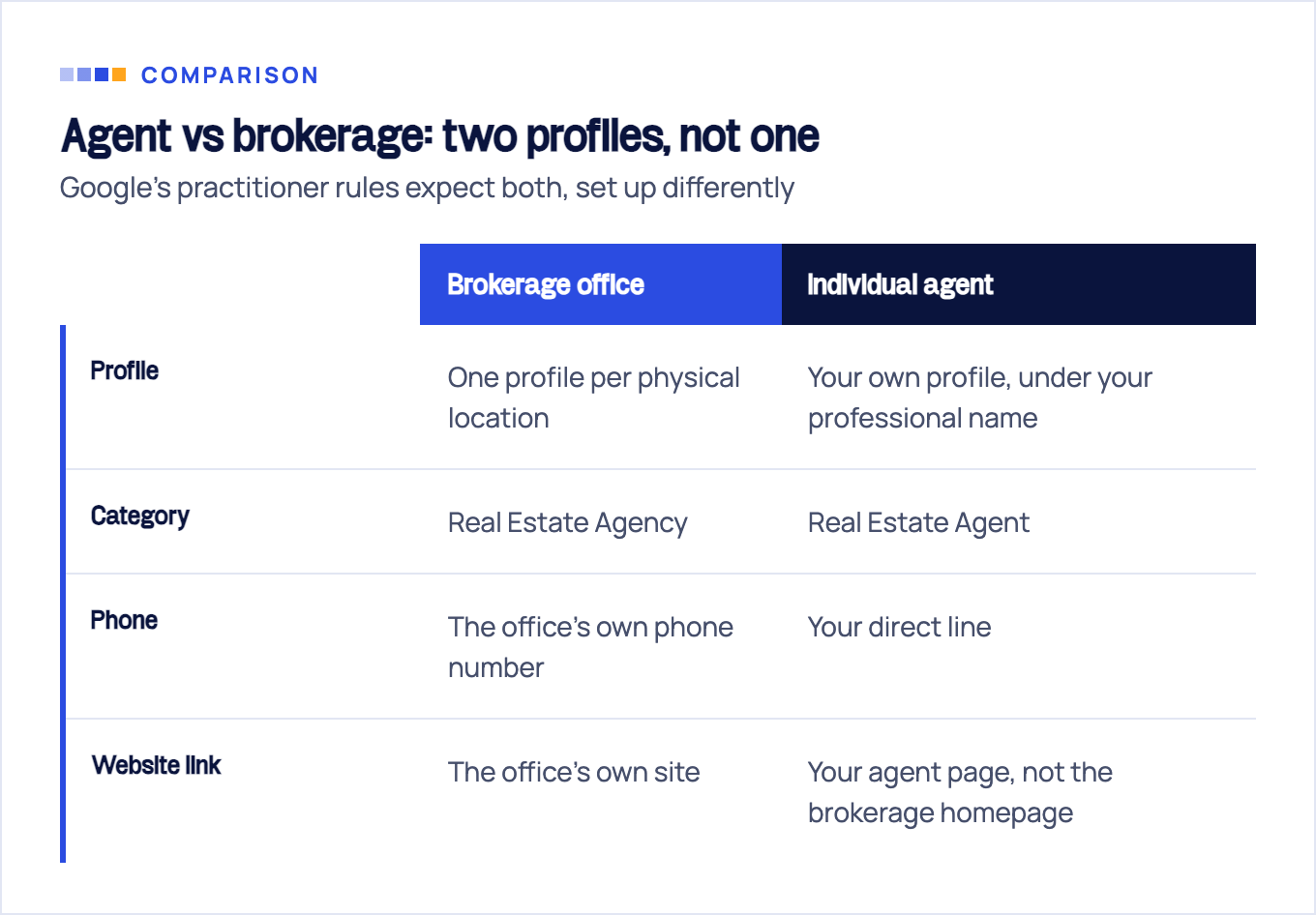
Should an agent have a profile separate from the brokerage? Yes, and this is the question most guides skip entirely. Google’s Business Profile guidelines explicitly list real estate agents among the individual practitioners eligible for their own profile. The same guidelines add that when multiple practitioners work at one location, “the organization should create a Business Profile for this location, separate from that of the practitioner”. In plain terms: the brokerage office gets a profile, and each public-facing agent can hold their own, at the same address, without violating anything.
The structure that follows from the rules:
- Brokerage office: one profile per physical location, category “Real Estate Agency”, the office’s own phone number and website.
- Individual agent: your own profile under your real-world professional name, category “Real Estate Agent”, your direct line, and a link to your agent page rather than the brokerage homepage.
- Home-based and service-area agents: per the same guidelines, businesses without a storefront customers can visit should hide the address and define service areas instead. List the cities and neighborhoods you genuinely work, not the entire metro.
Two violations get real estate profiles suspended more than anything else. The first is the name field: guidelines require your real-world name, with no taglines and no service or product keywords. “Jane Rivera” is compliant; “Jane Rivera | Top Austin Realtor | Homes For Sale” is a policy violation waiting for a competitor to report it. The second is stuffing the office address onto a profile for an agent who works from home. Hide it and use service areas.
With the structure right, the setup itself is straightforward:
- Fill every field: phone, hours, appointment link, and a site link that points to your own page.
- Upload real photos on a regular schedule: you, the office, closings, the neighborhoods you farm. No stock.
- Publish updates for open houses, just-listed and just-sold properties.
- Seed the Q&A section with questions clients actually ask (areas served, buyer process, how you get paid) and answer them yourself before someone else does.
Reviews: the prominence engine Google admits to
Google almost never confirms a ranking factor in writing. Reviews are the exception. The local ranking documentation says it plainly: “More reviews and positive ratings can help your business’s local ranking”. That makes reviews the most controllable input into prominence you have.
The consumer side is just as decisive. Per BrightLocal’s Local Consumer Review Survey, 97% of consumers read reviews for local businesses, and 31% will only use a business rated 4.5 stars or higher, up from 17% a year earlier. Freshness and responsiveness carry weight too: 74% of consumers look for reviews written within the last three months, and 80% say they’re likely to use a business that responds to all of its reviews.
For an agent this translates into a closing-day system, not an occasional campaign:
- Ask every client, at every closing. Google explicitly permits asking customers for reviews and sharing your direct review link or a QR code. Ask in person at the closing table, then text the link the same day, while the keys are still in their hand.
- Never trade anything for a review. The same policy is blunt: offering incentives “in exchange for customers to post reviews, change reviews, or remove negative reviews is considered fake & misleading content and is strictly prohibited”. A gift card for a five-star review can cost you the entire profile.
- Respond to everything, including the ugly one. A calm, factual reply to a negative review gets read by hundreds of future clients, and answering all reviews is a behavior four out of five consumers reward.
- Protect velocity over lifetime totals. When 74% of consumers go looking for reviews from the last three months, an agent who closes two deals a month and asks every client will out-signal a stale profile with triple the review count.
Neighborhood pages: the highest-impact content play for agents
Buyers don’t start with a house; they start with a place. In NAR’s 2025 buyer data, quality of the neighborhood was the top factor in choosing a location, cited by 59% of buyers, ahead of convenience to friends and family at 47%. Neighborhood pages capture exactly that behavior: people evaluating where to live before deciding what to buy.
A neighborhood page that ranks and converts contains things no portal can generate:
- Your market read. What’s selling in this neighborhood right now, what sits, what buyers compete over. Two honest paragraphs, refreshed quarterly, beat any widget dump of auto-generated stats.
- Price and inventory context written in your own words, with the date you wrote it.
- Local texture. The commute reality, the school-pickup chaos, the street that floods after heavy rain, the block with the good coffee. Detail only someone who works the area can write.
- Internal links to active listings in the area, adjacent neighborhood pages, and the city hub page above them.
- A person. Your name, photo and direct contact on the page. Its job is to start a conversation, not to collect a pageview.
The failure mode is the templated version: fifty pages where only the neighborhood name changes between them. That find-and-replace pattern is what Google’s doorway-page and thin-content policies exist to catch, and it’s the fastest way to teach Google to distrust your whole site. The test is simple: swap in a different neighborhood name and reread the page. If it still reads true, the page shouldn’t exist.
Structure the cluster as one city hub linking down to neighborhood spokes, and be selective about which spokes to build. That’s a keyword decision, and our guide to real estate SEO keywords covers how to find the district-level queries with genuine buyer intent behind them.
Citations and NAP: the real-estate-specific stack
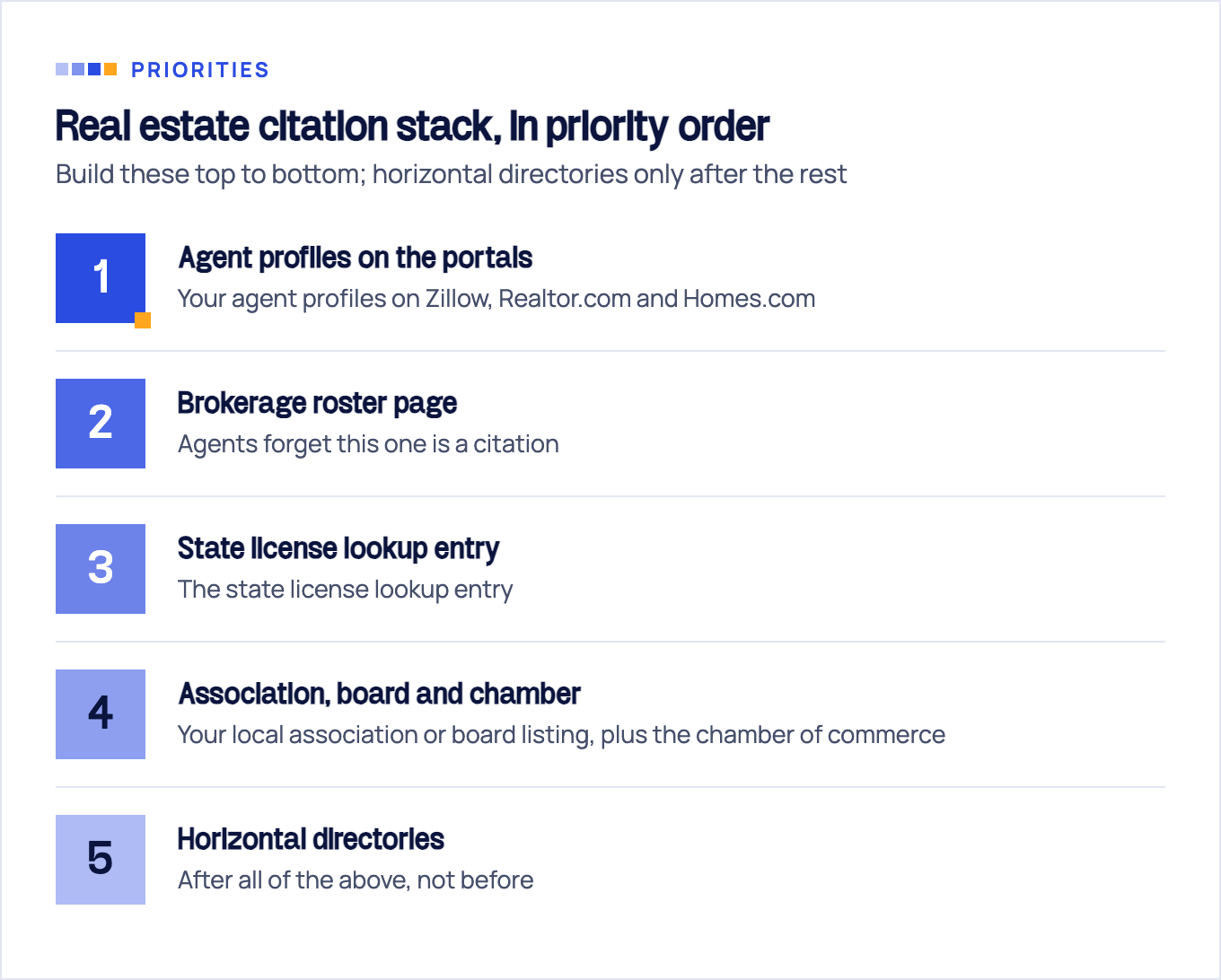
Citations are the mentions of your name, brokerage, address and phone scattered across the web, and their completeness and consistency feed the relevance and prominence factors Google describes. Generic advice stops at “submit to directories”. Real estate has a stronger stack sitting in plain sight:
- Your agent profiles on Zillow, Realtor.com and Homes.com
- Your brokerage’s roster page (agents forget this one is a citation)
- The state license lookup entry
- Your local association or board listing, plus the chamber of commerce
- The usual horizontal directories after all of the above, not before
The gotcha unique to this niche is the brokerage move. Every time an agent changes brokerages, the old office address, old phone and old brokerage name survive on portals, directories and cached roster pages, and NAP consistency quietly collapses. After every move, audit the full stack above, update each listing to the new office, and ask the previous brokerage to remove your roster entry. Conflicting data doesn’t just dilute ranking signals; it routes calls to a front desk that no longer forwards them.
On-site foundations: IDX listings, schema, and site speed
IDX is where agent websites quietly bleed. A typical integration generates thousands of listing and search-result pages that are duplicated across every other IDX site in the MLS, thin, or not indexable at all, and they can consume your crawl budget while the neighborhood pages that differentiate you wait in line. The hygiene rules: keep search-result and filter pages out of the index, make sure individual listing pages render server-side rather than inside an iframe, and let the pages only you could write carry the site’s indexation weight.
Schema is the second foundation. schema.org defines a RealEstateListing type, a listing that describes one or more real-estate offers, currently in schema.org’s “new” area with properties like datePosted. Pair it with RealEstateAgent or LocalBusiness markup on your agent site so Google can connect the website to your Business Profile. Implementation details, including what to mark up on listing pages versus agent pages, are in our real estate schema markup guide. If the problems run deeper (crawl bloat, render-blocking IDX scripts, mobile speed), that’s audit territory, and our technical SEO service exists for exactly that class of fix.
Measuring local SEO like a lead channel, not a vanity project
Most agents check rankings the way they check horoscopes: occasionally, and without consequences. Treat local SEO as a lead channel instead, with numbers someone is accountable for.
| Metric | Source | What it tells you |
|---|---|---|
| Map-pack position by neighborhood | Grid rank tracking from the areas you serve | Whether profile work is landing where your clients actually are |
| GBP actions: calls, direction requests, website clicks | Business Profile performance report | Demand reaching you, not impressions floating past |
| Organic form fills and tracked calls | CRM plus call tracking, attributed to organic | Leads: the number that pays |
| Lead-to-appointment rate | CRM | Whether those leads are real people ready to transact |
Set expectations honestly. The typical buyer in the NAR data searched for 10 weeks before purchasing, and profile authority, review velocity and neighborhood pages all compound on a similar horizon: months, not days. The trade-off is worth naming. Ads produce leads next week and stop the day you stop paying; local SEO starts slow and becomes unfair, because the agent who owns the map pack for a farm area collects inquiries from every search while competitors rebuy their visibility each month.
This loop, ranking for the queries that produce signed clients, measuring to the appointment, and pruning what never converts, is how we run Focused Lead Generation across niches. If you want to start this week without hiring anyone: fix the agent-plus-brokerage profile structure, text your last five closed clients the review link, and draft one honest page for the neighborhood where you closed the most deals. And if you’d rather have the whole loop built and run for you, that’s what our local SEO service does: profile structure, review systems, neighborhood content and reporting that counts leads, not impressions.
Sources & fact-check
Every factual claim in this article is checked against primary sources, not opinion. Written by Roman Sydorenko, Chief SEO & AI search. Last verified July 16, 2026.
- OfficialGoogle Business Profile Help, Tips to improve your local ranking on Google (relevance, distance, prominence)
- OfficialGoogle Business Profile Help, Guidelines for representing your business on Google (agent and name field rules)
- OfficialGoogle Business Profile Help, Tips to get more reviews (you may ask for reviews, incentives are prohibited)
- Officialschema.org, RealEstateListing (defines the listing type and its datePosted property)
- Primary dataNAR, 2025 Profile of Home Buyers and Sellers (88 percent of buyers used an agent or broker, 10 week search)
- Primary dataBrightLocal, Local Consumer Review Survey 2026 (97 percent read reviews, recency and replies matter)
