The best SEO keywords for real estate split into four intent buckets: buy-side (“homes for sale in Austin”), sell-side (“sell my house fast”), neighborhood (“living in Wallingford”), and investor (“off market properties Dallas”). Buy-side terms carry the search volume, sell-side terms carry the lead value, neighborhood terms win the local map pack, and investor terms reach a segment most agent websites ignore entirely. The single most valuable pattern for a typical agent is a geo-modified sell-side term like “sell my house fast [city]”, because nearly every homeowner who searches it ends up hiring an agent. This guide lists the keywords with real US search volumes and difficulty scores, then maps each bucket to the page type where it can actually rank and convert.
The best SEO keywords for real estate, with real numbers
Most “top 100 real estate keywords” articles hand you a wall of phrases with no data attached. Searches like “top real estate agent keywords” and “real estate keywords list” mostly land on the same undifferentiated dumps, and the few pages that do attach search volumes still leave out difficulty, the number that tells you whether you can actually rank. Here is what the demand actually looks like in Ahrefs (US monthly volume and keyword difficulty, checked July 2026):
| Keyword | US searches/mo | KD (Ahrefs) |
|---|---|---|
| real estate keywords | 600 | 2 |
| best SEO keywords for real estate | 500 | 5 |
| commercial real estate keywords | 450 | 4 |
| real estate SEO keywords | 400 | 5 |
| real estate keywords list | 400 | 6 |
| long tail keywords for real estate | 400 | 2 |
| keywords for real estate investors | 350 | 4 |
| meta keywords for real estate | 350 | 1 |
| keywords for real estate agents | 300 | 2 |
| most searched real estate keywords | 100 | 3 |
Two things stand out. Every difficulty score sits in single digits, which tells you how low the content bar in this space is. And notice that even the most searched real estate keywords here are research terms, the queries marketers and agents type while planning. The keywords that actually generate leads are geo-modified patterns like “homes for sale in Plano” or “sell my house fast Tampa”, and their volume depends entirely on your market.
That is why a fixed real estate keywords list will always disappoint. The rest of this guide is organized by pattern instead: swap in your own city and neighborhoods and you have a working set. Every pattern falls into one of four buckets, and the best keywords for a real estate website depend on which of those buckets matches how you actually make money.
Why keyword intent beats keyword volume in real estate
Search demand in this niche is lopsided. Per the NAR 2025 Generational Trends report, 43% of all buyers started the home buying process by looking online for properties, the most common first step in every generation. The same report found that 51% of buyers ultimately found the home they purchased on the internet, rising to 63% among buyers aged 26 to 34, versus 29% who found it through an agent.
So buy-side demand is enormous. It is also the hardest to capture, because the portals absorb most of it. Sell-side demand is the mirror image: a fraction of the searches, several multiples of the lead value, because nearly every seller who searches ends up hiring someone.
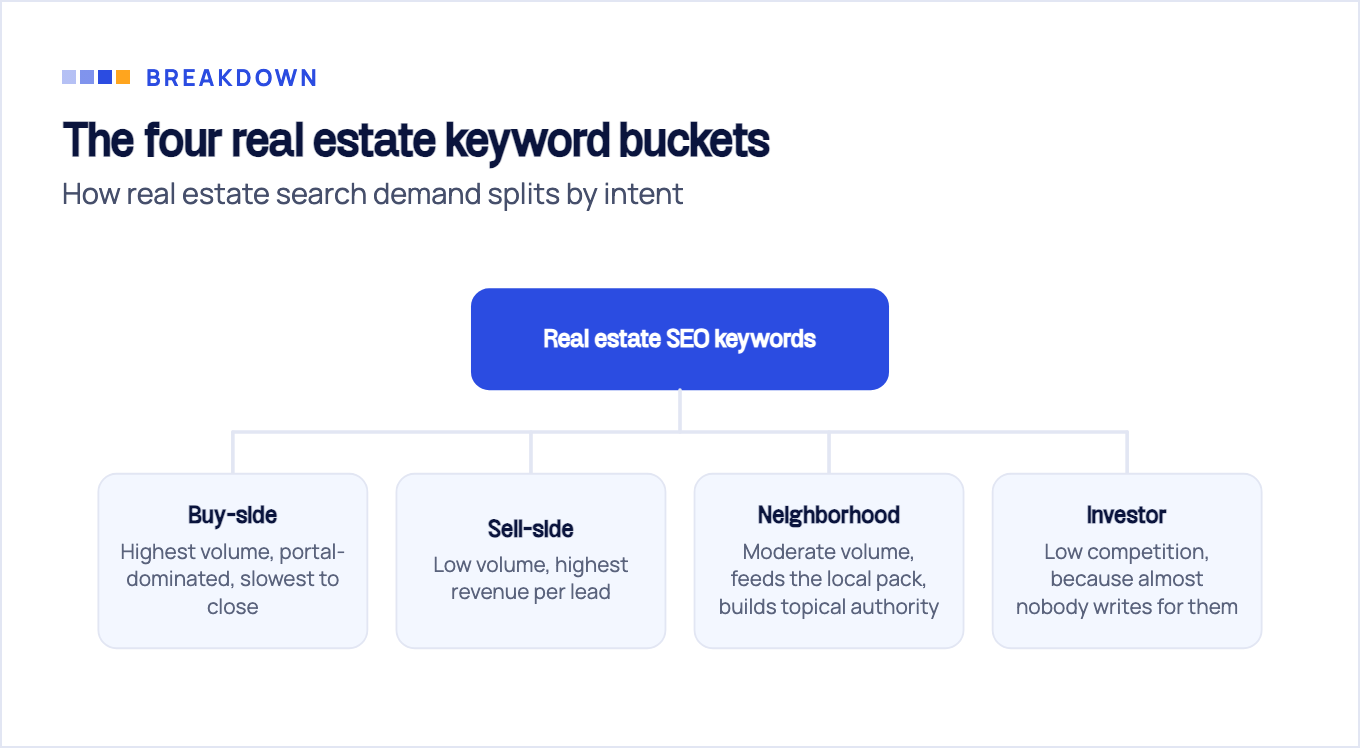
The four buckets, in one pass:
- Buy-side. Buyers hunting listings. Highest volume, portal-dominated, slowest to close.
- Sell-side. Homeowners deciding to list. Low volume, highest revenue per lead.
- Neighborhood. People choosing where to live. Moderate volume, feeds the local pack, builds topical authority.
- Investor. Buyers and sellers operating outside the classic resale funnel. Low competition, because almost nobody writes for them.
This split is also why the 100-keyword dump articles fail in practice. Ahrefs found that 96.55% of all pages get zero traffic from Google, based on a study of roughly 14 billion pages. Publishing against an unfiltered list is how you join them: you end up competing with portals you cannot beat, for searchers who were never going to call an agent.
Buy-side keywords: listings, MLS, and the portal problem
The patterns everyone starts with:
- homes for sale in [city]
- [city] condos under $400k
- houses with a pool in [city]
- new construction homes [city]
- [city] MLS listings
- townhomes for sale [neighborhood]
Now the honest part. Zillow (DR 92) and Realtor.com outrank agent sites for nearly every head term in this bucket; Zillow ranks even for the keyword-research query this very article targets. You will not beat a portal for “homes for sale in Austin”, and paying an agency that promises to try is money burned.
Where agents do win buy-side is the long tail. Long tail keywords for real estate follow a formula: property type plus price band plus feature, as in “3 bedroom homes with a pool under 600k in Round Rock”. Each one is tiny on its own, but they add up, and the portals serve them with generic filtered pages that a well-built IDX listing category page can beat on specificity. That is also where keywords for real estate listings belong: on listing category pages with real inventory, never on blog posts.
Know who is searching, too. NAR reports that first-time buyers fell to 21% of the market in 2025, the lowest share since tracking began in 1981, with the median first-time buyer now 40 and the median buyer overall 59. The young starter-home searcher your content calendar imagines is increasingly rare. Move-up buyers and downsizers filter hard by feature and price, which is exactly what long-tail modifiers capture.
One trade-off to accept before you invest here: buyer leads browse for months and convert at lower rates than seller leads. Which brings us to the bucket that deserves the first slot in almost every plan.
Sell-side keywords: the highest-value leads on the board
Seller queries are rarer, and each one is worth more than a page of buyer clicks:
- sell my house fast [city]
- what is my home worth
- home value estimator [city]
- best listing agent in [city]
- how much will I make selling my house
- should I sell my house now or wait
The math behind that claim comes straight from NAR’s 2025 Profile of Home Buyers and Sellers: 91% of sellers used an agent or broker, while for-sale-by-owner transactions fell to 5%, a historic low. A homeowner typing “sell my house” into Google is almost certainly going to hire someone. The only open question is who shows up when they search.
The standard conversion asset for this bucket is a home valuation landing page: address in, estimate and follow-up out. Point every valuation query and most “sell my house” variants at it. Sending that traffic to your homepage, where it has to hunt for the right link on its own, is the most common conversion leak we see on agent sites.
Neighborhood and local keywords: own your market, not the country
Nobody hires “a real estate agent” in the abstract; they hire one in a place. Neighborhood keywords are how you attach your site to the place:
- [neighborhood] homes for sale
- best neighborhoods in [city] for families
- moving to [city] guide
- living in [neighborhood] pros and cons
- [city] cost of living
These pages do two jobs. They rank for the queries above, and they feed your local pack presence. Google is unusually transparent here: local ranking runs on relevance, distance, and prominence, and the same documentation states flatly that “there’s no way to request or pay for a better local ranking on Google.” Deep, genuinely useful neighborhood content is the relevance lever you fully control; reviews and citations build the prominence side. We walk through the whole stack, Google Business Profile included, in our guide to local SEO for real estate, and it is the core of our local SEO service.
The city-list footer will get you filtered, not ranked
One warning before you scale this bucket. You have seen the footer: “Real estate agent in Springfield, Riverdale, Oakwood, Maplewood, Cedar Hills” and thirty more towns. Google’s spam policies name this exact pattern, listing “blocks of text that list cities and regions that a web page is trying to rank for” as an example of keyword stuffing. Build a real page for every market you genuinely serve, or skip the market. A wall of city names ranks for none of them and puts the rest of your site at risk.
Investor and commercial keywords: the segment every competitor skips
Open any ranking real estate keywords listicle and look for the investor terms. You get generic browse phrases like “investment property” and “rental listings”, and almost never the high-intent patterns investors actually search: we buy houses, cash home buyers, off market properties, multifamily, cap rate. That gap holds despite “keywords for real estate investors” pulling 350 searches a month at KD 4 and “commercial real estate keywords” another 450 at KD 4. The demand exists. The content supply does not.
Patterns worth building around:
- off market properties [city]
- we buy houses [city]
- cash home buyers [city]
- investment property for sale [city]
- multifamily for sale [city]
- what is a good cap rate for rental property
- BRRRR method explained
“We buy houses [city]” is a special case because it works in both directions: investors rank for it to reach distressed sellers, which has made it one of the most commercially contested local terms in the niche. Expect real competition there and budget accordingly.
For an investor-facing brokerage, the play is different. Informational content on cap rates, 1031 exchanges, and financing structures earns rankings and trust with an audience that transacts repeatedly. A homeowner sells once a decade; an active investor closes several deals a year. That difference changes what a single ranking is worth, and it is invisible to anyone working from a generic keyword dump.
Map every keyword to a page type or it will not rank
Here is the mistake that quietly kills most agent sites: every keyword gets pointed at the homepage. A homepage can rank for your brand and perhaps “[city] real estate agent”. Everything else needs its own page, built for its own intent.
| Bucket | Page type | Conversion asset |
|---|---|---|
| Buy-side long tail | IDX listing category pages | Listing alerts signup |
| Sell-side | Home valuation landing page + seller guides | Valuation form |
| Neighborhood | Neighborhood hub pages | Buyer consultation |
| Investor | Investor service page + blog cluster | Off-market list signup |
| Informational “how to” | Blog posts | Internal links to the pages above |
The informational row matters more than it looks. Blog posts rarely convert directly; their job is to rank for question queries and pass authority to the money pages through internal links. A post without a link to the page it supports is a dead end, however well it ranks.
Two implementation details separate pages that rank from pages that merely exist. Listing and neighborhood pages should carry structured data, and we cover which types Google actually rewards in our real estate schema markup guide. And the unglamorous wiring of titles, headings, internal links, and one-intent-per-page discipline is most of what our on-page SEO service delivers for real estate clients.
How to build your own list (and the two myths that waste your time)
You can assemble a market-specific keyword set in an afternoon:
- Seed the four buckets. Combine every pattern in this article with your city and your ten most active neighborhoods.
- Run a gap analysis. Pull the keywords the top three agent sites in your market rank for that you do not. Their winners are your shortlist.
- Mine Search Console. Queries where you already sit on page two are the cheapest rankings you will ever earn; they usually need a refresh of an existing page, not a new one.
- Prioritize difficulty against lead value. A KD 2 seller keyword beats a KD 40 buyer keyword every single time, whatever the volume columns say.
Two myths to drop on the way. First, meta keywords: “meta keywords for real estate” still pulls around 350 searches a month, all of them wasted effort. Google confirmed back in 2009 that it does not use the keywords meta tag in web ranking, and that statement is still live in its documentation today. Leave the tag empty. Second, the idea that stacking more keywords onto a page earns more rankings. Past a natural handful of variants it becomes keyword stuffing, the same policy violation as the city-list footer above. One page, one intent, a few natural variations.
That mapping discipline, where every keyword is chosen for the lead it can produce and assigned to a page built to convert it, is the FLG method we run for agents, teams, and brokerages. It comes from 10+ years of doing this for 100+ clients across the USA, UK, and EU, with 200,000+ keywords in top 3. If you would rather see the keyword-to-page map built for your market than build it yourself, start with our real estate SEO page.
Sources & fact-check
Every factual claim in this article is checked against primary sources, not opinion. Written by Roman Sydorenko, Chief SEO & AI search. Last verified July 16, 2026.
- Primary dataNAR, 2025 Home Buyers and Sellers Generational Trends (43% of buyers looked online first, the top first step)
- Primary dataNAR, Top 10 takeaways from the 2025 Profile of Home Buyers and Sellers (91% of sellers used an agent, FSBO 5%)
- OfficialGoogle Business Profile Help, Improve your local ranking (relevance, distance and prominence, no paid ranking)
- OfficialGoogle Search Central, Spam policies for Google web search (lists of cities and regions are keyword stuffing)
- OfficialGoogle Search Central Blog, Google does not use the keywords meta tag in web ranking (still unsupported)
- Primary dataAhrefs, Search traffic study (96.55% of pages get no traffic from Google, across roughly 14 billion pages)
