Enterprise SaaS SEO is search engine optimization for SaaS companies that sell into enterprise accounts: high contract values, sales cycles that run six to twelve months, and purchase decisions made by a buying committee rather than a single user. The goal is not traffic. It is being present, with the right page, every time someone on that committee quietly researches your category, your security posture, or your competitors without ever telling you they exist. This guide covers how to build that presence and how to measure whether it produces pipeline.
What is enterprise SaaS SEO?
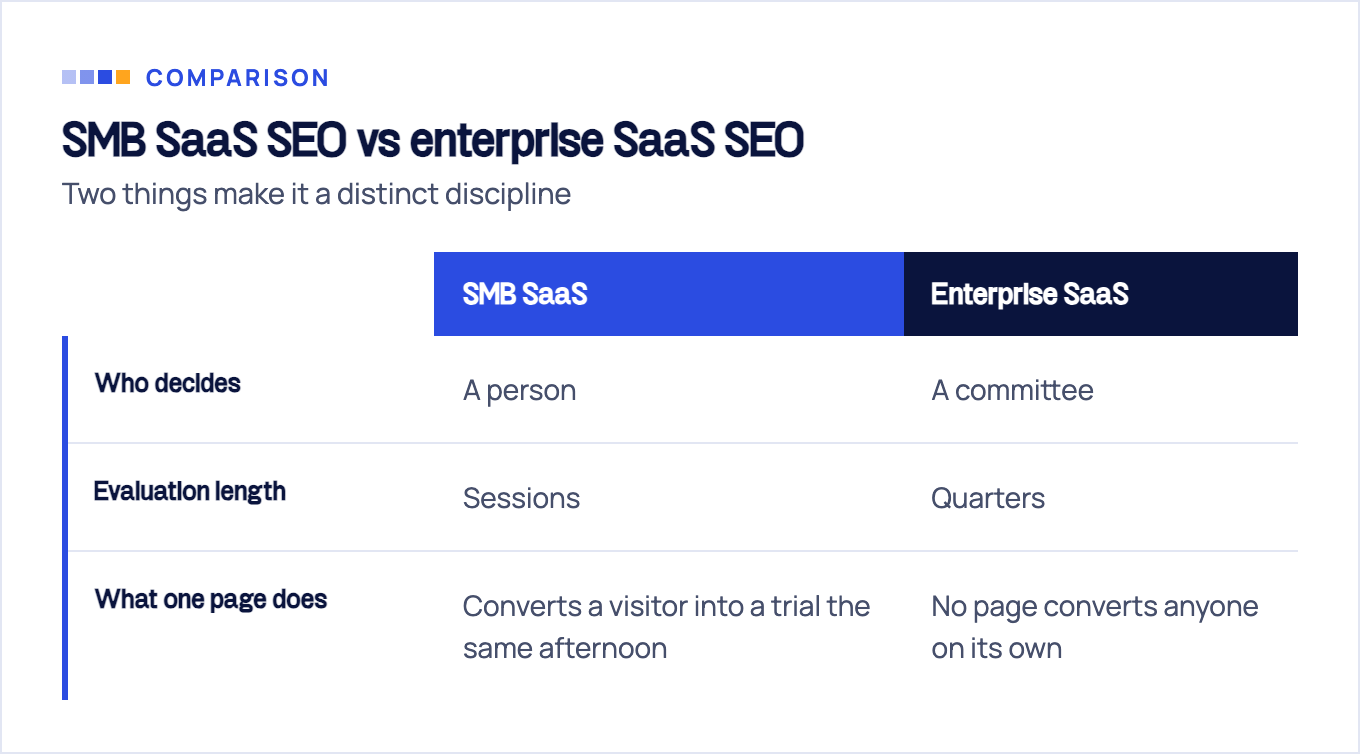
Enterprise SaaS SEO means ranking for the queries an enterprise buying committee runs during evaluation (category and comparison searches from the champion, API and integration questions from the technical evaluator, SOC 2 and data-residency checks from the security reviewer, pricing and ROI queries from procurement) and keeping the large, multi-product site behind those pages technically sound. Two things make it a distinct discipline: the buyer is a committee, not a person, and the evaluation stretches across quarters, not sessions.
One disambiguation before we go further, because this exact phrase gets read two ways. This article is about SEO for enterprise SaaS companies, meaning strategy. It is not a roundup of enterprise SEO software platforms, which is what part of this search result page is selling. If you want the foundation the enterprise motion builds on, our SaaS SEO playbook covers the general system: bottom-funnel pages first, comparison templates, PLG assets.
The enterprise layer changes the emphasis. In SMB SaaS, a good comparison page can convert a visitor into a trial the same afternoon. In enterprise SaaS, no page converts anyone on its own. Each page does a narrower, more valuable job: it answers one stakeholder’s question well enough to keep you on the shortlist, and it holds up when that stakeholder pastes the link into Slack for the rest of the committee.
Enterprise deals are decided in search before sales ever gets a call
The research phase of an enterprise deal is long, anonymous, and mostly finished before you know the account exists. The 6sense 2024 B2B Buyer Experience Report puts numbers on it: 69% of the purchase process happens before buyers engage with sellers, 85% of buyers establish their purchase requirements before ever contacting sales, and 81% have already chosen a preferred vendor before the first sales conversation.
Read those three numbers together and the strategic picture is blunt. By the time a demo request lands, the requirements list is written and a favorite has usually been picked. Your content either shaped that requirements list, or a competitor’s content did. The RFP criteria that mysteriously match a rival’s feature set were not a coincidence. Someone on the committee read their comparison page months ago.
This is also where enterprise SaaS SEO diverges from traffic-driven content marketing. A handful of high-intent queries searched by the right five people at a target account matter more than a keyword with ten thousand monthly searches from students and job-seekers. We call this operating principle FLG (Focused Lead Generation), and enterprise SaaS is the segment where it applies in its purest form, because the entire addressable audience for some of your most valuable pages might be a few hundred security reviewers a year.
Map keywords to the buying committee, not a single persona
Most SaaS keyword research builds a list for one imagined user. Enterprise keyword research needs a matrix, because five different people at the same account are searching independently, with different vocabularies, and each can veto the deal. Map queries to roles:
| Committee role | What they actually search | Page that should answer |
|---|---|---|
| Champion / end user | ”yourproduct vs competitor”, “competitor alternatives”, workflow how-tos | Comparison and alternatives pages, use-case pages |
| Technical evaluator | ”yourproduct API rate limits”, “yourproduct SSO SAML setup”, “yourproduct Snowflake integration” | Public docs, integration pages |
| Security / compliance reviewer | ”yourproduct SOC 2”, “is yourproduct HIPAA compliant”, “yourproduct data residency” | Indexable trust and compliance pages |
| Procurement / finance | ”yourproduct enterprise pricing”, “yourproduct ROI”, “yourproduct implementation cost” | Pricing page, business-case content |
| Executive sponsor | ”best yourcategory for financial services”, analyst-style category queries | Category page, industry solution pages |
Each row is a separate research thread happening on its own timeline. The champion found you in month one. The security reviewer shows up in month five, types your brand plus “SOC 2” into Google, and judges you on whatever ranks. The executive sponsor spends ten minutes total and forms an opinion from a category page and whatever an AI assistant summarizes.
Two practical consequences follow. First, coverage beats depth-in-one-spot: a brilliant blog strategy aimed only at champions still loses deals in the security review. Second, every page on your site is a proxy sales rep, because links get forwarded internally and read by people who never visit another page. Write each page to stand alone: state what the product is, who it is for, and where to go next, even on pages “everyone” supposedly reaches through the homepage.
Building this matrix is the core of the keyword work we do in B2B SEO engagements: pull real queries from sales-call transcripts, security questionnaires, and support tickets, then assign each to a committee role and a page type before writing anything.
Security and compliance queries: the highest-converting pages nobody builds
Here is the strangest gap in enterprise SaaS SEO, and the reason it deserves its own section: the queries with the most direct pipeline impact are the ones almost no vendor builds indexable pages for.
When a security reviewer searches “is yourproduct SOC 2 compliant” or “yourproduct data residency Europe”, one of three things happens. Your page answers them. A third-party site answers for you, with whatever accuracy it happens to have. Or nothing answers, and your champion gets an email asking questions that stall the deal for two weeks. Only the first outcome is good, and it is entirely within your control, because these queries have near-zero competition: no publisher writes about your subprocessor list.
The common failure mode is having the answers but hiding them. Trust centers gated behind email walls, security details locked inside PDFs, compliance pages blocked from indexing out of vague caution. The reviewer never fills in your form to read what a competitor publishes openly. Gate the audit report itself if you must; never gate the existence of the certification.
What to build, one indexable URL per question:
- SOC 2 (and the audit period it covers), ISO 27001, and any industry-specific attestations
- GDPR and data residency: where data lives, what regions you offer, transfer mechanisms
- HIPAA, if you touch health data, including whether you sign BAAs
- SSO, SAML, and SCIM support, with the plans they are available on
- Uptime SLA and public status history
- DPA and subprocessor list, in HTML, not only PDF
Format each page the same way: plain-language answer in the first two sentences, details below, links to the formal documents at the end. Then link to these pages from pricing and product pages, because reviewers navigate as often as they search, and internal links tell Google the pages matter.
Content that survives a 6-12 month sales cycle
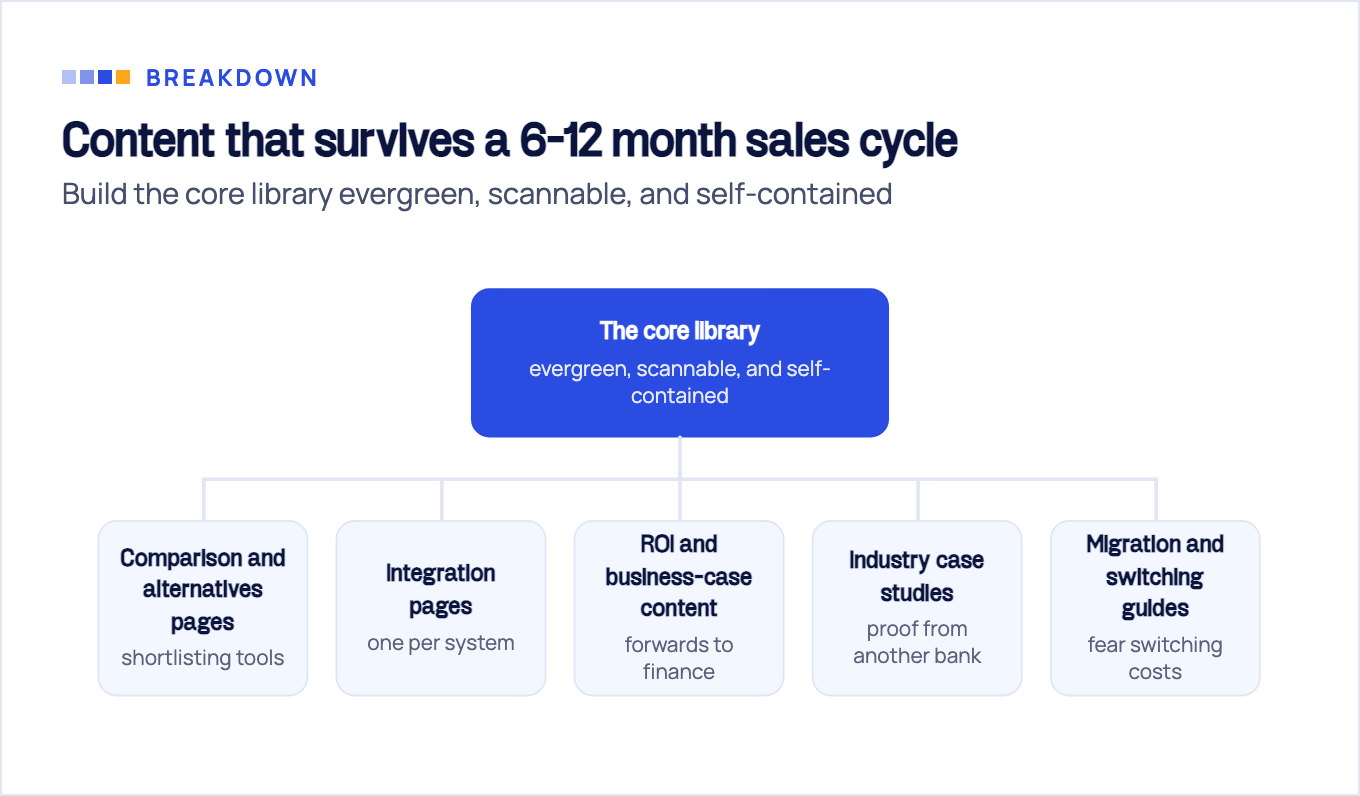
Enterprise content has a shelf-life requirement that SMB content does not. A page discovered in February gets re-shared to a procurement lead in September; if it opens with “as of this quarter” trend-chasing, it reads stale exactly when the deal is closing. Build the core library evergreen, scannable, and self-contained:
- Comparison and alternatives pages: the champion’s shortlisting tools, and often the first touch of the entire deal
- Integration pages: one per system in the enterprise stack you connect to, with real setup detail, not logo walls
- ROI and business-case content: the page a champion forwards to finance to justify the line item; give it the structure of an internal memo, because that is the job it does
- Industry case studies: an executive sponsor at a bank wants proof from another bank, not a generic logos-and-percentages page
- Migration and switching guides: enterprises fear switching costs more than price; a concrete “how to move from CompetitorX” guide de-risks the decision
The connective tissue matters as much as the pages. The same account will hit your site dozens of times over the cycle, from different roles and entry points. Internal linking between blog posts, solution pages, and the trust content from the previous section is what turns scattered visits into a coherent evaluation, and it is worth far more here than in SMB SaaS, where journeys are short. Our guide to B2B SaaS SEO covers the broader multi-stakeholder content motion this builds on.
One honest caveat: do not build all of this at once. Sequence by deal impact: comparisons and compliance pages first, because they sit inside active evaluations, then integrations, then the business-case and industry layers.
Technical SEO at enterprise SaaS scale
Enterprise SaaS sites break in predictable places: a docs subdomain with tens of thousands of auto-generated pages, an integration marketplace spawning URL variants, programmatic template pages, and a multi-product architecture where three teams ship to the same domain without talking. The good news is that the scary-sounding problems are diagnosable with primary-source thresholds instead of folklore.
Take crawl budget, the most over-diagnosed issue in enterprise SEO. Google’s own crawl-budget documentation says it is mainly a concern for sites with over a million unique pages that change weekly, or ten thousand-plus pages changing daily, and that most sites do not need to worry about it. A five-thousand-page marketing site with indexation problems has a quality or internal-linking problem, not a crawl-budget problem. Check which one you actually have before renaming half your URLs.
Sitemaps are the cheapest diagnostic instrument you have at scale. Per Google’s sitemap documentation, a single sitemap caps at 50,000 URLs or 50MB uncompressed, with sitemap index files tying larger sets together. Use that structure deliberately: one sitemap per section (docs, integrations, blog, product) so Search Console shows you indexation rates per section and tells you where the problem lives instead of averaging it away.
Rendering is the third recurring failure. If your marketing site or docs run as a client-side JavaScript app, remember that Google processes JavaScript in three phases (crawling, rendering, indexing) and pages queue for rendering, which can take seconds or considerably longer. Content that only exists after JS execution gets indexed late or inconsistently. Server-render or statically generate anything a committee member might search for; that includes the docs your technical evaluator lives in.
When a site has grown past the point where anyone holds the full picture, a structured technical SEO audit is usually worth more than another content sprint. It tends to surface a handful of section-level indexation problems that cap everything else.
AI search: when the buying committee asks ChatGPT instead of Google
A growing share of committee research now happens inside AI assistants. The security reviewer asks ChatGPT whether you are SOC 2 compliant. The executive sponsor asks for the best platform in your category for their industry. You will never see these queries in a rank tracker, but pages you control still decide the answers.
Two primary-source facts anchor what to do about it. First, Google states plainly that there are “no additional requirements to appear in AI Overviews or AI Mode, nor other special optimizations necessary”: no special files, no AI-specific markup. Foundational SEO carries over. Second, OpenAI’s bot documentation confirms that OAI-SearchBot is what surfaces websites in ChatGPT search; block it in robots.txt and you disappear from those answers. The two tokens are separate: a rule aimed at GPTBot, the training crawler, says nothing about OAI-SearchBot, while a blanket wildcard quietly blocks both. Plenty of those rules were written years ago and never revisited, so check yours today.
The practical work is mostly the work you have already done if you followed this guide. The indexable, plainly-worded compliance and comparison pages from earlier sections are exactly what AI systems cite when a buyer asks about you: self-contained answers, stated in the first sentences, on crawlable URLs. Vendors whose security posture lives behind an email gate are invisible in these answers, and an AI summary of your product assembled from third-party scraps is not a summary you want in front of an executive sponsor. We cover the mechanics in more depth in our guide to ranking in AI Overviews.
Measuring enterprise SaaS SEO: pipeline, not traffic
Measurement is where enterprise SaaS SEO programs most often get killed unfairly, because last-click attribution is close to worthless across a multi-quarter cycle. The security reviewer who read your SOC 2 page in month five will never fill in a form; the demo request arrives months later from a colleague on a branded search. Judge the channel on last click and the pages doing the heaviest lifting look useless.
Track what reflects how the deal actually happened:
- Organic-influenced pipeline: deals where any committee member touched organic pages during the cycle, which your CRM or account-based tooling can surface even when individual visitors stay anonymous
- Demo requests from organic-touched accounts, not just organic-last-click conversions
- Committee query coverage: for the queries in your buying-committee matrix, does a page you control rank? Treat gaps as open vulnerabilities on live deals, because that is what they are
- Section-level indexation health from the segmented sitemaps above, so technical decay shows up before rankings do
Set timeline expectations in the same honest register: this channel compounds in quarters, not weeks, and anyone promising enterprise pipeline from SEO in month two is guessing. The compensation is durability: a compliance page or comparison page keeps working every deal, every quarter, without a per-click bill.
This buying-committee system (the query matrix, the trust content, the pipeline-first measurement) is what we run for enterprise SaaS clients: 10+ years, 100+ clients across the USA, UK, and EU, 200,000+ keywords in the top 3. Our enterprise SEO services page explains how an engagement is scoped and what the first quarter looks like.
Sources & fact-check
Every factual claim in this article is checked against primary sources, not opinion. Written by Roman Sydorenko, Chief SEO & AI search. Last verified July 16, 2026.
- OfficialGoogle Search Central, AI features and your website (no special optimization for AI Overviews or AI Mode)
- OfficialOpenAI, Overview of OpenAI Crawlers (OAI-SearchBot serves ChatGPT search, GPTBot crawls for model training)
- OfficialGoogle Search Central, Managing crawl budget for large sites (applies at 1M+ pages weekly or 10k+ daily)
- OfficialGoogle Search Central, Build and submit a sitemap (one sitemap caps at 50MB uncompressed or 50,000 URLs)
- OfficialGoogle Search Central, JavaScript SEO basics (crawling, rendering and indexing are separate phases)
- Primary data6sense, The 2024 B2B Buyer Experience Report (survey of 2,509 B2B buyers behind the 69/85/81 figures)
