B2B SaaS SEO is organic search acquisition for software sold to companies rather than individuals. It differs from B2C SaaS SEO in three structural ways: the buyer is a committee of roughly 10 to 11 people according to 6sense’s Science of B2B research, the buying journey runs over 10 months with about 6 of them spent in anonymous research, and success is measured in pipeline and revenue rather than signups. Every section in this guide solves one of those three problems.
What makes B2B SaaS SEO different from B2C SaaS SEO
B2C SaaS sells to one person who can swipe a card today. B2B SaaS sells to an organization, and that single change breaks most of the standard SEO playbook. Here is where the two diverge:
| B2C SaaS | B2B SaaS | |
|---|---|---|
| Who decides | One user | A buying committee of ~10-11 people |
| How long it takes | Minutes to days | 10+ months, ~6 of them anonymous |
| What SEO must produce | Signups | Opportunities and closed-won revenue |
| Keyword logic | Volume matters | Intent and deal stage matter |
Three consequences follow, and they shape everything else in this article.
The buyer is a committee. The typical B2B practitioner in the 6sense research sells to buying teams of 10 to 11 individuals. An end user, a champion, an economic buyer, a security reviewer, and procurement all touch the deal, and each of them types different things into Google. A keyword strategy built around one persona leaves the other roles unconvinced, and any one of them can kill the purchase.
The sales cycle is long and mostly invisible. The same research puts the typical buying journey at over 10 months, with around 6 of those spent in what 6sense calls the Selection Phase: anonymous research, shortlisting, and reading your comparison pages without filling a single form. Your content does most of its selling before you know the account exists.
The scoreboard is pipeline. A B2C team can celebrate signups the same week a post ranks. In B2B, a page pulling a few dozen visits a month from security reviewers can matter more than a blog post pulling thousands from students. If your reporting stops at traffic, you cannot tell the two apart.
The rest of this guide works through those three problems in order: map keywords to the committee, map intent across the cycle, and wire attribution so organic search gets credit for the revenue it creates.
Map keywords to the buying committee, not one persona
Standard SaaS keyword research starts with a question that is too small for B2B: “what does our user search for?” Once a deal needs sign-off from finance, security, and procurement, the user is only one of five audiences, and usually the easiest one to win.
Each committee role searches differently, and each needs a different page to say yes:
| Committee role | Typical query patterns | Page that convinces them |
|---|---|---|
| End user | ”how to do X”, feature-level how-tos | Docs, help center, product-led tutorials |
| Champion | ”you vs competitor”, “best tool for X”, “competitor alternatives” | Comparison and alternatives pages |
| Economic buyer | ”category ROI”, “cost of X”, “is X worth it” | Pricing page, ROI and cost-justification content |
| IT / security reviewer | ”product + SOC 2”, “product + security”, “product + GDPR” | Security and trust page, compliance documentation |
| Procurement | ”product pricing”, contract and SLA terms | Pricing, terms, vendor onboarding pages |
Most SaaS marketing sites only serve the champion, because the champion is who the marketing persona describes. That is the gap. The champion finds you, loves you, brings you into the deal, and then the security reviewer googles your product name plus “SOC 2” and finds a competitor’s trust center, a stale forum thread, or nothing. The deal stalls, and no analytics report will ever tell you why.
The practical rule: for your core use case, build at least one search-facing asset per committee role. That usually means five pages, not fifty, and most of them are pages your product and legal teams half-maintain already. SEO’s job is to make them findable, current, and persuasive.
Intent mapping across a 10-month sales cycle
The LinkedIn B2B Institute, working with the Ehrenberg-Bass Institute, calls it the 95-5 rule: at any given moment, about 95% of your potential buyers are not in the market, and only around 5% are actively buying. For a category with a 10-month cycle, this is not a slogan. It is the actual shape of your demand.
That reframes the funnel more usefully than TOFU/MOFU/BOFU labels do:
- In-market content serves the 5%. Comparison, alternatives, pricing, and integration queries. These searchers can become pipeline this quarter, so these pages get built first.
- Out-market content serves the 95%. Problem-space and education queries. Nobody reading them buys this month. Their job is memory: when a reader enters the market in month eight, your name is already on the mental shortlist, and the branded search that follows looks like it came from nowhere.
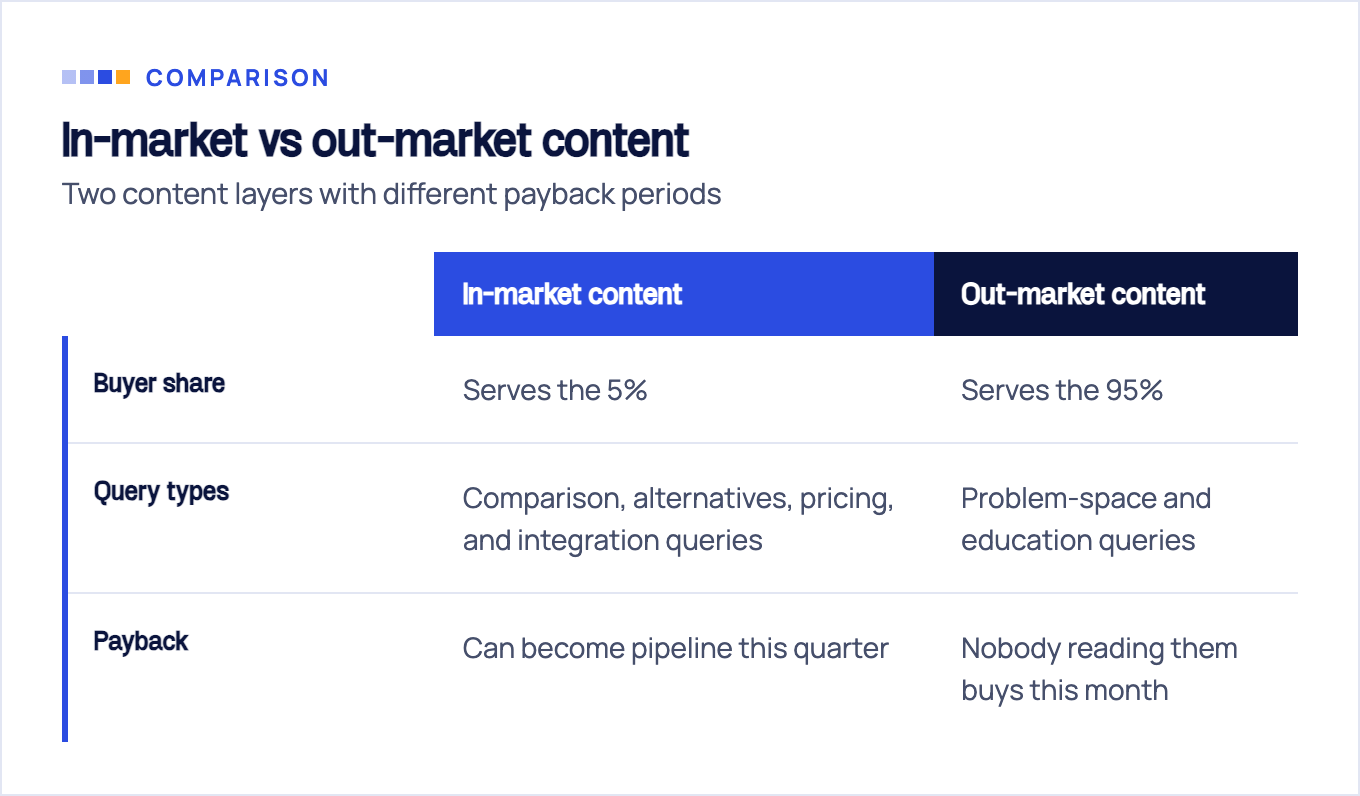
Both layers matter, but they are investments with different payback periods, and mixing them in one “content calendar” is how teams end up unable to explain what any of it achieved.
The other adjustment is how you value keywords. Volume-first prioritization fails twice in B2B. First, most published content earns nothing anyway: an Ahrefs study of roughly 14 billion pages found 96.55% of them get zero traffic from Google. Second, volume tools measure the whole internet, while your buyer pool might be a few thousand companies. A query a tool reports as ten searches a month can be typed exclusively by people evaluating vendors, which makes it worth more than a ten-thousand-volume definitional term.
The fix is to price keywords against your CRM instead of a volume column. For every candidate keyword, ask which deal stage the searcher is in and which page moves them to the next stage. A keyword that maps cleanly to “evaluation” or “security review” earns a page even at near-zero reported volume. A keyword that maps to no stage earns nothing, whatever its volume. This buyer intent mapping is the single highest-leverage hour in B2B SaaS keyword research.
If you want the general system this sits on top of, our SaaS SEO playbook covers the full bottom-funnel-first framework; this article is the B2B layer on top of it.
BOFU pages that create pipeline, not traffic
Sequencing is the advice most guides skip: build bottom-of-the-funnel pages first, because they are the only SEO investment that can pay back inside a single sales cycle. Out-market content compounds beautifully, but it compounds from zero for most of a year. BOFU pages catch the 5% who are buying right now.
For B2B SaaS, five page types carry the weight:
- Competitor comparisons. “You vs competitor” for every serious rival. Honest tables, real screenshots, a verdict per segment.
- Alternatives pages. “Competitor alternatives” queries are typed by their unhappy customers. Warmest traffic in the category.
- Integration pages. One page per integration partner, written around the workflow the pairing enables rather than the plumbing.
- Use-case and industry pages. One per core use case per target industry, in the language that industry uses, not your feature names.
- Pricing-adjacent content. Pricing explainers, cost comparisons, “how X pricing works”. Economic buyers and procurement live here.
Write all of these as product-led content: show the product actually doing the searcher’s job, with real interface, real steps, and honest notes about where it is not the right fit. A committee that has watched your product solve their exact problem arrives at the demo pre-sold, and admitting a weakness costs you the deals you would have lost anyway while earning trust in all the others.
Expect these pages to look unimpressive in a traffic report and dominant in a pipeline report. Bottom of the funnel keywords in B2B often show tiny volumes, and the resulting pages convert at rates editorial content never approaches. That mismatch is exactly why volume-first teams skip them, and why building them is still an easy edge.
For the page-by-page execution details, from title patterns to internal linking, work through our SaaS SEO checklist.
CRM attribution: prove revenue, not rankings
Here is the problem no competitor guide on this topic touches: in B2B, last-click attribution systematically erases SEO’s contribution. Recall the 6sense finding that roughly 6 of the 10+ buying-journey months happen in anonymous research. A buyer reads your comparison page in month two, comes back through a branded search in month nine, and books a demo. Last-click hands the credit to “branded search” or “direct”, and the comparison page that actually did the selling reports zero.
If you cannot fix this, you will underinvest in exactly the content that creates pipeline. The wiring takes a few hours in GA4 plus HubSpot or Salesforce:
- Capture first organic touch. Stamp the first landing page and source (organic, referral, paid) onto the contact record at form fill. Hidden form fields fed by a first-party cookie are enough.
- Report first-touch and multi-touch side by side. First-touch shows which pages open relationships; multi-touch shows which pages appear in closed-won journeys. You need both views, because each one alone lies.
- Add self-reported attribution. A free-text “how did you hear about us?” field on the demo form catches the dark funnel that no cookie sees: a colleague’s recommendation, a community thread, an AI chat that summarized your comparison page.
- Review quarterly, in revenue terms. Opportunities and closed-won by first organic touch, page by page. This is the report that survives a CFO conversation; a ranking screenshot does not.
This measurement discipline is the core of how we run engagements at SEOBRO. We scope SEO to focused lead generation, meaning the deliverable is defined in leads and pipeline rather than traffic, and the attribution wiring above goes in during week one of our B2B SEO service so every page built afterwards is measured in revenue from day one.
Technical foundations specific to B2B SaaS sites
Technical SEO for a B2B SaaS site is mostly standard, with four decisions that are specific to the model and worth getting right early.
Separate the marketing site from the app. Keep the application on its own subdomain and the marketing site on the root domain, and make sure logged-in app URLs never leak into the index. Crawl budget and link equity should concentrate on the pages that sell.
Decide your docs indexation strategy deliberately. Help-center and documentation queries are how end users, one of your committee roles, find and judge you. Indexed docs can rank for hundreds of long-tail jobs; unindexed docs are a wasted asset. Whichever way you go, choose it, rather than inheriting whatever your docs platform defaults to.
Template integration and use-case pages without going thin. Templated pages scale, but every instance needs content only that instance could carry: the specific workflow, the specific data objects, a screenshot of that integration working. If you cannot say anything specific about a pairing, do not publish the page; thin near-duplicates put the whole template at risk.
Ship software schema. Mark up the product with SoftwareApplication or WebApplication structured data. Per Google’s structured data documentation, three properties are required: name, offers.price (set to 0 if there is a free tier), and either aggregateRating or review. It is ten minutes of work for eligibility in software rich results.
AI search: your buyers now start in ChatGPT and AI Overviews
Search this article’s own topic and the first thing you see is an AI Overview. That is the new baseline for software queries, and it changes the economics of ranking. In an Ahrefs study of 300,000 keywords, the presence of an AI Overview correlated with a 34.5% lower clickthrough rate for the top-ranking page compared to similar queries without one.
For B2B SaaS the trade is better than it sounds. Committee members increasingly do their early research inside ChatGPT and AI Overviews, then click through already oriented, sometimes already convinced. Google’s own documentation states there are no additional requirements to appear in AI Overviews or AI Mode beyond standard SEO best practices, and notes that clicks from pages with AI Overviews are higher quality, with users more likely to spend more time on the site. Fewer clicks, warmer clicks.
The practical play is citability. AI systems quote content that is easy to lift: a clean two-sentence definition at the top of a section, a sourced statistic, a comparison table with honest rows. Everything this guide already recommends for the buying committee, in other words, doubles as AI-answer material. If a model summarizes your comparison page to a security reviewer, that is a committee touch you never see in analytics, which is one more reason self-reported attribution belongs on your forms.
We keep a separate tactical guide on how to rank in AI Overviews; apply it to your BOFU pages first, since those are the answers buyers act on.
A 90-day B2B SaaS SEO roadmap
Everything above compresses into a first quarter that looks like this.
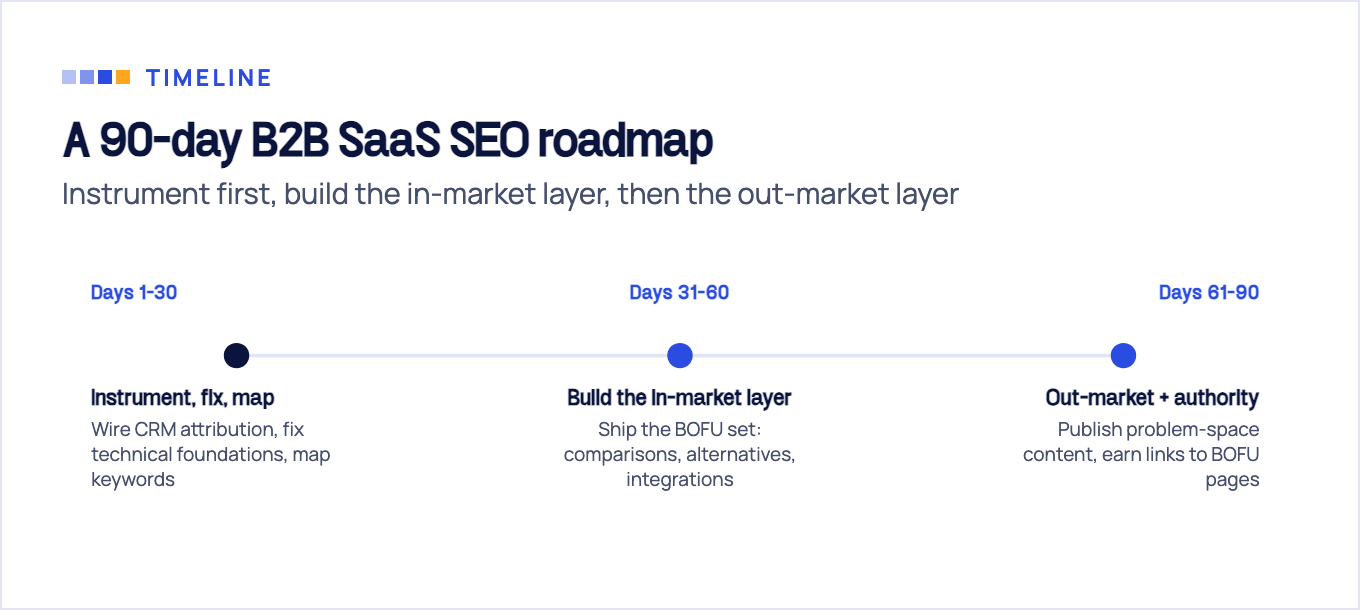
Days 1-30: instrument, fix, map. Wire CRM attribution before you publish anything, so every page built afterwards is measured from its first visit. Fix the technical foundations: app/marketing split, docs indexation decision, software schema. Build the committee keyword map for your core use case, five roles deep, priced by deal stage rather than volume.
Days 31-60: build the in-market layer. Ship the BOFU set: comparison pages for your top competitors, alternatives pages, the first integration and use-case pages, and a security and trust page the reviewer role can find. This is the layer that can produce pipeline inside the current sales cycle.
Days 61-90: start the out-market layer and build authority. Publish the first problem-space content for the 95%, aimed at the queries your future buyers run months before they are buyers. Begin earning links to the BOFU pages, which rarely attract them naturally; our SaaS link building guide covers the approaches that work for software companies without junk directories.
Set expectations against the sales cycle, not the calendar quarter. First rankings and first organic-sourced conversations typically show up within the quarter; provable closed-won attribution takes roughly one full sales cycle, because that is how long your buyers take to buy. After that first cycle the system compounds: the BOFU pages keep converting, the out-market content starts feeding them, and the attribution reports get harder to argue with each quarter.
That sequencing, measured in pipeline instead of traffic, is the whole method. We have been running it for over 10 years across 100+ clients in the USA, UK, and EU, and it is the reason the model holds 200,000+ keywords in top 3. If you would rather see how it applies to your product than build it solo, our SaaS SEO team starts every engagement with exactly the committee map and attribution setup described here.
Sources & fact-check
Every factual claim in this article is checked against primary sources, not opinion. Written by Roman Sydorenko, Chief SEO & AI search. Last verified July 16, 2026.
- OfficialGoogle Search Central, AI features and your website (no extra requirements for AI Overviews or AI Mode)
- OfficialGoogle Search Central, Software App structured data (required properties, and WebApplication is supported)
- Primary data6sense, AI-Driven Go-to-Market (buying teams average 10.9 people over a journey longer than 10 months)
- Primary dataLinkedIn B2B Institute with Ehrenberg-Bass, The 95-5 Rule (about 95% of potential buyers are out-market today)
- Primary dataAhrefs, Search traffic study (96.55% of around 14 billion indexed pages get zero traffic from Google)
- Primary dataAhrefs, AI Overviews reduce clicks (position-1 clickthrough 34.5% lower across a 300,000 keyword sample)
