SaaS SEO is the practice of ranking the pages that map to how software buyers actually search (category terms, competitor comparisons, alternatives, use cases, and documentation queries) so that organic search produces signups and demos, not just traffic. It differs from traditional SEO because recurring revenue changes what a ranking is worth: a page that brings two paying customers a month can outearn a blog post pulling fifty thousand visits. This guide covers the full playbook: what to build, in what order, and what to skip.
What is SaaS SEO? (and how it’s different from regular SEO)
SaaS SEO means building and ranking pages for every stage of a software buyer’s evaluation: the category query when they realize they need a tool, the comparison and alternatives queries when they shortlist, and the how-do-I-do-this queries after they sign up. The output metric is qualified pipeline, not sessions.
Three things make SEO for SaaS companies genuinely different from publisher or e-commerce SEO:
Recurring revenue changes the math. An e-commerce ranking earns one transaction per visitor. A SaaS ranking earns a subscription that pays out every month for years. That means low-volume, high-intent keywords, the ones most content teams ignore, are usually the most valuable pages on the site.
Buyers self-serve most of the research. By the time a software buyer talks to sales, they have typically already read comparisons, checked pricing, and skimmed the docs. If your pages are not the ones they read, a competitor’s pages did the selling.
You can manufacture your own bottom-funnel demand. A plumber cannot invent new “emergency plumber near me” searches. A SaaS company can create pages for every competitor’s alternatives query, every integration pairing, every template a user might search: inventory that compounds.
Do SaaS companies need SEO at all? If your category has paid search competition, yes. Software keywords carry some of the most expensive CPCs in advertising, and paid acquisition stops the moment you stop paying. Organic rankings for the same commercial queries keep converting without a per-click bill, which is why organic tends to become the cheapest durable channel as a SaaS company scales.
Bottom-funnel first: the order most SaaS teams get backwards
Almost every failed SaaS SEO strategy fails the same way: the team hires writers, publishes two blog posts a week on broad top-of-funnel topics, and eighteen months later has hundreds of articles and no pipeline. The scale of that failure mode is measurable. An Ahrefs study of roughly 14 billion pages found that 96.55% of all pages get zero traffic from Google. Publishing more of what nobody clicks is not a strategy.
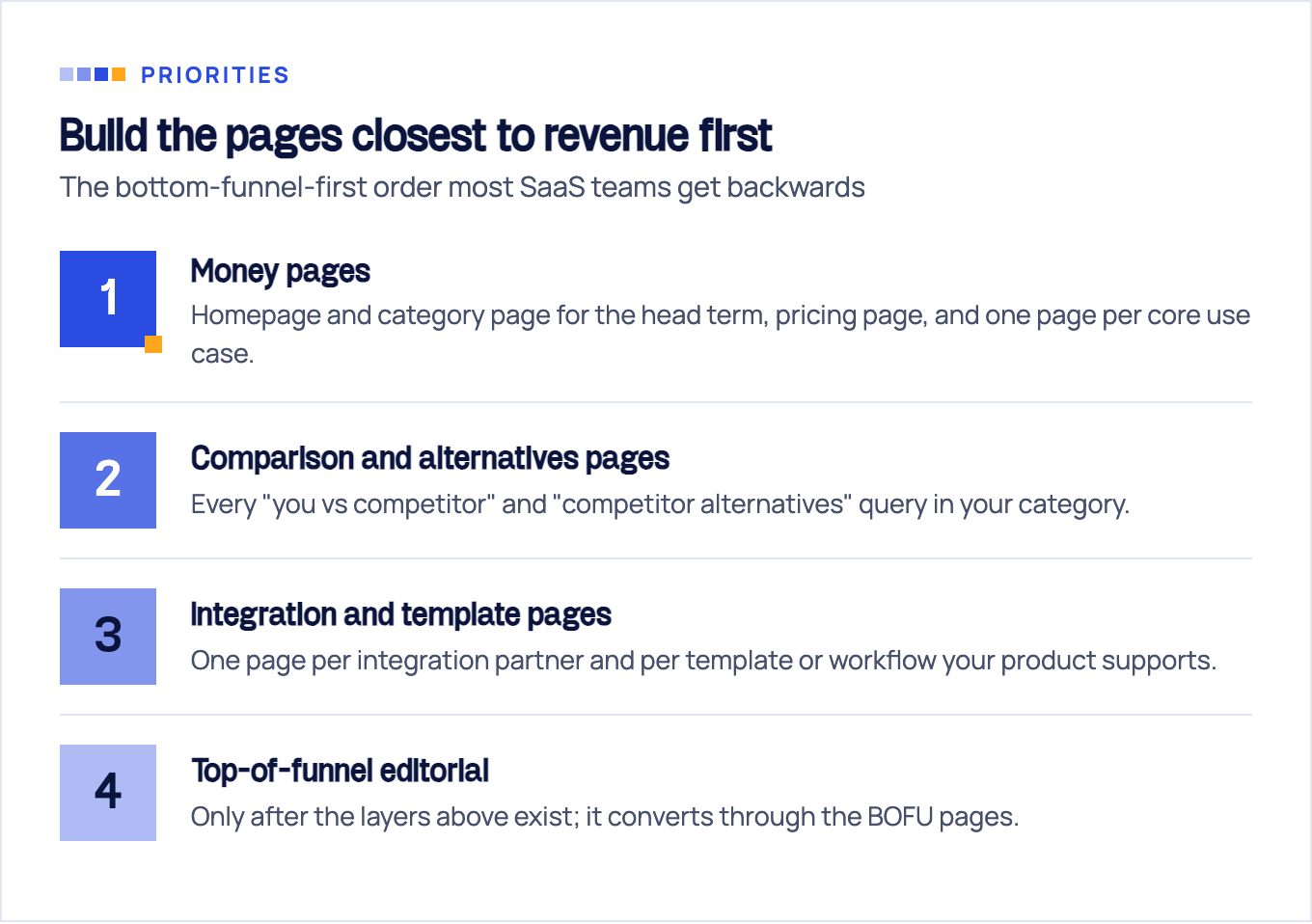
The fix is to invert the order. Build the pages closest to revenue first:
- Money pages. Your homepage and category page targeting the head term (“applicant tracking system”), pricing page, and one page per core use case.
- Comparison and alternatives pages. Every “you vs competitor” and “competitor alternatives” query in your category. These deserve their own section below.
- Integration and template pages. One page per integration partner and per template or workflow your product supports.
- Top-of-funnel editorial. Only after the layers above exist. TOFU content builds topical authority and feeds retargeting, but it converts through the BOFU pages, so it needs somewhere to send people.
We call this operating order FLG (Focused Lead Generation), and it is the thesis behind everything in our SaaS SEO content hub. The keyword-mapping method that drives it is compact:
| Step | What you do |
|---|---|
| 1. Harvest | Pull competitor brand terms, “alternatives” and “vs” queries, and jobs-to-be-done phrasing from sales calls and support tickets |
| 2. Map | Assign every keyword a funnel stage (BOFU / MOFU / TOFU) and a page type (comparison, use case, integration, editorial) |
| 3. Prioritize | Rank by proximity to revenue, not search volume: a 150-volume alternatives query outranks a 20,000-volume definition query |
| 4. Ship | Build one page type at a time so templates, internal links, and learnings compound |
Sibling reads if your situation is more specific: we keep separate playbooks for B2B SaaS, enterprise SaaS, and early-stage startups. This guide is the general system they all build on.
Comparison and alternatives pages: the highest-ROI pages you can build
The big-name SaaS SEO guides give comparison pages a paragraph. That is a mistake. These are the pages where buyers make decisions, and they come in four types:
| Page type | Pattern | Who lands on it |
|---|---|---|
| Alternatives | ”Best alternatives to CompetitorX” | Their unhappy customers, actively looking to switch |
| Head-to-head | ”You vs CompetitorX” | Shortlisters comparing you directly |
| Third-party referee | ”CompetitorA vs CompetitorB” | Buyers comparing two rivals; you show up as the honest third option |
| Category roundup | ”Best time-tracking software” | Category-aware buyers assembling a shortlist |
The referee type is the one most teams miss: you rank for a query that never mentions you, present a genuinely fair comparison of two competitors, and introduce your product as the option worth considering for a specific segment. Done honestly, it converts because the reader was never pitched.
Rules that keep these pages ranking and converting:
- Honest feature tables. Mark the rows where the competitor wins. Google’s own quality self-assessment asks whether content demonstrates “first-hand expertise … that comes from having actually used a product or service.” Per Google’s helpful content guidance, making content primarily to attract search engine visits is “not aligned with what our systems seek to reward.” Actually use the competitor’s trial before writing.
- Real pricing. Buyers on these pages want numbers. If the competitor hides pricing, say so and show yours.
- Current screenshots. A comparison with no product screenshots reads as unresearched, because it is.
- A verdict per segment. “Pick them if you need X; pick us if you need Y.” Specificity is what makes the honesty credible.
Add SoftwareApplication structured data so the product is eligible for software rich results. Per Google’s software app documentation, only three properties are required: name, offers.price (set to 0 if there is a free tier), and either aggregateRating or review. A minimal valid block:
{
  "@context": "https://schema.org",
  "@type": "SoftwareApplication",
  "name": "YourProduct",
  "applicationCategory": "BusinessApplication",
  "operatingSystem": "Web",
  "offers": {
    "@type": "Offer",
    "price": "0",
    "priceCurrency": "USD"
  },
  "aggregateRating": {
    "@type": "AggregateRating",
    "ratingValue": "4.7",
    "ratingCount": "312"
  }
}
BusinessApplication is one of the application categories Google supports; pick the one that matches your product, and only mark up ratings you can actually display on the page.
Docs SEO: your help center is a ranking asset, not a support cost
No mainstream SaaS SEO guide covers documentation, which is strange, because for many products the docs outrank the blog on the queries that matter. Help articles and API references capture the long tail of “how to export data from ToolX” and “ToolX Slack integration” searches: queries typed by current users, evaluators mid-trial, and increasingly by AI assistants assembling answers about your product.
The playbook:
- Keep docs indexable. No login walls, no
noindexblankets applied by a support platform’s default settings. Audit this; it is the most common docs-SEO failure and usually nobody chose it deliberately. - Prefer a subfolder (
yoursite.com/docs/) over a subdomain where your stack allows it, so the docs inherit and reinforce the main domain’s authority. - One canonical page per task. Five near-duplicate articles about CSV export split relevance five ways and confuse both crawlers and customers.
- Write H1s the way users phrase the task. “How to connect Salesforce” beats “Salesforce Integration Overview.”
- Format troubleshooting as questions and answers. It matches how the queries are phrased and gives AI systems clean, liftable passages.
One technical trap: many docs platforms render entirely client-side in JavaScript. Google’s JavaScript documentation explains that pages are processed in three phases (crawling, rendering, indexing), and JS pages wait in a rendering queue that can take seconds or longer, “once Google’s resources allow.” A docs site that only exists after JavaScript executes is betting its long tail on that queue. If your help center behaves this way, it is a rendering-strategy problem, the kind our technical SEO service exists to unwind.
PLG-specific SEO: free tools, templates, and programmatic pages
For product-led companies the signup is the conversion, and that changes which pages are worth building.
Free tool pages. Calculators, generators, graders, converters. They target “free X tool” queries with real volume, they earn links passively because people cite useful tools, and every user is one click from your actual product. The tool must genuinely work standalone; a lead-capture form wearing a calculator costume earns neither links nor rankings.
Template libraries. One indexable page per template, targeting “X template” queries. Templates are try-before-you-buy for your product: the visitor’s first session is already a product session.
Programmatic pages. Per-integration, per-use-case, or per-data-slice pages generated at scale. This works only when each page carries unique substance: real data, real screenshots, integration-specific instructions. Generating hundreds of pages from one template with swapped nouns is precisely the search-engine-first content Google’s helpful content guidance warns against. Google’s spam policies have a name for that exact pattern: scaled content abuse, “when many pages are generated for the primary purpose of manipulating search rankings and not helping users.” That is a policy violation, not a stylistic preference.
Be honest about the timeline here: PLG SEO compounds beautifully, but it compounds in quarters, not weeks. A free-tool page earns its links and rankings gradually. Budget for that or skip it.
Technical SEO for SaaS: JS frameworks, app vs. marketing site, schema
SaaS technical SEO is narrower than general technical SEO, but the failure points are sharper because most SaaS marketing sites run on React, Next.js, or a heavily scripted Webflow build.
- Render on the server. SSR or static generation for every marketing and docs page. The same rendering queue that threatens client-side docs threatens a client-side marketing site. Do not make Google wait to see your pricing page.
- Keep the app out of the index.
app.yourdomain.comshould be noindexed or blocked; logged-in screens ranking in search are useless at best and a security review at worst. Meanwhile the marketing site and docs must stay fully indexable; teams regularly get this exactly backwards with one careless robots.txt line. - Canonical hygiene on integration directories. Faceted or filtered listings (“integrations by category”) generate URL variants; pick one canonical version per page and point everything else at it.
- Sitewide schema.
Organizationon the whole site,SoftwareApplicationon product and comparison pages as covered above.
This section is deliberately short because a real audit looks at your specific rendering path, not a generic checklist.
Link building for SaaS (what actually moves these SERPs)
Good news: most SaaS SERPs outside the mega-categories are not won on link volume, so a modest but genuine link profile goes a long way. What earns links for software companies:
- Engineering-as-marketing. The free tools from the PLG section double as passive link magnets.
- Original data studies. Anonymized, aggregated product usage data produces statistics journalists and bloggers cite for years.
- Integration partner pages. Every integration is a mutual-linking opportunity with a relevant, real site.
- Founder commentary. Expert quotes and digital PR put your domain in industry press without paying for placements.
Skip bulk guest posting: the effort-to-impact ratio is poor and the footprint is easy to discount. The full playbook, including outreach templates, lives in our SaaS link building guide.
AI search: getting your SaaS cited by AI Overviews and ChatGPT
Search a term like “saas seo” and an AI Overview often answers before the first organic result. That is the new reality for informational queries, and it comes with usable, primary-source facts rather than vibes:
There is no secret AI markup. Google’s AI features documentation states there are “no additional requirements to appear in AI Overviews or AI Mode”; a page needs to be indexed and eligible for a snippet, nothing more. No special files, no AI-specific tags. Anyone selling you “AI Overview optimization markup” is selling smoke.
AI answers tax informational clicks. An Ahrefs study of 300,000 keywords found the presence of an AI Overview correlated with a 34.5% lower clickthrough rate for the top-ranking page. Read that strategically: TOFU rankings are losing click value, while BOFU queries (comparisons, pricing, alternatives) still demand a human reading actual pages. The bottom-funnel-first order is also an AI-era hedge.
ChatGPT visibility is a robots.txt setting. Per OpenAI’s bot documentation, sites opted out of OAI-SearchBot “will not be shown in ChatGPT search answers, though can still appear as navigational links,” while GPTBot separately controls training-data use. You can allow search visibility and still opt out of training. Check your robots.txt today, because a stale wildcard or an AI-bot blocklist that scooped up OAI-SearchBot alongside the training crawlers quietly keeps you out of ChatGPT search answers.
Practical moves: open each key page with a self-contained, quotable definition; use real comparison tables AI systems can lift with attribution; keep docs current, since stale docs get quoted too. We go deeper in our guide to ranking in AI Overviews.
Measuring SaaS SEO and when to bring in help
Traffic is a diagnostic, not a KPI. The numbers that tell you whether a SaaS SEO strategy is working:
- Signups and demos by landing page: which URLs actually start pipeline
- Influenced MRR: revenue from accounts whose journey touched organic pages
- Share of BOFU keywords in the top 3: your rank-tracker view weighted by intent, not volume
To make it concrete: a page ranking first for a 200-searches-a-month alternatives query will typically out-earn a number-one blog post with twenty times the traffic, because everyone typing that query is choosing a vendor. Judge every page by that standard.
On timelines, be equally honest in both directions. A comparison page can start converting within weeks of ranking, because the intent is already there. The full compounding curve (topical authority, links accruing, programmatic layers indexing) plays out over quarters. Anyone promising the second on the first’s schedule is guessing.
When does it make sense to bring in help? Usually at one of two points: before you invest (to avoid eighteen months of backwards publishing), or after a content push that produced traffic without pipeline. The bottom-funnel-first system in this guide is exactly what we run for software clients (10+ years, 100+ clients across the USA, UK, and EU, 200,000+ keywords in the top 3), and our SaaS SEO services page explains how an engagement works. If you would rather run it yourself first, start with our SaaS SEO checklist, which turns this guide into a working task list.
Sources & fact-check
Every factual claim in this article is checked against primary sources, not opinion. Written by Roman Sydorenko, Chief SEO & AI search. Last verified July 16, 2026.
- OfficialGoogle Search Central, Creating helpful, reliable, people-first content (first-hand expertise self-check)
- OfficialOpenAI, Overview of OpenAI Crawlers (opting out of OAI-SearchBot removes a site from ChatGPT search answers)
- OfficialGoogle Search Central, SoftwareApplication structured data (needs name, offers.price, and a rating or review)
- OfficialGoogle Search Central, AI features and your website (no special markup or AI text files needed to appear)
- Primary dataAhrefs, 96.55% of Content Gets No Traffic From Google (sample of roughly 14 billion pages)
- Primary dataAhrefs, AI Overviews Reduce Clicks (300,000 keywords, correlates with 34.5% lower average CTR for top result)
