SEO for the hotel industry is the work of optimizing a hotel’s website and Google presence so travelers find the property in search and book directly, rather than through an online travel agency that keeps a slice of every reservation. It runs on three layers: local search (the map pack and “hotels near X” queries), brand search (owning the results for your hotel’s own name), and content (pages that capture travelers while they plan). The goal is not traffic. The goal is moving bookings from commissioned channels to your own booking engine.
What is hotel SEO and why it beats paying OTA commissions
Hotel SEO differs from generic SEO in one fundamental way: the competitor set. When a plumber invests in search, they compete with other plumbers. When you invest in SEO for a hotel website, your rivals for almost every valuable query are Booking.com, Expedia, and Tripadvisor. Platforms that list your rooms, outrank your site for your own inventory, and charge you for the privilege.
The scale of that toll is public record. Booking Holdings reported $186.1 billion in gross bookings for FY2025 against $26.9 billion in revenue, meaning roughly 14.5% of the value flowing through its platforms stayed with the platform, per its FY2025 earnings release. That is a blended take rate across everything the group sells, airline tickets and rental cars included, not the commission rate on any single hotel booking. What it measures is the scale of the distribution layer an independent property is up against. SEO is how an individual property claws its share back.
Because the competitors differ by query type, we treat hotel SEO as three distinct layers rather than one checklist:
- Local SEO wins discovery searches: the map pack, “hotels near the convention center,” “boutique hotel Lisbon.”
- Brand SEO protects demand you already earned: your hotel’s name, name plus “deals,” name plus “official site.”
- Content SEO captures travelers earlier: destination guides, amenity pages, event and season pages.
Most guides on this topic are written by booking-engine vendors and blur the layers together. Keeping them separate matters, because each layer has a different competitor, a different fix, and a different payback speed.
The direct booking economics: what OTA dependence actually costs
Run the arithmetic on your own numbers before deciding how much hotel SEO deserves. Say your average rate is $150 and an OTA keeps 14.5% of booking value, Booking Holdings’ blended take rate from above, used here as a placeholder rather than a commission any contract quotes. That is roughly $22 per room-night that never reaches you. A 20-room independent filling ten rooms a night through OTAs gives up around $220 a day, on the order of $80,000 a year. Scale the same math to a 200-room property and the annual figure grows tenfold. These are illustrations, not benchmarks, but the shape holds at any size.
The commission is only the visible cost. The OTA also keeps the guest relationship: the email address, the booking history, the ability to remarket. A direct guest can be sent a return offer that costs you almost nothing. An OTA guest has to be re-acquired, at full commission, every single stay.
Meanwhile, one zero-commission placement sits unclaimed on most independent hotels’ Google presence. Google’s hotel booking module, the price panel travelers see on a hotel’s profile, includes free booking links: hotel partners pay no fee for them, and Google collects no payment for placement or engagement, as stated in Google Hotel Center Help. Your official site can show a rate inside that module right next to the OTAs’ paid ads. We cover how to claim it in the brand layer below.
Layer 1: local SEO for the map pack and “hotels near X” searches
A question hotel owners keep asking, including in the Reddit threads that rank for this topic: does local SEO even apply to hotels? Yes, more than to almost any other business type. A hotel is a physical location people search for by area, and the map pack plus Google’s hotel results sit above the classic organic listings for nearly every discovery query.
Google is unusually explicit about how local ranking works. Results are based mainly on relevance, distance, and prominence; businesses with complete and accurate information are more likely to show up; and Google states outright that “more reviews and positive ratings can help your business’s local ranking,” per Google Business Profile Help.
For a hotel, that translates into a concrete worklist:
- Claim and complete your Google Business Profile. Hotels get a special GBP layout with a booking module, amenity list, and rate display. Fill in every amenity, check-in and check-out times, and every photo category. An empty field is a lost relevance signal and a lost conversion argument.
- Build review velocity, not just review count. A steady stream of recent reviews beats a large stale pile. Ask at checkout, reply to everything, and answer negative reviews as if a future guest is reading, because they are.
- Keep categories and attributes precise. “Hotel,” “Boutique hotel,” and “Extended stay hotel” match different queries. Wrong category means wrong searches.
- Keep your name, address, and phone consistent across the booking engine, OTA listings, and travel directories, so Google trusts the entity data behind your profile.
The mechanics here, from citation cleanup to review workflows, are the same discipline we run for any location-based business. Our local SEO service page breaks the process down if you want the deeper version.
Layer 2: brand SEO to stop OTAs from outranking your own name
Search your hotel’s exact name in an incognito window. If Booking.com or Expedia sits above your website, every guest who found you through word of mouth, a magazine feature, or your own advertising is being intercepted and taxed on the way to checkout. Brand queries are the highest-converting searches you will ever receive, and OTAs both rank organically for them and bid on them in ads.
Defending the brand SERP is unglamorous, and it has the fastest payback of anything in hospitality SEO:
- Own position 1 for your name. Exact hotel name in the homepage title tag, Hotel schema on the site, a claimed GBP, consistent naming everywhere. Once Google is confident in the entity, sitelinks appear under your result and push OTAs further down the page.
- Claim your free booking links. Participation goes through a Hotel Center account and needs a live rate and availability feed, supplied either directly or through your booking engine or channel manager acting as the connectivity partner. Once live, your official rate appears inside Google’s booking module with no fee and no commission.
- Publish the pages OTAs weaponize against you. A real offers page and a clear best-rate statement give brand searchers a reason to click your result even when an OTA ad loads above it.
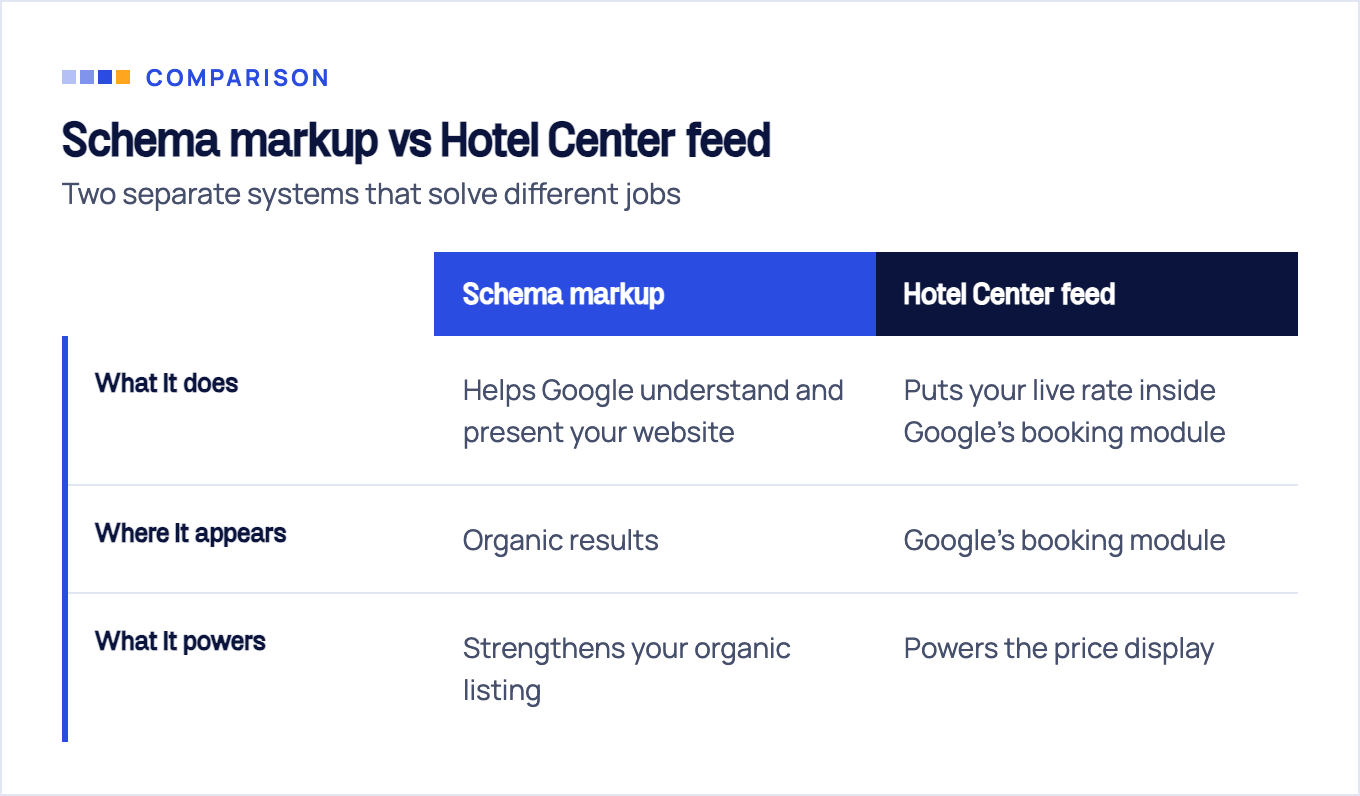
One distinction almost every hotelier gets wrong, because no vendor guide explains it: the prices inside Google’s hotel module do not come from your website’s markup. Live rates and availability in Google’s lodging features are powered by Hotel Center feed integrations. Google’s own vacation-rental structured data documentation restricts that markup to sites already connected with a Google Technical Account Manager and Hotel Center access, which tells you where the real pipeline lives. On-page schema strengthens your organic listing; the feed powers the price display.
Layer 3: content SEO with destination and demand-capture pages
OTAs are structurally weak in exactly one place: they know nothing real about your neighborhood, your rooms, or what your front desk recommends at 10pm. Content is how a hotel website exploits that weakness.
Map page types to intent instead of publishing a generic blog:
| Page type | Intent | Example query |
|---|---|---|
| Room and suite pages | Transactional | ”junior suite riverside London”, “suite with balcony near Duomo” |
| Amenity pages | Commercial | ”pet friendly hotel Austin”, “hotel with rooftop pool Barcelona” |
| Venue pages | Commercial | ”small wedding venue Savannah”, “conference hotel near airport” |
| Destination guides | Informational | ”things to do in Alfama”, “3 days in Porto itinerary” |
| Seasonal and event pages | Mixed | ”hotels near Oktoberfest grounds”, “F1 weekend accommodation” |
Three rules make these pages book rooms instead of merely ranking:
- Every informational page links down-funnel. A “things to do” guide should link to specific room pages and carry an availability CTA with dates, not a generic button in the header.
- One page per distinct intent. “Pet friendly” and “family rooms” are different searches from different travelers. A combined amenities page ranks for neither.
- Write from the property, not from the SERP. The destination guide worth ranking contains what your staff actually tells guests: the bakery that opens at 6am, the viewpoint tourists miss. That specificity is the moat an aggregator cannot crawl its way into.
Sequencing this layer, which pages first, how many, and how they interlink, is a planning exercise of its own. We laid out the planning-level view in our hotel SEO strategy guide.
Technical foundations: schema markup, Core Web Vitals, and booking-engine pitfalls
Three technical areas decide whether the layers above get full credit from Google.
Lodging schema. Schema.org defines hotel-specific markup: LodgingBusiness types such as Hotel, Resort, BedAndBreakfast, and Hostel, plus Accommodation types like HotelRoom and Suite, with recommended properties including amenityFeature, checkinTime, checkoutTime, starRating, and numberOfRooms, per the Schema.org hotels documentation. A minimal example:
{
  "@context": "https://schema.org",
  "@type": "Hotel",
  "name": "Harborview Hotel",
  "starRating": { "@type": "Rating", "ratingValue": "4" },
  "checkinTime": "15:00",
  "checkoutTime": "11:00",
  "numberOfRooms": 42,
  "amenityFeature": [
    { "@type": "LocationFeatureSpecification", "name": "Free WiFi", "value": true },
    { "@type": "LocationFeatureSpecification", "name": "Outdoor pool", "value": true }
  ]
}
Remember the boundary from the brand section: this markup improves how Google understands and displays your organic listing. It does not place live prices in the hotel module; that remains the Hotel Center feed’s job.
Core Web Vitals. Hotel sites fail performance checks more often than most because they are built from full-bleed photography. Google’s “good” thresholds are LCP within 2.5 seconds, INP of 200 milliseconds or less, and CLS of 0.1 or less, measured at the 75th percentile of page loads, per web.dev. On image-heavy hotel templates, LCP is the usual failure: compress the hero, serve modern formats, and preload the one image that actually paints first.
Booking-engine pitfalls. The booking stack causes more hotel SEO damage than any content decision:
- JavaScript-only booking flows. If room details exist only inside a JS widget, Google may never index your actual product. Keep a crawlable HTML page for every room type.
- Booking subdomains. A booking.yourhotel.com setup splits authority away from the main domain. Prefer a subdirectory, and keep all marketing content on the primary domain either way.
- Parameter sprawl. Date, occupancy, and rate-code parameters can mint thousands of near-duplicate URLs that drain crawl budget. Canonicalize aggressively and keep parameter combinations out of internal links.
Auditing exactly this layer is what our technical SEO service exists for, and hotel booking stacks are among the most frequent offenders we crawl.
Hotel SEO in the AI search era
AI Overviews now answer many hotel-marketing and travel-planning queries before the first organic listing appears, so it is fair to ask whether this whole playbook still applies. Google’s answer is direct: “There are no additional requirements to appear in AI Overviews or AI Mode, nor other special optimizations necessary.” Standard people-first SEO and technical eligibility apply, and Google notes that AI features display “a wider and more diverse set of helpful links” than classic results, per Google Search Central.
That wider net is the opportunity. Query fan-out means an AI answer about “romantic hotels in Porto with river views” can pull from an amenity page that never cracked the top three for anything. Pages that lose the classic ten-blue-links fight can still get cited.
What earns those citations in practice:
- Quotable, self-contained definitions and answers. Two or three sentences that stand alone, like the opening of this article, are what AI systems lift.
- FAQ blocks answering questions guests genuinely ask. Parking, pet policy, early check-in, airport distance.
- Entity-rich amenity and location copy. Name the neighborhood, the landmarks, the walking distances. Vague copy gives a language model nothing to anchor.
The mechanics of earning AI citations are the same across industries; we cover them in depth in how to rank in AI Overviews.
Measuring hotel SEO: bookings and revenue, not rankings
Rankings are a diagnostic, not a result. The KPI stack that keeps a hotel SEO program honest:
- Direct booking revenue from organic sessions. The only line ownership ultimately cares about.
- Booking-engine conversion rate from organic compared against paid and OTA-referred traffic.
- Brand versus non-brand split. Brand defense protects revenue you generated elsewhere; growth has to show up in non-brand.
- Map-pack visibility for your priority “hotels in X” and “hotels near X” queries.
- Brand SERP ownership. Your site, your GBP, and your sitelinks should fill the first screen for your hotel’s name.
Starting from zero, sequence the first 90 days by payback speed:
- Weeks 1 to 4: claim and complete the GBP, launch the review workflow, audit the brand SERP.
- Weeks 5 to 8: fix the homepage title and Hotel schema, claim free booking links through your connectivity partner, triage crawl and Core Web Vitals issues.
- Weeks 9 to 12: ship the first content pages, amenity pages before destination guides, because they sit closer to the booking.
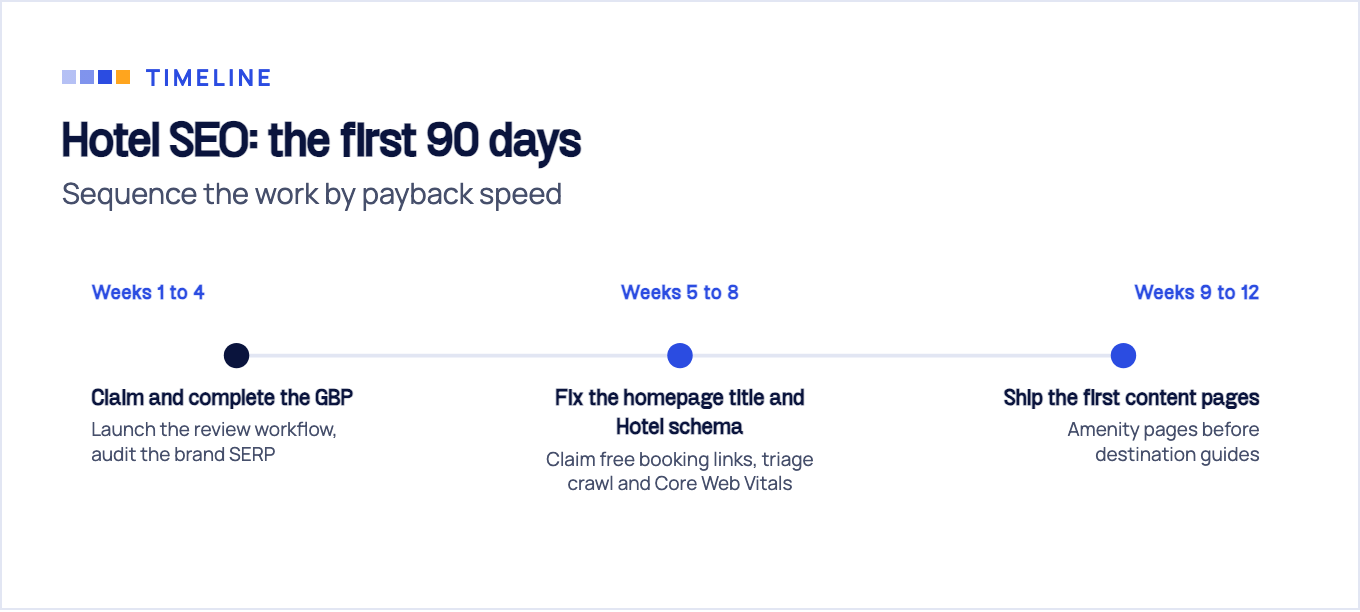
The local and brand layers usually move first, since you are fixing your own presence rather than outranking anyone. Content compounds more slowly, and it is where durable non-brand growth lives.
If you would rather have this done for you, our hotel and resort SEO team runs this exact playbook end to end: 10+ years in SEO, 100+ clients across the USA, UK, and EU, 200,000+ keywords in top 3. Either way, start with your Google Business Profile this week. It is the highest-impact hour in hotel SEO.
Sources & fact-check
Every factual claim in this article is checked against primary sources, not opinion. Written by Roman Sydorenko, Chief SEO & AI search. Last verified July 16, 2026.
- OfficialSEC EDGAR, Booking Holdings FY2025 earnings release (gross bookings vs revenue give a 14.5% blended take rate)
- OfficialGoogle Business Profile Help, Tips to improve your local ranking on Google (relevance, distance, prominence)
- OfficialGoogle Hotel Center Help, About hotel free booking links (hotel partners pay no fee for free booking links)
- OfficialGoogle Hotel Center Help, How to get started with hotel campaigns (needs a price feed or integration partner)
- Officialweb.dev, Web Vitals (LCP 2.5s, INP 200ms and CLS 0.1 thresholds at the 75th percentile)
- OfficialGoogle Search Central, AI features and your website (no extra requirements for AI Overviews or AI Mode)
