A hotel SEO strategy is a 12-month plan that decides three things: where organic search sits in your booking channel mix, when to publish based on your market’s demand seasonality, and which local and technical foundations to fix first. It is a sequencing document, not a tactic list. The individual optimizations (schema, page speed, review requests, landing pages) are tactics that execute the plan, and we cover those in the companion hotel SEO guide. This article is about the plan itself, and the one KPI it answers to is direct bookings, not rankings.
Most content ranking for “hotel seo strategy” is a tactical guide wearing a strategy label. It tells you what to optimize but never when, in what order, or how organic fits next to the OTAs eating your margin. That sequencing is the whole job. Get it right and every direct booking compounds; get it wrong and you publish a beach guide in July that needed to rank in February.
What a hotel SEO strategy actually is (and how it differs from tactics)
The difference is altitude. Tactics answer “how do I optimize this page?” Strategy answers “which pages, in what order, timed to which demand wave, funded by which budget, measured against which goal?” A hotel can execute flawless on-page SEO and still lose money if it ranks for the wrong queries at the wrong time of year.
Three decisions define the strategy, and they are the sections of this article:
- Channel mix. How much of your visibility should come from organic search versus OTAs, metasearch, and paid, given that each organic direct booking recaptures a commission.
- Seasonality timing. When to publish, because guests search months before they stay, so content has to rank before the demand wave arrives.
- Foundation order. Which local, technical, and content layers to fix first so effort lands where bookings are, not where traffic looks good.
Everything else, from keyword maps and calendars to schema and KPIs, hangs off those three. Anchor the whole plan to direct bookings and the priorities sort themselves. A page that ranks but does not move someone toward your booking engine is a cost, not a win.
Channel mix: where organic search fits next to OTAs, metasearch, and paid
Start here, because channel economics decide how much SEO is worth to your specific property. A hotel’s visibility comes from four places: OTAs (Booking.com, Expedia), metasearch (Google’s hotel results, Trivago), paid ads, and organic, meaning your own site plus your Google Business Profile. They are not equal on margin.
Every booking that arrives through an OTA hands the platform a double-digit commission. Every booking you capture directly keeps it. That is what makes organic search the compounding channel: a page you rank once keeps earning commission-free bookings for years, while a paid click buys one visit and stops the moment the budget does. Paid is rented reach. Organic is owned.
There is a piece of this most hotels leave on the table. Google’s hotel booking module (the price panel travelers see on a property’s profile) includes free booking links, and clicks on them cost nothing. Per Google Hotel Center Help, “There’s no cost for clicks on free booking links,” and their ranking depends on signals like landing page experience and the historical accuracy of the prices you send Google, not on bids: “Bids have no impact on the ranking of free booking links.” Your official rate can sit inside that module, next to the OTAs’ paid ads, for free, provided your site and Hotel Center feed are in order.
That is the strategic case in one line: direct visibility is largely free, and it recaptures commission on every booking, so the return on organic compounds while paid stays flat. It is also where a focused-effort lens earns its keep. You do not need to rank for every hotel query in your city. You need to rank for the ones that convert to bookings (brand searches, high-intent “hotels in [city] with [amenity]” terms, and the destination content that feeds them) and skip the vanity traffic that never reaches checkout.
Map demand seasonality before you write anything
Most competing guides skip this section, and it is the one that decides whether your content earns anything. Travelers search long before they stay. A ski-town hotel’s guests are pricing December trips in September; a summer beach property’s peak searches land in spring. If you publish when demand is visible, you have already missed it, because a new page takes weeks to months to rank. Content has to be live and indexed before the search wave, which for most seasonal demand means publishing three to six months ahead.
So the first artifact of a hotel SEO strategy is a demand map for your specific market. Build it in three layers:
- Season shape. Mark your peak, shoulder, and off-season months by occupancy and rate, not by weather. A conference hotel and a beach resort in the same city can have opposite curves.
- Booking lead windows. For each season, how far ahead do guests actually search and book? Long-haul and peak stays book earlier; last-minute city breaks book late. This gap is your publishing deadline.
- Event spikes. Conferences, festivals, sporting events, graduations. These are predictable, dated, usually less contested than the head terms, and they repeat annually, so a page you build once keeps earning every cycle.
You do not need a paid tool to build this. Google Trends shows the shape of demand for “[your city] hotels” and “things to do in [your city]” across the year. Google Search Console shows when your property’s own queries actually spike, which is the ground truth for your market. Layer those two and you have a calendar of when each piece of content must be live. Every publishing date in the next section is derived from this map.
The hotel keyword map: property, destination, and question layers
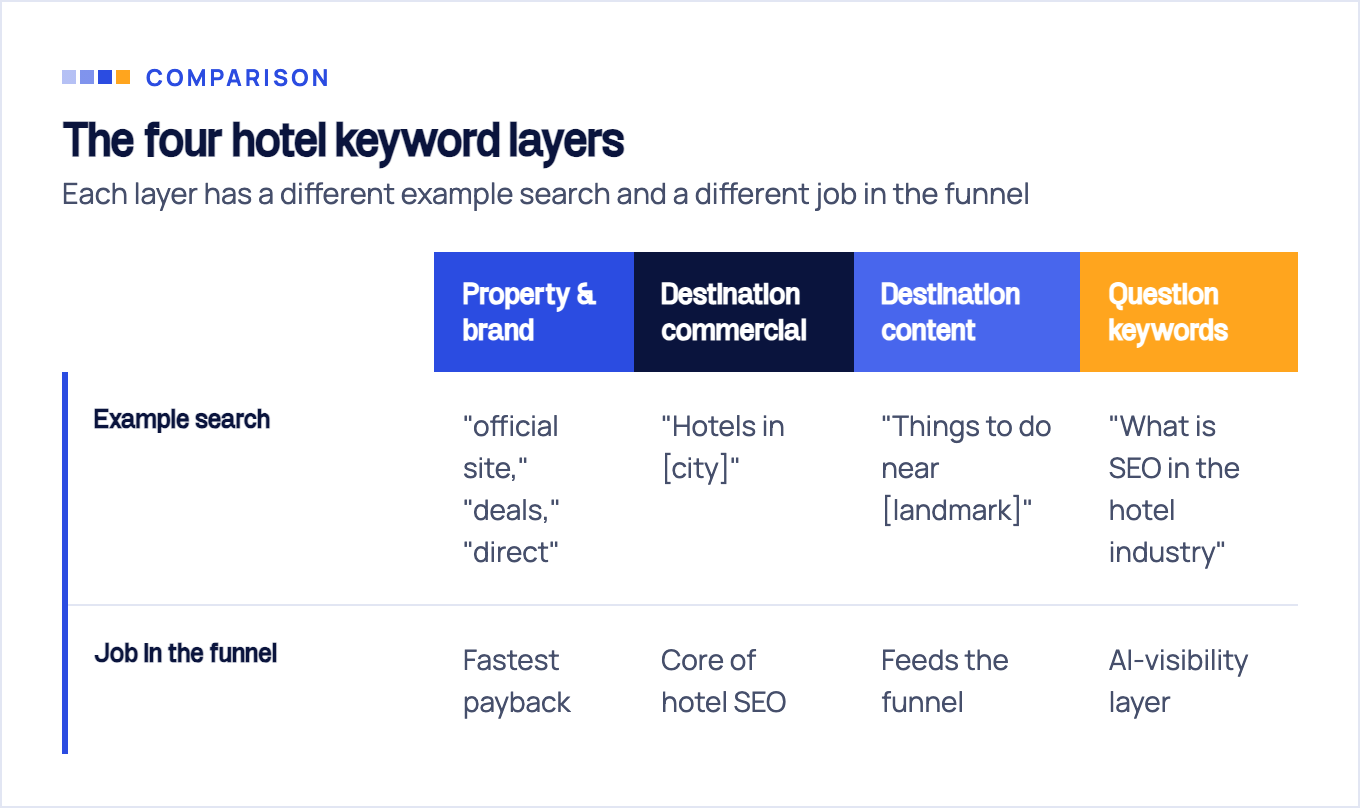
A keyword strategy for hotels is an architecture decision, not a tool exercise. Group your targets into four layers, each with a different competitor and a different job in the funnel.
- Layer 1, property and brand. Your hotel’s exact name, plus “official site,” “deals,” “direct.” These are the highest-converting searches you will ever get, and OTAs both rank and bid on them. Defending this layer is the fastest payback in hotel website SEO.
- Layer 2, destination commercial. “Hotels in [city],” “[city] hotel with [amenity],” “boutique hotel [neighborhood].” High commercial intent, and the core of seo for hotels. The SERP here is crowded with OTAs, so pick fights by specificity: amenity and neighborhood modifiers are winnable where the bare “hotels in [city]” term is not.
- Layer 3, destination and experience content. “Things to do near [landmark],” “best time to visit [city],” neighborhood guides. Lower intent, but this is what feeds the funnel and what AI answers cite.
- Layer 4, question keywords. “What is SEO in the hotel industry,” “when is the cheapest time to book [city],” and the practical questions guests ask. These are the passages AI Overviews lift, so they are your AI-visibility layer.
Keyword difficulty on hotel terms tends to be low, but the SERPs are vendor-crowded and OTA-dominated, so raw difficulty scores understate the fight. Choose by intent and winnability, not by volume alone. A layer-2 amenity term with 200 searches that you can actually rank for is worth more than a 5,000-search head term you will never crack against Booking.com. This is also where hotel local SEO overlaps the map: your layer-1 and layer-2 terms are the ones your Google Business Profile competes for directly.
A 12-month hotel content calendar
Here is the plan the seasonality map produces: a quarter-by-quarter rhythm that fixes foundations in the quiet months and ships demand-capturing content ahead of each wave. Adjust the calendar to your own season shape (an off-season in one market is peak in another), but the sequence holds everywhere.
| Phase | Timing vs. peak | Primary theme | Assets to ship | Goal |
|---|---|---|---|---|
| Off-season | 6+ months out | Foundations | Technical fixes, schema, evergreen destination guides, neighborhood pages | Build the base while traffic is low and stakes are small |
| Pre-peak | 3 to 6 months out | Demand capture | Seasonal landing pages, event pages, “best time to visit” content | Rank before the search wave arrives |
| Peak | During high season | Conversion + trust | Review generation, GBP posts, offer pages, rate parity checks | Convert the traffic your earlier work created |
| Post-peak | 0 to 2 months after | Refresh + prune | Update seasonal pages, prune thin content, capture last-minute deal terms | Compound gains and clean the site for next cycle |
Two rules make this calendar work. First, seasonal and event pages are permanent URLs, not disposable posts. You build “[City] Jazz Festival hotels” once and refresh it every year, so it accrues authority instead of resetting. Second, the off-season is when technical work happens, because a booking-engine migration or a Core Web Vitals fix during peak risks revenue you cannot get back.
The local layer: Google Business Profile, reviews, and the map pack
A hotel is a physical location people search for by area, so the local layer sits above classic organic results for nearly every discovery query. Google is unusually direct about how it ranks these. Per Google Business Profile Help, local results are based on three factors (relevance, distance, and prominence), and Google states plainly that “more reviews and positive ratings can help your business’s local ranking.”
That last point has a strategic consequence most hotels miss: reviews are a rankings input, not just a reputation metric. So review generation belongs on the marketing calendar (that is why “peak = review generation” sits in the table above), not buried in operations. A steady stream of recent reviews, asked for at checkout and replied to publicly, feeds both ranking and conversion at once.
The rest of the local worklist is concrete:
- Categories and attributes. “Hotel,” “Boutique hotel,” and “Extended stay hotel” match different searches. Pick the precise one, then fill every amenity attribute: pool, parking, pet policy, check-in times.
- Photos. Hotels get a rich GBP layout. Populate every photo category; empty ones are a lost conversion argument on your highest-intent surface.
- NAP consistency. Keep your name, address, and phone identical across your booking engine and every OTA profile, so Google trusts the entity behind your listing.
The mechanics of citation cleanup and review workflows are the same discipline we run for any location business; our local SEO service page has the deeper version. For the wider set of hotel-specific local tactics, the hotel SEO category collects them.
Technical and schema foundations hotels get wrong
Two technical problems are near-universal in hospitality, and both are strategic because they cap how well everything else can perform.
The first is authority fragmentation. Hotels routinely push their booking engine onto a subdomain or a third-party domain, so the highest-intent step of the journey, the actual reservation, happens off the domain you are building authority for. Where the booking flow can live on your primary domain, keep it there. Where it cannot, make sure internal links, canonicals, and analytics still treat the journey as one property.
The second is speed. Hotel sites are image-heavy by nature, and unoptimized hero galleries wreck Core Web Vitals. Google’s thresholds for a good experience, per web.dev, are LCP within 2.5 seconds, INP of 200 milliseconds or less, and CLS of 0.1 or less, measured at the 75th percentile across mobile and desktop. Compress and lazy-load imagery, reserve layout space so galleries do not shift, and treat this as off-season work.
On schema, mark up what you are. Schema.org’s Hotel type defines lodging-specific properties (checkinTime, checkoutTime, amenityFeature, numberOfRooms, petsAllowed, starRating) that tell Google exactly what your property offers.
{
  "@context": "https://schema.org",
  "@type": "Hotel",
  "name": "The Example Boutique",
  "starRating": { "@type": "Rating", "ratingValue": "4" },
  "checkinTime": "15:00",
  "checkoutTime": "11:00",
  "petsAllowed": true,
  "amenityFeature": [
    { "@type": "LocationFeatureSpecification", "name": "Free WiFi", "value": true },
    { "@type": "LocationFeatureSpecification", "name": "Pool", "value": true }
  ]
}
Set expectations correctly on one gotcha. Google’s vacation rental structured data is not open to everyone. The instructions “are intended for sites that have already connected with a Google Technical Account Manager and have access to the Hotel Center,” so markup alone will not buy you those listings. What LocalBusiness and Hotel markup does earn is knowledge-panel support: per Google’s local business documentation, it lets you tell Google about details like business hours and departments, which can surface in knowledge panels and business carousels. Do not use it to mark up your own guest reviews, though. Google recommends the review and aggregateRating properties only for “sites that capture reviews about other local businesses,” and its review snippet guidelines make a page ineligible for review stars when the entity being reviewed controls the reviews about itself, including reviews pulled in through an embedded widget. Your reviews still do ranking work; they just do it through your Google Business Profile, as the local section above describes. Deeper implementation lives on our technical SEO service page.
AI search and the hotel guest journey
Travelers increasingly ask an AI assistant to plan the trip (“where should I stay in Lisbon for a quiet weekend,” “build me a three-day itinerary near the coast”), and the strategic question is whether your property surfaces in that answer. The good news is that there is no separate playbook to learn. Google states in its AI features documentation that “there are no additional requirements to appear in AI Overviews or AI Mode, nor other special optimizations necessary” beyond the foundational SEO you are already doing.
That reframes the earlier sections as your AI-visibility play. The layer-4 question content, the specific destination guides, and the structured data you shipped for classic search are exactly what AI systems draw on to answer travel prompts. What wins citations is specificity and first-hand knowledge: a genuinely useful “best neighborhoods for families near X” page beats a generic city overview, because AI answers reward the source that actually says something concrete. If you want the mechanics of earning those citations, our guide on how to rank in AI Overviews goes deep.
Measuring the strategy: direct-booking KPIs, not rankings
Close the loop where you opened it: bookings, not positions. A ranking is a means; the strategy is judged on revenue moved from commissioned channels to your own. Track a KPI stack that reflects that:
- Organic sessions that reach the booking engine. Not raw traffic, but the slice that actually enters the reservation flow. This is your intent filter.
- Direct-booking revenue and commission saved. Every direct booking has a shadow number: the OTA cut you did not pay. Report both.
- GBP actions. Calls, direction requests, and website clicks from your Google Business Profile, the local layer’s conversion signal.
- Branded vs. non-branded clicks in Search Console. Rising non-branded share means the content and destination layers are pulling in new demand, not just harvesting reputation you already had.
Review this stack on the same quarterly cadence as your seasonality map, so measurement and planning share a calendar. Each quarterly review asks one question: did the content we shipped ahead of this season’s wave convert, and what do we adjust before the next one?
This bookings-first lens is exactly how we run SEO for hospitality clients. The FLG method starts from the queries that convert to reservations and works backward, rather than chasing traffic that never books. Across 10+ years and 100+ clients in the USA, UK, and EU, with over 200,000 keywords driven into the top 3, that discipline is what separates a strategy from a to-do list. If you want the plan built and run for your property, our hotels and resorts SEO page is where to start.
Sources & fact-check
Every factual claim in this article is checked against primary sources, not opinion. Written by Roman Sydorenko, Chief SEO & AI search. Last verified July 16, 2026.
- OfficialGoogle Search Central, Local business structured data (hours and departments, can surface in knowledge panels)
- OfficialGoogle Search Central, Review snippet structured data (no star snippets for self-controlled reviews)
- OfficialGoogle Hotel Center Help, Free booking links (clicks cost nothing and bids do not affect ranking)
- OfficialGoogle Business Profile Help, Tips to improve local ranking (relevance, distance, prominence, reviews help)
- Officialweb.dev, Web Vitals (good thresholds of LCP 2.5s, INP 200ms and CLS 0.1 at the 75th percentile)
- OfficialGoogle Search Central, AI features and your website (no special markup or AI text files needed to appear)
