A link building campaign is a time-boxed, goal-driven effort to earn links to a specific set of target pages, with a defined audit, prospect list, outreach plan, and reporting cadence. It is not “buy a few links every month.” A real campaign runs on a schedule, tracks against ranking and lead goals, and judges itself on whether the pages that produce revenue actually moved.
This guide walks the five parts of that anatomy in order: the Month 0 audit, the target map, the outreach waves, the reporting framework, and the failure modes that kill campaigns before they pay off. Everything below is the process we run at SEOBRO, laid out so you can copy it or hire it out with your eyes open.
Why bother at all? Because links still carry weight. Google’s own documentation on ranking says it considers “if other prominent websites link or refer to the content,” and that such links are “generally a good sign that the information is trustworthy” (Google: How Search Works). The effort is worth it. The waste comes from spending it badly.
What is a link building campaign?
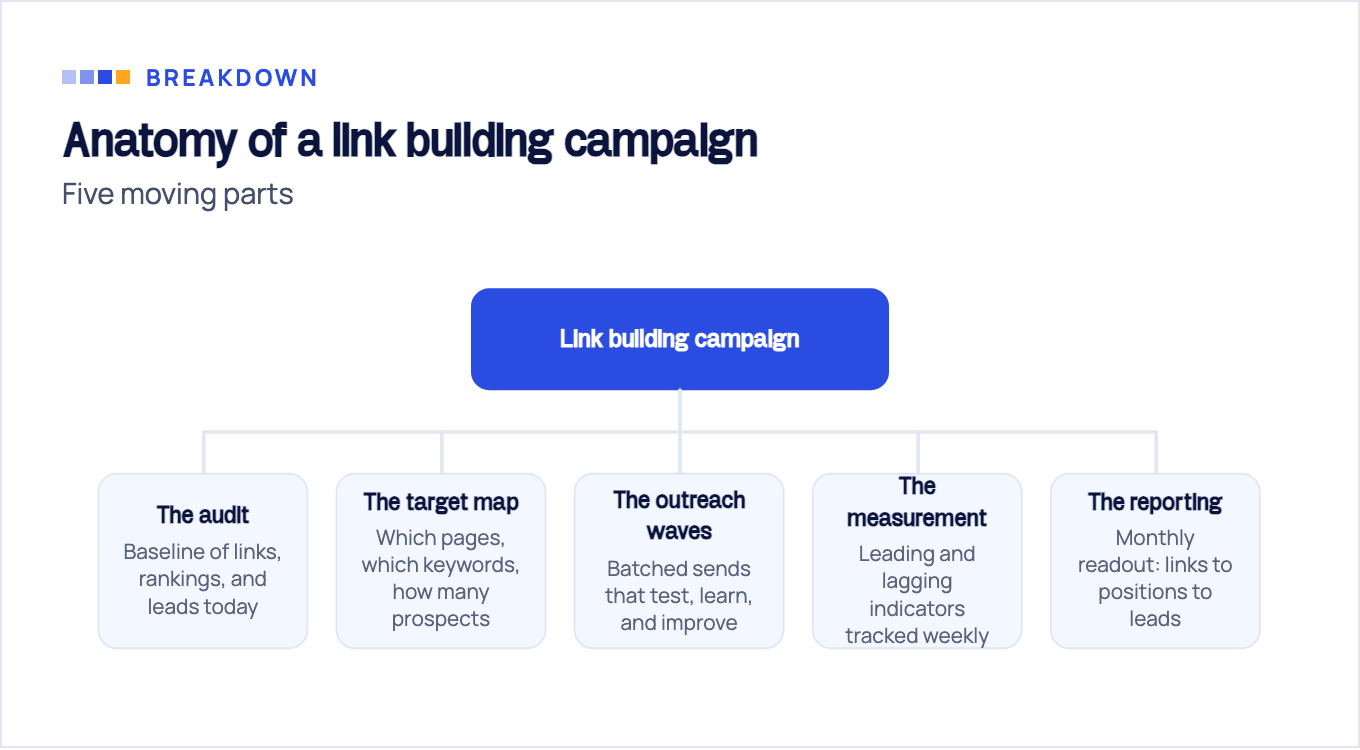
Strip away the jargon and a campaign has five moving parts:
- The audit. A baseline snapshot of where your links, rankings, and leads stand today.
- The target map. Which pages you’re moving, for which keywords, and how many prospects that takes.
- The outreach waves. Batched sends that test an angle, learn, and improve.
- The measurement. Leading and lagging indicators tracked weekly.
- The reporting. A monthly readout that ties links placed to page positions to leads.
The difference between a campaign and ongoing link building is the shape of it. Ongoing link building is a faucet: some links trickle in every month, aimed wherever. A campaign is a project with a start, a target-page list, a timeline, and a definition of done. You can run campaigns inside an ongoing program, but the campaign is the unit that actually moves rankings, because it concentrates effort.
Month 0: audit and baseline
Before a single email goes out, you take a snapshot. Skip this and you have no way to prove the campaign worked, which means you have no way to know either.
Record four things for the pages you intend to move:
- Current referring domains. How many unique sites link to each target page today.
- Anchor-text distribution. The mix of branded, naked-URL, and keyword anchors already pointing in.
- Competitor link gap. Which domains link to competitors ranking above you but not to you.
- Baseline rankings. Current positions for the money keywords, plus the leads or conversions those pages produce.
That last item is where most audits stop short. They baseline rankings and forget revenue. We baseline both, because the goal of the campaign is not “more links” or even “higher rankings.” It’s more leads from the pages that produce them. A target page that ranks #4 and converts is worth ten that rank #1 and don’t.
This is also why you concentrate links on a few pages instead of spreading them across the site. Ahrefs’ study of roughly 14 billion pages found that 96.55% get zero organic traffic from Google, and only about 1 in 6,671 pages with no referring domains earns more than 1,000 monthly visits (Ahrefs: Search Traffic Study). Links are the scarce resource. Point them at the three to five URLs that pay, not at forty that don’t.
A proper audit is the foundation of the whole quarter. If you’d rather have it done rigorously before committing budget, that’s exactly what our SEO audit service delivers as a standalone.
Month 1: build the target map
With the baseline set, Month 1 is sourcing and qualifying prospects. Four sources produce most of them:
- Competitor backlinks. Sites already linking to pages that outrank you.
- Resource pages. Curated link lists in your niche.
- Unlinked mentions. Places that name you already but don’t link.
- Niche publications. The sites your buyers actually read.
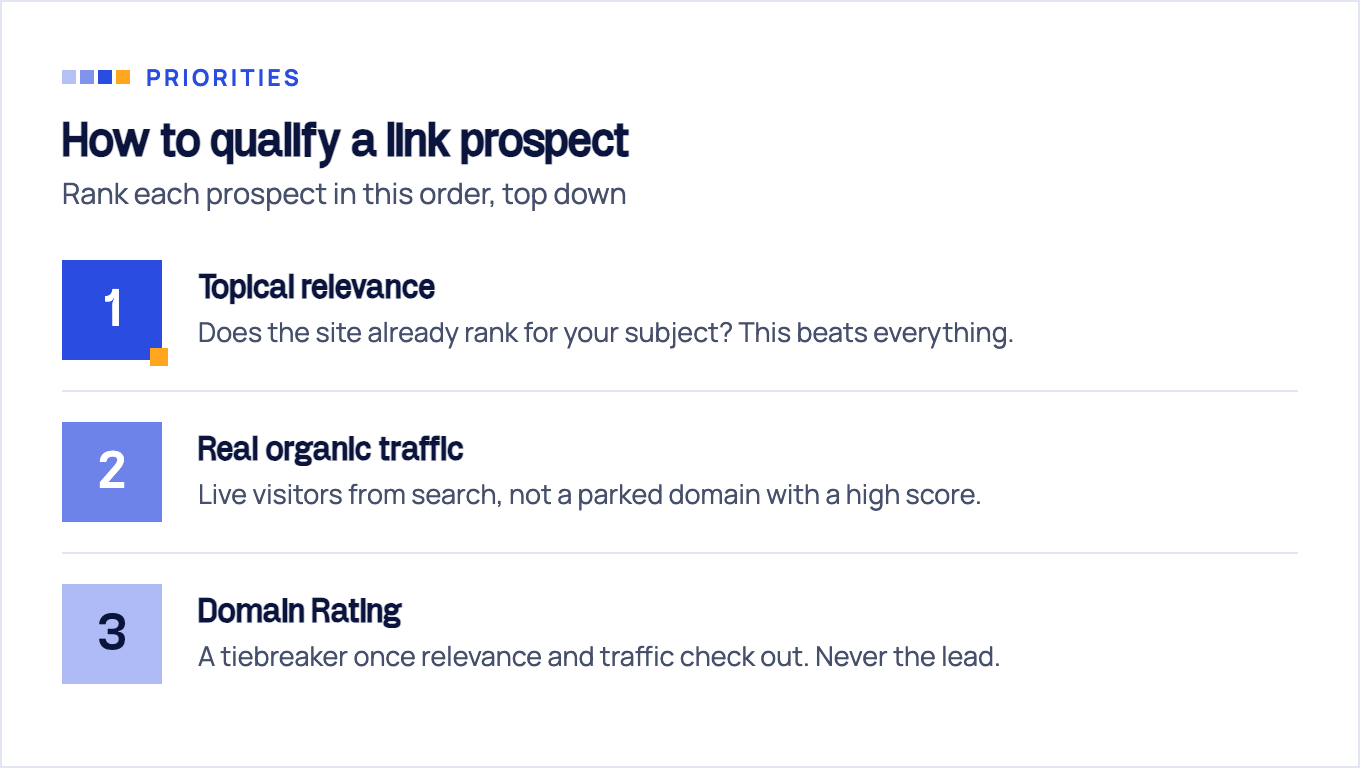
Qualify in this order: topical relevance first, then real organic traffic, then Domain Rating. DR is the number vendors lead with because it’s easy to sort by, but a DR 40 site squarely in your niche usually beats a DR 70 general site. Relevance is what Google reads; DR is a proxy you shouldn’t optimize for directly.
How big does the list need to be?
Here is the math every competitor guide skips. Cold outreach converts at a known rate: a Backlinko and Pitchbox analysis of 12 million outreach emails found only 8.5% of them get any response at all (Backlinko: Email Outreach Study). A response is not a placement. After you account for the drop-off from reply, to interested, to actually-published, roughly 2 to 3 in 100 qualified prospects turn into a live link.
Work backwards from that. To land about 10 links, you need on the order of 350 to 500 qualified prospects in the pipeline. Build a list of 50 and you’re not running a campaign, you’re running a disappointment.
Lay it out as a target map so the effort is legible:
| Target page | Primary keyword | Prospects needed | Lead tactic |
|---|---|---|---|
| /pricing/ | “[category] pricing” | ~120 | Niche edits + resource pages |
| /solutions/x/ | ”[problem] software” | ~150 | Guest posts + digital PR |
| /guide/ | “how to [job]“ | ~100 | Unlinked mentions + resource pages |
The prospect counts flow directly from the response-rate math above and from how many links each page needs to close its competitor gap. This is the document a real campaign runs on. Everything downstream references it.
Months 2–4: outreach in waves
Do not blast the whole list at once. Send in waves, because the first wave teaches you what the next ones should say.
Wave 1 (50–100 prospects) tests the angle. Which subject line gets opens, which pitch gets replies, which target page editors actually want to link to. Waves 2 and 3 apply what wave 1 taught you: better angle, tighter targeting, the tactics that worked repeated at volume. A single blast gives you one data point and no chance to correct.
The cadence rules come straight from the same 12-million-email dataset:
- One follow-up lifts replies by 65.8% over a single send.
- Personalized email bodies raise response rate by 32.7%.
- Multi-contact, multi-message sequences perform 160% better than one email to one person.
Read those together: a personalized sequence with follow-ups isn’t a nicety, it’s the difference between an 8.5% baseline and something that makes the campaign math work. Skipping follow-ups is the most common reason we see a list of 400 produce two links.
Mix tactics across waves so you’re not dependent on one channel: guest posts, digital PR, resource-page and unlinked-mention outreach, each aimed at the target page it fits. The full send-side mechanics (templates, sequencing, personalization at scale) are in our link building outreach guide.
One rule holds across every wave: stay inside Google’s link spam policy. Google defines link spam as “creating links to or from a site primarily for the purpose of manipulating search rankings,” and explicitly lists buying or selling links for ranking purposes, excessive link exchanges, and “links with optimized anchor text in articles, guest posts, or press releases” as examples (Google: Spam policies). No paid placements passing ranking credit. No exact-match anchor stuffed into a guest post. Anything you’d have to hide from Google is a link you’re paying to have neutralized. Our take on doing this cleanly is in the white hat link building guide.
Months 3–6: report against rankings, not link counts
This is the section no competitor guide has, and it’s the one that matters most.
Links land in months 2 and 3. Rankings move later, often much later. Ahrefs’ 2025 ranking-time study found that only 1.74% of newly published pages reach Google’s top 10 within a year, the average #1-ranking page is five years old, and 72.9% of top-10 pages are more than three years old (Ahrefs: How Long Does It Take to Rank). There is a lag between the work and the payoff, and a campaign that reports only on final rankings will look like a failure for months while it’s actually succeeding.
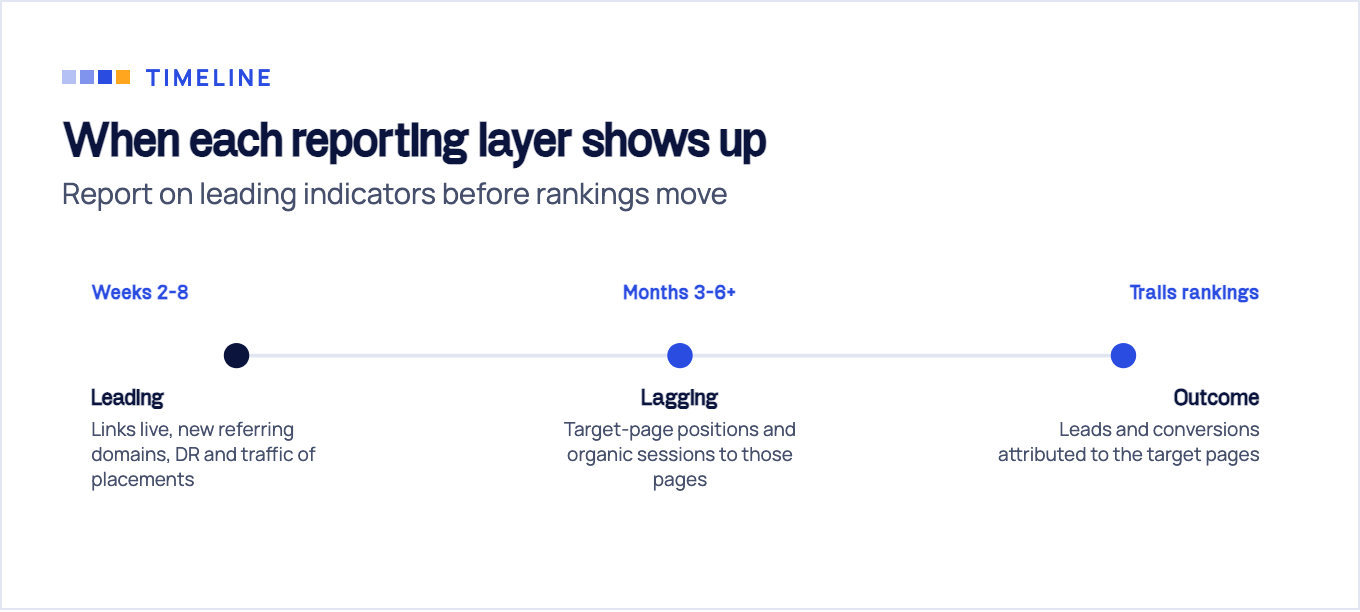
The fix is reporting on both leading and lagging indicators:
| Layer | What you report | Shows up |
|---|---|---|
| Leading | Links live, new referring domains to each target page, DR and traffic of placements | Weeks 2–8 |
| Lagging | Target-page positions, organic sessions to those pages | Months 3–6+ |
| Outcome | Leads and conversions attributed to the target pages | Trails the rankings |
The monthly readout follows one line: links placed → target-page position deltas → leads attributed. You show the leading indicators first (they moved, proof the work happened), then the position deltas as they emerge, then the lead movement that justifies the whole thing.
That last layer is the point. We judge a campaign on lead movement on the money pages, not on a links-delivered spreadsheet. A report showing 15 links and no ranking change six months out is a report of failure, however green the checkmarks look. A report showing 8 links and a demo page climbing from #9 to #4 with bookings following is the campaign working exactly as designed.
Where campaigns die
Most campaigns don’t fail at outreach. They fail at one of these, and each has a one-line fix.
- No linkable asset worth citing. Nobody links to a thin service page. Fix: build something worth a reference (data, a tool, a genuinely thorough guide) before you pitch.
- Chasing DR over relevance. High-DR, off-topic links underperform relevant ones. Fix: qualify on topical fit first; treat DR as a tiebreaker.
- Anchor-text over-optimization. Google lists “links with optimized anchor text in articles, guest posts, or press releases” as link spam. Fix: let anchors read naturally, branded and contextual, not exact-match keyword.
- Quitting at month 3. Teams stop right before the ranking lag pays off. Fix: commit to a full quarter minimum; the links you placed in month 2 haven’t been priced in yet.
- Counting links instead of rankings. A links-delivered spreadsheet measures activity, not results. Fix: report against target-page positions and leads from Month 0’s baseline.
In-house vs hiring it out
Run the funnel from Month 1 and the workload becomes obvious. To land ~10 links you’re qualifying 350 to 500 prospects, then personalizing and sequencing at an 8.5% baseline reply rate, with follow-ups on every thread and quality-checking each placement. Per wave that’s real hours: prospecting, research, writing bespoke pitches, chasing replies, and vetting what actually goes live.
That workload is why most teams outsource after running one campaign themselves. It isn’t hard in any single step; it’s relentless across hundreds of them, and it competes with everything else on a small marketing team’s plate. If you want cost benchmarks before deciding, our link building pricing guide breaks down real market rates.
When we run it, the campaign is built against your lead targets and reported against your rankings, not delivered as a link count and called done. That’s the whole difference, and it’s what our link building service is structured to do.
Sources & fact-check
Every factual claim in this article is checked against primary sources, not opinion. Written by Roman Sydorenko, Chief SEO & AI search. Last verified July 16, 2026.
- OfficialGoogle, How Search Works: Ranking results (links from prominent sites signal that information is trustworthy)
- OfficialGoogle Search Central, Spam policies for Google web search (defines link spam and lists paid-link examples)
- Primary dataAhrefs, 96.55% of Content Gets No Traffic From Google (index study of 14 billion pages behind the figure)
- Primary dataAhrefs, How Long Does It Take to Rank in Google (source of the 1.74% top-10 figure and the page-age data)
- Primary dataBacklinko with Pitchbox, Email Outreach Study (12 million emails, source of the reply and follow-up lifts)
