Link building pricing in 2026 comes down to three bands. Quality editorial links run $150–600 each at market rates, high-authority placements in competitive niches climb to $1,500 and beyond (Siege Media puts the ceiling near $2,000), and managed programs cost $1,000–5,000 per month for most small and mid-size businesses, stretching to $3,000–25,000 per month at large-agency scale. Anything dramatically cheaper is usually a placement fee for inventory Google has already learned to ignore.
One thing to know before you compare quotes: almost every cost guide ranking for this topic was written by a link vendor justifying its own price list. We sell link building too, so read us with the same skepticism. The difference is that this guide runs on published market data and our actual prices, and it covers the part vendors skip: what Google does to cheap links after you pay for them.
How much does link building cost in 2026?
Two datasets anchor the numbers in this guide: Ahrefs’ pricing study, which approached 450 sites across nine competitive niches about link insertions and pitched a further 180 for guest posts, recording what each one charged (published in 2022, last updated July 2024), and BuzzStream’s analysis of a 500,000+ site vendor database, updated June 2026. Add our own rate card at SEOBRO and the market looks like this:
| Tier | Cost per link | Typical monthly spend | What you actually get |
|---|---|---|---|
| Marketplace / budget | $83 average placement fee (2022 survey) | Under $1,000 | Low-authority inventory, mostly neutralized by Google |
| Mid-market editorial | $150–600 | $1,000–5,000 | Vetted, topically relevant sites with real organic traffic |
| Premium / digital PR | $1,250–1,500 per earned link | $3,000–25,000 | High-authority editorial coverage won through campaigns |
That $83 figure deserves a caveat, because it gets quoted everywhere as the average cost of a backlink. It comes from Authority Hacker’s 2022 survey of 755 link builders (the original page is offline; the number survives in Ahrefs’ article) and measures the placement fee alone. No outreach labor, no content, and overwhelmingly low-quality inventory.
This is why survey averages look nothing like real quotes. A legitimate per-link price includes finding the site, qualifying it, producing something an editor will accept, and absorbing the cost of every rejection along the way. Once that labor is priced in, quotes land several times above the raw placement fee, which is exactly where the $150–600 band sits.
Why link prices vary so wildly (from $50 to $2,000 for one link)
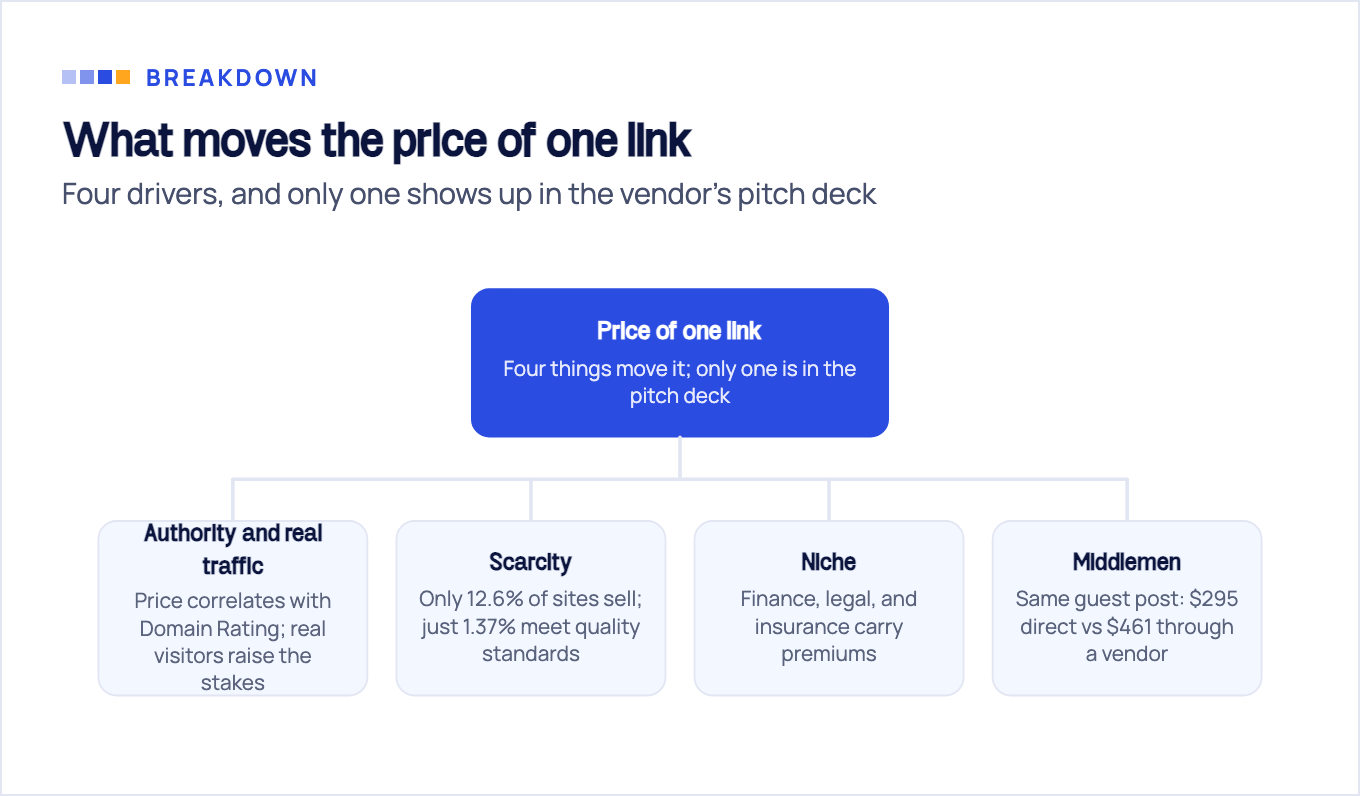
Four things move the price of a single link, and only one of them shows up in the vendor’s pitch deck.
Authority and real traffic. Ahrefs found that price correlates positively with the site’s Domain Rating: stronger sites know what their links are worth and charge accordingly. Traffic compounds this, because a site with genuine organic visitors has something to lose by linking carelessly.
Scarcity. This is the driver buyers underestimate most. In Ahrefs’ outreach experiment, only 12.6% of the 450 sites approached were willing to sell a link at any price, at an average of $361.44. BuzzStream found that just 1.37% of the 500,000+ guest-post sites in vendor databases met its quality standards. The sites worth being on mostly don’t sell. What you pay for is the labor of finding and persuading the minority that will place you editorially.
Niche. Finance, legal, and insurance carry premiums, partly because publishers in those spaces are more careful, and partly because everyone chasing the same expensive keywords is bidding for the same small pool of credible sites.
Middlemen. BuzzStream’s data shows the same guest post averages $295 negotiated directly and $461 bought through a vendor. Convenience costs roughly $170 per link. Sometimes that markup buys real vetting; often it buys a spreadsheet.
Link building pricing models compared
The model you buy under matters as much as the price, because each one pays the vendor to optimize for something different.
| Model | Typical cost | Fits best | Built-in incentive problem |
|---|---|---|---|
| Per-link | $150–600 per delivered link | Filling a known gap, testing a new vendor | Rewards quantity, not impact on revenue pages |
| Monthly retainer | $1,000–5,000/mo at SMB scope | Sustained campaigns with a fixed target-page list | Pays for activity unless deliverables tie to outcomes |
| Digital PR project | $5,000–10,000 per campaign | Brands with data or stories journalists want | A typical campaign earns 6 to 7 domains; a weak one earns zero |
| Freelancer | Day rate or per-link, varies widely | Founders who can supervise closely | You buy hours; results depend on your management |
| Marketplace / vendor list | $83 average placement fee plus markup | Honestly, nobody we’d advise | Opaque inventory; you pay $461 for a $295 guest post |
| In-house team | Salaries, tools, and content budget | Companies with continuous link demand at real scale | High fixed cost and a slow ramp before the first link lands |
The model matters less than what the price is anchored to. At SEOBRO we price link building as a program around specific revenue pages: the retainer buys movement on the three to five URLs that produce demos, bookings, or sales, and the link count is subordinate to that goal. A deliverable of “eight links per month” means nothing if they point at blog posts nobody converts from.
What each link type costs: guest posts, niche edits, digital PR
Tactic by tactic, here is what the published data says. BuzzStream’s figures are current to June 2026; Ahrefs’ outreach numbers were published in 2022, so treat them as a floor rather than a current quote.
Guest posts
BuzzStream puts the average guest post at $295 when you negotiate directly with the site and $461 through a vendor. Ahrefs pitched 180 sites and found paid guest posts averaging just $77.80, though that average rests on the small share that named a price at all: most never replied, and of the 25.5% who did, roughly half asked for a fee. Nearly every site selling at that level had a low DR. Treat cheap guest post pricing as a signal in itself: a site that sells to anyone for $80 is selling to everyone, and Google sees the same footprint you do.
Niche edits (link insertions)
The average link insertion costs $179 per BuzzStream, rising to roughly $780 on DR 80+ sites with 100k+ monthly organic visits. Ahrefs’ cold-outreach version landed higher, at $361.44 average across the 12.6% of sites willing to sell. The spread between those numbers is the marketplace-versus-outreach gap: pre-listed inventory is cheaper because the best sites never list themselves.
Digital PR
BuzzStream puts digital PR at $1,250 to $1,500 per link, with typical campaigns costing $5,000 to $10,000 and netting 6 to 7 linking domains. Worth carrying one caveat: unlike its guest post and link insertion figures, which come out of the 500,000-site database, BuzzStream’s digital PR range rests on agency experience and interviews rather than a dataset. Expensive per unit, but these are links no budget can buy directly: news coverage, data citations, editorial mentions on sites that would delete a paid pitch on sight. In competitive niches this is often the only tier that moves the needle.
Resource pages and expert quotes
The low-cash, high-labor tier. Resource-page links and expert-commentary placements cost little money and a lot of hours: finding curated lists worth being on, answering journalist queries fast enough to get picked. If you have more time than budget, start here. The mechanics of getting these placements are in our link building outreach guide, and the anatomy of a link building campaign shows how the tactics combine over a quarter.
The real cost of cheap links
Here is the section every vendor guide skips, because it’s bad for business.
Google’s spam policies classify buying or selling links for ranking purposes as link spam, and that covers any exchange of money, goods, or services for a link. Enforcement changed shape with the December 2022 link spam update: SpamBrain, Google’s AI-based spam system, “can now detect both sites buying links, and sites used for the purpose of passing outgoing links.” The consequence is quieter than a penalty: “spammy links are neutralized and any credit passed by these unnatural links are lost.”
Read that again from a buyer’s chair. The $50 link is not a gamble that might trigger a penalty. Its most likely fate is that it does nothing: the credit is silently removed, with no Search Console notice and no visible ranking drop to warn you. You keep buying, the monthly report keeps showing green checkmarks, and the budget is gone.
Red flags that a price list is selling neutralized inventory:
- A public rate card sorted by DA or DR, with guaranteed metrics
- Instant approval, meaning no editor ever says no
- “All niches accepted,” including casino, CBD, and essay mills
- Impressive authority scores but no visible organic traffic
- The same author bylines recycled across dozens of unrelated blogs
- Bulk panels selling hundreds of links per order
There is a compliant way to pay for placements. Google’s guidance on qualifying outbound links says to mark advertisements and paid placements with rel=“sponsored” (nofollow is still acceptable, though Google prefers sponsored). Marked that way, a placement is policy-clean, and what you’re buying is referral exposure rather than rankings. Useful for a launch; useless for SEO. Links that pass ranking credit have to be earned editorially, which is the whole substance of white hat link building in practice.
How to read an agency quote (and what a fair one includes)
A fair quote in the $150–600 band breaks down into work you can verify: prospecting (hundreds of candidates reviewed per placement), qualification (rejecting most of them), content an editor will actually publish, and the outreach labor of getting to yes against a default no. When a quote is far below that band, one of those four ingredients is missing. Usually it’s the qualification.
Questions to ask before signing anything:
- Which of my URLs will these links point at, and why those pages?
- Show me three placements from the last 90 days, with their organic traffic.
- What are your refusal criteria? Which sites won’t you take, even cheap ones?
- What happens if a link drops or the site decays? Get the replacement policy in writing.
- What does the fee include: prospecting, content, and outreach, or just the placement?
A vendor with a real process answers all five without flinching. A reseller stalls on the second and third.
What a fair deliverable looks like: a topically relevant site, real and stable organic traffic, an in-content editorial dofollow link surrounded by copy that makes sense, pointing at a page you actually monetize. If any of those four is treated as negotiable, the price should drop a lot, or you should walk.
Agencies buying for clients should hold suppliers to the same list twice as hard, because margin pressure is exactly how neutralized inventory ends up in client reports. Our breakdown of white label link building covers that supply chain from both sides.
Budgeting: how many links do you actually need?
Cost per link is the wrong unit. The question that decides your budget is what it costs to move a page that makes you money.
The process we run with clients:
- Pick the three to five pages that produce revenue: service pages, category pages, high-intent comparisons.
- Measure the referring-domain gap. How many relevant domains link to the pages ranking above you versus yours?
- Budget links against that gap, page by page, instead of committing to a sitewide monthly quota.
A worked example. A B2B SaaS has two money pages, and gap analysis shows the competitors ranking above them hold a combined edge of about 15 relevant referring domains. At $300–600 per quality link, closing that gap costs $4,500–9,000 spread over a quarter. That’s a concrete number you can weigh against the value of one closed deal from either page. If an average contract clears it, the program pays for itself on the first attributable win; if it doesn’t, you’ve just learned links are the wrong investment for now, which is also worth knowing.
On timing: links are not a light switch. Placements need to be crawled, evaluated, and weighed against everything else pointing at the page. We tell clients to judge a program at quarter scale, not week scale, and to judge it on leads from the target pages rather than on DR, which your accountant cannot deposit.
Get a quote you can verify
If you take one habit from this guide, make it this: force every vendor to price against your money pages and to show live placements with real traffic. We publish our own numbers, $150–600 per quality link and programs from $1,000–5,000 per month, and after 10+ years and 100+ clients across the USA, UK, and EU we’re comfortable being compared line by line. What those figures include is spelled out on our link building services page. Or send us the quote you’re evaluating, and we’ll tell you straight whether it’s fair, even when it isn’t ours.
Sources & fact-check
Every factual claim in this article is checked against primary sources, not opinion. Written by Roman Sydorenko, Chief SEO & AI search. Last verified July 16, 2026.
- OfficialGoogle Search Central, Spam policies for Google web search (buying or selling links for ranking is link spam)
- OfficialGoogle Search Central, December 2022 link spam update (SpamBrain detects link buyers and sellers, credit lost)
- OfficialGoogle Search Central, Qualify your outbound links to Google (mark paid links sponsored, nofollow accepted)
- Primary dataAhrefs, Should You Buy Backlinks in 2024? It Depends (outreach study, 12.6% of sites sold links, $361 average)
- Primary dataBuzzStream, Link Building Pricing (vendor database, $295 per guest post direct versus $461 via a vendor)
- Trusted sourceSiege Media, How Much Does Link Building Cost in 2026? (practitioner estimates of per link and monthly ranges)
