Link building outreach is the process of contacting site owners, editors, and writers to earn editorially given backlinks: links they place because your content genuinely serves their readers, not links you buy off a rate card. It runs in four moves: build a prospect list worth emailing, personalize enough to earn a reply, follow up on a fixed cadence, then measure the funnel from prospects to placed links. The catch that decides everything downstream is scale: across 12 million outreach emails, only 8.5% got any response at all, per Backlinko’s study with Pitchbox. Process quality is the difference between that 8.5% floor and a campaign that actually books links.
Most guides on this topic sell outreach as a service, so read them, and us, with skepticism. The difference here: we run outreach for our own sites and 100+ clients across the USA, UK, and EU, and this guide covers the two things every top-ranking competitor skips. Deliverability and legal compliance, and the full pipeline math that tells you exactly how many prospects a target link count needs.
What is link building outreach?
Link building outreach is direct contact (usually email) with the person who controls a web page, asking them to link to something on your site because it improves their page. It is distinct from buying placements: an outreach link is editorially given, which is what makes it hold value through Google’s updates. Buying a link is a transaction; outreach is a pitch.
The workflow the rest of this article walks through is four steps. Prospect (find sites and people worth emailing), personalize (write something that reads as human and specific), follow up (touch each contact more than once, on a schedule), and measure (track the funnel so you know your real conversion rate). Skip any one and the numbers collapse, usually at follow-up, which almost nobody does well.
Does it still work? Yes, and the 8.5% baseline response rate is the reason it’s worth doing carefully rather than the reason to quit. A low floor means the operators with a real process take almost all the wins. Volume without craft dies in the spam folder; craft without volume never sends enough to matter. The job is doing both.
Prospecting: build a list worth emailing
Bad lists are the quiet killer of outreach campaigns. You can write a perfect email and still get an 8.5% response rate if you send it to the wrong 200 sites. Prospecting is where reply rate is actually won, before a single word gets written.
Start by matching the tactic to the prospect type, because each type wants a different pitch:
- Resource pages: curated “best of” lists that exist to link out. The pitch is “my asset belongs on your list.” We break down the full workflow in our guide to resource page link building.
- Broken links: pages with dead outbound links you can replace with live content of your own.
- Guest posts: editorial sites that accept contributor articles from people with something original to say.
- Unlinked mentions: sites that already named your brand, product, or data without linking.
- Data-study and digital PR: journalists and bloggers who cite original research when you give them a reason to.
Once you have candidates, vet them in the right order. Topical relevance comes first: a modest site your buyers actually read beats a high-authority general-news domain that links to everyone. Organic traffic and Domain Rating are sanity checks after relevance, not metrics to worship: a DR number with no traffic behind it is a site Google may already have discounted.
Then find the actual human. A named author or editor and their real email beats a generic info@ inbox every time, because a person can say yes and an inbox rarely does. Where you can, list two contacts per domain: Backlinko found that emailing multiple people at the same organization lifts response rates by 93%. Two solid contacts on a tightly relevant site is worth more than ten addresses scraped off a domain nobody in your niche visits.
Personalization that actually scales
Here’s the practitioner position, and it runs against the “personalize every email by hand” advice you’ll read everywhere: hyper-personalizing every single message doesn’t scale, and it doesn’t pay for the hours it costs. But fully generic blasts die on arrival. The workable middle is a scoped template with two or three researched fields that make each email specifically about the recipient.
The data backs the middle path over the extremes. Personalized subject lines improve response rates by 30.5%, and personalized message bodies by 32.7%, in Backlinko’s outreach study. Notice what personalization means there: it’s not writing a novel about their blog. It’s naming the specific thing that makes this email non-generic.
The fields worth researching for each prospect:
- Their specific page: the exact URL your link would fit on, named in the email.
- The exact spot the link fits: which paragraph, which broken link, which gap in their list.
- Why their reader benefits: the concrete reason a link helps their audience, not yours.
Fill those three slots well and the email reads as human even though the skeleton is reused. That’s the point: personalization is targeting, applied one email at a time. A tighter, more relevant list means the researched fields are easier to fill and more likely to land, which loops straight back to prospecting. Spray-and-pray fails twice: the list is loose and the personalization is empty.
Outreach email templates (starting points, not scripts)
Templates below are skeletons, not scripts. Copy them verbatim and you’ll get pattern-matched: editors have seen the widely circulated templates hundreds of times and delete them on sight. Every [bracketed slot] is a field you research per prospect. That’s the work the template can’t do for you. Keep each email short (under about 120 words including the subject line) because busy editors reward brevity.
1. Resource / link suggestion
Subject: A resource for your [specific page topic] page
Hi [name], I was reading your [linked page title] and found it genuinely useful for [specific reason]. I recently published [your asset], which covers [the exact gap their page doesn’t]. If it’s a fit, it might be worth a spot alongside [existing item on their page]. Either way, thanks for putting that page together.
2. Broken link
Subject: Broken link on your [page topic] page
Hi [name], quick heads-up: the link to [dead resource] on [their page URL] is returning a 404. I mention it because I have [your replacement asset] on the same topic, if you want a live link to swap in. No worries either way. Figured you’d want to know about the dead one.
3. Guest post pitch
Subject: Contributor idea for [their site]
Hi [name], I read your piece on [their specific article] and noticed you haven’t covered [angle they’re missing]. I’d like to write [proposed title] for your readers, with original [data / examples / experience], not a rehash. Here are two other headlines I could take instead: [option A], [option B]. Want me to send a full outline?
4. Data-study / digital PR
Subject: New data on [topic]: [headline stat]
Hi [name], you’ve written about [their beat], so this might be useful: we analyzed [dataset] and found [specific, surprising stat]. Full methodology and charts here: [link]. Happy to pull a custom cut for [their publication] if a particular angle fits your readers.
Follow-up cadence: how many touches, how far apart
Follow-up is the highest-impact fix in outreach and the one almost nobody does properly. The single email that gets ignored isn’t a dead prospect: it’s a prospect you haven’t reached yet. Backlinko’s data is blunt on this: one follow-up message boosts replies by 65.8%, and a three-part sequence sent to several contacts produces 160% more responses than a single email to one person.
A cadence that works without burning goodwill:
| Touch | Timing | Purpose |
|---|---|---|
| Initial email | Day 0 | The pitch |
| Follow-up | Day 3 to 4 | Short bump; assume they missed it |
| Optional final | Day 8 to 10 | One-line close, then stop |
After the final touch, stop. Emailing the same person a fourth and fifth time doesn’t win links; it burns your sending reputation and your reputation with a person you may want to pitch again next year. The goodwill you spend on a fifth email is worth more than any single link.
There’s an honest tension worth naming. Ahrefs advocates a single follow-up and no more. Backlinko’s data supports two touches over one. Both can be right depending on your list: on a tight, highly relevant list where each prospect is genuinely worth winning, two follow-ups earn their keep; on a looser, higher-volume list, one follow-up and move on protects your deliverability. Let list quality pick the number.
Deliverability and compliance: the part every guide skips
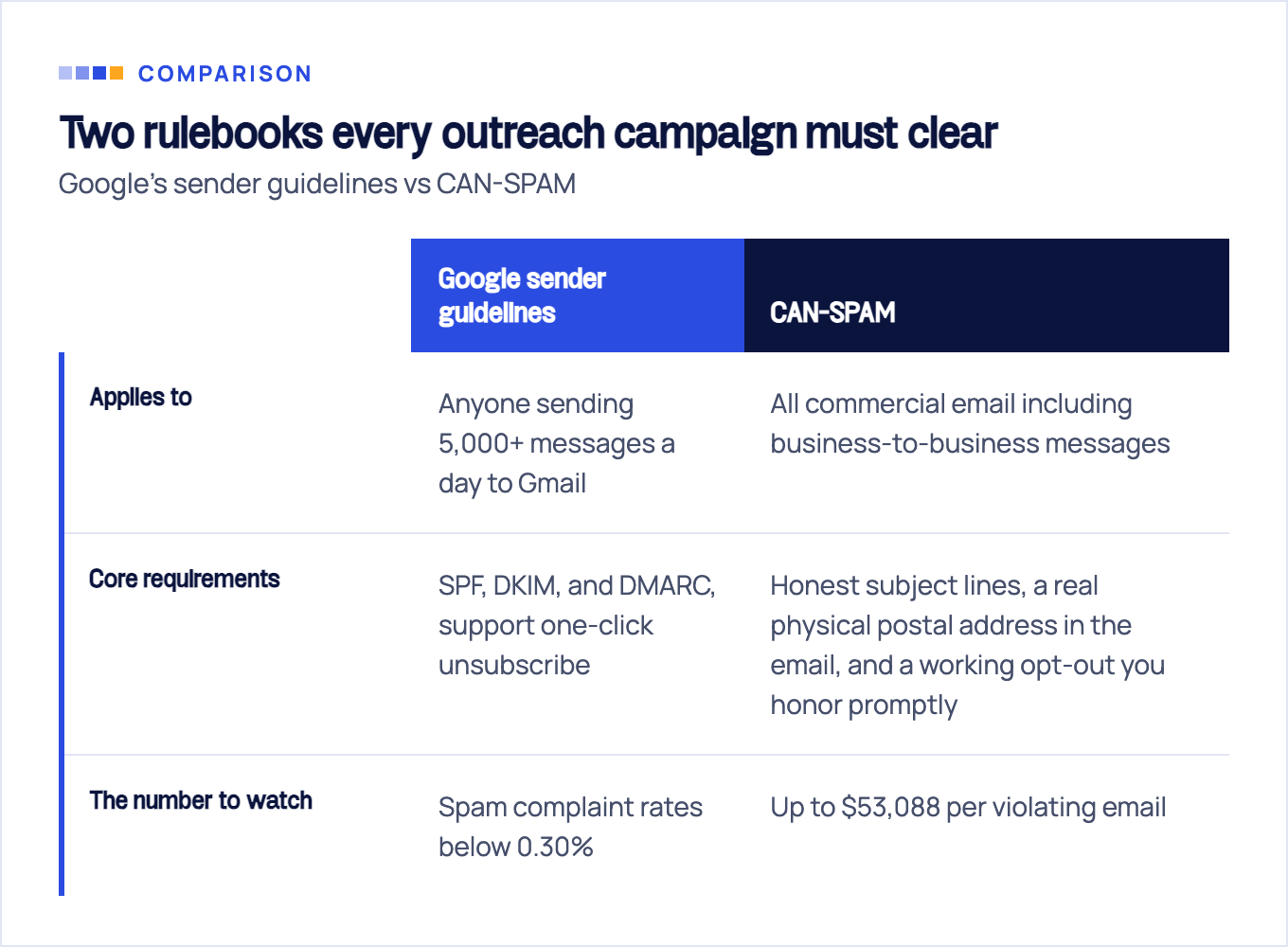
This is the section the other guides don’t write, and it’s the one that can quietly sink an entire campaign. You can nail prospecting, personalization, and cadence, and still land in spam because your sending setup is wrong or your emails break the law. Two rulebooks apply.
Google’s sender guidelines (enforced since February 1, 2024). Anyone sending 5,000+ messages a day to Gmail must authenticate with SPF, DKIM, and DMARC, support one-click unsubscribe, and keep spam complaint rates below 0.30% in Postmaster Tools, per Google’s email sender guidelines. The trap for outreach: if you send from your main company domain and trip these thresholds, you can tank deliverability company-wide, and your sales and support email starts landing in spam too. The fix is to send outreach from a separate domain, warm it up gradually before volume sending, and keep it isolated from your primary domain.
CAN-SPAM applies to B2B outreach. People assume the U.S. anti-spam law is only about consumer marketing. It isn’t: the FTC’s compliance guide states the law covers all commercial email including business-to-business messages, and each separate violating email carries penalties of up to $53,088. The requirements are not hard to meet (honest subject lines, a real physical postal address in the email, and a working opt-out you honor promptly), but “we didn’t know it applied to outreach” is not a defense.
A checklist you can run before any campaign goes out:
- Separate sending domain, warmed up before volume
- SPF, DKIM, and DMARC records verified
- Spam rate monitored in Google Postmaster Tools, kept under 0.30%
- One-click unsubscribe / clear opt-out in every email
- Truthful subject lines and “from” names, no bait-and-switch
- A real physical mailing address in the footer
- Opt-outs actioned quickly and never re-emailed
Metrics: what good outreach numbers look like
If you can’t state your reply rate and conversion rate from memory, you’re not running a campaign: you’re just sending emails and hoping. The funnel to track is simple: prospects → delivered → replies → conversions (a placed link). Each stage has a rate, and the rates tell you where to fix.
Benchmarks to measure yourself against. When Ahrefs polled 800+ people on X and LinkedIn about their outreach results, the average conversion was 1 to 5% of emails resulting in a link. Ahrefs’ own 515-email campaign hit a 17.55% reply rate and 5.75% conversion to links, a useful “well-run campaign” target, not a floor you should expect on attempt one.
Those numbers make budgeting arithmetic instead of guesswork. Work the funnel backwards from the links you want:
| You want | At this conversion rate | You need this many quality prospects |
|---|---|---|
| 10 links | 5% | 200 |
| 10 links | 2.5% | 400 |
| 20 links | 5% | 400 |
The lesson isn’t “send more.” It’s that the two levers on prospect count are conversion rate (better lists and follow-up) and target (fewer, better links). Improve conversion from 2.5% to 5% and you halve the prospects needed for the same result, which is exactly why prospecting and follow-up pay for themselves. If your question is what those links then cost in money and hours, our link building pricing guide runs the cost side of the same math.
Doing this in-house vs hiring it out
The honest framing: outreach is a volume-plus-craft operation, and the breakeven between in-house and agency turns almost entirely on how much volume you can genuinely commit to. Run the pipeline math above and it’s clear: to book roughly 10 links a month at a 5% conversion rate, you need about 200 quality prospects worked every month, with someone tracking the funnel and running follow-up on schedule.
If you can commit that consistently, in-house is realistic and often cheaper per link. Below that threshold, the fixed costs (tools, a warmed sending domain, and the hours to prospect, write, and follow up) usually mean your true cost per link beats agency pricing only on a spreadsheet, not in practice. The ramp is slow and the first links are the most expensive you’ll ever produce.
Whichever route you pick, stay inside Google’s rules, because the wrong kind of outreach undoes itself. Google’s spam policies list buying or selling links and requiring links in contracts as link spam, and warn that violating sites may rank lower or not appear at all. Google’s webspam team has also stated plainly that guest or contributor posts published at scale mainly to build links back to the author’s site violate its link scheme guidelines, and that questionable links in such articles should carry rel="nofollow". Outreach earns links; it doesn’t manufacture them. Where that line sits in practice is the whole subject of our guide to white hat link building.
If you’d rather have a team run the full loop (prospecting by buyer audience, personalized outreach, disciplined follow-up, and reporting against the pages that make you money), that’s what our link building service does, and the anatomy of a link building campaign shows what a done-for-you version looks like over a full quarter. Either way, the process in this guide is the same one that works: a list worth emailing, personalization that scales, follow-up that doesn’t quit, and numbers you can actually read.
Sources & fact-check
Every factual claim in this article is checked against primary sources, not opinion. Written by Dmitry Shpytaliev, Master SEO tech & content. Last verified July 16, 2026.
- OfficialGoogle Workspace Admin Help, Email sender guidelines (bulk sender rules above 5,000 Gmail messages a day)
- OfficialGoogle Search Essentials, Spam policies for Google web search (buying or selling links for ranking is spam)
- OfficialGoogle Search Central Blog, A reminder about links in large-scale article campaigns (link schemes guidance)
- OfficialFTC, CAN-SPAM Act: A Compliance Guide for Business (B2B email included, up to $53,088 per violating email)
- Primary dataBacklinko with Pitchbox, Email Outreach Study (12 million emails, 8.5% reply rate, 65.8% follow-up lift)
- Primary dataAhrefs, Link Outreach guide (1 to 5% average conversion in its 800+ person poll, plus a 515-email case study)
