White hat link building means earning backlinks without violating Google’s link spam policies. Google defines link spam as creating links “primarily for the purpose of manipulating search rankings” per its spam policies. White hat work is every acquisition method that fails that description, because the link would exist even if Google didn’t. The term itself is industry slang, not Google vocabulary. The policy text is the real standard, and it is both more specific and more forgiving than most guides admit.
There’s a reason those guides stay vague: almost every page ranking for this topic is written by a company that sells links, and quoting the policy verbatim would indict half their product line. We sell link building too, so keep your skepticism handy. This guide maps each tactic to what Google actually publishes, including the ones we tell clients not to buy.
What is white hat link building?
White hat link building is the practice of acquiring backlinks in ways that comply with Google’s spam policies: publishing things worth citing, building relationships with people who publish, and asking for links only where a link genuinely serves the linking site’s readers. The dividing line is purpose. A link placed because a page deserves it is fine; a link manufactured primarily to move rankings is spam, whatever channel produced it.
Two things follow from that definition.
First, “white hat” is not a Google category. Google doesn’t grade hats; it defines link spam and treats everything outside that definition as normal web behavior. Arguing about hat colors is less useful than reading the policy.
Second, the work is still worth doing. PageRank remains one of Google’s core ranking systems (its own ranking systems guide says so plainly), which means links still pass ranking credit, and earning them still compounds.
The practical test we apply to every tactic in this guide: would this link exist if search engines didn’t? If yes, you’re white hat. If the only party who benefits is your rankings, you’ve crossed the line no matter what the vendor’s sales page says.
White hat vs. gray hat vs. black hat: where Google actually draws the line
Google’s spam policies don’t speak in generalities. They name eleven concrete link-spam patterns: buying or selling links for ranking purposes, excessive link exchanges, links built by automated programs, links required by a Terms of Service or contract, text advertisements or text links that don’t block ranking credit, advertorials or native advertising carrying links that pass ranking credit, low-quality directory and bookmark links, keyword-rich links embedded in widgets, widely distributed footer and template links, forum comments with optimized links in the post or signature, and low-value content created primarily to manipulate linking and ranking signals.
Here is how the common tactics map against that list:
| Tactic | Policy status | What actually happens |
|---|---|---|
| Editorial links earned by content or PR | White hat, outside the spam definition | Pass ranking credit and compound |
| Paid links qualified with rel=“sponsored” or nofollow | Explicitly compliant | Legitimate advertising; pass no ranking credit |
| Buying or selling followed links for rankings | Named link spam | Devalued at scale; manual action risk |
| Excessive link exchanges (“you link to me, I link to you”) | Named link spam | Obvious footprint; devalued |
| Links created by automated programs or services | Named link spam | Ignored or devalued |
| Links required by a contract or Terms of Service | Named link spam unless qualified | Partner-page footprints are easy to detect |
| Text ads or text links that don’t block ranking credit | Named link spam unless qualified | Devalued; the classic paid-link trap |
| Advertorials or native advertising with credit-passing links | Named link spam unless qualified | The “sponsored post” package; devalued at scale |
| Low-quality directory and bookmark links | Named link spam | Ignored; wasted effort |
| Keyword-rich links embedded in widgets | Named link spam | Devalued sitewide |
| Widely distributed footer and template links | Named link spam | Devalued sitewide |
| Forum comments with optimized links in signatures | Named link spam | Ignored or devalued |
| Low-value content created primarily to manipulate linking signals | Named link spam | Devalued; what scaled guest posting turns into |
Notice the second row, because most guides get it wrong. Buying links is not automatically a violation. Google’s policy targets links that pass ranking credit; a paid placement qualified with rel=“sponsored” or rel=“nofollow” is compliant advertising. Google’s outbound link documentation asks site owners to mark paid placements with the “sponsored” value (nofollow remains acceptable, sponsored is preferred) and user-generated links with “ugc”. The catch for buyers: a properly qualified paid link does nothing for rankings, which is exactly why the unqualified kind gets sold.
So where is gray hat? It’s every tactic the policy doesn’t name that still fails the primary-purpose test. Scaled guest posting on sites that publish anyone, “niche edits” inserted into old posts for a fee, ABC link swaps engineered to hide the exchange. Google didn’t list your specific scheme, but if the link exists primarily for rankings, it’s inside the definition of link spam. The list is prefaced as examples, not an exhaustive menu. Sites that cross the line “may rank lower in results or not appear in results at all,” in the policy’s own words.
Why cutting corners stopped paying: Penguin, SpamBrain, and manual actions
The old argument for white hat was fear of penalties. The current argument is economics, and it’s stronger.
Enforcement changed shape in 2016. With Penguin 4.0, link-spam detection became real-time and part of Google’s core algorithm. Here is the pivot: Penguin shifted to devaluing spam links rather than demoting the whole site. Today Google runs a range of spam detection systems, including SpamBrain, against behavior that violates its spam policies. The default fate of a bought link is not a penalty. It’s silence: the link gets neutralized, passes nothing, and nobody sends you a notification.
Manual actions still exist for the loud cases. Google issues an “unnatural links to your site” action when it detects “a pattern of unnatural, artificial, deceptive, or manipulative links,” per the Manual Actions documentation. A parallel action exists for unnatural links from your site, which is what link sellers risk.
That reframing matters for budgeting. A cheap link that gets devalued isn’t cheap; it’s a total loss. An editorial link that keeps passing credit through every update wins on unit economics before you even price in risk.
7 white hat link building techniques that survive every update
You don’t need fifteen tactics. You need a handful that pass the “would this link exist without rankings?” test and suit your resources. These seven do.
1. Data studies and digital PR
Publish original data (surveys, internal metrics, scraped datasets) and pitch the findings to journalists and bloggers who cover your space. Writers link because they’re citing a source, which is the most natural link on the web. This is the highest-ceiling technique on the list and the most work per asset.
2. Unlinked brand mentions
Someone already wrote about your company, product, or study and didn’t link. Find those mentions with a brand-monitoring alert or a search operator, then send a short note asking for credit. Conversion is high because the editorial decision was already made; you’re requesting a formatting fix, not a favor.
3. Broken link building
Find dead outbound links on pages in your topic, build or identify a live replacement on your site, and let the page owner know. You’re doing them a service (fixing a broken page) and yourself one (earning the replacement slot). The link exists because it helps the linking page’s readers, so the test passes by construction.
4. Resource page link building
Curated “best resources” pages exist to link out, which makes them the rare prospect where asking for a link is exactly what the page is for. The bar is that your asset genuinely belongs on the list. We cover prospecting, qualification, and pitch angles in our guide to resource page link building.
5. Journalist request platforms
Reporters post source requests; you answer with genuine expertise; they quote and usually link. The brands have churned: Cision shut HARO and Connectively down in December 2024, then Featured bought both names and revived them, running HARO as the free newsletter and Connectively as the platform, with Featured itself relaunched in June 2026 as an AI co-pilot for PR. Qwoted and Source of Sources cover the same ground. Speed and specificity win. Canned expert commentary gets deleted, and earns nothing.
6. Guest posting on sites with real readers
Writing for an editorial site that has actual organic traffic, with natural anchors and something original to say, is white hat and always has been. The technique has a bad name because of what it became at scale, and there’s more on that in the next section. The filter: would this site publish you if you offered the article with no link in it?
7. Linkable assets aimed at high link intent keywords
Some queries are searched by people who are writing something: statistics roundups, definitions, templates, calculators, free tools. Build the best page for one of those queries and it collects links passively for years. This pairs with technique 1: your data study becomes the stats page bloggers cite.
Picking tactics is the easy half. Execution (prospect lists, personalization, follow-up cadence, anchor discipline) is where campaigns live or die, and we’ve written up our full process in the link building outreach guide.
The gray zone, honestly: guest posts, niche edits, and paid placements
This is the section link vendors can’t write, so let’s be precise.
Guest posting is white hat when it’s editorial and spam when it’s industrial. One thoughtful column on a site your buyers read passes every test. The same words syndicated across forty pay-to-play blogs with keyword-rich anchors is a link scheme wearing a content costume, and the sites that accept those posts leave a footprint SpamBrain reads at scale. The tactic isn’t the problem; the intent and the volume are.
Niche edits (link inserts) are almost always paid placements: you pay a site owner to add your link to an existing post. Follow the policy chain and the product falls apart. Paid placements must carry rel=“sponsored” to be compliant. A sponsored link passes no ranking credit. So the version buyers actually want (followed, credit-passing, anchor of your choice) is policy-violating by definition, and the compliant version is worthless for rankings. There is no white hat niche edit for sale.
Link marketplaces selling “DR90 links from $200” are selling exactly what that price implies: inventory farmed for resale, sites whose DR was inflated by the marketplace’s other customers, with no organic traffic and an outbound profile full of strangers. Every vendor fishes the same pond, and Google sees the whole pond.
Our position at SEOBRO is boring by design: we operate inside the policy line, and when a client asks about a gray tactic we say “gray” out loud, because devalued links are wasted spend and we’d be the ones explaining the flat traffic curve. An agency that can’t tell you where the line sits is usually on the other side of it.
How to vet a link prospect like an agency does
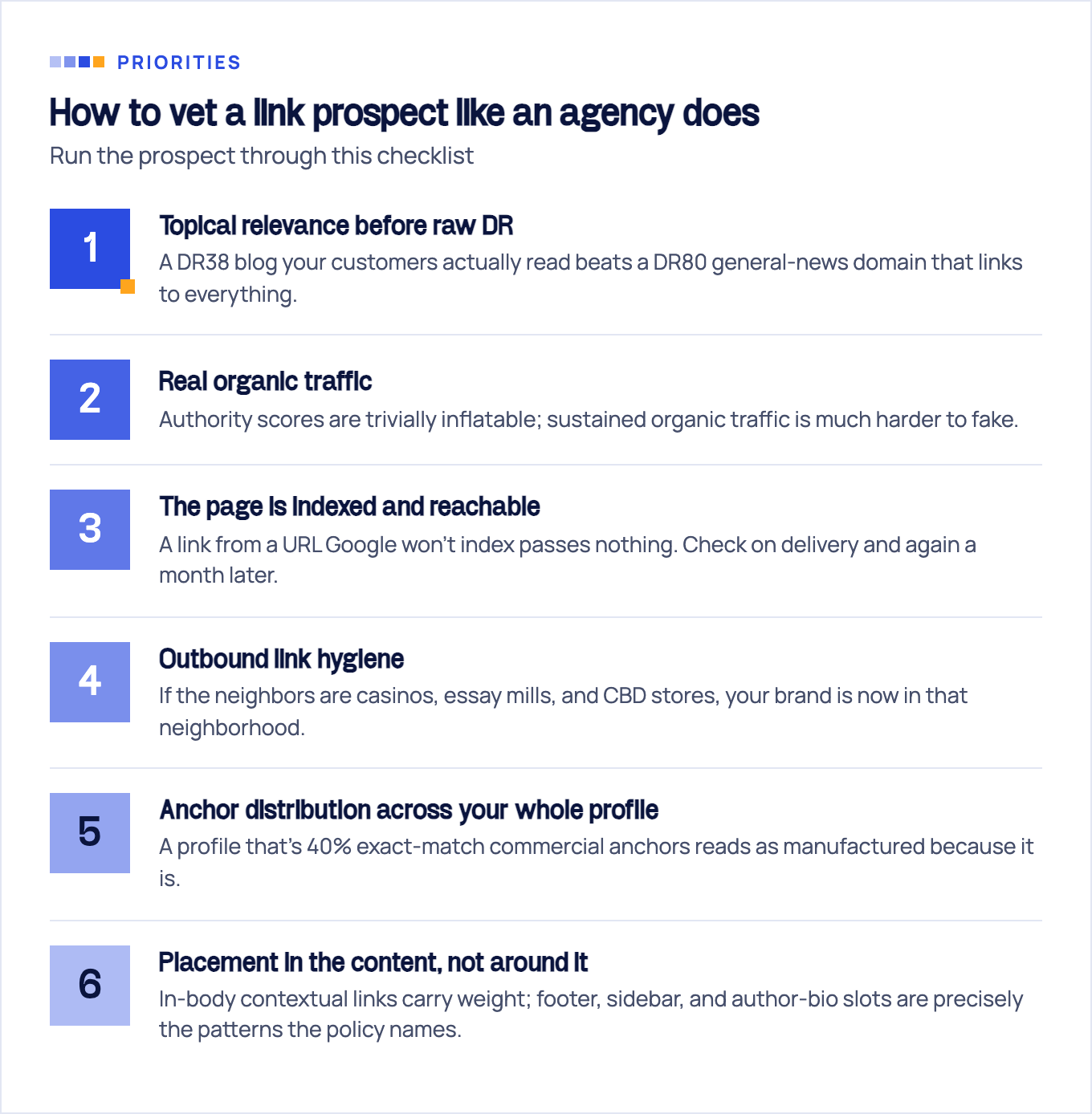
Metrics screenshots are marketing. Before pursuing (or paying for) any placement, run the prospect through this checklist:
- Topical relevance before raw DR. A DR38 blog your customers actually read beats a DR80 general-news domain that links to everything. Relevance is what makes a link plausible to both users and algorithms.
- Real organic traffic. Check the site in Ahrefs or Semrush yourself. Authority scores are trivially inflatable; sustained organic traffic is much harder to fake.
- The page is indexed and reachable. A link from a URL Google won’t index passes nothing. Check on delivery and again a month later.
- Outbound link hygiene. Look at who else the site links to. If the neighbors are casinos, essay mills, and CBD stores, your brand is now in that neighborhood.
- Anchor distribution across your whole profile. Judge each new anchor against the aggregate. A profile that’s 40% exact-match commercial anchors reads as manufactured because it is.
- Placement in the content, not around it. In-body contextual links carry weight; footer, sidebar, and author-bio slots are precisely the patterns the policy names.
The filter that ties these together is the one we build campaigns around: does this site’s audience contain your buyers? A link that sends qualified referral visitors is simultaneously the safest link you can earn (it visibly exists for humans) and the highest-ROI one (it produces leads while it boosts rankings). When you select prospects by audience instead of by metrics, policy compliance mostly takes care of itself.
One cleanup note, because gray-hat history creates anxiety: you almost certainly don’t need to disavow anything. Google’s disavow documentation states that in most cases it can assess which links to trust without guidance, reserves the tool for sites with a considerable number of spammy links plus an actual or likely manual action, and warns that incorrect use can harm your site. Random spam pointing at your domain gets ignored; leave it alone.
Measuring white hat link building beyond domain rating
Domain rating is a prospecting input, not a result. If your monthly report leads with DR movement, you’re measuring the vendor’s convenience, not your business.
Links matter because of what they do to pages that earn revenue. Ahrefs’ search traffic study of roughly 14 billion pages found that 96.55% get zero traffic from Google, and that pages with more referring domains get more organic traffic. Read those together: links move pages, and links pointed at pages nobody needs move nothing. Direct your link budget at the pages that convert.
The metrics worth reporting:
- Referring domains to commercial pages, not sitewide totals, which blog-only links inflate.
- Rankings on money keywords: the queries with buyers behind them, tracked against the pages links point to.
- Organic leads and assisted conversions: the number the whole exercise exists to move.
Set timeline expectations up front, because editorial links compound on a content schedule, not an ad schedule. Outreach takes weeks to convert, placements take weeks to be crawled and weighted, and rankings respond over months. A white hat campaign judged at day 30 always looks like a failure; judged at month six, the compounding is visible and keeps paying after you stop.
Budget is the other expectation to set honestly. Our link building pricing guide breaks down what real editorial placements cost and why the cheap tiers are cheap. And if you’d rather have a team run the whole loop (prospecting by buyer audience, outreach, anchor discipline, reporting against money pages), that’s what our link building service does, the same way we’ve done it for our own sites and 100+ clients across the USA, UK, and EU.
Sources & fact-check
Every factual claim in this article is checked against primary sources, not opinion. Written by Roman Sydorenko, Chief SEO & AI search. Last verified July 16, 2026.
- OfficialGoogle Search Central, Spam policies for Google web search (the eleven named link spam patterns)
- OfficialGoogle Search Central, A guide to Google Search ranking systems (PageRank still core, plus SpamBrain)
- OfficialGoogle Search Central, Qualify your outbound links to Google (the sponsored, ugc and nofollow values)
- OfficialGoogle Search Console Help, Manual Actions report (the unnatural links to your site action)
- OfficialGoogle Search Console Help, Disavow links to your site (most sites never need the tool)
- Primary dataAhrefs, Search traffic study of ~14 billion pages (source of the 96.55% zero-traffic figure)
