Ecommerce link building is the practice of earning backlinks to an online store’s category pages, product pages, and supporting content so those pages rank higher and bring in more organic revenue. It differs from generic link building in one important way: almost nobody links to a commercial page voluntarily, so the real job is deciding where links should land before deciding how to earn them. Most guides skip that first decision. This one starts with it.
What is ecommerce link building?
The definition above covers the what. The question store owners actually type into Google, usually after reading a skeptical Reddit thread, is whether any of this still works in 2026.
It does, and the evidence is not subtle. Backlinko’s analysis of 11.8 million search results found that the #1 result had on average 3.8x more backlinks than positions #2 through #10, and roughly 3x more referring domains. The same study found that domain diversity has a substantial impact on rankings: ten links from ten different sites beat ten links from one. Looking from the other direction, Ahrefs studied about 14 billion pages and found that 96.55% of them get zero organic traffic from Google. Among pages with no backlinks at all, only about 1 in 6,671 attracts more than 1,000 search visits a month.
So links still separate pages that rank from pages that don’t. What the skeptics are correctly sensing is that the generic playbook fails for stores. Your money pages are grids of products with prices. Journalists don’t cite them. Bloggers don’t reference them. Left to grow naturally, a store’s link profile piles up on the homepage and blog while the category pages that pay the bills sit at zero referring domains.
That is the store-specific problem: ecommerce link building is a targeting problem first and an outreach problem second. Get the targeting right and even a modest number of links moves rankings, because your competitors almost certainly got it wrong.
Why stores struggle to earn links (and the page-targeting framework that fixes it)
Before you pick tactics, map where links should land. We run every store engagement on a three-tier model:
| Tier | Where links land | What they buy you | Typical sources |
|---|---|---|---|
| Brand | Homepage | Trust, entity recognition, a natural anchor profile | Suppliers, press, associations, sponsorships |
| Money | Category pages, sometimes hero products | Rankings for commercial keywords that convert | Resource pages, roundup reclamation, broken link building, deep directory listings |
| Content | Guides, tools, data studies | Link equity you route internally to money pages | Journalists and bloggers citing something genuinely useful |
The tiers are not equal. Brand links are the easiest to earn and set the foundation. Content links are the easiest to scale. Category page links are where rankings actually move, because that’s where commercial search demand concentrates. And that demand keeps growing: US ecommerce sales reached $326.7 billion in Q1 2026, 16.9% of total retail and up 9.8% year over year, per the US Census Bureau. Every point of growth pulls more competitors into the same category keywords.
One prerequisite before any of this: links amplify pages that already deserve to rank. If your category pages are thin product grids with a keyword stuffed in the H1, fix the pages first. Our guide to building category pages that rank covers that on-page half of the equation.
Category-page link building: the highest-ROI target
Nobody links to a grid of products. People link to pages that helped them, and that insight drives every tactic below.
Make the category page citable. Add a real buying guide below the product grid: how to choose, sizing logic, material comparisons, the mistakes first-time buyers make. Now the URL is something a blogger can reference mid-article, and every link it earns lands directly on a money page. This is the single highest-impact move in category page link building because it turns future outreach from “please link to my shop” into “here’s the best resource on choosing X.”
Reclaim spots in outdated roundups. Search for “best [your category]” articles ranking on page one and two. A surprising share of them recommend discontinued products, dead brands, or stores that no longer ship. Pitch the author a concrete update, with your category or product page as the replacement. You’re improving their article, which is why this converts better than cold guest-post begging.
Run broken link building against competitors. Stores are uniquely suited to this tactic. Products get discontinued, category trees get reshuffled, replatforming breaks old URLs. Crawl competitor backlink profiles for dead commercial URLs, find the sites still linking to them, and offer your live equivalent. The linker gets a fixed page; you get their link.
Get listed on resource pages and niche directories. Skip the mass web directories. Look for curated resource lists in your vertical: a homebrewing association’s supplier list, a quilting blog’s “where to buy fabric” page. The good ones link deep to category pages, not just homepages. We break down the qualification process in our link building outreach guide.
A note on anchors before you start pitching. Google’s guidance is that good anchor text is “descriptive, reasonably concise, and relevant to the page that it’s on and to the page it links to,” and that forcing keywords into anchors crosses into spam territory, per its link best practices documentation. In practice: “this guide to choosing trail running shoes” is a healthy anchor for a category page. Fifty external links that all read “buy trail running shoes online” are pattern-filter fodder. Suggest anchors, don’t dictate them.
Product-led digital PR
Your inventory is a PR asset most content sites would kill for. Digital PR for ecommerce runs on four plays:
- Product seeding. Sending products to journalists, editors, and creators who cover your space, with no strings attached, hoping they find it worth writing about.
- Data studies from store data. You sit on pricing history, seasonal demand curves, return rates, and regional buying patterns. A “what people actually pay for X” index or a seasonal demand report earns links no listicle ever will.
- Expert commentary. Your founder or head buyer can comment on supply chains, pricing swings, and product trends. Reporter-request platforms and direct journalist relationships turn that expertise into brand links.
- Launch newsjacking. Tie product launches to moments journalists already care about: seasons, regulation changes, viral trends in your niche.
Now the part every other guide skips: two of these plays have compliance traps.
Google’s spam policies define link spam as links intended “primarily for the purpose of manipulating search rankings,” and they explicitly list “sending someone a product in exchange for them writing about it and including a link” as a form of buying links. Compensated or sponsored links are only compliant when qualified. Google’s own guidance on qualifying outbound links says paid placements should carry rel=“sponsored”, with rel=“nofollow” still acceptable.
The FTC adds a second layer. Its Disclosures 101 guidance requires endorsers to disclose any material connection with a brand, explicitly including free or discounted products, and the disclosure is required even if you never asked to be mentioned.
What this means operationally: seed products for coverage, not for links. No “please include a followed link to our category page” in the pitch. If coverage happens and the writer links, you earned it. If you pay for placement, the link gets qualified and you treat it as advertising, not SEO. The upside of playing it straight is that earned product coverage often produces the most defensible links a store can get, plus unlinked brand mentions you can later convert with a polite reclamation email.
Supplier, manufacturer, and brand-ecosystem links
This is the most underused source of links for ecommerce websites, and none of the guides ranking for this topic mention it.
If you’re a retailer, every brand you stock probably runs a “where to buy,” stockist, or authorized-dealer page. Those pages exist to send customers to you. They live on relevant, established manufacturer domains, they carry real referral traffic, and the link costs nothing beyond an email to your account manager. Go through your supplier list brand by brand and ask. Ten minutes per supplier, and each yes is a trusted, topically perfect link most competitors never think to request.
If you’re a DTC brand, flip the direction. Your ecosystem includes:
- Retailers and distributors that carry your products and list their brand partners
- Certification bodies and industry associations with member directories
- Chambers of commerce and local business organizations
- Events, teams, and charities you sponsor, which routinely credit sponsors with a link
These links usually point at your homepage with a brand-name anchor. That’s not a weakness. It’s exactly the natural profile the brand tier needs, and it raises the ceiling for every category page you target afterward.
The outreach itself is short: who you are, the business relationship you already have, the specific page you’d like to be added to. Existing relationships mean you can skip the persuasion theater that makes cold link outreach such a grind.
Content assets that earn links: how to route equity to money pages
Content marketing advice is table stakes on this topic, so here’s the compressed version. Three asset types reliably earn links for stores: genuinely thorough guides on problems your buyers face, calculators and interactive tools, and original research built from your own data. What doesn’t earn links: thin listicles, reworded manufacturer specs, and “ultimate guides” that summarize other people’s ultimate guides.
The part competitors state but never operationalize is routing. A linkable asset is a means, not an end. Every asset you build should carry a contextual link to its target category page, placed high in the content where it passes the most value, with a descriptive anchor. When the asset earns ten referring domains, your category page inherits a share of that authority through internal linking. Build the asset, earn the links, route the equity. Skip the third step and you’ve built a well-linked blog post and an unranked store.
What to skip: tactics that burn ecommerce sites
Ten relevant links to a category page beat a hundred vanity links to blog posts. That’s the FLG lens we apply to every campaign: links exist to make money pages rank and produce revenue, not to inflate a Domain Rating chart. The tactics below fail that test, and several carry real penalty risk.
- Guest-post marketplaces and link farms. Sites that exist to sell placements are the most identifiable link scheme on the web. Cheap, fast, and worthless at best.
- Mass 301-ing discontinued products to the homepage. It hoards crawl budget and teaches Google your redirects are noise. Redirect discontinued URLs to the closest relevant category instead.
- Press-release syndication for links. A hundred duplicate placements on wire-service mirrors, all seen and discounted years ago.
- Widget and badge schemes. Google’s spam policies name keyword-rich links embedded in widgets distributed across various sites. An “award badge” that ships those links back to your store is the same pattern with a ribbon on it.
- Exact-match commercial anchors at scale. Covered above; the fastest way to turn good placements into an algorithmic problem.
If a vendor pitches you guaranteed links at a fixed price per DR point, you’re looking at the first item on this list wearing a suit. More patterns worth avoiding, and the white-hat alternatives, live in our link building hub.
Measuring results, timelines, and cost
Measure at the page level, not the site level. The KPIs that matter for a store:
| KPI | Why it matters |
|---|---|
| Referring domains to money pages | The direct input; sitewide totals hide whether category pages are actually gaining |
| Category keyword rankings | The mechanism; track your target commercial terms, not vanity keywords |
| Organic revenue per landing page | The outcome; ties the campaign to money, which is the point |
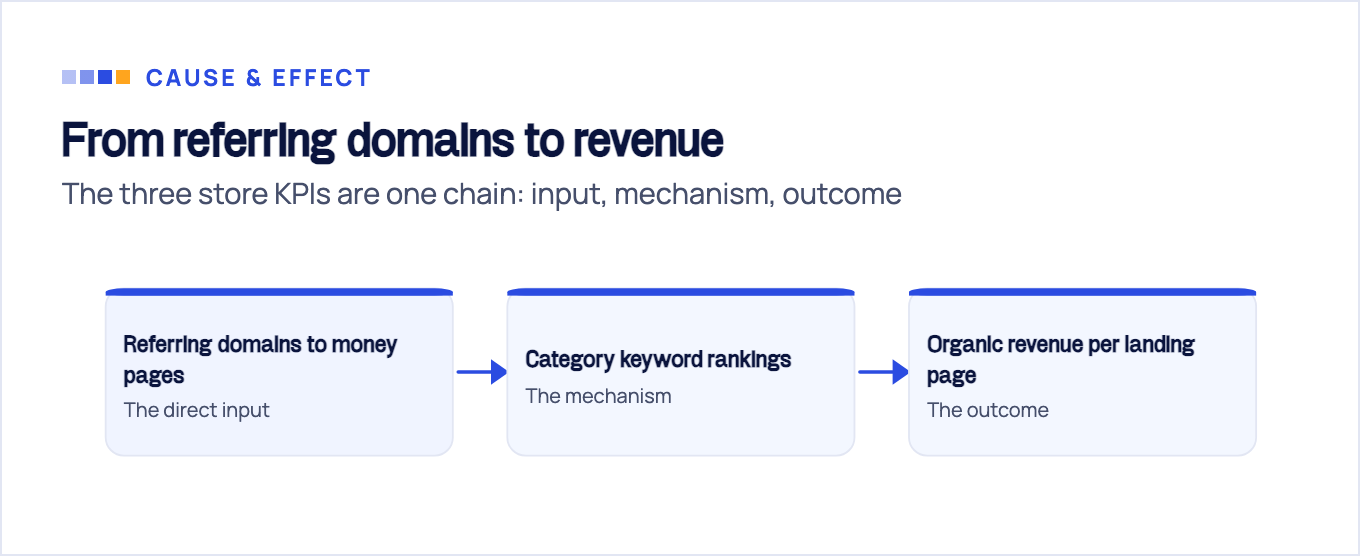
Domain Rating is deliberately absent. DR is a third-party estimate of sitewide link strength, and optimizing for it is how stores end up with a hundred links to infographics and category pages stuck on page three.
On timelines, honesty beats optimism: links compound over months, not weeks. Crawling, recalculation, and ranking shifts take time, and the pages you’re targeting usually need a handful of referring domains before movement shows. Any vendor promising ranking jumps in two weeks is describing something other than link building. Budget-wise, pricing varies enormously with niche competitiveness and link quality; our link building pricing breakdown covers what stores actually pay per link and per campaign, and which pricing models to avoid.
When it makes sense to hand this off
Everything above is doable in-house if someone owns it week over week: prospecting, pitching, follow-up, and the content work that makes pages worth linking to. Where stores stall is consistency, and links are a consistency game. If you’d rather buy the outcome than build the function, our link building service runs this exact playbook, category-page targeting included, and reports on referring domains to money pages and the revenue behind them. Ten-plus years of doing this for 100+ clients across the USA, UK, and EU taught us one thing worth repeating: the stores that win are rarely the ones with the most links, just the ones whose links point at the right pages.
Sources & fact-check
Every factual claim in this article is checked against primary sources, not opinion. Written by Roman Sydorenko, Chief SEO & AI search. Last verified July 16, 2026.
- OfficialGoogle Search Central, Spam policies (defines link spam, paid and gifted links need rel=sponsored or nofollow)
- OfficialGoogle Search Central, Link best practices for Google (anchor text should be descriptive, not keyword stuffed)
- OfficialFTC, Disclosures 101 for Social Media Influencers (free products count as a material connection, disclose it)
- OfficialUS Census Bureau, Quarterly Retail E-Commerce Sales ($326.7 billion in Q1 2026, 16.9 percent of retail sales)
- Primary dataAhrefs, 96.55% of Content Gets No Traffic From Google (index study of about 14 billion pages)
- Trusted sourceBacklinko, We Analyzed 11.8 Million Google Search Results (#1 averages 3.8x more backlinks than #2 to #10)
