SEO for product pages means making every product detail page (PDP) in your store rankable: the title pattern, URL rules, H1, description, images, structured data, reviews, and canonical handling for variants. For any store past a few dozen SKUs, this is a template problem, not a page-by-page problem. You optimize the template and the product data that feeds it once, then hand-polish only the pages that actually produce revenue. This guide covers each element, grounded in Google’s own documentation, and ends with the part most guides skip: what to do when one product spawns seventeen URLs.
What product page SEO actually involves
Product page SEO optimizes two things: the PDP template your platform renders, and the product data fields that populate it. When both are right, every SKU ships with correct on-page signals the moment it goes live, without anyone touching it.
The elements that matter, in rough order of impact:
- Title tag and meta description built from product name, key attribute, and brand
- URL that is descriptive, stable, and free of tracking junk
- H1 and heading structure that mirror how buyers scan
- Product description that is not the manufacturer’s copy-paste
- Images with descriptive filenames, alt text, and sane file sizes
- Product schema markup for rich results and shopping surfaces
- Reviews rendered where crawlers can actually read them
- Canonical and variant rules so one product indexes as one URL
Product pages differ from category pages in the queries they catch. PDPs win long-tail, high-intent searches: “buy this exact model in this exact color.” Category pages take the broader commercial head terms, and they usually carry more commercial keyword volume, so decide the split deliberately. The PDP’s edge is that nobody else can rank for your exact SKU-plus-attribute combinations, and the traffic that lands there is one click from checkout.
Optimize the template, not one page at a time
A store with 3,000 SKUs cannot hand-optimize 3,000 pages, and it should not try. Products rotate, go out of stock, and get replaced faster than anyone can maintain artisanal meta descriptions. What the pages share is one template, so that is where most of the SEO lives.
The workflow we run with ecommerce clients has three steps:
- Fix the template once. Title formula, H1 logic, schema markup, canonical rules, review rendering, image handling. Every SKU inherits the fix on the next crawl.
- Fix the data feeding it. Clean product names, complete attribute fields, accurate availability. A templated title is only as good as the fields behind it, and most “SEO problems” we find in audits are actually PIM problems.
- Hand-optimize the short list. Rank PDPs by revenue potential multiplied by search demand, then give the top 20 to 50 pages custom treatment: rewritten descriptions, expanded FAQs, better photography, internal links from supporting content.
This is FLG (Focused Lead Generation) logic applied to product pages: chase the pages that produce sales, not vanity coverage. A PDP ranking for a query nobody buys from is decoration. A PDP ranking for “product name + size + fast shipping” is a salesperson.
Titles, URLs, and headings built from product data
Templated metadata gets a bad reputation from stores that template it badly. Built from clean product data, a formula beats hand-written titles at any real catalog size.
Title tag formula: Product Name + Key Attribute + Brand.
Kanken Backpack 16L, Graphite | PackPointPull each part from fields you already maintain in your platform or PIM. The attribute worth including is the one buyers type into search: capacity, material, compatibility, size. Not marketing adjectives. “Premium” has never disambiguated a search query.
H1: the product name, plain. Save the creativity for the description.
Meta description: template it from price, availability, and one concrete selling point, such as your shipping threshold or warranty. Google rewrites descriptions often, but a templated one still beats a blank or a duplicated one, and it sets the words buyers see before they click.
URLs deserve more care than most platforms give them by default. Google’s URL guidance for ecommerce sites is specific: use descriptive path segments, represent variants either as a path segment (/t-shirt/green) or a query parameter (/t-shirt?color=green), stick to ?key=value formats rather than bare values, never link to URLs containing session IDs or tracking parameters, and minimize alternative URLs that return the same content.
| Weak URL | Strong URL |
|---|---|
/product?id=8347 | /backpacks/kanken-16l/ |
/p/8347?ref=nav&sid=a81x | /backpacks/kanken-16l/?color=graphite |
/collections/sale/products/kanken-16l linked site-wide | one canonical product path in all internal links |
Every alternative URL you let into internal linking is a page Google has to crawl, deduplicate, and pick a canonical for. Do the picking yourself.
Product descriptions that beat the manufacturer feed
The manufacturer description is the single biggest duplicate-content source in retail. Every store selling that SKU received the same paragraph, and most pasted it verbatim. When fifty domains publish identical copy, Google picks a handful to rank, usually the highest-authority ones, and a mid-size store is rarely in that group.
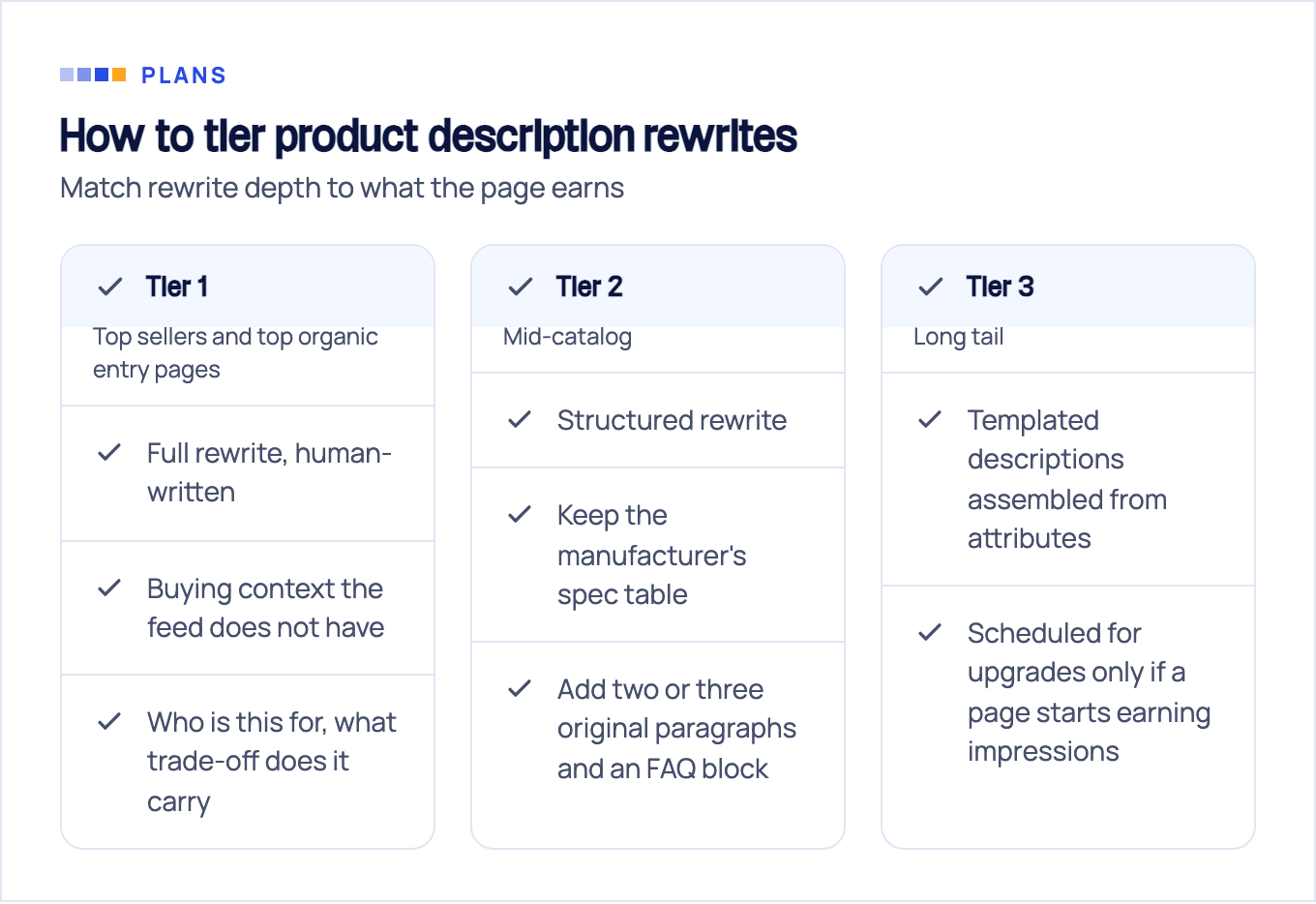
Rewriting everything at once is unrealistic, so tier it:
- Tier 1, top sellers and top organic entry pages: full rewrite, human-written, with buying context the feed does not have. Who is this for, what trade-off does it carry, what do returns data and support tickets say people misunderstand.
- Tier 2, mid-catalog: structured rewrite. Keep the manufacturer’s spec table (specs are facts, not copy), add two or three original paragraphs and an FAQ block.
- Tier 3, long tail: templated descriptions assembled from attributes, scheduled for upgrades only if a page starts earning impressions.
Structure every tier for scanning: a specs table, short prose, then an FAQ block answering real pre-purchase questions. Mine those questions from support chats, review text, and your search console query report. “Does this fit a 16-inch laptop” is worth more than three paragraphs of brand story.
On AI-generated descriptions: they work as a scale drafting tool and fail as a publish-and-forget tool. Generate drafts against your structured attribute data, forbid any claim not present in the source fields, and put a human pass on Tier 1. An AI draft that invents a dimension or a compatibility claim does not just hurt rankings, it generates returns.
Product schema: merchant listings, snippets, and what actually shows up
Structured data is where product pages earn their visible advantage: prices, availability, and stars directly in search results.
Google supports two classes of Product result: product snippets, for pages where people cannot buy directly (reviews, aggregators), and merchant listing experiences, for pages where they can. If you run a store, you want merchant listings, and the same markup does double duty: adding the merchant-listing properties also makes your pages eligible for product snippets.
A minimal but complete JSON-LD block for a PDP:
{
  "@context": "https://schema.org",
  "@type": "Product",
  "name": "Kanken Backpack 16L",
  "image": ["https://example.com/img/kanken-16l-graphite.jpg"],
  "description": "16-liter everyday backpack, water-resistant Vinylon F.",
  "sku": "F23510-031",
  "brand": { "@type": "Brand", "name": "Fjallraven" },
  "aggregateRating": {
    "@type": "AggregateRating",
    "ratingValue": 4.7,
    "reviewCount": 213
  },
  "offers": {
    "@type": "Offer",
    "url": "https://example.com/backpacks/kanken-16l/",
    "priceCurrency": "USD",
    "price": 89.00,
    "availability": "https://schema.org/InStock",
    "itemCondition": "https://schema.org/NewCondition"
  }
}
Populate it from live store data, never hardcode. A schema price that disagrees with the page price is worse than no schema at all.
Google’s own recommendation is to provide as much rich product information as you have available, regardless of which experience ends up using it, and to pair on-page structured data with a Merchant Center feed, since both together maximize eligibility for product experiences. Merchant Center listings are free, and the feed reuses the same product data you just cleaned up in step two.
Schema lives in the template. That cuts both ways: one malformed field suppresses rich results across the whole catalog, and one fix restores them everywhere. Validate with the Rich Results Test after any template deploy, not just the first one.
Reviews: rankings, rich results, and the rules most stores break
Reviews are the only part of a product page that writes itself, stays fresh, and uses your customers’ vocabulary instead of your copywriter’s. They also power the star ratings in search results, if you follow rules that many stores quietly break.
Google’s review snippet requirements are strict on provenance: ratings must be sourced directly from users, an aggregateRating needs a real ratingValue, and self-serving reviews are ineligible, meaning Organization and LocalBusiness entities cannot earn stars from reviews they control. Product reviews written by your customers on your product pages are fine. Marking up your agency-style “our clients love us” testimonials as review schema is not.
The technical traps matter more than the policy ones in practice:
- Widgets in iframes or late-executing JavaScript. If your review platform injects content after load, crawlers may index a page with zero review text on it. Server-render the reviews or use a widget that outputs crawlable HTML.
- Reviews on a separate subdomain. Review content living on
reviews.yourstore.comearns nothing for the PDP that needs it. - Markup without visible content. Stars in schema that a visitor cannot find on the page invite a manual action.
Treat reviews as conversion assets first. Each answered objection in a review is a support ticket that never happens and a hesitation that never becomes an abandoned cart. The rankings benefit compounds on top.
Variant deduplication: one product, seventeen URLs
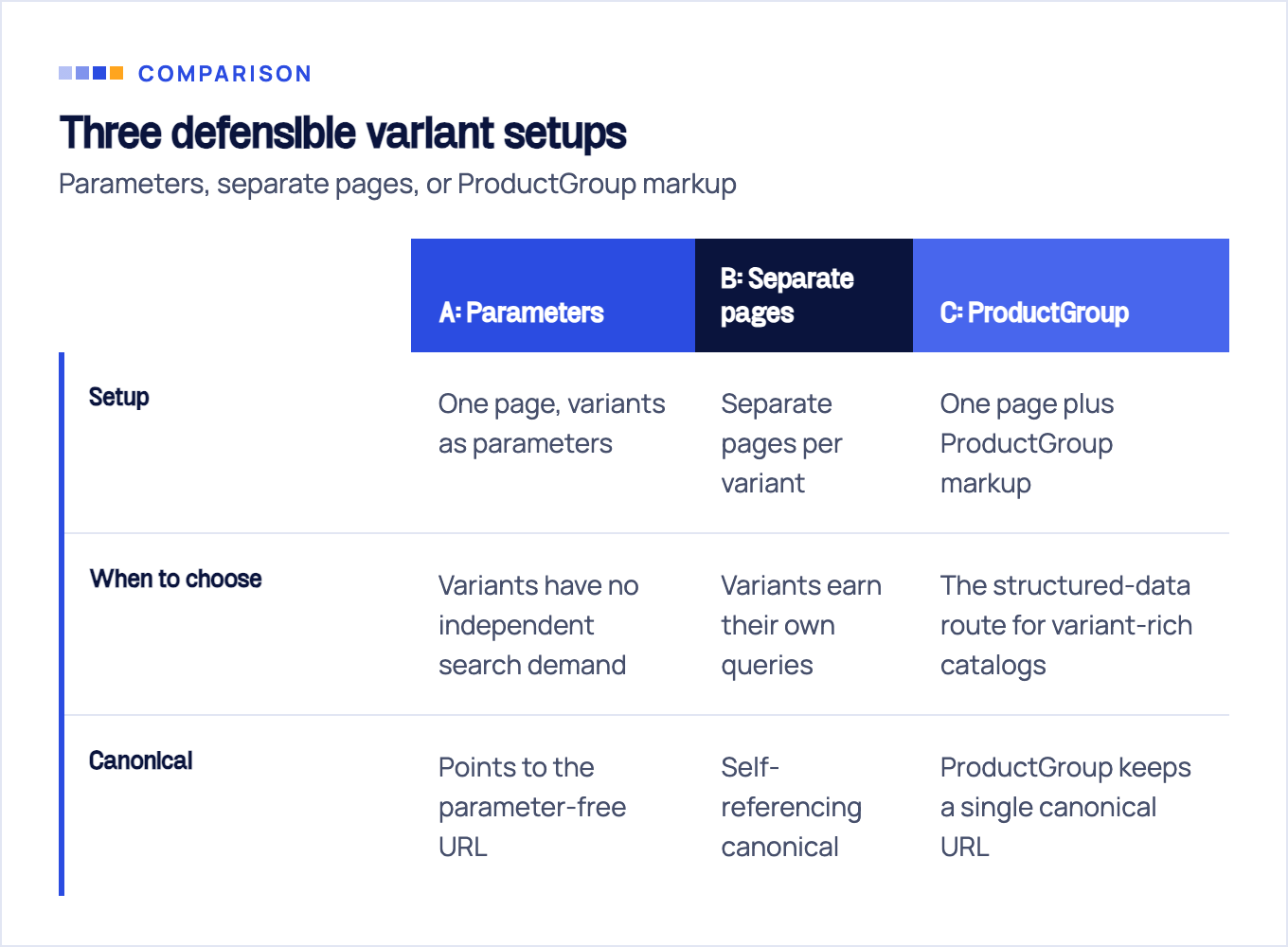
Here is the section most product page SEO guides skip, and the one that decides whether a large catalog gets crawled sanely. A t-shirt in five colors and four sizes, reachable through two collections plus tracking parameters, can produce dozens of URLs for one product. You have three defensible setups.
Option A: one page, variants as parameters. The default, right for most stores. All variants live on a single PDP, selectable via query parameters, and the canonical points to the parameter-free URL, exactly as Google’s ecommerce URL guidance prescribes. Choose this when variants have no independent search demand. Nobody searches for a size.
Option B: separate pages per variant. Justified only when variants earn their own queries, typically at color or model level: “kanken graphite” and “kanken ochre” are distinct searches with distinct buyers. Each variant page then gets a self-referencing canonical and genuinely distinct content: its own images, its own copy, its own reviews if you can segment them. Separate URLs with identical content are duplicates you built on purpose.
Option C: one page plus ProductGroup markup. The structured-data route for variant-rich catalogs. Google’s product variant documentation sets a requirement that trips up most implementations: each variant must be preselectable through a distinct URL, for example ?size=small&color=green, so Google can crawl and identify every variant, while the ProductGroup keeps a single canonical URL. If your variant picker only mutates page state in JavaScript and no URL exists per variant, the markup is not eligible.
Two platform-flavored complications round this out. First, multi-category paths: Shopify renders products under /collections/x/products/y for every collection they belong to, and while its canonical tags point to /products/y, your internal links, feeds, and sitemaps should use the canonical path directly rather than making Google reconcile the duplicates. The Shopify specifics, from collection-path linking to review app rendering, are the core of our Shopify SEO service. Second, out-of-stock variants: keep the page live and mark availability accurately in the Offer if restock is coming; reserve 404s and redirects for products that are genuinely gone. The crawl-budget mechanics behind all of this, faceted URLs, parameter handling, log analysis, get the full treatment in our ecommerce technical SEO guide.
Page speed on PDP templates
Product pages are heavy by nature: image galleries, review widgets, size charts, chat, analytics, upsell scripts. The benchmark to hit is Google’s Core Web Vitals thresholds, measured at the 75th percentile of page loads: LCP within 2.5 seconds, INP at or under 200 milliseconds, CLS at or under 0.1.
The business case is blunter than the ranking case. Deloitte’s Milliseconds Make Millions study, commissioned by Google and published in 2020, found that a 0.1-second improvement in mobile site speed lined up with retail conversions 8.4% higher and average order value 9.2% higher. It is a four-week correlational study, not a controlled experiment, so read it as a strong directional case rather than a guaranteed return. Speed is a conversion lever that happens to also be a ranking input, which is the FLG view of every optimization in this article.
On PDPs the culprits are predictable: oversized gallery images shipped at upload resolution (LCP), review and personalization scripts blocking interaction (INP), and late-loading trust badges or sticky add-to-cart bars shoving content around (CLS). Because it is one template, every fix multiplies across the catalog: compress and lazy-load the gallery once, defer the widget once, reserve layout space once.
Product pages in AI search
AI answers are spreading through the research phase and pulling back from the buy click. Semrush tracked more than 600,000 US keywords and found the share of commercial-intent SERPs carrying an AI Overview grew 71% between November 2025 and April 2026, while the share of transactional SERPs, the “buy this exact model” queries a PDP itself targets, fell 5%. Treat it as a shortlist play. The answer that assembles someone’s shortlist runs on the same inputs you have been building through this whole article: clean Product schema, an accurate Merchant Center feed, crawlable specs, and plainly worded FAQ answers. Stores that render prices in JavaScript soup and bury specs in tabbed widgets risk handing those systems a page with no price and no specs on it; stores with structured, server-rendered product data give them something worth quoting.
Practical moves that pay off in both classic and AI results: keep specs and FAQ content in real HTML rather than client-side-only widgets, keep schema in lockstep with visible page data, and write the first sentence of each description as a self-contained answer about what the product is and who it fits. The broader playbook, including how answer engines pick their citations, is in our guide to ranking in AI Overviews.
Do this next
Run your store through this list before touching anything by hand:
- Title and meta description templates built from product name, key attribute, brand
- URLs descriptive,
?key=valueparameters only, no tracking params in internal links - Product, Offer, and AggregateRating schema populated from live store data
- Merchant Center feed connected alongside on-page markup
- Reviews server-rendered on the PDP, sourced from real customers
- One canonical URL per product; variant strategy chosen deliberately (A, B, or C above)
- Gallery images compressed; Core Web Vitals green at the 75th percentile
- Top 20-50 revenue PDPs flagged for hand-optimization
After 10+ years of doing this for 100+ clients, our honest read is that most stores fail four or more of these checks, and they usually trace back to the template. If you want the full store-wide version of this audit, work through our ecommerce SEO checklist, or have us run the template-level review as part of an on-page SEO engagement. Fixing one template is the cheapest SEO win a catalog of any size will ever get.
Sources & fact-check
Every factual claim in this article is checked against primary sources, not opinion. Written by Roman Sydorenko, Chief SEO & AI search. Last verified July 16, 2026.
- OfficialGoogle Search Central, Designing a URL structure for ecommerce sites (descriptive paths, key=value parameters)
- OfficialGoogle Search Central, Product structured data (markup plus a Merchant Center feed maximizes eligibility)
- OfficialGoogle Search Central, Review snippet structured data (ratings must come from users, no self-serving reviews)
- OfficialGoogle Search Central, Product variant structured data (each variant needs its own query-parameter URL)
- Primary dataDeloitte Ireland, Milliseconds Make Millions (0.1s faster mobile, 8.4% retail conversion lift, correlational)
- Primary dataSemrush, AI Overviews are expanding across commercial intent search (up 71% on commercial SERPs, vendor data)
