SaaS link building is the practice of earning backlinks to a software company’s site to build the authority needed to rank for competitive, high-value software keywords. It differs from link building in every other industry for one reason: your product is the linkable asset. Integrations, usage data, free tools, and your founder’s expertise generate link opportunities that a content-only site has to invent from nothing.
Most guides to link building for SaaS companies ignore that advantage. They recycle the same nine tactics you would hand a plumbing site: guest posts, broken links, HARO, repeat. This guide leads with four product-native plays the generic playbook skips, covers the classics quickly, then answers the question half the people searching this term actually have: what it costs, and when to hand it to an agency.
What is SaaS link building? (and why it works differently for software companies)
Start with why any of this is worth your engineering-constrained, runway-constrained time.
In Ahrefs’ search traffic study of roughly 14 billion pages, 96.55% got zero organic traffic from Google, and only 1.94% got between one and ten visits a month. The study found a clear correlation between referring domains and organic traffic: pages with none mostly stay invisible, and the ones that do pull traffic without links are almost all on low-competition topics. And the gap at the top is steep. In Backlinko’s analysis of 11.8 million search results, the #1 result averaged 3.8x more backlinks than positions 2 through 10.
For SaaS specifically, the keywords that print revenue (“best CRM for startups”, “project management software”, “your-competitor alternatives”) are exactly the ones where that gap decides who gets the demo request. You do not outrank an incumbent on those terms with content quality alone.
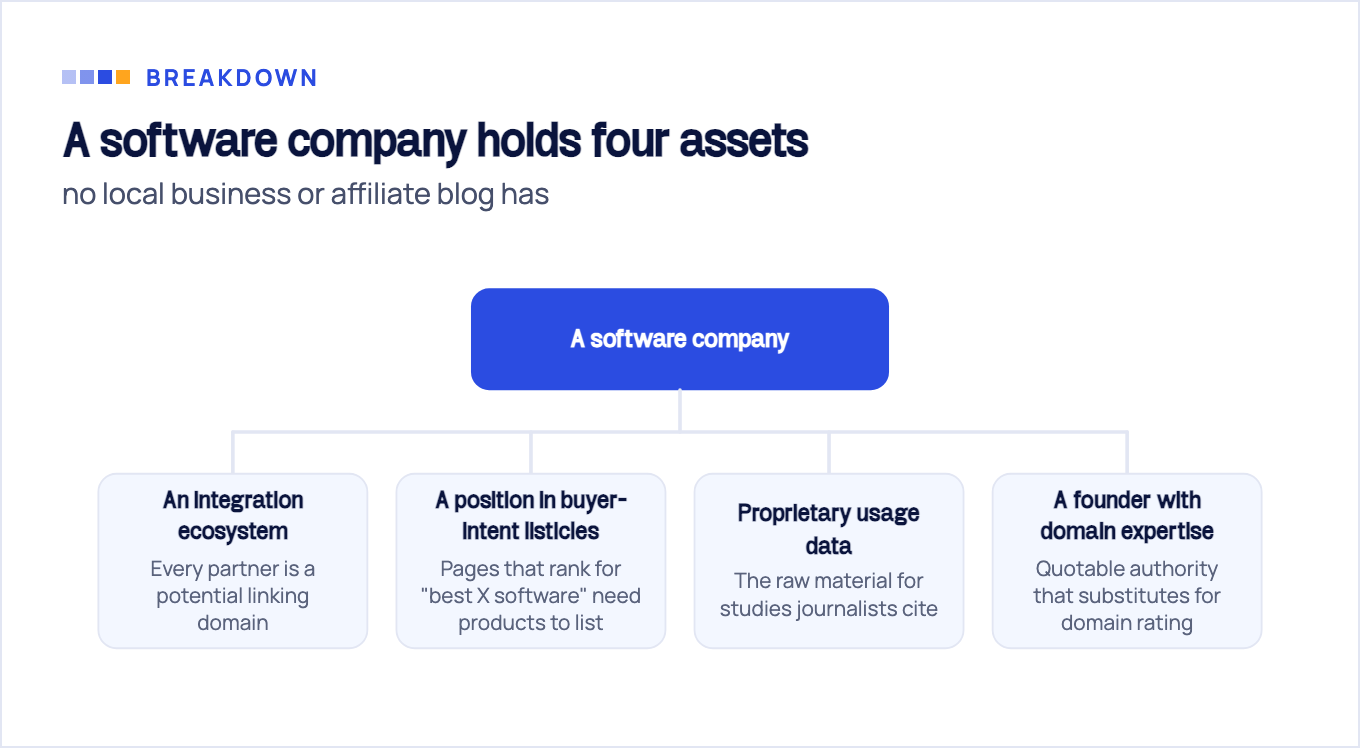
Here is what the generic guides miss. A software company holds four assets no local business or affiliate blog has:
- An integration ecosystem. Every partner is a potential linking domain.
- A position in buyer-intent listicles. Pages that rank for “best X software” need products to list.
- Proprietary usage data. The raw material for studies journalists cite.
- A founder with domain expertise. Quotable authority that substitutes for domain rating.
The rest of this guide works through each play, then the classic tactics, in the order we would run them for a client.
Integration pages: the most underused link source in SaaS
Every integration you ship creates a two-way link opportunity, and most SaaS teams collect neither side of it.
Think through what a single integration launch puts on the table. The partner’s marketing site usually has a partners or integrations directory you can be listed in. The app marketplaces (Zapier, Slack, HubSpot, Shopify’s app store) each give you a profile page and often a link. Partner documentation references your product. And every “tools that work with X” roundup that covers your partner’s ecosystem now has a reason to include you.
These links have two properties that outreach-based links never match. Relevance is perfect: a link from a product your users literally connect to is exactly the kind of editorial context Google’s systems reward. And the marginal cost is close to zero, because the engineering work was already justified by the product roadmap.
The playbook:
- Build a dedicated /integrations/ hub with one page per integration. This gives partners a specific URL to link to and gives you pages that rank for “your-product + partner” searches.
- Co-announce every launch. A joint blog post on the partner’s site is a contextual link from a relevant domain; treat it as a standard line item in the partnership agreement, not an afterthought.
- Ask for both placements. The directory listing and the blog mention are separate links from separate pages. Teams that ask get both; teams that don’t get whichever the partner’s template defaults to.
- Sweep the ecosystem roundups. Search for list posts covering your partner’s app marketplace and pitch inclusion. You belong there by definition.
Getting into comparison listicles and “best X software” roundups
Listicle inclusion is the highest-converting link type in SaaS, because the linking pages rank for buyer keywords. A mention in “10 best invoicing tools for freelancers” sends visitors who are actively choosing software, which means these placements pay for themselves twice: once in link equity, once in referral pipeline.
The process is systematic, not creative:
- Pull the backlink profiles of your top three competitors in Ahrefs or Semrush.
- Filter for pages with “best”, “top”, or “alternatives” in the title where a rival appears and you don’t. That list is your pipeline.
- Qualify each page. Does it rank for anything, does it get traffic, is it updated? A listicle last touched in 2022 is a dead end.
- Pitch the author with a concrete reason to add you. A feature the listed tools lack, a pricing tier below everyone on the page, a free plan, a data point. “We think we’d be a great fit” is deleted on sight; “you list five tools starting at 49 dollars, we cover the same use case at 15” gets a reply.
Backlinko’s study points to why breadth beats trophy-hunting here: the same analysis found #1 results have 3x more referring domains than positions 2 through 10. Twenty inclusions in mid-tier roundups build more ranking power than one placement on a single famous list, because each new domain counts separately.
There is also a reciprocal move most teams miss. Publish your own alternatives and comparison pages, and feature real competitors honestly. Vendors monitor their brand mentions; being covered fairly on your domain regularly earns links, shares, and relationships from the companies you feature. Our SaaS SEO guide covers where these pages sit in the wider content architecture.
Product-led data stories: turn your usage data into backlinks
Nobody else has your dataset. That single fact makes anonymized product data the most defensible link asset in SaaS.
Aggregate what your product already measures and publish it as an original study: average response times across 10,000 support teams, email open rates by industry, how invoice payment delays shifted this year. Journalists and bloggers writing about your category need numbers to cite, and a well-packaged benchmark report becomes the number they cite, with a link, for years.
What separates studies that earn hundreds of referring domains from studies that earn four:
- One flagship annual report beats five thin surveys. Depth and a repeatable methodology make it citable; an annual refresh means writers link to a living resource instead of a stale PDF, and the links compound with every edition.
- Package the stats as standalone one-liners. A writer on deadline will not read your 40-page report. Give them a “key findings” section where every stat is a complete, quotable sentence with the year and sample size baked in.
- Distribute it like digital PR, not a blog post. Pitch the specific finding that matters to each journalist’s beat. The report is the asset; the outreach angle is the individual number.
Founder-led link building: quotes, podcasts, and POV content
Generic guides treat expert commentary as a side note. For early-stage SaaS it deserves to be a system, because it is the one tactic where a new domain competes on equal footing: the founder’s credibility substitutes for the domain rating the site doesn’t have yet.
Three channels, run weekly:
Journalist and writer requests. Platforms like Qwoted, Connectively (Featured moved its expert-request platform to that name and URL in May 2026), and MentionMatch (formerly Help a B2B Writer) route questions from writers who need expert quotes. A founder who answers two or three well-matched requests a week, with specific numbers and a real opinion, lands recurring mentions in industry publications. Speed and specificity win; generic answers written to hit a keyword lose.
Niche podcasts. Every episode produces a show-notes page with a link, and podcast hosts in B2B niches are far easier to book than editors are to pitch. Target shows your buyers actually hear, not the biggest feed you can get on. Twenty minutes of honest operator detail beats a rehearsed pitch every time.
Opinionated essays. A founder take that disagrees with category consensus (pricing models, build-vs-buy, where the market is heading) earns editorial citations that “10 tips” content never will. Publish on your own blog so the links land on your domain.
Be honest about what this produces: a mix of linked and unlinked brand mentions, not a tidy monthly link quota. That is fine. The unlinked mentions convert to links through the outreach covered below, and the mention footprint itself feeds AI-search visibility, which we come back to at the end.
Classic tactics that still work for SaaS (and which to skip)
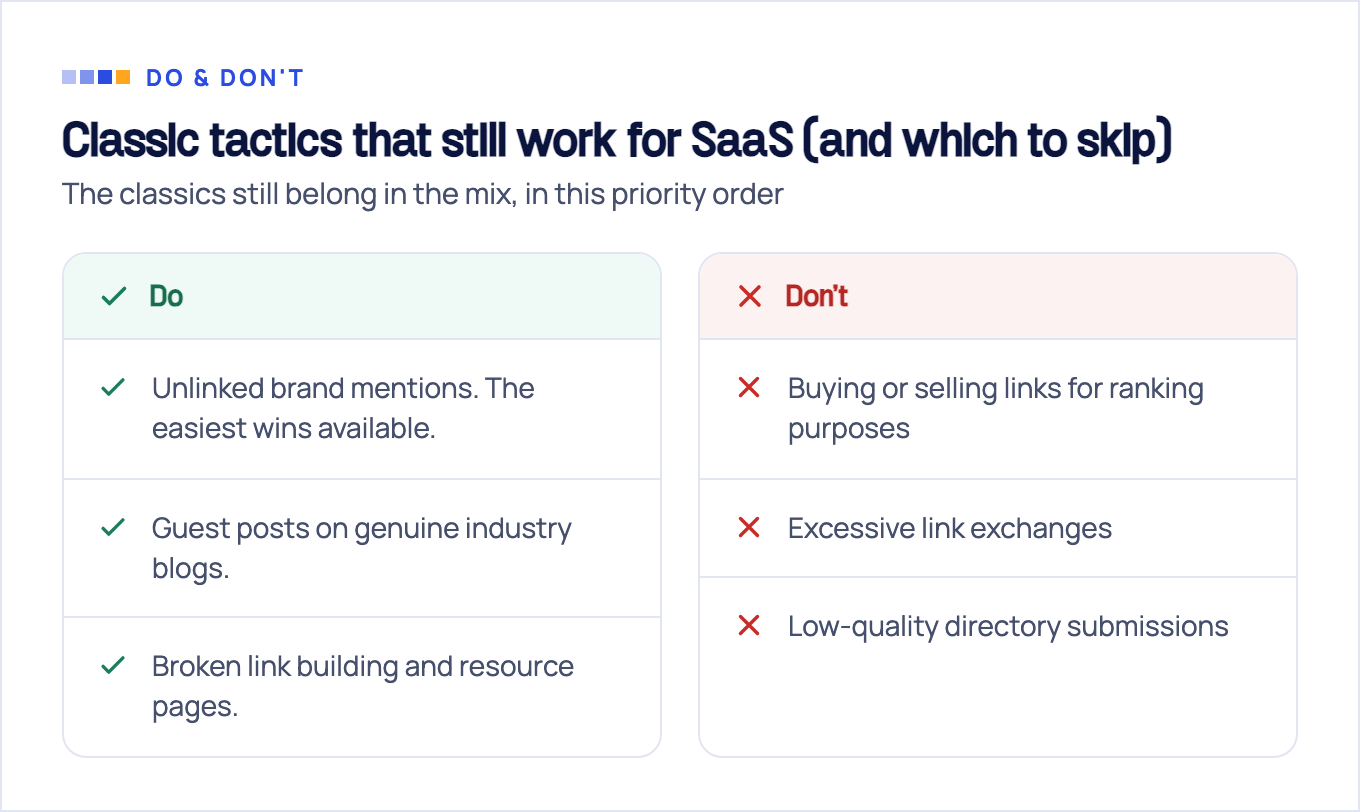
The four plays above are the differentiated core of a b2b SaaS link building program. The classics still belong in the mix, in this priority order:
- Unlinked brand mentions. The easiest wins available. Set up alerts for your brand and product names, find mentions without links, and send a short, polite ask. Conversion on these is high because the editorial decision to feature you was already made.
- Guest posts on genuine industry blogs. Still effective when the host site has real traffic and readers, and a waste of budget when it’s a “write for us” content farm. One post on a blog your buyers read outranks ten on domains that exist to sell placements.
- Broken link building and resource pages. Both work in SaaS because software niches are full of curated tool lists and outdated documentation. For the tactic-level detail on running these cleanly, see our guide to white-hat link building rather than re-explaining them here.
Two tactics to drop entirely. Google’s spam policies define link spam as links created primarily to manipulate rankings, and the examples they list explicitly include buying or selling links for ranking purposes and excessive link exchanges, the “link to me and I’ll link to you” schemes that still circulate in SaaS founder communities. Scaled link swaps between SaaS blogs are not a gray area; they are named in the policy. The same goes for low-quality directory submissions: a directory nobody browses passes no authority and pattern-matches to spam.
What SaaS link building costs, and when to hire an agency
Honest numbers first, because most guides refuse to print them.
Per Siege Media’s cost benchmarks, quality link building runs roughly 100 to 1,500+ dollars per link, approaching 2,000 dollars in competitive niches, with typical campaign budgets between 3,000 and 25,000 dollars per month. SaaS sits at the expensive end of that range: the SERPs are crowded with funded competitors, and the sites worth earning links from receive constant pitches.
One clarification before you interpret “cost per link” as “price per link”. Under Google’s guidelines on qualifying outbound links, paid placements must be marked rel="sponsored" or nofollow, and links carrying those attributes are generally not followed, meaning they pass no ranking credit. So a purchased “dofollow” link is not a clever shortcut; it is a policy violation by both definitions Google publishes. Legitimate cost-per-link math reflects the labor of earning editorial links: prospecting, content, outreach, and relationship management.
Build in-house or hire an agency?
The decision usually comes down to three variables:
| Factor | Favors in-house | Favors an agency |
|---|---|---|
| Founder/team bandwidth | You have a marketer with 15+ hours a week for prospecting and outreach | Everyone is shipping product; outreach dies after week two |
| Velocity needed | You can afford 2 to 4 links a month while you learn | A funded competitor is pulling away and you need volume now |
| Existing relationships | You already know editors and partners in your niche | You are starting from a cold list |
The in-house path costs less cash and more time, and the first three months are mostly paying tuition. The agency path costs more cash and carries selection risk, which you manage by demanding four things: relevance of linking sites over raw DR, transparent sourcing (they show you how each link was earned), a hard no on PBNs and link farms, and reporting that lists every placement URL. Any agency that hesitates on transparency has something to hide. Our breakdown of link building pricing goes deeper on what each budget tier realistically buys, and if you want to see how we apply this playbook in practice, our SaaS SEO service page shows the niche-specific process.
Do backlinks still matter for SaaS in AI search?
Yes, and the reasoning is straightforward. Google states in its documentation on AI features that there are no additional requirements and no special optimizations for appearing in AI Overviews or AI Mode (pages need only be indexed and snippet-eligible), and that these AI experiences surface a wider and more diverse set of helpful links than traditional results. The fundamentals that earn rankings, authority included, are the same fundamentals that earn AI citations.
Two of the plays in this guide double as AI-visibility tactics. Data stories give language models a citable primary source with your brand attached. Founder-led mentions spread your brand across the exact corpus these systems train on and retrieve from. Link building and AI-search optimization are converging into the same work.
Either way, start with the assets you already own. Ship the integrations hub, sweep your unlinked mentions, and get your first data story into the calendar before you spend a dollar on outreach. And if you would rather hand the whole program to a team that has run it for 10+ years across 100+ clients, our link building service is built around exactly the playbook you just read.
Sources & fact-check
Every factual claim in this article is checked against primary sources, not opinion. Written by Roman Sydorenko, Chief SEO & AI search. Last verified July 16, 2026.
- OfficialGoogle Search Central, Spam policies for Google web search (defines link spam, names paid links and exchanges)
- OfficialGoogle Search Central, Qualify your outbound links to Google (paid links need rel=sponsored; not followed)
- OfficialGoogle Search Central, AI features and your website (no special optimization for AI Overviews or AI Mode)
- Primary dataAhrefs, 96.55% of Content Gets No Traffic From Google (14bn pages; clear referring-domain correlation)
- Trusted sourceBacklinko, We Analyzed 11.8 Million Google Search Results (#1 has 3.8x backlinks, 3x referring domains)
- Trusted sourceSiege Media, How Much Does Link Building Cost? ($100 to $1,500+ per link; $3k to $25k a month)
