Resource page link building is the practice of getting your page added to a curated list that exists specifically to link out to useful resources on a topic. It’s the one outreach tactic where your ask matches the page’s whole reason for existing: the curator built that page to collect good links, so a good link is a favor, not an interruption. The work is three moves (find real resource pages, qualify the ones worth pitching, and send an ask that makes the curator’s job effortless), and most campaigns die on the qualifying step, not the finding step.
That order matters. Every top guide teaches you the search operators and hands you a template, then goes quiet on the two things that decide whether you get links: which pages are worth pitching, and why most pitches get ignored. This one lives in that gap.
What is resource page link building?
A resource page is a page whose job is to point visitors to helpful material elsewhere. Universities publish them (“financial aid resources”), industry associations publish them (“tools and guides for members”), and bloggers tuck mini versions inside long posts (“further reading”). The defining trait: the page adds value by linking out, so its owner is actively looking for things to link to.
That’s what separates this from cold outreach for a guest post or a link insertion. When you pitch a guest post, you’re asking someone to publish your writing. When you pitch a resource page, you’re offering to complete a list the curator already wants to be complete. The intent behind the page and the intent behind your email finally agree.
A concrete example: a marketing professor keeps a “recommended reading for students” page and links to fifteen articles explaining core concepts. If you’ve published the clearest explainer on one of those concepts and it isn’t on the list, adding it makes the page better. That’s the whole model. Your job is to find pages like that one, confirm they’re genuine, and give the curator a reason to say yes.
Why resource page links still work in 2026
Links are still how Google finds and weighs pages, and that hasn’t changed. Google’s own documentation describes discovery plainly: it finds new pages when it “extracts a link from a known page to a new page,” per Google Search Central. Links from established pages remain a primary way the crawler reaches yours.
Discovery is the floor. The ceiling is traffic, and the correlation there is stark. Ahrefs studied roughly 14 billion pages and found that 96.55% get zero traffic from Google, and among the ~20 million pages with no referring domains at all, only 2,997 (about 1 in 6,700) pull more than 1,000 monthly search visits, according to Ahrefs’ search traffic study. Pages without links almost never earn meaningful traffic. That’s the case for building them.
Here’s the line most guides skip, and it’s the one that keeps resource page link building on the right side of Google. A curated resource page is not a directory. Google’s spam policies explicitly flag “low-quality directory or bookmark site links” as an example of link spam, per its spam policies. The difference is curation. A real resource page has a human who chose each entry because it helps a specific audience; a directory lists anything that pays or submits. The value of a resource page link lives entirely in that curation, which is exactly why qualifying pages matters more than finding them.
How to find real resource pages (operators that still work)
Search operators do the heavy lifting. You’re looking for the footprints resource pages leave in their URLs and titles. Combine each operator with your topic keyword and work through the results.
| Operator pattern | What it surfaces |
|---|---|
[topic] inurl:resources | Pages with “resources” in the URL path |
[topic] intitle:resources | Pages titled as resource lists |
[topic] intitle:links | Older-style “useful links” pages |
[topic] "useful resources" | Exact-phrase resource sections |
[topic] "helpful links" | Curated link roundups |
[topic] inurl:links.html | Legacy static link pages (often unmaintained) |
Operators are one input. There are two more that most guides underuse.
Reverse-engineer competitor backlinks. Pull the backlink profile of a page that ranks where you want to rank and filter its referring pages for resource-page footprints: URLs containing /resources, /links, /tools. If a resource page links to a competitor’s explainer, it’s a live prospect for yours, and you already know the curator links to content like it.
Hunt mini resource sections inside posts. Not every resource page announces itself as one. Plenty of long-form articles end with a “further reading” or “tools we recommend” block that behaves exactly like a resource page. These are undervalued because most link builders only chase pages titled “Resources.” Backlinko calls these “Mini Resource Pages” and notes they’re tricky to find because no single term ties them all together. Most guides skip them.
Then there’s the force multiplier: broken links. A dead link on a resource page is the strongest opening you’ll get. The curator has a visible problem (a link that 404s and makes their page worse), and you have the fix, provided your content genuinely replaces what died. That overlap between broken-link building and resource page outreach is where the highest response rates live. We break down the ethics and mechanics of that overlap in our guide to white hat link building.
Qualifying resource pages: the filter that decides the campaign
This is where campaigns are won or lost, and it’s the step every ranking guide rushes. Finding a hundred “resource pages” is easy. Knowing which fifteen are worth an email is the entire skill.
Run every prospect through this red-flag checklist. Any single flag isn’t automatically disqualifying, but two or more usually is.
- Not updated in years. A page frozen since 2018 has an absent curator. No one’s home to add your link.
- 200+ outbound links. That’s a link dump, not a curated list. Your link would sit in a pile no one reads, and the page’s own value has already collapsed.
- Off-topic entries. If the “SEO resources” page also links to crypto casinos and weight-loss pills, it’s not curated. It’s for sale or abandoned.
- Charges for placement. Some “resource pages” quietly sell followed links. Google’s guidance is to mark advertisements and paid placements with
rel="sponsored", andnofollowis still an acceptable way to flag them, per Google’s outbound link guidance. A resource page selling you a followed link is asking you to participate in a policy violation you’d inherit. Walk away. - Zero organic traffic. A page Google ignores passes little value. Check it in your SEO tool before you spend a pitch on it.
Now the bar you set instead of the flags you avoid. Qualify on topical and audience match first, metrics second. A DR40 resource page read by your exact buyer beats a DR70 page read by nobody who’d ever hire you.
That reframe is the whole difference between chasing vanity metrics and building links that produce leads. A resource page linked from a university’s career center might carry a big number, but if your buyer is a SaaS founder, the audience is wrong and the link does nothing for your pipeline. Filter by who reads the page, and the metrics take care of themselves.
The pitch: outreach that actually gets you added
Once a page qualifies, the pitch is straightforward, because you’re making a small, well-aimed ask. The data on what moves response rates is unusually clear, and almost no resource-page guide cites it.
Backlinko analyzed 12 million outreach emails. The results, from its email outreach study:
- Personalized subject lines lifted responses by 30.5%.
- Personalized body copy lifted responses by 32.7%.
- A single follow-up message produced 65.8% more replies.
- Emailing more than one contact at the target site improved response rates by 93%.
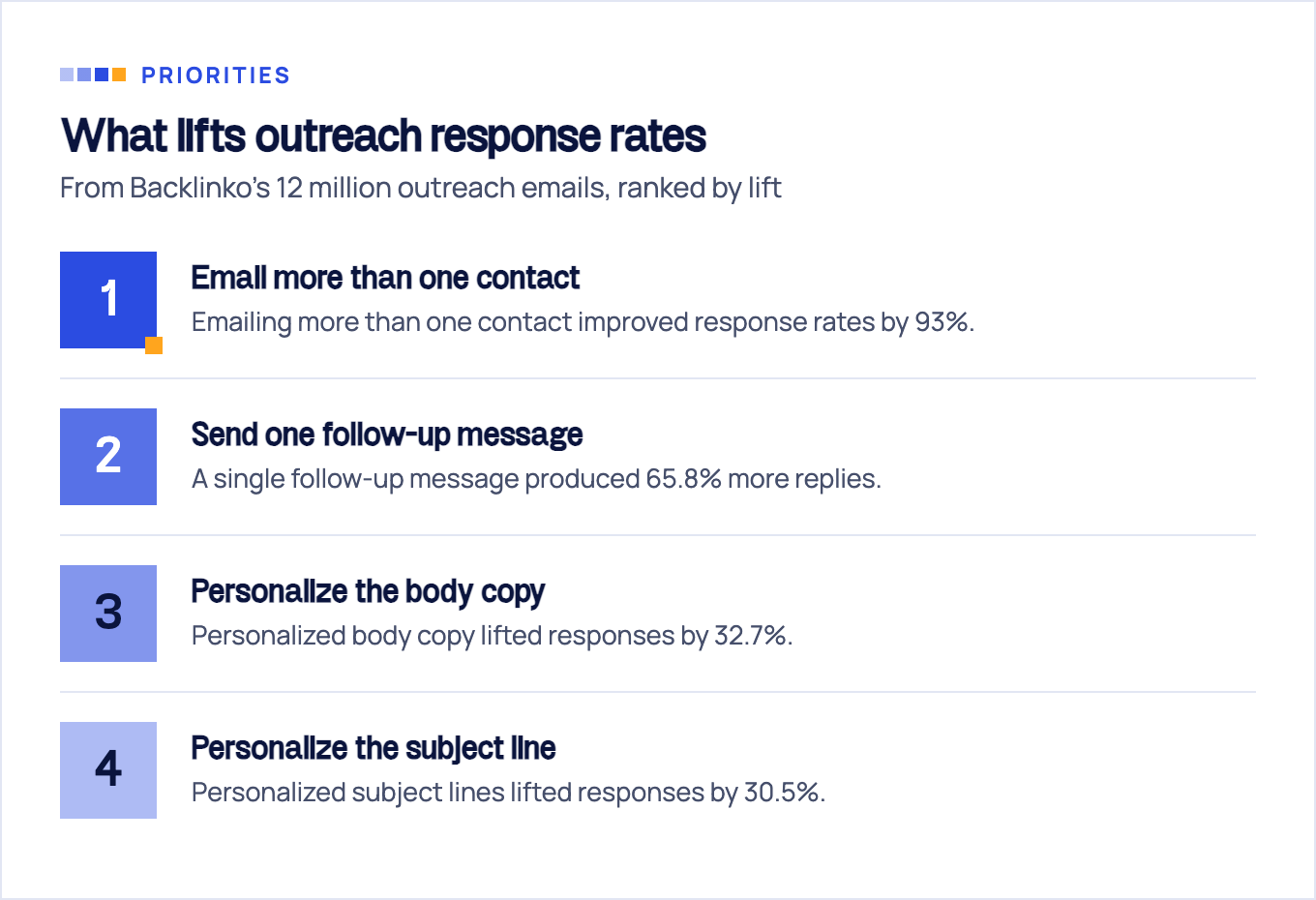
Translate that into a pitch. Personalize the subject and the opening line: reference the specific page and why it’s good, not a mail-merge token. Then make the curator’s decision zero-effort by handing them everything they need to add your link in one click:
- The exact page title you’d like used.
- The URL.
- A one-line description they can paste as-is.
- Suggested anchor text that’s descriptive and concise.
That last point comes straight from Google. Good anchor text is “descriptive, reasonably concise, and relevant to the page that it’s on and to the page it links to,” per Google’s link best practices. Suggest anchor that fits the curator’s page naturally; don’t ask for a keyword-stuffed phrase that flags the link.
If you found a broken link on the page, lead with it. “Your resources page links to X, which now 404s. Here’s a working replacement that covers the same ground” is a pitch that helps the curator before it helps you. And send a follow-up. One polite nudge a week later is worth 65.8% more replies for the cost of two minutes. For the full outreach system (sequencing, personalization at scale, and reply handling), see our link building outreach guide.
Why most resource page campaigns fail
Start with honest math, because “failure” is often just normal numbers misread. Only 8.5% of outreach emails get any response at all, per the same Backlinko study. A 100-prospect list yielding a handful of links isn’t a failed campaign. It’s the expected conversion rate. Anyone promising a 50% hit rate is selling you something.
With that baseline set, here are the real killers, the mistakes that push you below even that 8.5%:
- Pitching a money page. A curator links to genuinely useful resources, not to your pricing page or a product landing page. Commercial pages are unlinkable assets on a resource page. If you have nothing worth curating, you have nothing to pitch.
- Skipping qualification. Spraying a list of 500 unfiltered “resource pages” gets you into link dumps and abandoned pages, and burns your sending reputation for nothing.
- Generic templates. The mail-merged pitch that opens “Hi [First Name], I love your blog” gets deleted. Personalization isn’t a nicety; the data says it lifts replies by about a third.
- No follow-up. Most people send once and quit, and skip the single follow-up that lifts replies by 65.8%.
- Chasing DR instead of rankings. A link is an input to a ranking that produces leads, not a trophy. If you optimize for the domain rating number, you’ll collect links from pages your buyers never see.
The deepest fix is upstream of all of these. Build the asset first. Create the genuinely useful free thing your ideal customer would bookmark (the definitive calculator, the honest comparison, the explainer that finally makes a hard concept click), and the link becomes a byproduct of the asset instead of the goal. Resource page curators exist to link to exactly that kind of page. Make the asset worth curating, wire it internally to the pages that generate your leads, and outreach stops being a grind and starts being an announcement.
Doing it at scale: DIY math vs. handing it off
Resource page link building has real unit economics, and they’re worth doing before you commit a quarter to it. Per placed link, budget for prospecting, qualification, personalization, and follow-ups. Call it a couple of hours of skilled work spread across the funnel, most of it in qualification and personalization, the two steps you can’t safely cut. At an 8.5% response rate and a lower link rate than that, a single quality link can represent a meaningful block of someone’s week.
That math tells you when to hand it off. If the person doing outreach is your founder or your best marketer, their hour is worth more than the link, and the time is better spent on the asset that earns links passively. If you’ve got the asset and just need volume, dedicated outreach, in-house or done-for-you, usually wins on cost per link.
When we run this for clients, resource pages are one channel inside a broader campaign, never the whole strategy, and the qualification bar is the same one above: audience overlap first, metrics second. If you want to see how the channel fits into a full program (and what it should cost), our link building service lays out the process, and our breakdown of link building pricing sets realistic expectations before you budget. Over 10+ years and 100+ clients across the USA, UK, and EU, the campaigns that compounded were always the ones that led with a linkable asset and qualified ruthlessly, not the ones that sent the most emails.
Whichever way you run it, keep the loop honest: find real resource pages, qualify hard on audience fit, pitch a page worth curating, follow up once, and treat every link as an input to a ranking that brings you customers. That’s the whole playbook, and it’s more than enough to win a keyword this winnable.
Sources & fact-check
Every factual claim in this article is checked against primary sources, not opinion. Written by Dmitry Shpytaliev, Master SEO tech & content. Last verified July 16, 2026.
- OfficialGoogle Search Central, In-depth guide to how Google Search works (crawling starts from links on known pages)
- OfficialGoogle Search Central, Spam policies for Google web search (low-quality directory and paid links are spam)
- OfficialGoogle Search Central, Qualify your outbound links to Google (mark paid links with rel=sponsored or nofollow)
- OfficialGoogle Search Central, Link best practices for Google (anchor text should describe the page it points to)
- Primary dataAhrefs, 96.55% of Content Gets No Traffic From Google (first-party study of about 14 billion indexed pages)
- Primary dataBacklinko, We Analyzed 12 Million Outreach Emails (source of the 8.5% response rate and the reply lifts)
