White label link building is a reseller arrangement: a specialist provider builds backlinks for your agency’s clients, and you deliver those links under your own brand. The client sees your name on the strategy, the reports, and the invoice. The provider stays invisible.
Almost every guide on this topic is written by a white label vendor pitching its own service, which is why none of them show real margin math and all of them soft-pedal the risk. We sell link building ourselves, so read this with that in mind too. But we wrote it from the buyer’s side: how the model works, where the margin actually goes, and who eats the loss when it goes wrong.
What is white label link building?
The arrangement comes in two flavors, and the difference matters more than most agencies realize when they sign up.
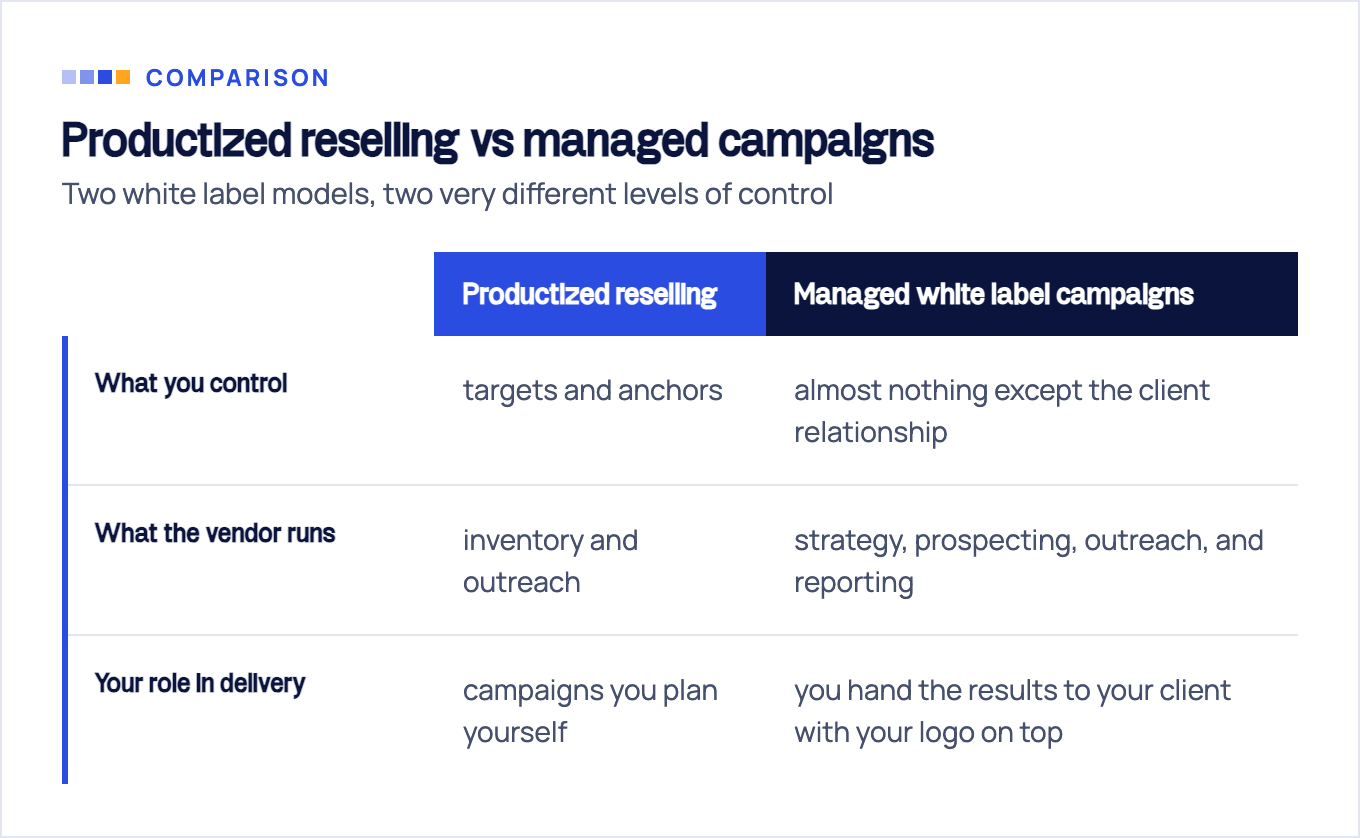
Productized reselling is a menu. You order links one at a time, priced by the host site’s authority tier and traffic, and slot them into campaigns you plan yourself. You control targets and anchors; the vendor controls inventory and outreach.
Managed white label campaigns go further. The provider runs strategy, prospecting, outreach, and reporting, and you hand the results to your client with your logo on top. You control almost nothing except the client relationship.
Agencies buy either one for the same reason: link building is the hardest SEO function to staff in-house. It needs prospecting tooling, outreach volume, editorial contacts, and relentless quality control. For an agency where links are an add-on rather than the core deliverable, building that machine internally rarely pencils out.
That is the pitch. The rest of this guide covers what the pitch leaves out.
How the white label workflow actually runs
From the agency’s seat, a typical engagement moves through five steps:
- Client brief. You define target pages, priority keywords, and the competitive gap the links need to close.
- Order placement. You send the vendor target URLs and anchor text, plus any constraints (niches to avoid, minimum traffic, language, geo).
- Prospecting and outreach. The vendor finds host sites, negotiates placements, and gets content written and published.
- Placement and delivery. Links go live; the vendor sends a report with URLs, anchors, and site metrics.
- White-labeled handoff. You QC the links (more on that below), rebrand the report, and present it to the client as your work.
One decision inside that flow separates agencies that make this work from agencies that get burned: who owns anchor and target strategy. Keep it. A vendor who “helpfully” picks anchors and targets for you is optimizing for their inventory (the sites they can place on this week), not for your client’s rankings. You should arrive at the vendor with a link plan, not ask them for one.
If you have never built that plan yourself, start with our breakdown of a real link building campaign from brief to live links. You cannot QC a vendor against a strategy you do not have.
The margin math of reselling links
Here is the section no vendor-written guide includes, so let’s anchor it to independent data first.
Per uSERP’s 2025 Backlinks Report, a survey of 800+ SEO professionals, low-authority links average roughly $300 apiece, while digital PR and high-authority contextual placements run $500 to $2,000 per link. The same survey found 46.5% of respondents spend $5,000 to $10,000 per month on link building, 35.5% spend $1,000 to $5,000, and 18% spend over $10,000. Those are your clients’ reference points whether they know it or not.
Now a worked example. The numbers are hypothetical; the structure is not.
Say you sell a client a 10-link monthly retainer at $600 per link: $6,000 in revenue, comfortably inside the spend band most serious buyers already sit in. Your vendor’s wholesale price for the tier you need is $350 per link, so your cost of goods is $3,500 and your gross margin is $2,500, a healthy-looking 42%.
Then the hidden costs land:
- QC time. Every delivered link needs traffic verification, relevance review, and an outbound-profile check. Budget it per link, because skipping it is how bad links reach client reports with your name on them.
- Replacement chasing. Some links drop or never index. Someone has to notice, open a ticket, and follow up until the replacement ships.
- Rejections and revisions. Links you refuse to pass on to the client still consumed a slot in the vendor’s queue and a cycle in yours.
- Account management. Explaining to the client why this month’s links went live on sites they have never heard of takes real senior time.
Load ten to fifteen hours of that work against the retainer at your real hourly cost and the 42% gross margin quietly compresses toward 20%, before a single link fails. This is why “we mark links up 2x and print money” reseller math never survives contact with month three.
For a full picture of what links cost across the market (and why the cheap end of the menu is cheap), see our guide to link building pricing.
QC: how to vet every link before it reaches a client report
Your vendor’s report is a sales document. Run your own checks on every link before a client ever sees it:
- Real organic traffic. Check the host site in Ahrefs or Semrush yourself. DR alone is trivially inflatable; a DR55 site with 40 organic visits a month is a ghost.
- Topical relevance. Would this site plausibly link to your client without being paid? If the answer is no, the link is a footprint.
- Outbound link profile. Look at who else the site links out to. If the neighboring links point at casinos, CBD shops, and essay mills, your client is now in that neighborhood.
- Indexation at 30 days. A link on a page Google refuses to index passes nothing. Re-check a month after placement, not just on delivery day.
- Anchor distribution across the campaign. Vendors fill orders link by link; nobody but you is watching whether the client’s aggregate anchor profile still looks natural.
There is a structural reason to be paranoid here. In Ahrefs’ buying-backlinks study, Joshua Hardwick asked 450 sites across nine competitive niches to sell a link outright, and only 12.6% were willing, at an average of $361.44 per niche edit. A separate pitch to 180 sites in the same niches put the average paid guest post at $77.80. The pool of sites that sell links to strangers is small, which means it is farmed hard.
The fix is holding vendor output to the same bar you would hold your own outreach. Our white hat link building standards are the tactic-level checklist we apply internally; nothing about white labeling exempts a link from them.
The Google risk you are reselling
Time for the part vendor guides compress into one reassuring sentence.
Google’s spam policies classify “buying or selling links for ranking purposes” as link spam, explicitly including exchanging money for links or for posts that contain links. Paid placements are only acceptable when qualified with rel="nofollow" or rel="sponsored". Google’s outbound-link guidelines tell publishers that sponsored is the preferred attribute for anything paid. Sit with the implication: a followed link that exists because money changed hands is, by Google’s written definition, the thing its spam systems are built to catch. That is the product most white label menus sell.
Enforcement runs on two tracks. Since the December 2022 link spam update, Google’s SpamBrain system detects both sites buying links and sites that exist to pass outgoing links, and neutralizes the credit those links pass: rankings simply lose the boost, usually with no notification. Separately, a detected pattern of unnatural links can still draw a manual action against some or all of a site, with a matching manual action for sites selling the outbound links.
Neutralization is the common failure and it is quieter than a penalty: the links stay live, the reports stay green, and the spend simply stops buying anything. Manual actions are rarer but existential for a client whose revenue rides on organic.
Note the asymmetry in who absorbs each outcome. When links get neutralized, the vendor has already been paid and moves on to the next reseller. You hold the client relationship, the awkward quarterly review where rankings flatlined despite six months of link spend, and the churn.
None of this means the model is unusable. It means the agency’s job is exactly the QC and strategy work described above, which is also where the margin went. That trade-off is the honest core of white label link building.
When white label link building goes wrong: 5 failure modes
These are the recurring patterns, each with the contract term that prevents it:
| Failure mode | What it looks like | Contract protection |
|---|---|---|
| Recycled inventory | The same host sites appear across hundreds of the vendor’s clients, creating an obvious paid-link footprint | Site list under NDA; cap on how often a domain is reused; right to reject any domain |
| Silent link drops | Placements vanish after 60 to 90 days once the host’s “guaranteed live” window lapses | 12-month live-link SLA with free replacement, monitored by you |
| DR-inflated ghost domains | Metrics look great, organic traffic is near zero, content is AI filler | Minimum verified organic-traffic threshold written into the order spec |
| Vendor reaches your client | The provider cold-emails your client directly, or the client reverse-searches a placement and finds the reseller marketplace | Non-solicitation clause; no vendor branding anywhere in deliverables |
| Turnaround blowouts | Links promised in 3 weeks arrive in 9, blowing your client reporting cycle | Delivery deadlines with fee credits, and a buffer between vendor SLA and client promise |
The common thread: every one of these is cheap to prevent in the contract and expensive to litigate by email thread after the fact. If a vendor resists these terms, that resistance is the information.
How to choose a white label partner
Skip the sales deck and run an operational audit:
- Ask for sample placements from live campaigns, then verify the host sites’ traffic and outbound profiles yourself. Never accept screenshots of dashboards.
- Check the vendor’s own backlink profile. A link building company whose own domain ranks on farmed links is telling you what it will build for your clients.
- Request the site list under NDA. A refusal usually means the list is either embarrassing or doesn’t exist until your order does.
- Run a paid trial of 2 to 3 links before any retainer. Judge the trial on process (communication, pre-approval, turnaround), not just on the links.
- Demand pre-approval of every placement before it publishes. This one term converts you from a passive reseller into an editor with veto power.
Red flags that end the conversation:
- Guaranteed DR bundles at improbable prices. Against market averages of roughly $300 for low-authority links and $500 to $2,000 for high-authority placements, a “$50 DR50 link” is not a bargain. It is arithmetic proof of a farm.
- Refusal to show where links go live until after publication.
- “Proprietary private network” as a selling point. That phrase is a PBN wearing a suit.
- Anchor text chosen for you by default, with exact-match commercial anchors as the norm.
Resell, build in-house, or partner: a decision framework
Outsourcing itself is not the question. Per uSERP’s survey, 60% of respondents already work with link building providers, freelancers, or contractors. The question is how much control you trade away, and the answer depends on where links sit in your business.
Resell (white label) when you have a handful of clients needing links, no outreach staff, and link building is an add-on to a broader retainer. Keep strategy and QC in-house, treat the vendor as fulfillment, and price the QC hours into the retainer.
Build in-house when link building is a core deliverable, you are reselling at volume, or your QC and replacement overhead has grown to rival the cost of just doing the outreach. At that point the vendor margin you are paying buys you risk, not leverage. Our guide to link building outreach covers what that internal machine actually requires.
Run a hybrid when you are in between: in-house digital PR and relationship links for flagship clients, vetted vendor fulfillment for overflow, with one QC standard across both.
There is also a fourth option most agencies skip past: partner with a team on outcomes instead of buying links by the unit. At SEOBRO we don’t sell links as a commodity line item. We run link building inside focused lead-gen campaigns, where every placement exists to move a specific money page for a specific query. If you are weighing the in-house path against a partner who owns results rather than deliverables, that is what our link building service is built for.
Sources & fact-check
Every factual claim in this article is checked against primary sources, not opinion. Written by Roman Sydorenko, Chief SEO & AI search. Last verified July 16, 2026.
- OfficialGoogle Search Central, Spam policies for Google web search (buying or selling links for ranking is link spam)
- OfficialGoogle Search Central, Qualify your outbound links to Google (sponsored is preferred for paid placements)
- OfficialGoogle Search Central, December 2022 link spam update (SpamBrain neutralizes credit from bought links)
- OfficialGoogle Search Console Help, Manual Actions report (unnatural links to your site, and from your site)
- Primary datauSERP, 2025 Backlinks Report (vendor survey of 800+ SEOs behind the $300 and $500 to $2,000 anchors)
- Primary dataAhrefs, Should You Buy Backlinks in 2024? It Depends (vendor outreach study: 450 sites, then 180 sites)
