SEO for SaaS startups is stage-dependent, not a fixed checklist. Before product-market fit you build crawlable foundations and validate that anyone actually searches for the problem you solve, and it costs close to nothing. After PMF you shift to bottom-of-funnel content velocity and links. The biggest startup SEO mistake is running a scale-stage playbook, a content calendar and a link budget, at a validation-stage company that has not yet earned either. This guide maps what to do at each stage, and gives you the kill-or-scale checkpoints no generic guide includes.
What does SEO for a SaaS startup actually look like?
At its core, SEO for a SaaS startup means earning organic search traffic that turns into signups and pipeline, sequenced to your company’s stage rather than run as one monolithic program. A pre-PMF startup and a Series A startup need almost opposite things from search, so treating “SaaS startup SEO” as a single motion is where most teams waste their first year.
The practical version fits in a table. Find your stage, do only what that row asks, and ignore the rest until you graduate.
| Stage | Goal | Main activities | Monthly effort | What to measure |
|---|---|---|---|---|
| Pre-PMF | Foundations + demand validation | Indexable site, GSC + analytics, clean IA, positioning pages | A few hours, mostly one-time | Indexation, impressions, whether demand exists at all |
| Post-PMF | First real rankings | BOFU pages: comparisons, alternatives, use cases, pricing-intent | 2-4 strong pages/month | Target pages entering top 20, then top 10 |
| Scaling | Compounding pipeline | Widen to MOFU, refresh winners, build links | Content hire or agency | Organic-sourced pipeline and revenue |
Two things to notice. The monthly effort in the first row is deliberately tiny, because pre-PMF SEO is mostly a setup task you do once. And the measurement column changes at every stage, which is the whole point: judging a pre-PMF site on pipeline, or a scaling site on impressions, tells you nothing useful.
First: decide whether SEO is even the right channel yet
Most agency pages skip the honest question and go straight to selling you a retainer. We start here because for a meaningful share of startups, the correct answer this quarter is “not yet,” and paying for SEO before that changes wastes money you cannot spare.
SEO is a compounding, slow channel. An Ahrefs study of ranking speed found that only 1.74% of newly published pages rank in Google’s top 10 within a year, and across 1.3 million keywords the average number-one result is five years old. That math is fine if you have runway to wait. It is a trap if you are trying to prove traction before a raise.
Here is the honest gate. Run down both columns before you spend a dollar.
| SEO is probably the wrong channel yet | SEO is worth starting |
|---|---|
| Under ~12 months of runway | 18+ months of runway, or profitable |
| Nobody searches for your problem yet | Real search demand for the pain you solve |
| Enterprise GTM closing ~5 big deals a year | PLG or low-ACV motion needing volume |
| No one to own it, even part-time | A founder or hire who owns it |
If your motion is five enterprise deals a year closed through founder relationships, paid ads and outbound will almost always beat SEO on payback, and you should come back to search later. If real people are already typing your problem into Google and a competitor is quietly winning that pipeline, SEO is exactly where you should be.
Pre-PMF: foundations only (the near-zero-cost checklist)
While you are still iterating on the product, do not build a content engine. Build a foundation that will be ready the moment you have something worth ranking. This is a one-time, low-cost setup, not an ongoing program.
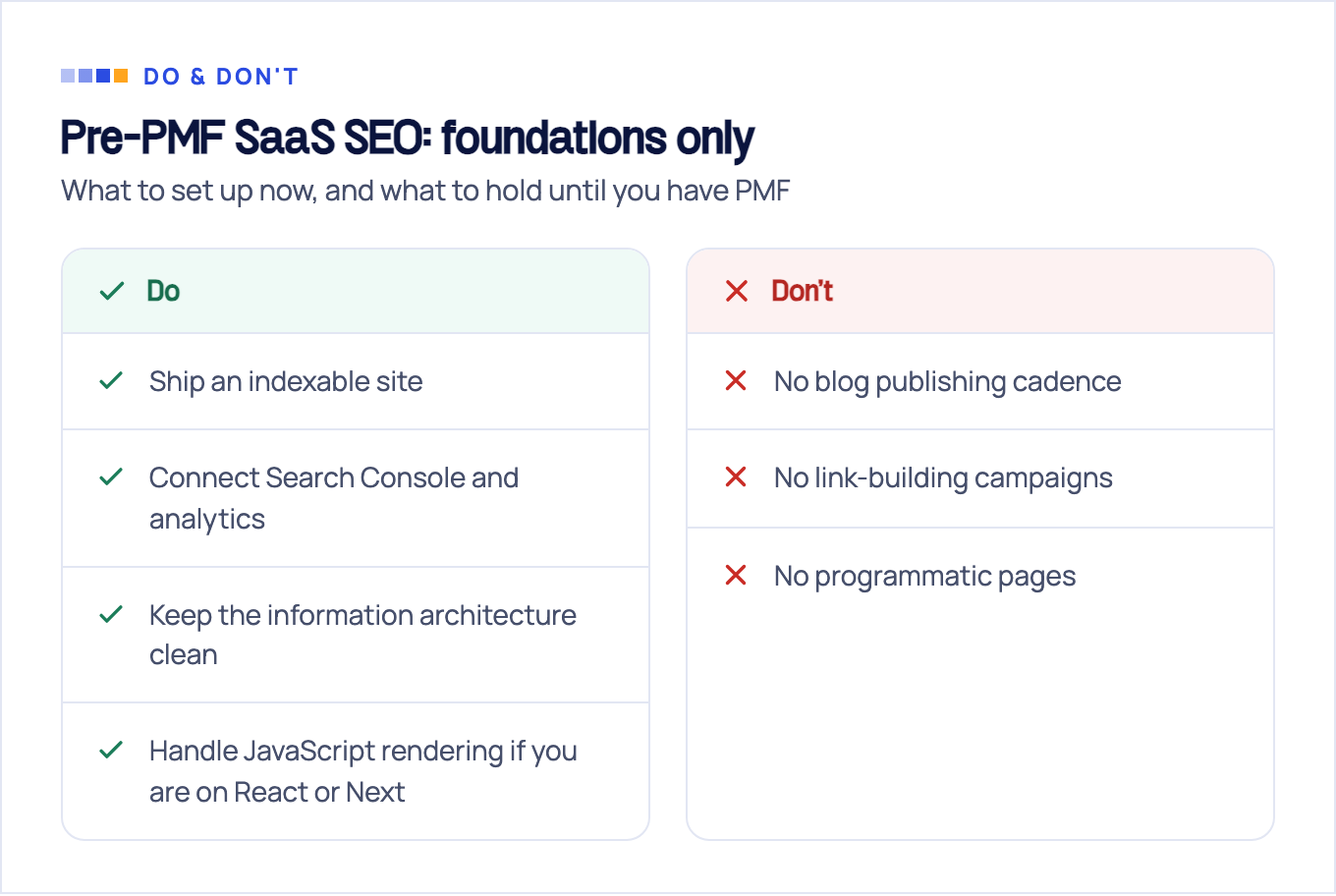
Do these, and only these:
- Ship an indexable site. Content must appear in the raw HTML, real
<a href>links, no signup wall in front of the pages meant to rank. - Connect Search Console and analytics. You cannot validate demand you are not measuring. GSC impressions are your earliest signal that Google is even considering you.
- Keep the information architecture clean. A homepage and a handful of positioning pages that name your category in plain words the way a buyer would search for it.
- Handle JavaScript rendering if you are on React or Next. Google processes JavaScript pages in three phases, and per Google’s JavaScript SEO documentation they wait in a render queue and are only rendered “once Google’s resources allow.” Google’s own docs say “server-side or pre-rendering is still a great idea” because it is faster for users and crawlers and not all bots run JavaScript.
For the rendering piece specifically, our guides on Next.js SEO and the complete React SEO guide cover the exact SSR and prerendering setups that keep an early-stage app crawlable without a rebuild.
Now the harder discipline, what NOT to do yet:
- No blog publishing cadence. You have nothing to say with authority until the product settles.
- No link-building campaigns. You have no page worth pointing links at.
- No programmatic pages. Scaling thin templates before you have proven one page works is how startups manufacture index bloat.
None of this is expensive. Most small sites get discovered by Google automatically, so foundations are cheap by design. The goal of the pre-PMF stage is simply to be ready, and to watch GSC for the first faint signal that search demand for your category actually exists.
Post-PMF: the first 90 days of real SEO
Once you have product-market fit, the game changes. You have a product people want, reference customers, and a clear category. Now you publish, but in a specific order that respects your near-zero domain authority.
Go bottom-of-funnel first. On a low-authority domain, ranking for a definitional term like “what is workflow automation” is nearly impossible and would attract browsers, not buyers. Ranking for “CompetitorX alternatives” is achievable and pulls people who are one step from a demo. Sequence your first 90 days like this:
- Comparison and alternatives pages. “You vs CompetitorX,” “CompetitorX alternatives,” and honest “CompetitorA vs CompetitorB” pages where you show up as the third option.
- Use-case and integration pages. One page per job your product does and per integration a buyer would search for.
- Pricing-adjacent queries. “CompetitorX pricing,” “[category] cost,” the searches people run with a budget open.
Only after that commercial layer exists do you touch top-of-funnel content. The reason is brutal and worth internalizing: an Ahrefs study of roughly 14 billion pages found that 96.55% of all pages get zero organic traffic from Google, driven by three causes, no search demand, no backlinks, and content that does not match search intent. A startup cannot afford to publish into that 96%. BOFU-first sequencing is how you stay out of it.
Your keyword-selection heuristic at this stage is deliberately simple:
- Volume floor low. A page that converts three qualified visitors a month is worth more than one that entertains 3,000 who will never buy.
- KD ceiling low. Pick fights a DR-0 domain can actually win.
- Buying intent high. The searcher should be close to evaluating a tool, not idly reading.
This is exactly where “startup SEO” diverges from a generic “SaaS SEO strategy” built for an established domain. An incumbent can chase volume. You are trading on intent, because it is the only lever a new domain has.
Scaling content velocity without torching quality
When your BOFU pages start converting, and only then, you widen into the middle of the funnel: how-to content, comparison frameworks, the questions buyers ask while they shortlist. The trap at this stage is volume for its own sake, cranking out fifteen thin posts a month and wondering why none of them rank.
Your unfair advantage is that you have actually built and used the product. Google explicitly rewards this. Its guidance on people-first content defines people-first content as “content that’s created primarily for people, and not to manipulate search engine rankings,” and its self-assessment asks: “Does your content clearly demonstrate first-hand expertise and a depth of knowledge (for example, expertise that comes from having actually used a product or service, or visiting a place)?” A founder writing from real experience, or reviewing a writer’s draft for accuracy, is exactly what that question is asking for, and it is the hardest thing for agency filler to fake.
Practical cadence guidance:
- Two to four strong pages a month beats fifteen thin ones. Depth compounds; thin content is a liability that dilutes your whole domain.
- Bias toward refreshing over publishing new. An existing page that is close to page one is usually a faster win than a net-new post starting from zero.
- Make the first content hire when the map outruns your hours. Outsource execution before you outsource judgment; the founder should keep owning what gets said, even when someone else writes it.
Links and authority when you’re starting from DR 0
Startups panic about backlinks, then buy link packages, which is the fastest way to waste money and risk a penalty. You are starting from domain rating zero, and the good news is that at this difficulty level, links accelerate but do not gate entry.
The evidence for that is on the SERP itself. At the time of writing, a roughly 3,000-word stage-by-stage competitor held page one for this exact topic with no backlinks to that page. Check the SERP yourself before you budget for links, because positions move. Links help you move faster and hold positions, but a well-targeted page can rank without them when the keyword difficulty is low. So do not treat link-building as a prerequisite to publishing.
Build links the honest way a startup actually can:
- Launch coverage. Product Hunt, category newsletters, and press around funding or launches earn real, contextual links.
- Integration partner pages. Every tool you integrate with usually has a partners or directory page worth being listed on.
- Data from your own product. Aggregate, anonymized benchmarks from your usage data are genuinely linkable because no one else has them.
- Founder appearances. Podcasts, guest posts, and expert roundups put a real person and a real link behind your domain.
What to avoid: paid link packages, however they are marketed to you. They are the opposite of the durable, editorial links that move rankings. Our guide to SaaS link building breaks down the tactics that actually work for a young software company.
Kill or scale: the checkpoint calendar (month 3, 6, 12)
This is the section no competitor gives you, and it is the difference between a disciplined SEO program and a money pit. You set explicit gates in advance, then judge the program against leading indicators at each one, not against a gut feeling.
The reason you judge leading indicators early is that rankings genuinely take time to settle. Google’s SEO Starter Guide states plainly that “some changes might take effect in a few hours, others could take several months,” and advises waiting to assess whether SEO work had a beneficial effect. So at month three you are not measuring revenue, you are measuring whether the machine is warming up at all.
| Checkpoint | What good looks like | Kill trigger | Scale trigger |
|---|---|---|---|
| Month 3 | Indexation complete, impressions trending up | Target pages still not indexed at all | Impressions climbing on multiple pages |
| Month 6 | Some target pages in the top 10 | Nothing has moved on any page | Several pages ranking and converting |
| Month 12 | Organic-sourced pipeline exists | No pipeline, no rankings, no path to either | Repeatable pipeline you can pour fuel on |
The month-six gate is the sharpest one, and it has hard data behind it. The same Ahrefs ranking-speed study found that of the pages that reached the top 10 during the year it tracked, 40.82% got there within a month of publishing. Early movement is a strong leading indicator. If a page has shown nothing after roughly six months, it rarely recovers on its own, so the correct move is to revisit your targeting, intent match, page quality, or keyword choice, before writing yet another page into the same void.
AI search changes the math for early SaaS
At the time of writing, a search for “seo for saas startups” returned an AI Overview above the organic results. Check the SERP for the terms you care about before you plan around it. That is not a footnote, it changes which strategy pays off. An Ahrefs study of 300,000 keywords found that the presence of an AI Overview correlated with a 58% lower average click-through rate for the top-ranking page, up from 34.5% when the same team ran the study in 2025.
Read that in the context of everything above. A high-volume, top-of-funnel strategy is exactly what an AI Overview eats, because the Overview answers the informational question and the searcher never clicks. A bottom-of-funnel, high-intent strategy is far more resilient, because someone comparing two tools before a purchase is not satisfied by a paragraph summary. The AI shift rewards precisely the BOFU-first approach a startup should be running anyway.
There is a second move: format to be the source the AI cites. That means quotable definitions in the first sentence of a section, claims anchored to a specific stat and source, and clean, literal headings. Our guide on how to rank in AI Overviews goes deeper, but the short version is that citable, answer-first writing is now table stakes for early SaaS visibility.
Where to go from here
The through-line of this playbook is discipline over volume: do only what your stage requires, sequence bottom-of-funnel before top, and set kill-or-scale gates before you spend. That is a lot to run while also building a product, which is the whole reason the “is this the right channel yet” question matters so much.
If you want a partner who leads with that question instead of a retainer, that is what our startup SEO service is built around. It is the Focused Lead Generation method applied to early SaaS: the stage-appropriate program, the checkpoint calendar, and the honesty to tell you when your money belongs somewhere else this quarter. With 10+ years and 100+ clients across the USA, UK, and EU, we have run this exact staging enough times to know where startups burn money, and where it compounds.
Sources & fact-check
Every factual claim in this article is checked against primary sources, not opinion. Written by Roman Sydorenko, Chief SEO & AI search. Last verified July 16, 2026.
- OfficialGoogle Search Central, SEO Starter Guide (changes can take hours to months, wait weeks before judging)
- OfficialGoogle Search Central, Creating helpful, reliable, people-first content (defines people-first quality)
- OfficialGoogle Search Central, JavaScript SEO basics (Google renders JS in phases, pre-rendering still advised)
- Primary dataAhrefs, How Long Does It Take to Rank in Google? (1.74% of new pages reach the top 10 within a year)
- Primary dataAhrefs, 96.55% of Content Gets No Traffic From Google (sample of ~14 billion indexed pages)
- Primary dataAhrefs, AI Overviews Reduce Clicks by 34.5% (150k keyword pairs, lower CTR for the top-ranking page)
